
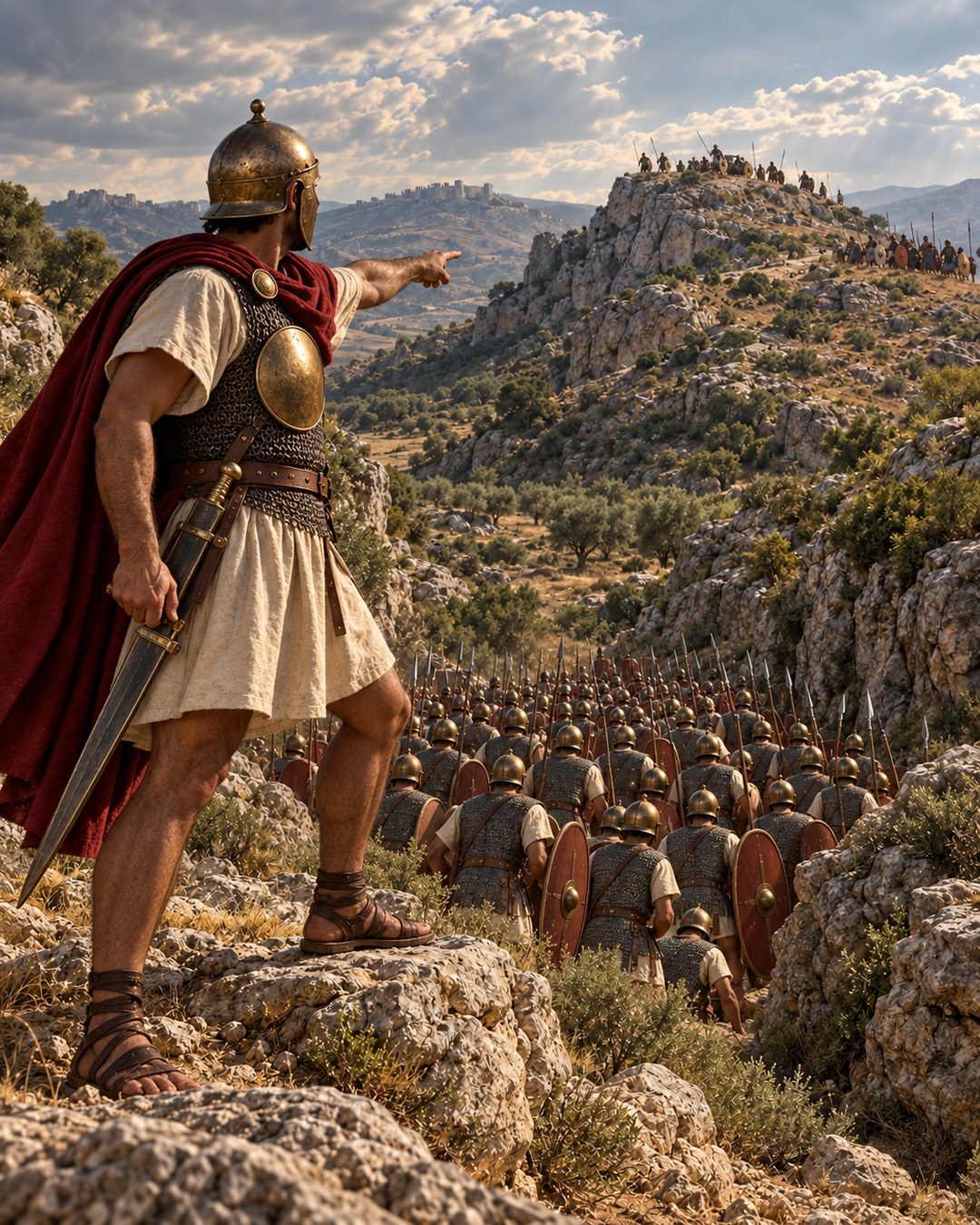
The Roman army had walked into a trap in Sicily. Carthaginian troops held the hills and the useful ground; the Romans were exposed to surprise and encirclement. In the version Aulus Gellius drew from Cato’s Origins, a military tribune saw one exit, but it required four hundred soldiers to become the object every enemy would attack.
The plan was brutally exact. Put the detachment on a rough rise. Let the Carthaginian commander send his strongest horse and foot against it. Use the struggle to move the main Roman force onto safe high ground. The tribune did not disguise the likely cost when he explained it to the consul: the four hundred would be slaughtered. When asked who could lead them, he volunteered himself.
The hills had already decided the danger
Gellius places the action in Sicily during the First Punic War. Before the Roman army could secure the useful terrain, the Carthaginian commander occupied the hills and strategic points. The Romans then entered a position exposed to surprise and extreme danger. This was not a crisis created by a single broken formation. The larger army’s location had become the problem.
The tribune approached the consul with a diagnosis before offering a solution. Destruction threatened because the ground was unfavorable and the enemy had surrounded them. The sequence matters. He did not propose a heroic charge merely because a charge looked bold. He identified what held the army in place: the enemy’s control of terrain and attention. Any escape had to change where Carthaginian strength was directed.
Another Roman battlefield episode shows how music could regulate an advancing line in the discussion of Spartan pipes and disciplined movement. Caedicius’s proposal worked at a different scale. It did not synchronize the whole army. It separated a small body from it and made that body impossible for the enemy to ignore.
A rough rise became the bait
The tribune pointed to a high and difficult piece of ground. Cato, in Gellius’s paraphrase, called it a “wart.” About four hundred soldiers should be ordered and solemnly charged to occupy it. Once the Carthaginians saw them move, the tribune predicted, the enemy’s most active and courageous men would focus on attacking that one place.
The number was part of the plan’s mechanics. Four hundred men were large enough to look dangerous on the rise, resist for a meaningful interval and demand a serious response. They were also small enough to be detached while the consul tried to preserve the remaining army. Gellius does not supply legion totals or distances, so the account cannot support a map measured in paces. It does preserve the exchange of lives for time with unusual clarity.
The tribune stated the expected result without promising rescue. While the enemy killed the detachment, the consul would have time to extract the army. In his judgment there was no other path to safety. The proposal therefore joined terrain, visibility and enemy reaction. The hill did not save the four hundred. It made them the chosen point of pressure.
The volunteer answered the consul’s last question
The consul called the advice wise, then exposed its human gap: who would lead the men into the middle of the enemy? A plan that depended on occupation of the rise still needed someone whose presence could turn an order into movement. The tribune answered that if no one else could be found, the consul could use him. He offered his life to commander and country.
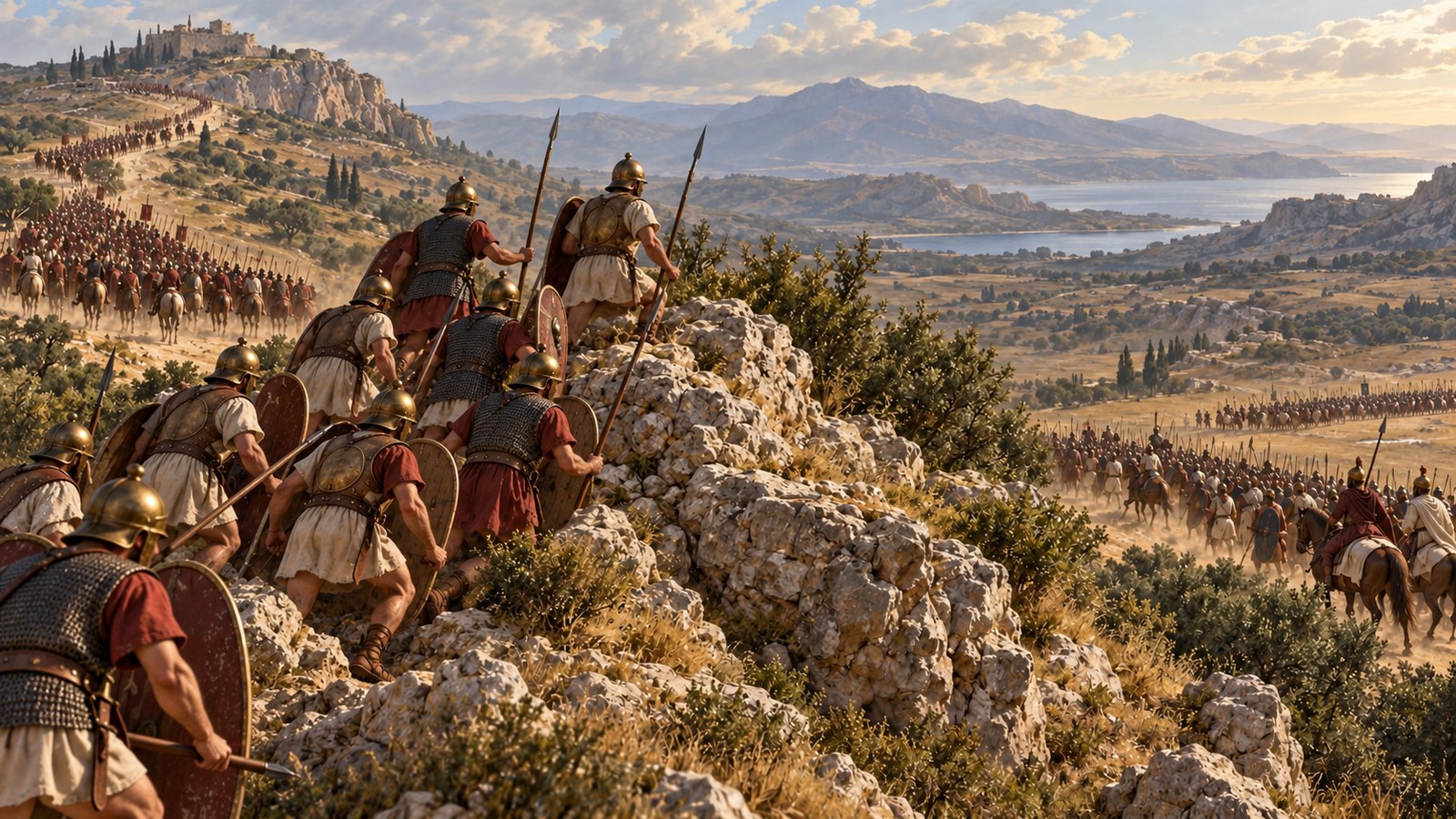
Gellius’s narration slows at that moment. The consul thanked and commended him. The tribune and the four hundred marched out toward what the text describes as death. The Carthaginians first watched in wonder, waiting to see the destination. When the rise became clear, their commander committed his strongest infantry and cavalry.
That reaction confirmed the tribune’s reading of the field. The detachment was surrounded but continued to resist. Gellius calls the fight long and doubtful before numbers finally prevailed. The main Roman army was not winning that struggle. It was using the struggle’s duration. While Carthaginian force closed around the rise, the consul withdrew to secure high ground.
The dead concealed one survivor
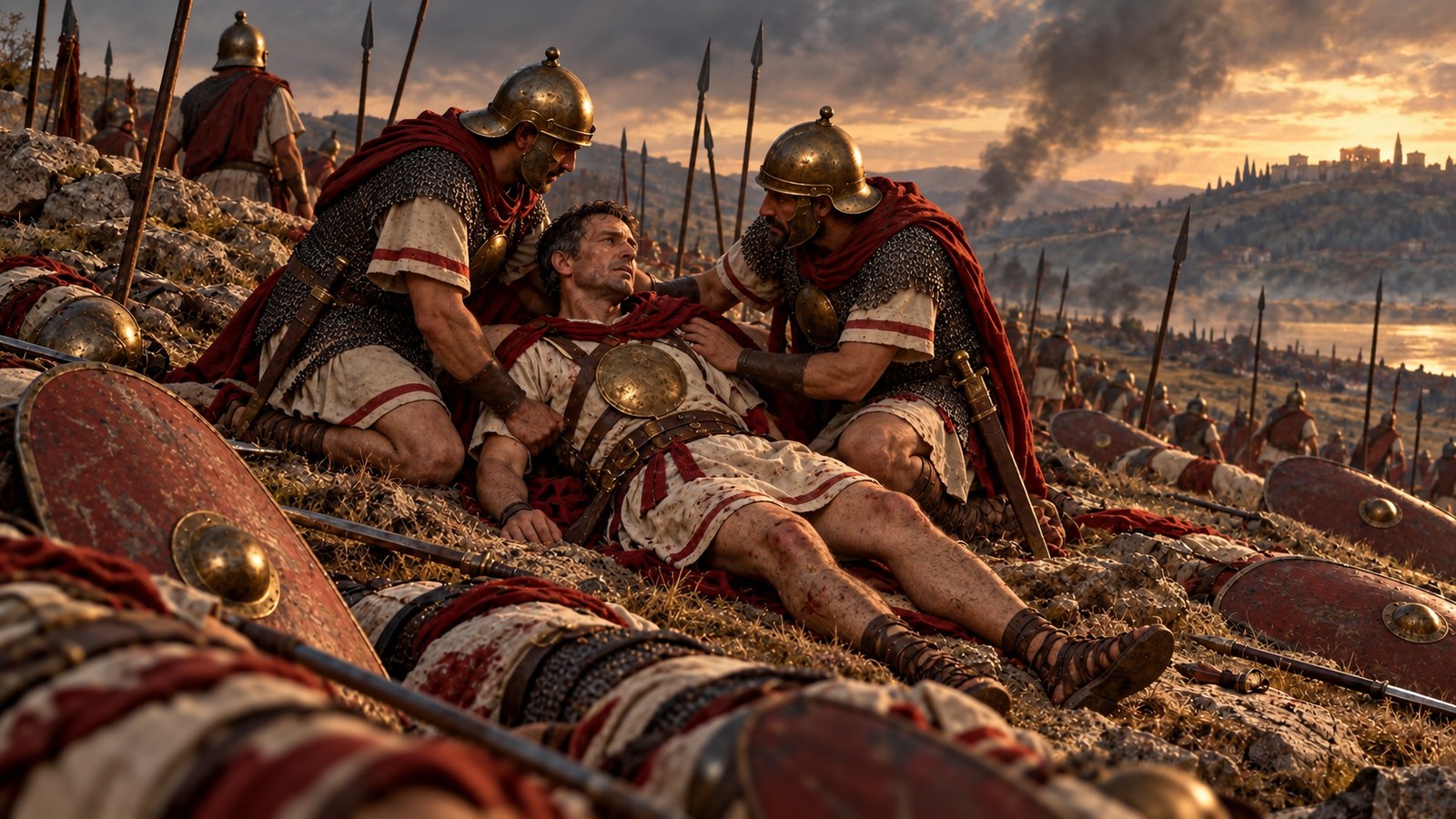
Gellius then leaves his own summary and quotes Cato’s outcome. The tribune had been wounded in many places, yet his head remained uninjured. Searchers recognized him among the dead, unconscious from wounds and loss of blood. They carried him away. He recovered and later gave Rome more brave and vigorous service.
The survival changes the memory of the episode without softening its cost. The leader had offered a life and entered a fight he expected to consume everyone. His body lay among the fallen because the predicted destruction came. Recovery was not evidence that the plan had been safer than stated; it was the extraordinary remainder after it worked as grimly as expected.
Even the tribune’s name is not perfectly stable. Gellius calls him Quintus Caedicius, but Claudius Quadrigarius, another annalist, called him Laberius. Preserving the disagreement is more honest than forcing the sources into artificial certainty. The tactical sequence is detailed; the identification carried competing traditions.
Cato measured glory as well as courage
Cato’s purpose extended beyond recounting a successful diversion. He compared the Roman tribune with Leonidas at Thermopylae. Greece, he said, answered Leonidas’s exploit with pictures, statues, honorary inscriptions, histories and other forms of remembrance. The Roman who had saved an army through a comparable offer received little glory.
The comparison reveals what Cato thought an achievement required after the battle. Courage alone did not make memory durable. Communities had to build forms that repeated a name and deed. The tribune’s service could save an army and still remain smaller in public memory if Rome supplied no equivalent network of monuments and stories.
That complaint gives the episode a second mechanism. On the field, four hundred bodies redirected an enemy and purchased time. Afterward, texts and monuments determined whether the bargain remained visible. A related question of Roman military memory appears in the tally of Sicinius Dentatus’s scars and rewards. Here Cato turns absence itself into evidence: the deed deserved commemoration, and the lack of it was part of the story.
The comparison also prevents an easy reading of the four hundred as faceless material. Cato wanted the Roman leader placed beside the most famous commander of a sacrificial stand. His criticism depends on treating the detachment’s fate as worthy of public gratitude, not merely as an efficient expenditure. Gellius preserves the number, the exposed destination, the encirclement and the recovery of the wounded leader because each detail makes the bargain concrete.
At the same time, the account never supplies speeches from ordinary members of the detachment. Their obedience is visible only through movement and resistance: they marched, climbed, were surrounded and continued fighting. The narrative gives agency most fully to the tribune who proposed and led the operation. That imbalance is itself a limit of the source. We can reconstruct the tactical function of the four hundred more confidently than the motives of the individual men.
The disagreement over the commander’s name adds another caution. It would be tempting to use survival and later service to build a smooth biography, but Gellius gives no offices, dates or family line after the recovery. The secure story is bounded by what Cato’s episode actually says. Its force comes from a sharply described decision, not from invented details about a career.
Gellius preserved both halves. Caedicius—or Laberius—read the terrain, named the probable cost, led the detachment and survived beneath the dead. Cato then asked why an act that saved a Roman army had not been given the cultural machinery that made Leonidas unforgettable.
Sources
Aulus Gellius, Attic Nights, 3.7, quoting and paraphrasing Marcus Cato, Origins.