

Aulus Gellius had to issue a judgment, but first he needed to know when his authority expired. The consuls had appointed him an extraordinary judge and ordered him to decide a case “within the Kalends.” Everyone accepted that he could act before the named day. The dangerous uncertainty was whether the Kalends themselves still belonged inside the deadline.
He took the question to Sulpicius Apollinaris, a scholar of language. Their discussion moved from courtroom practice to the ancestry of a preposition, then across the Tiber, around the ocean, up Mount Taurus and into a sentence where Cicero promised to remain below a limit. A single word became a test of how Roman procedure balanced original meaning against settled use.
The judge asked a language expert
Apollinaris first wondered why Gellius had not consulted the legal specialists who normally advised him. Gellius distinguished the problem from a disputed statute or a newly enacted rule. He wanted to know the use and nature of Latin words, so a master of language seemed the better guide.
That choice did not remove law from the problem. The phrase governed when an actual judgment could be rendered. A clever explanation that no court recognized would not protect the judge. Apollinaris therefore began with a warning: Gellius should hear the linguistic argument but act according to an interpretation accepted by everyone, or at least by many.
He made the warning broader. Long usage could change the proper meaning of common words, and tacit agreement could even leave provisions of law without effect. The expert did not claim that etymology automatically commanded practice. He separated what a word appeared to mean by origin from what institutions had learned to do with it.
Ordinary practice pointed in two directions
Apollinaris described the practical consensus. People assumed that a verdict could lawfully be delivered before the Kalends. The open question was whether the judge could also decide on the Kalends. In other words, custom confidently occupied the run-up to the boundary while becoming uncertain at the boundary itself.
The problem resembles a gate whose approach is clearly open but whose threshold has no agreed owner. If “within” meant before, the named day might already be too late. If it included the boundary, the judge still possessed the whole Kalends. Procedure needed an answer because delay or haste could each put the judgment outside the instruction.
Roman calendars could carry other kinds of institutional restraint. The days after Kalends, Nones and Ides were tied to rules about war offerings. Gellius’s judicial puzzle is not another unlucky-day story. Its pressure comes from the legal reach of one phrase attached to a particular deadline.

Apollinaris put the action on the boundary
The scholar turned to the family of Latin boundary words. He connected intra, citra and ultra with shorter early forms. The extra syllable, he argued, had been added because the old particles were too slight in sound. On this account, intra remained equivalent to in.
Examples from space supported him. To be within a town, room or festival was to be in it. Transferred to the date, “within the Kalends” should therefore mean on the Kalends themselves. A verdict issued earlier would be before the Kalends, not within them.
Apollinaris recognized that this conclusion collided with ordinary interpretation. Usage had made “within the Kalends” mean before the day as well, while leaving doubt about the very day his derivation emphasized. He called the result absurd, then conceded that usage had won. Language was ruled not only by clean relations among words but by habits strong enough to reverse expectations.
Cicero turned places into counterexamples
Gellius had prepared his own evidence. In the Third Verrine, Cicero said there was no place “within the ocean” too distant or hidden for Roman injustice to reach. Gellius argued that Cicero could not simply mean locations in the water. The phrase appeared to gather the lands on the near side of the ocean.
Apollinaris answered by changing the geometry. The ocean surrounded all land. Nothing could be merely “this side” of something that encircled it on every side. Lands lay within the ocean’s embrace as the sun moved within the heavens. His reply defended enclosure rather than a straight line with a near and far side.
Gellius later found a more troublesome Ciceronian example. In a letter, Cicero promised to act moderately, then corrected himself to “within moderation,” meaning less than the moderate limit. There intra did not identify the boundary itself. It marked a position short of it.
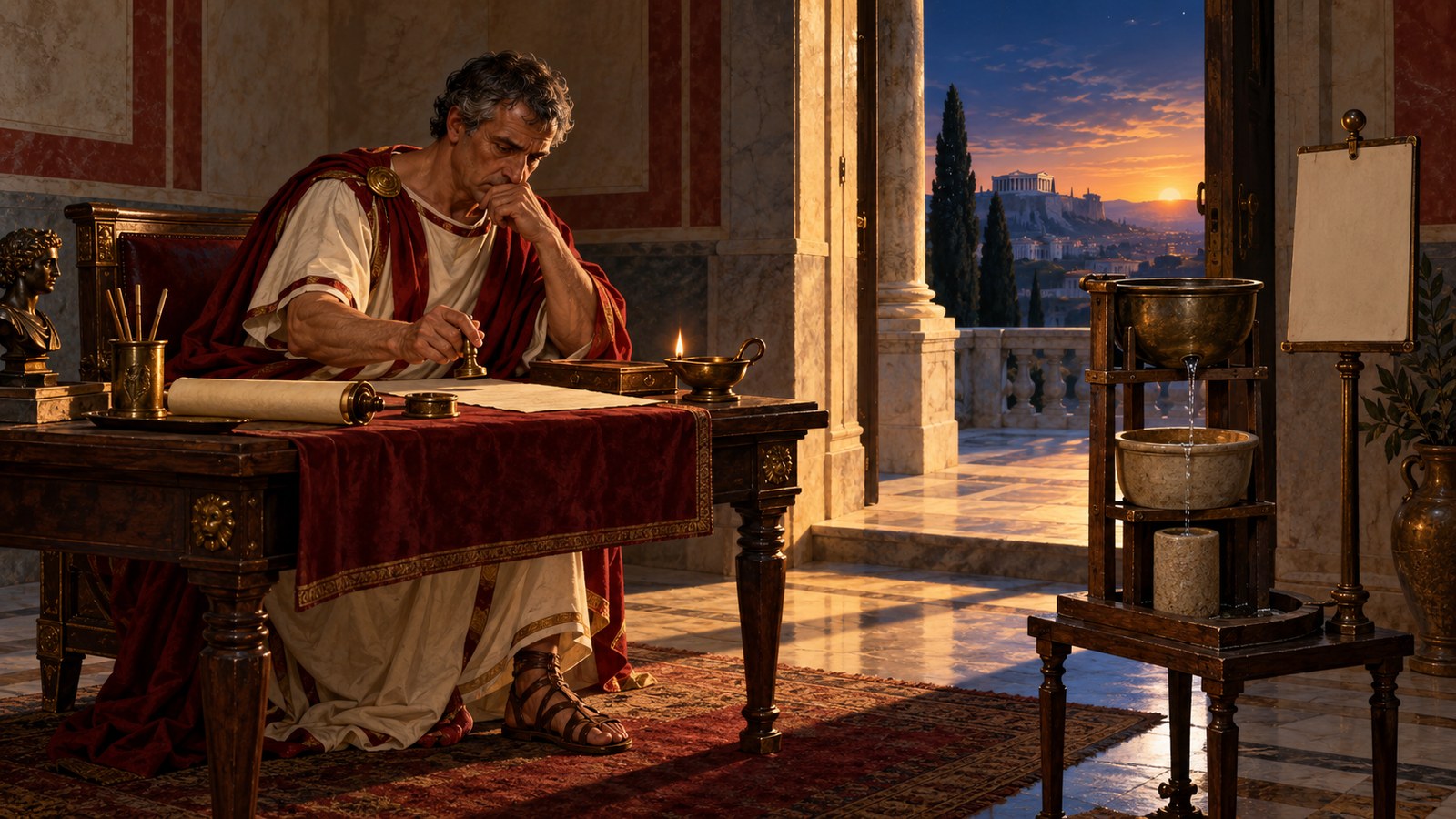
Mount Taurus supplied the final model
A third passage concerned the settlement imposed on Antiochus. Cicero said the king was ordered to keep his realm “within Mount Taurus.” That could not mean ruling inside the stone of the mountain. It meant territory bounded by the range, with the boundary included in the spatial arrangement.
Gellius compared a room. A person within a room does not stand inside its walls, yet the walls define the included space. By analogy, time embraced by the day of the Kalends could be “within the Kalends.” The phrase could cover the interval leading to the day and the day that completed the enclosure.
This was not a retreat to careless usage. Gellius ended by offering a reasoned model for the common interpretation. The boundary can name what closes an interval without being excluded from it. On that reading, the judge could act before the Kalends and on the Kalends themselves.
A separate Roman dispute about where a day began is explored in the argument that midnight bounded the civil day. Here the unit itself is not disputed. The question is whether a named endpoint belongs to the authorized interval.
The sequence of the exchange matters as much as its conclusion. Apollinaris does not lose because Gellius produces a quotation, and Gellius does not simply replace scholarship with convenience. Each example changes the shape of the boundary. A town encloses directly. The ocean surrounds from afar. Moderation acts as a scale that can be undershot. A mountain range marks territory without requiring anyone to live inside rock.
Those differences explain why analogy could illuminate and mislead at once. The same preposition carried relations between objects that were not geometrically identical. Translating all of them into one picture would create false precision. The judge needed to ask which feature of each example—enclosure, limit or position—mattered for a span of time.
The appointment as an extraordinary judge adds practical texture. Gellius was not composing an idle school exercise when the question began. His decision had a date fixed by consular instruction. Consultation was part of acting carefully under delegated authority. Even a learned man sought another specialist before staking procedure on his own reading.
We should also stop where the evidence stops. Gellius never names the litigants, tells us what dispute he judged or records whether he waited until the final day. The chapter supports a history of interpretation, not a reconstructed lawsuit. Its precision lies in the language of the order and the arguments around it.
Gellius does not tell us the case’s parties or final verdict. He preserves something more reusable: the intellectual work required before a deadline could be trusted. Legal time emerged from appointment, common practice, linguistic history and examples whose boundaries behaved differently. One word remained open until the judge learned how much time it could contain.
Sources
Aulus Gellius, Attic Nights, 12.13. Cicero, Against Verres 2.3; For Sestius; Letters to Servius Sulpicius.