
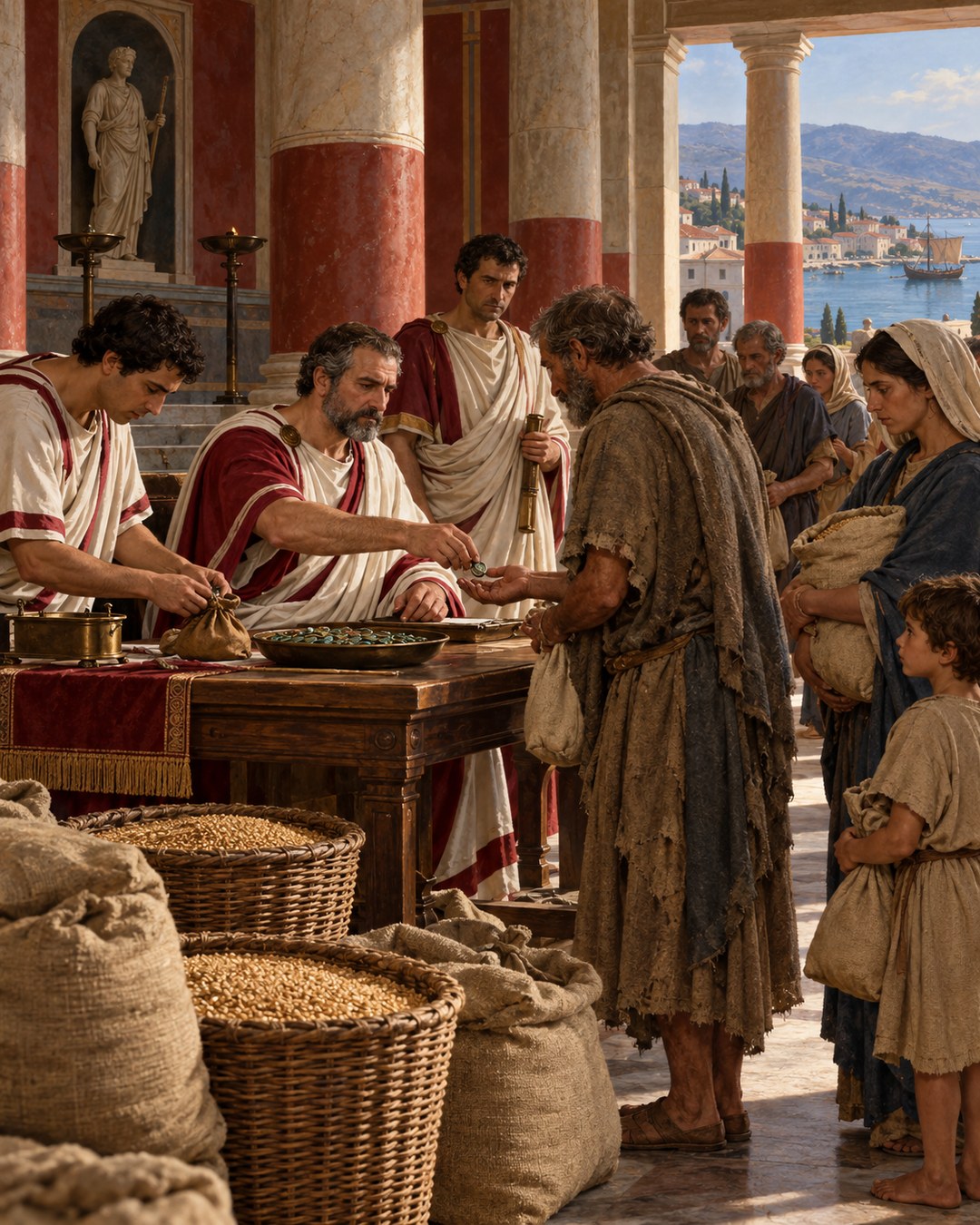
A collection for people in distress reached the Roman governor’s desk carrying two possible identities. It could be poor relief. It could also be a reason for residents to gather, contribute money and become an association that the imperial government did not trust. Pliny the Younger refused to decide which description controlled the case without asking Trajan.
The city made the question harder. Amisus was not presented as an ordinary municipality waiting for the governor to invent a rule. Pliny called it free and allied, with special laws connected to its treaty relationship. Trajan’s answer therefore turned on both purpose and jurisdiction: who had authorized the collection, and what did the money actually do?
A local memorial forced a provincial question
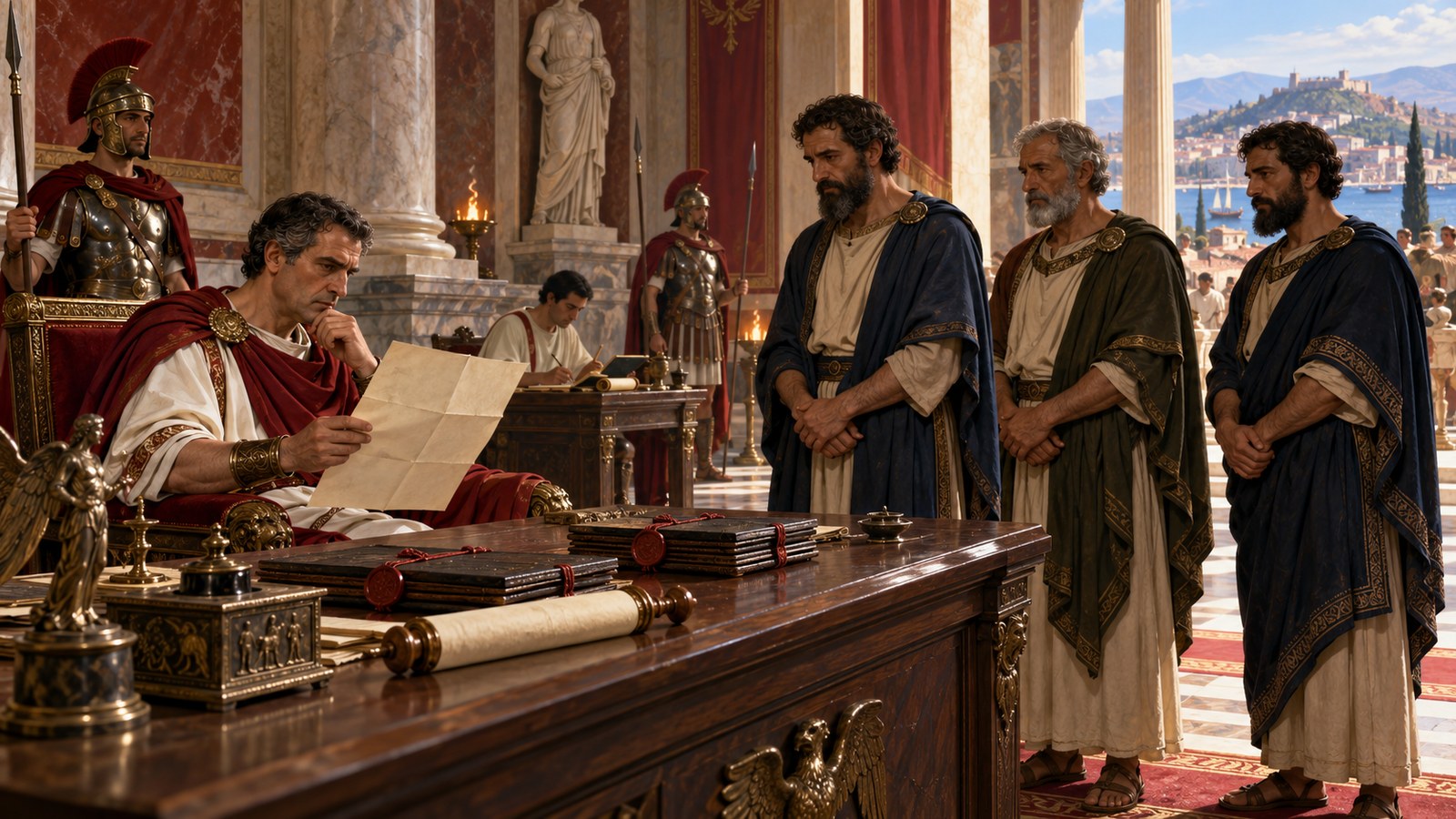
Pliny enclosed a memorial from Amisus about collections for poor residents. The memorial itself is not reproduced in the correspondence, so the city’s detailed language and procedure are missing. What survives is the governor’s compressed description and the emperor’s reply.
Pliny asked where the practice should be permitted, how far it could go and where it should be checked. Those verbs show that the choice was not simply charity or prohibition. A collection could have acceptable boundaries, dangerous extensions or local authorization that changed the answer.
The governor also began by naming the city’s standing. Amisus was free and allied and, in Pliny’s formulation, enjoyed its own special laws through imperial favour. That status placed a local legal layer between the residents’ practice and a blanket provincial command.
Another exchange from the same governorship shows Pliny opening civic rules to imperial scrutiny. Apamea produced its accounts while insisting that its privilege still mattered. Amisus raised a different issue, but the administrative habit was similar: local rights had to be identified before supervision could be justified.
The treaty supplied the first test
Trajan did not begin by praising generosity. He began with the laws governing the terms of Amisus’s alliance. If those laws permitted the collection, he wrote, there was no reason to prevent it. Permission was conditional rather than universal.
That condition matters because it kept the decision anchored to Amisus. The emperor did not announce that every city could establish the same fund whenever officials approved of its purpose. He treated the city’s legal position as a necessary part of the answer.
The ruling also avoided pretending that Roman control had erased every inherited arrangement. A treaty city could possess rules that remained operational inside the empire. The governor’s task was not merely to override them, but to determine whether the disputed practice stood within them.
At the same time, Trajan’s wording kept the emperor above the interpretation. Pliny had sent the memorial upward, and Trajan decided how treaty law and imperial policy fit together. Local autonomy was real enough to change the outcome, but it was being read through a correspondence with Rome’s highest authority.
Distress made the collection easier to defend
After the legal test came the purpose test. Trajan said the collection was used for the support of people in distress. That made him more willing to permit it. The money had a bounded beneficiary and a practical use rather than an openly political programme.
The letters do not identify individual recipients, contribution amounts or the official who held the fund. Inventing a queue of petitioners or a regular payment schedule would make the scene more vivid than the evidence allows. The secure chain is shorter: residents collected money, the memorial described the practice as aid for poor people, and the emperor accepted that purpose if local law authorized it.
Even that short chain is significant. It shows a city presenting organized material support as part of its civic practice. Relief did not appear only as an emperor’s spontaneous gift. It could emerge from local collection, local need and rules that preceded Pliny’s inquiry.
The arrangement should not be mistaken for a modern welfare system. The evidence gives no entitlement, rate or permanent bureaucracy. It gives a protected instance of collective assistance whose survival depended on a particular city’s laws and on the administration accepting its stated use.
An illicit society was the shadow beside the fund
Trajan drew his line by naming the danger the collection was not supposed to create. It could support distressed residents, but it must not bring people together to form illicit societies. Money and meetings could make a benevolent fund resemble an organization with its own loyalties.
The fear was not abstract in Pliny’s province. After a destructive fire, the governor proposed a tightly limited body of workmen for Nicomedia. Trajan rejected it because even a useful association could become something else. The refusal of Nicomedia’s proposed fire brigade shows how quickly practical organization could trigger political suspicion.
Amisus passed where that proposal failed because three features aligned. The city already had special legal standing. Its allied laws could authorize the collection. The reported use was relief, not the formation of a new society. Remove one feature and Trajan’s confidence disappears.
This distinction also explains why the emperor cared about mechanism, not only motive. Good intentions did not automatically legalize a body. Officials wanted to know whether people merely contributed to a recognized local fund or whether contributions created a durable association capable of assembling and acting together.
The permission stopped at the city boundary
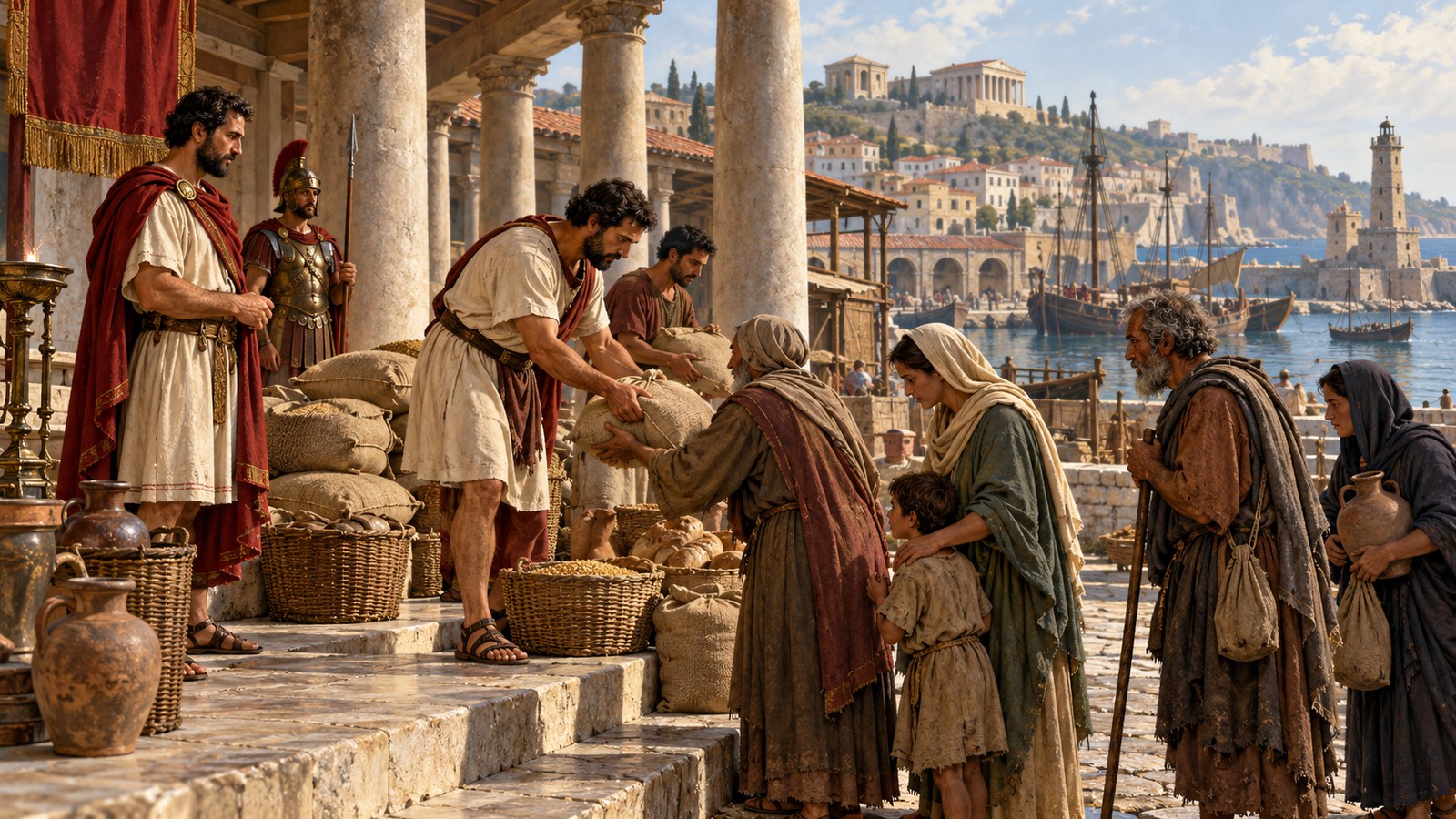
Trajan ended by refusing the same practice in other free cities under Roman jurisdiction. That closing restriction is the exchange’s sharpest detail. The emperor could accept poor relief in Amisus and still reject a general right to collect for the poor elsewhere.
The ruling was therefore an exception built from legal geography. A distressed resident in another city might have an equally compelling need, but need alone did not reproduce Amisus’s treaty. The city boundary marked the limit of the permission because the authority behind the collection changed beyond it.
For Amisus, the outcome preserved a civic tool without granting an unlimited license. The collection remained tied to its authorized purpose. It could not become a pretext for an association. It could not serve as a precedent that every neighbouring city copied.
That narrowness is what makes the letters valuable. They show imperial government neither simply crushing local institutions nor generously sponsoring relief everywhere. Pliny identified a collision between aid, association and autonomy. Trajan resolved it by allowing one city to use a lawful local mechanism—and by making sure the permission travelled no farther than the treaty did.
The correspondence also leaves the practical administrators in shadow. Someone in Amisus had to receive contributions, identify distress and deliver support, but Pliny did not preserve those rules in his summary. Trajan’s answer addresses legality at the point where the practice touched imperial concerns. It does not turn the surviving letter into a complete handbook for the fund. The silence is a warning against supplying procedures that the memorial may once have explained but the surviving exchange does not.
That gap changes what can responsibly be concluded. The exchange proves that a collection existed and that its stated purpose mattered. It does not prove how evenly aid was distributed or whether every resident could claim it. The legal permission is visible; the experience of receiving help is not.
Even so, the sequence is unusually clear. A city submitted a memorial. A governor identified the treaty issue instead of issuing an improvised ban. The emperor separated relief from association and returned a geographically limited ruling. Four administrative steps kept the collection operating without converting it into a right shared by the province.
Sources
Pliny the Younger, Letters, 10.92–93.