
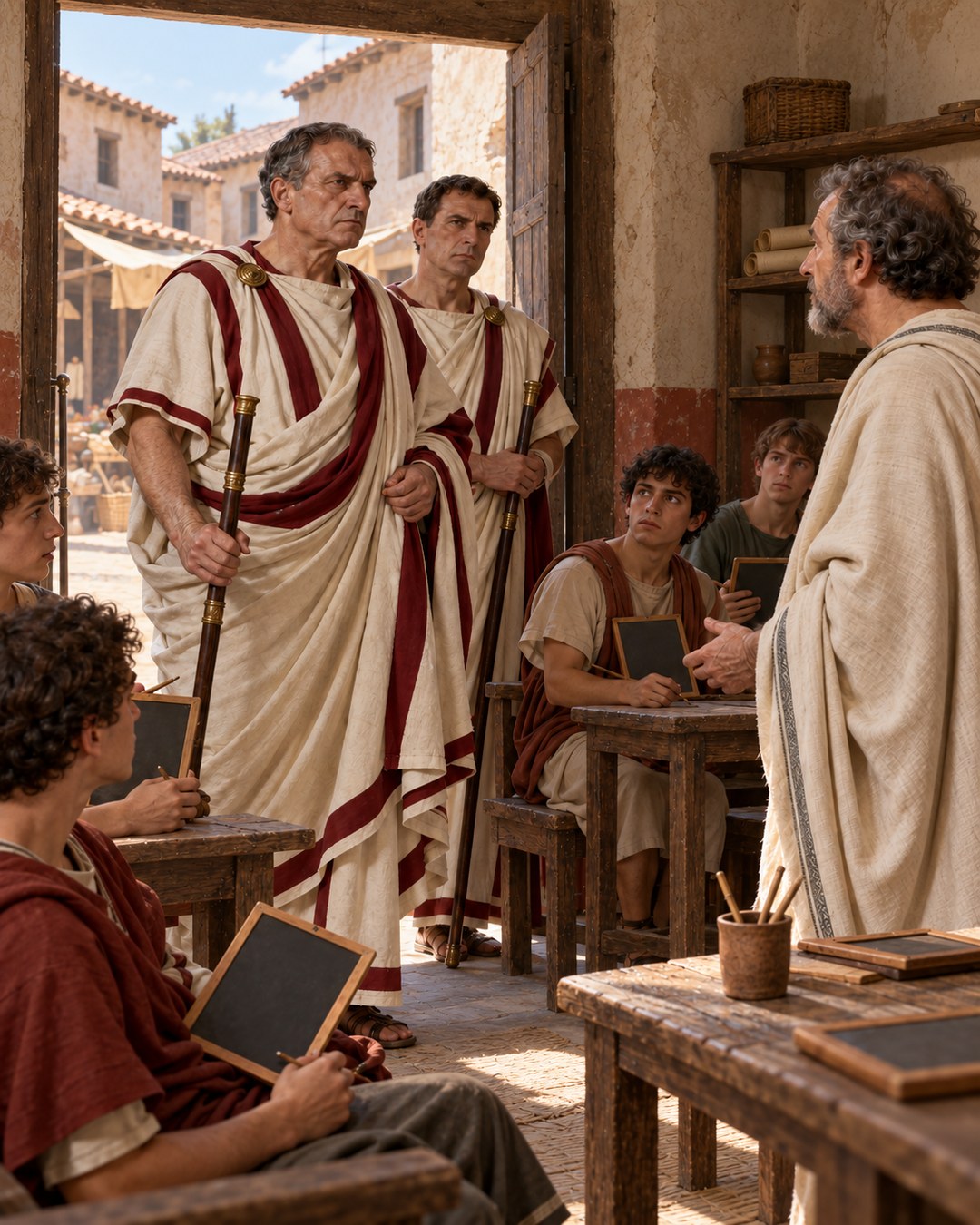
Rome’s censors did not enter a classroom and refute a speech lesson. They attacked the classroom itself. Aulus Gellius preserves their complaint that men calling themselves Latin rhetoricians had created a new kind of instruction where young people gathered and sat for entire days.
The wording turns education into an issue of public order. What were students doing, for how long, under whose title and according to whose model? Gnaeus Domitius Ahenobarbus and Lucius Licinius Crassus answered those questions by invoking ancestral practice and announcing that the new schools did not please them.
The archive preserves two different interventions
Gellius begins with an earlier Senate decision made in the consulship of Gaius Fannius Strabo and Marcus Valerius Messalla. Praetor Marcus Pomponius had referred philosophers and rhetoricians to the Senate. The senators told him to act as public interest and his good faith directed so that they should not be in Rome.
The language delegates enforcement. It names the groups and desired absence, but it leaves the praetor to decide how the order should be carried out. The state response therefore appears through office, discretion and a broad judgment about who belonged in the city.
Gellius then moves forward by “some years” to another document. The censors Domitius and Crassus were not simply repeating the Senate’s formula. Their edict addressed Latin rhetoricians and explained what about their institution offended.
Keeping the documents separate matters. The first concerns philosophers and rhetoricians as groups at Rome. The second describes a newly organized Latin school, its self-chosen title and the students’ use of time. Treating them as one timeless ban would erase the change Gellius wanted readers to notice.
A whole day in school became evidence
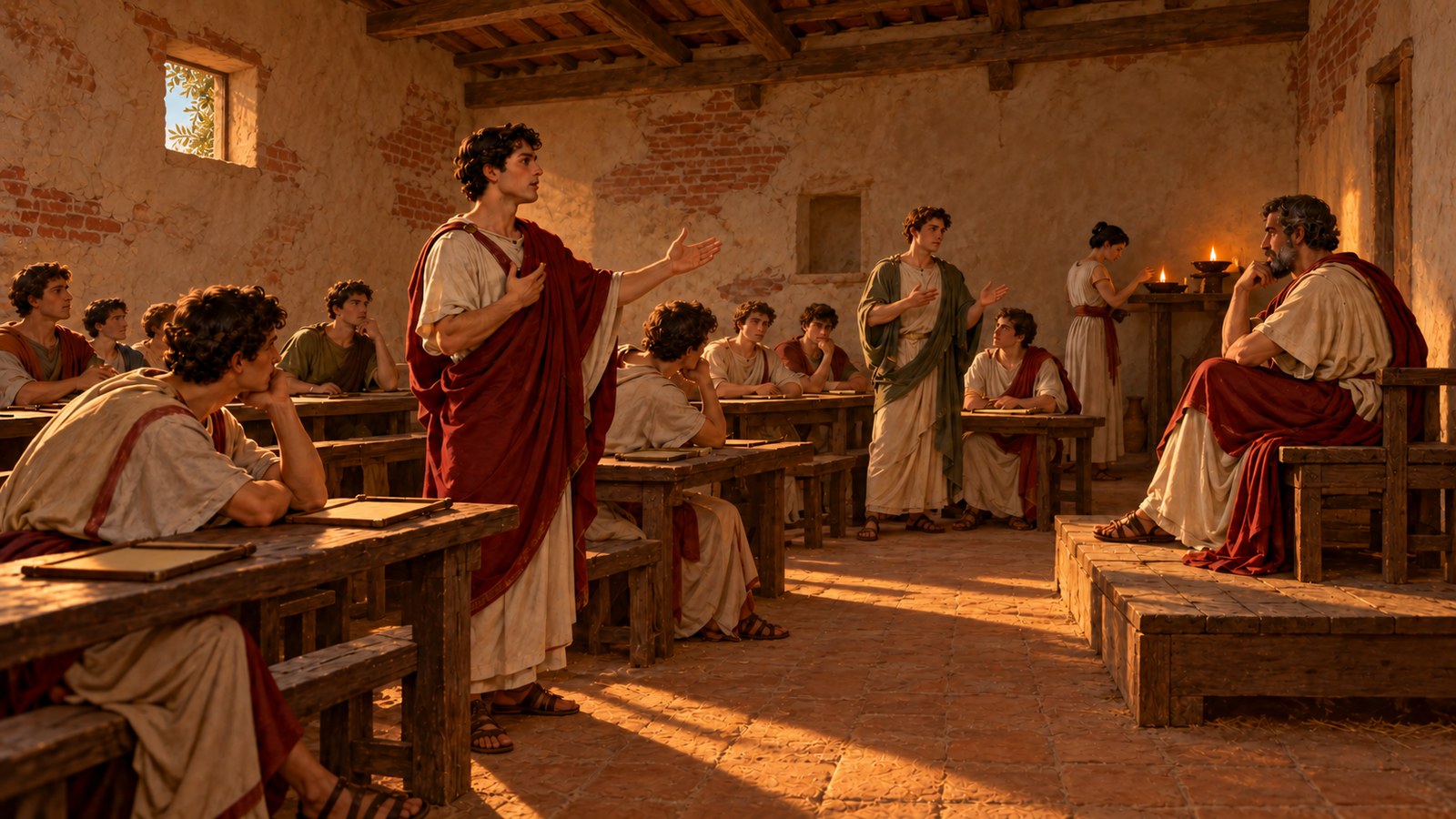
The censors said reports had reached them that certain men had established a new kind of learning. Young people gathered in their school. The teachers called themselves Latin rhetoricians. Their pupils sat there all day.
That final detail gives the edict its physical center. Education is not presented as a few dangerous sentences. It occupies bodies and hours. A young man who spent the day in one school was not spending it in another setting supervised by family, established teachers or the routines the censors associated with proper formation.
The institution also made rhetoric more accessible through Latin. Gellius’s quotation does not say that accessibility was the explicit offense, and it would be careless to invent a secret policy from silence. What it does show is that the new title mattered enough to repeat: these were Latini rhetores, teachers defining a recognizable form of instruction.
Roman schooling could demand long submission under a teacher. The Pythagorean discipline of two silent years represented duration as moral training. The censors read duration differently. A whole day inside an unauthorized new school became part of the charge.
The ancestors supplied a movable standard
Domitius and Crassus said the ancestors had established what their children should learn and which schools they should attend. The sentence does not provide a curriculum. It gives authority to inherited selection.
That vagueness made ancestral custom powerful. A fixed list could be debated item by item. An appeal to what forebears had already judged proper allowed the censors to classify novelty itself as suspect. The new schools were said to operate beyond custom and the practice of the ancestors.
The edict therefore guarded pathways as much as content. Romans did not lack rhetoric; public life depended on trained speech. The question was who could organize that training, under what name and in what institutional form. A familiar skill could become threatening when its delivery system changed.
This is not the same educational mechanism as a town financing instruction. Pliny’s gift of one third toward a school fund at Comum was designed to keep parents invested in choosing teachers. The censorial edict moved in the opposite direction: officeholders declared one new choice unacceptable.
Disapproval reached teachers and pupils
The censors addressed both sides of the doorway. Their judgment was to be shown to those who maintained the schools and to those accustomed to attend. The document did not portray students as passive material while punishing only instructors.
That dual address reveals how institutions persist. A school requires someone to offer instruction and people willing to organize their days around it. State disapproval aimed at the relationship. Closing a room without changing demand could merely move the lesson; shaming attendance sought to weaken the school’s social base.
Gellius says the censors considered the new practices neither pleasing nor right. The formulation is moral and administrative rather than philosophical. No surviving counterargument from the teachers appears in his chapter. We hear authority define the innovation, quote ancestral custom and publish its verdict.
The absence of the teachers’ voices limits any reconstruction. We do not know from this passage how they advertised, what exercises filled those days or how pupils defended the choice. The state’s document survives because Gellius copied it. Institutional losers left fewer words in this particular archive.
Gellius widened the pattern beyond one edict
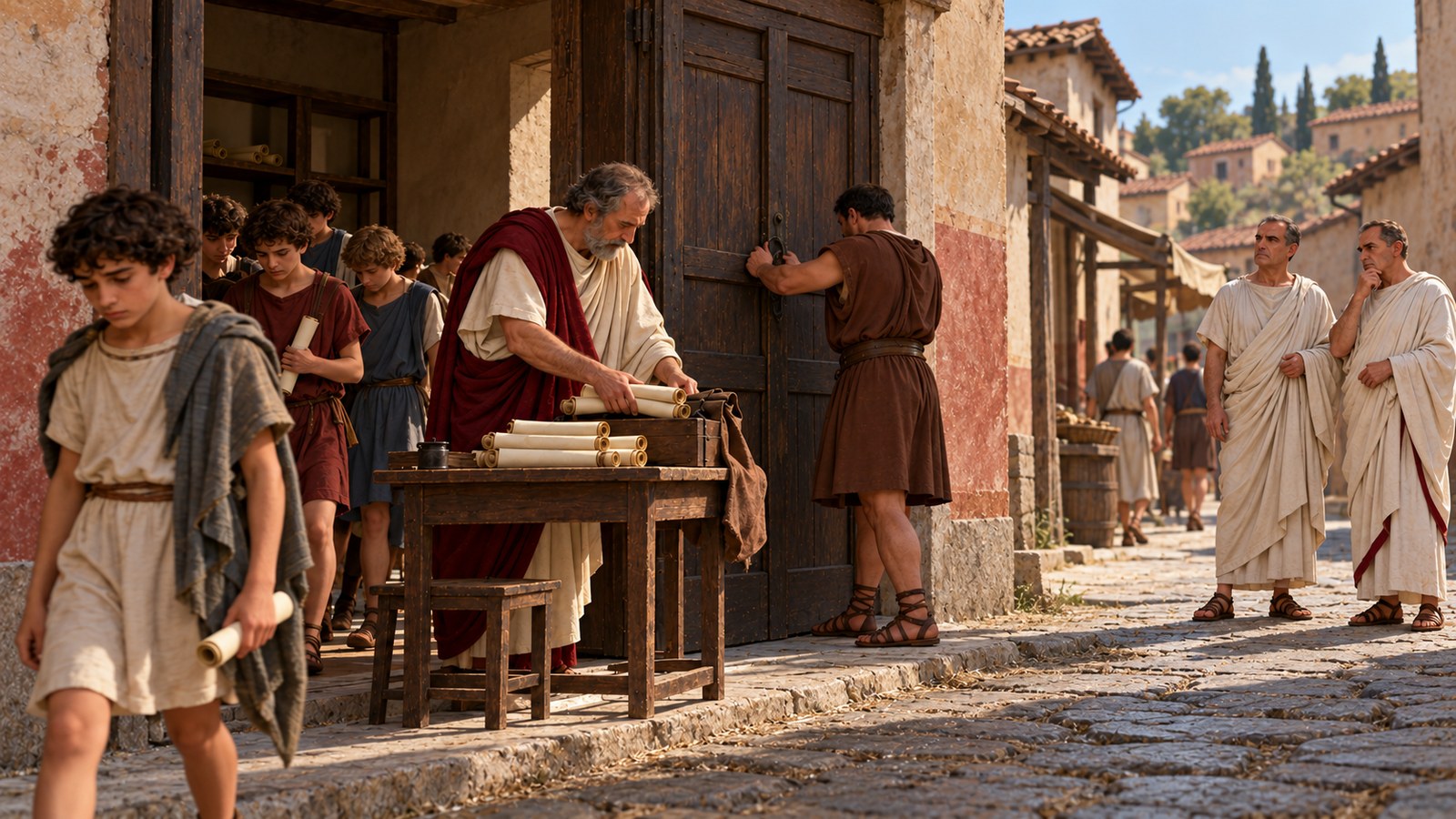
After quoting the censors, Gellius says expulsion was not confined to a supposedly rough early period before Greek learning had polished Rome. Under Domitian, philosophers were again driven from the city and barred from Italy by a Senate decision.
He names Epictetus, who went from Rome to Nicopolis in connection with that action. The addition changes the chapter’s horizon. Suspicion of organized teaching was not a single republican embarrassment outgrown by a more educated empire.
Still, the examples should not be flattened. The republican Senate order, the censors’ attack on Latin rhetorical schools and Domitianic expulsion belonged to different offices and circumstances. Gellius placed them together because documentary language let him show recurring power over intellectual residence and education.
The most revealing phrase remains the complaint about whole days. It translated institutional anxiety into a visible schedule. The new school claimed enough of a young man’s time to rival older routes into public life. The censors answered not by proving that its lessons failed, but by declaring that the ancestors had already decided where learning belonged.
That schedule also made the school easier to police. A book could circulate privately and a technique could pass between friends, but a room that repeatedly gathered young men through the day created a stable target. The censors could identify keepers, attendees and a self-declared professional title. Institutional visibility gave authority something concrete to condemn.
The surviving words say nothing about examination results or bad speeches. Instead, the censors move from report to classification: new instruction, named teachers, congregating youth, entire days, ancestral disapproval. Their evidence is social arrangement. Whether the pupils became better speakers is irrelevant to the official case as Gellius transmits it.
This is why “Latin” should not be treated as a decorative adjective. The edict repeats the name the teachers chose for themselves, making professional identity part of the record. Yet the document does not provide enough evidence to claim a simple contest between Latin virtue and Greek corruption. The earlier Senate action covered both philosophers and rhetoricians, while the later text targets a particular new school form.
Gellius, writing long afterward, lets administrative quotations do much of the work. He does not recreate classroom debates or supply a heroic resistance speech. The chapter’s force comes from official language surviving as an object of study. Readers can watch Roman power describe intellectual activity in its own preferred terms—and notice how much experience falls outside that description.
The quotation also makes restraint important for a modern retelling. It proves organized disapproval, named offices and a stated rationale. It does not prove that every school vanished permanently or that every pupil obeyed. The document records an intervention, not a complete census of its effects.
Sources
Aulus Gellius, Attic Nights, 15.11.