

A boy came to greet Pliny the Younger in his native district and left behind a funding problem. Asked whether he continued his studies, the boy said yes. Asked where, he answered Mediolanum. His father supplied the reason: their own town had no teachers.
Other fathers happened to be listening. Pliny turned the small exchange into a proposal for Comum. Pool the money that families already spent sending sons away, hire teachers locally, and let him contribute one-third of whatever total they agreed to raise.
The fraction was deliberate. Pliny said he would have promised the whole amount if full generosity did not risk serving private interests. A school funded entirely by a benefactor or from public money could lose the scrutiny of those using it. Parents who paid most of the cost and retained the right to choose, he argued, would inspect the teacher because their own money was at stake.
A Boy’s Journey Revealed the Missing Institution
Pliny recounts the conversation in a letter to Cornelius Tacitus. He was staying at his Tusculan villa, trying to finish another piece of writing, but sent this request ahead before returning to Rome. The school question had become urgent enough to interrupt the work already on his desk.
The discovery begins without a survey. A young son of a fellow townsman paid his respects. Pliny asked about study, then followed the answer to its geography. The boy was learning at Mediolanum because Comum lacked teachers. One household’s arrangement exposed a gap shared by others.
The father stood beside the child, and a number of fathers were within hearing. That audience let Pliny change register immediately. He no longer spoke only about why this boy traveled. He addressed men whose separate decisions were exporting the town’s pupils and whose combined budgets might support a local alternative.
Education was already costing them money. Pliny names lodging and travel as substantial expenses. His proposal did not begin by imagining an entirely new reservoir of wealth. It asked whether payments scattered along the road to another city could be concentrated into salaries at home. The absence of a local teacher was therefore not the absence of demand. It was a failure to gather many private journeys into one dependable appointment.
Lodging and Travel Became a Teacher’s Salary
Pliny’s case for local schooling joins economy to supervision. Children could remain in their native place, live under their parents’ eyes and avoid the expense of residence elsewhere. Home was not simply cheaper. In his argument, it connected instruction to household oversight and familiarity with the town.
This is a different educational mechanism from Cato composing a history for his own son. Cato brought the lesson into one household through his own labor. Pliny tried to make professional teaching viable for multiple households without turning himself into the teacher.
The fathers’ separate bills formed the hidden budget. Every lodging payment and allocation for travel proved that families already valued instruction enough to bear costs. Pooling could convert those costs from movement and absence into a local wage. The proposal depended on coordination more than invention.
Pliny also imagined a reversal. At present, children from Comum flocked elsewhere. If the town attracted distinguished teachers, boys from neighboring communities might travel toward Comum instead. A place losing students could become a destination, but only if its families created a reliable market for skill.
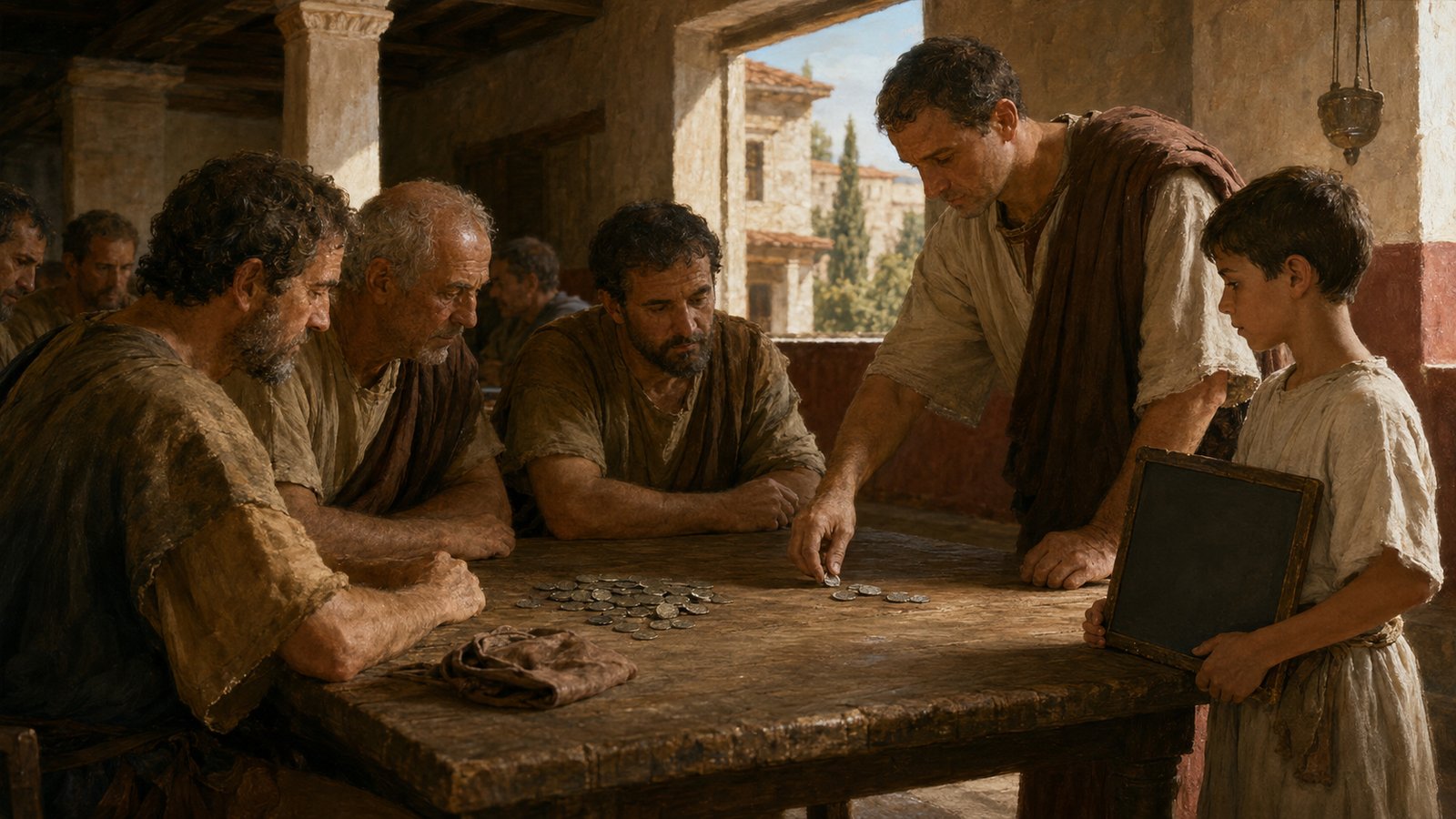
One Third Put a Ceiling on the Patron
Pliny had no children of his own. He nevertheless framed the community as something he might regard as child or parent and offered a third of the amount the fathers chose to collect. The wording made his obligation expand with theirs: a larger local commitment produced a larger gift from him.
Why stop at one-third? Pliny says he feared that paying the whole sum would let generosity be corrupted for private interests, as he believed happened in places where teachers were employed at public charge. The claim carries an elite benefactor’s suspicion of publicly financed appointments, but it also identifies a real governance question inside his proposal.
If one donor paid everything, families could seek influence without bearing the cost of a poor selection. If parents supplied most of the money, Pliny reasoned, they would care whether the teacher deserved it. The unpaid share was therefore not a gap awaiting further patronage. It was the pressure intended to keep judgment active.
The fraction also restrained Pliny. He could initiate, subsidize and recruit assistance, but he could not make the school wholly his possession. His name and money would matter, yet the institution would fail to exist unless other households acted together.
The Parents Kept the Appointment
Money and selection followed the same design. Pliny insisted that parents retain a free hand to judge and choose teachers. He asked Tacitus, surrounded by learned people, to identify promising candidates. Tacitus was to open a route, not settle the appointment.
Pliny explicitly avoided promising a job to anyone Tacitus approached. A teacher might go to Comum confident in personal ability, but without certainty of employment. That condition protected the parents’ decision from becoming ceremonial after two famous men had already chosen for them.
There is tension in the arrangement. Parents carried the largest financial burden and final selection, while Pliny defined the problem, supplied a prestigious subsidy and enlisted Tacitus’s network. This was not equal power distributed among every participant. It was an elite proposal designed to make local consent and local money indispensable.
The contrast with Quadratilla separating her grandson’s study from household entertainment shows two scales of educational control. Her repeated instruction protected one heir’s time inside a house. Pliny asked multiple houses to coordinate so their sons no longer needed another city.
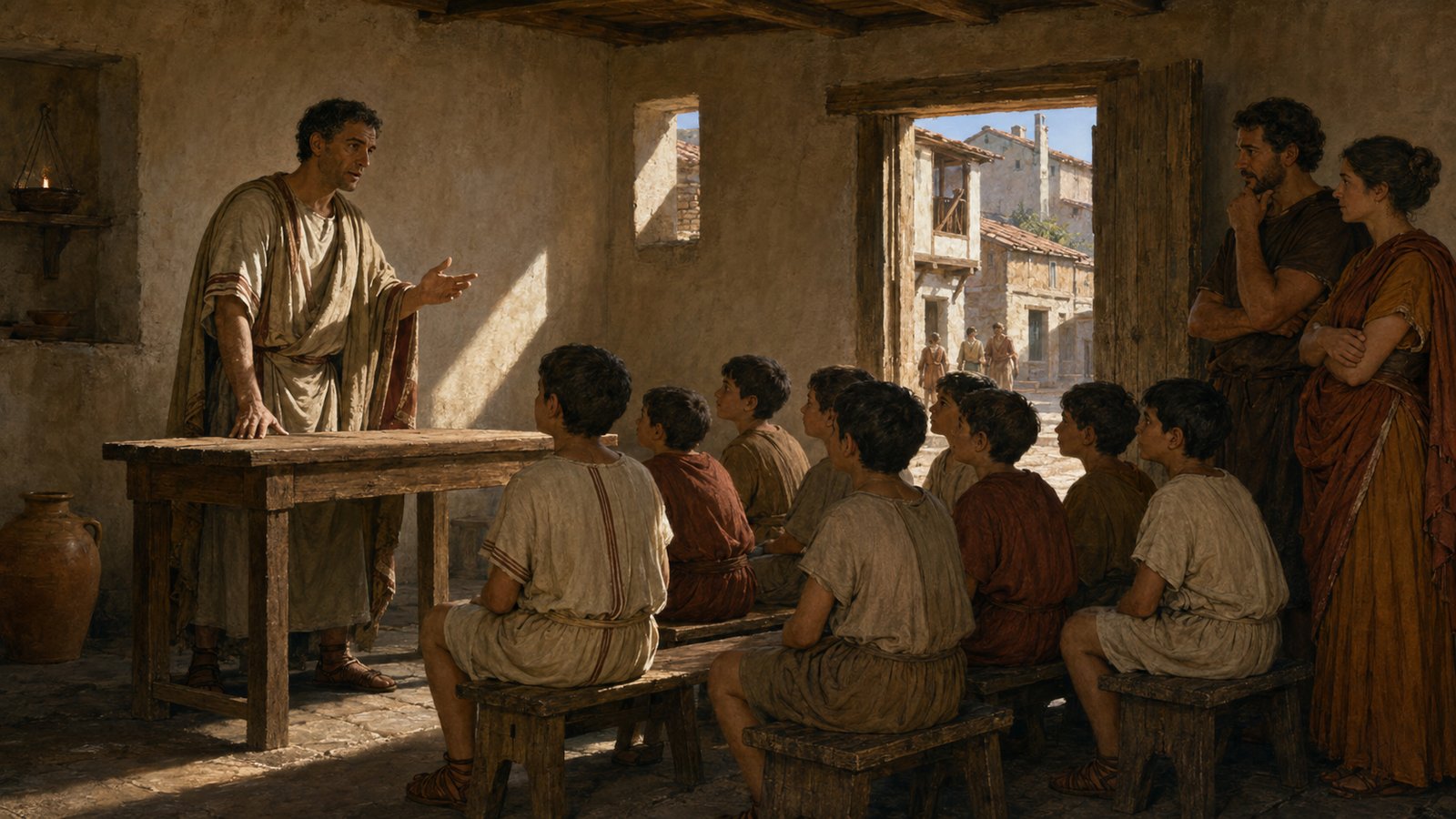
Comum Was Asked to Keep Its Children Close
Pliny’s emotional appeal returned to place. Let children born in Comum be brought up there, he urged, so they would know and love every part of their native soil from their earliest days. The school was meant to preserve attachment as well as reduce expense.
Yet affection alone could not hire a teacher. The letter gives local loyalty a mechanism: redirect current costs, pool contributions, match them with a one-third subsidy, search widely for talent, preserve parental choice and refuse a guaranteed appointment. Each step answers a different way the plan might collapse.
We do not learn from this letter which teacher was hired or whether Pliny’s hoped-for influx from neighboring towns occurred. The document preserves the proposal rather than its completed institution. Its value lies in showing a Roman patron thinking past the act of giving and into the incentives created after the gift.
The boy’s commute made the problem visible, but Pliny did not merely offer to pay his fare. He treated travel and lodging as evidence that Comum already financed education in a dispersed form. One third from the patron could help gather that demand without replacing it. The limit kept the parents’ money, judgment and responsibility inside the school they were being asked to build.
Sources
Pliny the Younger, Letters 4.13.