
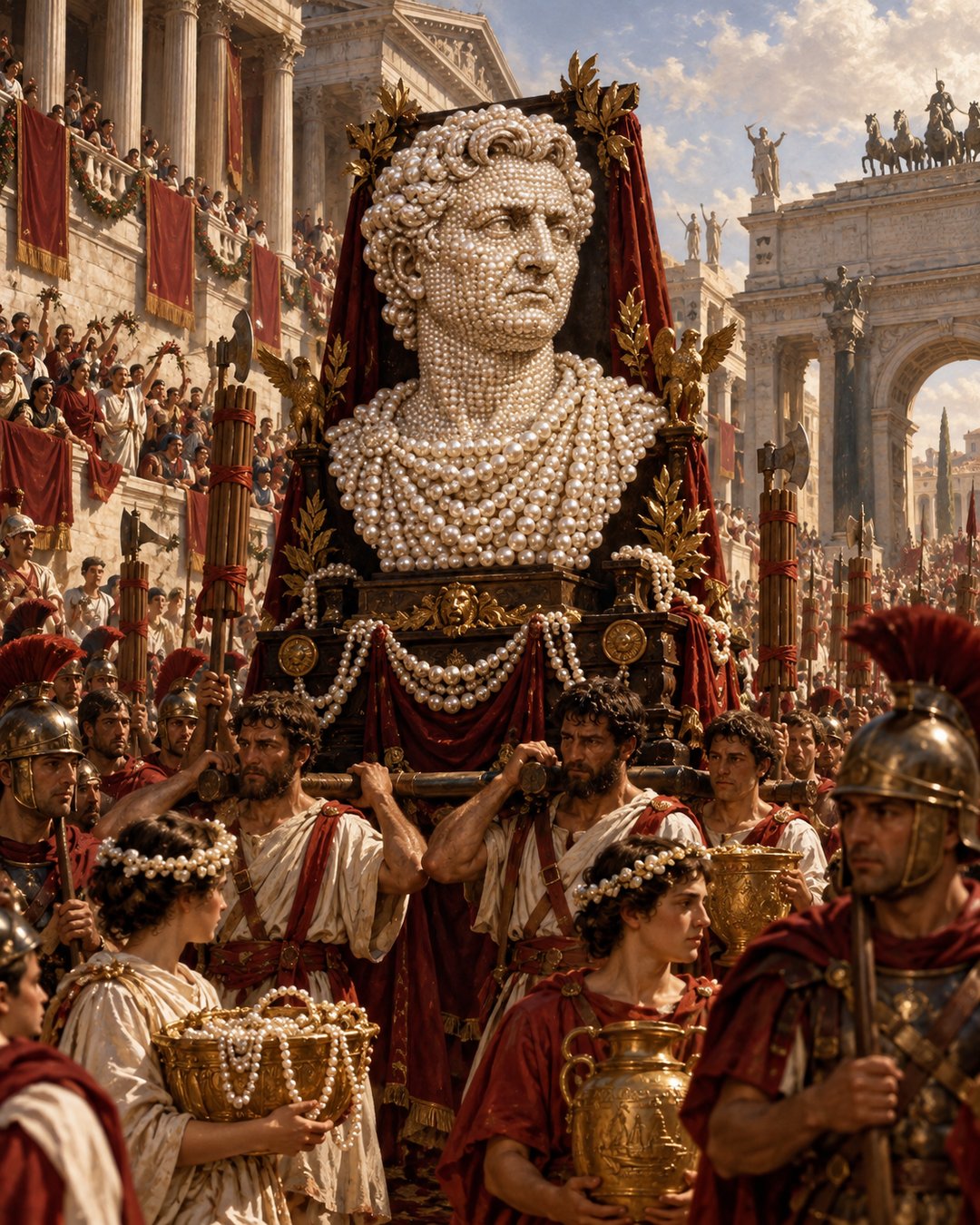
Pompey’s face entered Rome in pearls. The portrait showed the commander’s familiar hair swept back from his forehead, but flesh, paint, and bronze had all been rejected. His features were assembled from the spoils and fashions of eastern victory. In Pliny the Elder’s account, the image was meant to make triumph visible as value.
Pliny refuses to let it remain a flattering picture. He sets the pearl head among gaming pieces, golden furniture, crowns, gods, animals, and a grotto topped by a sundial. Then he looks backward from Pompey’s later death and sees a head without a body. The triumph had converted conquest into luxury, yet the most personal object in the procession escaped its maker’s control. A commander could organize the parade. He could not dictate how posterity would read his image.
Mithridates entered the Capitol through his gemstone cabinet
Pliny begins before the portrait, with collections. He calls Scaurus, the stepson of Sulla, the first Roman owner of a gemstone cabinet, or dactyliotheca. For years, he says, no other collection rivalled the novelty. Pompey changed the public scale by dedicating in the Capitol a cabinet that had belonged to King Mithridates.
The object carried two histories at once. It was a collection of worked stones, but it was also captured royal property. The cabinet’s route from Mithridates to Pompey and then to Jupiter’s precinct made possession into a political sentence. A foreign king had gathered the gems; a Roman commander had defeated him; Rome’s central temple received the evidence.
Yet Pliny inserts an awkward comparison. Varro and other authorities of the period said Pompey’s cabinet was far inferior to Scaurus’s. Military prestige did not automatically settle connoisseurship. A private aristocrat could still possess the finer collection. Pompey’s advantage was not simply quality. It was the power to turn a conquered king’s cabinet into a public monument.
Others followed. Julius Caesar dedicated six gemstone cabinets in the temple of Venus Genetrix, and Marcellus later placed one in the temple of Apollo on the Palatine. The sequence shows imitation operating through sacred display. Pompey did not merely bring stones to Rome. His victory helped establish a way for elite collections to become political offerings.
The third triumph taught victory to look like luxury
Pliny states the mechanism directly: victory over Mithridates made Roman fashion veer toward pearls and gemstones. Earlier conquests had redirected taste toward chased silver, cloth of gold, bronze-inlaid dining couches, Corinthian bronzes, and paintings. Triumph was therefore more than a report of territory gained. It was a moving showroom that taught spectators what to desire.
Pompey’s third triumph took place on September 29, his birthday, in 61 BC. It celebrated the defeat of pirates and the conquest of Asia, Pontus, and a long catalogue of peoples and rulers. Birthday and victory fused the commander’s biography with Rome’s expansion. The city was invited to read one man’s life as the route by which a world of objects had arrived.
A gaming board made of two precious minerals measured three feet by four feet. On it rested a golden moon weighing thirty pounds. The details mattered because scale translated distance into astonishment. Materials that most viewers knew as small ornaments became architecture for play and a platform for a heavy celestial emblem.
This was not the only way Pompey made conquest physical. The parade carried three gold dining couches and enough gem-inlaid gold vessels to fill nine display stands. Three gold figures represented Minerva, Mars, and Apollo. Thirty-three pearl crowns multiplied the imagery of rank. The objects did not explain eastern politics; they compressed victory into surfaces, weights, colours, and counts that a crowd could grasp.
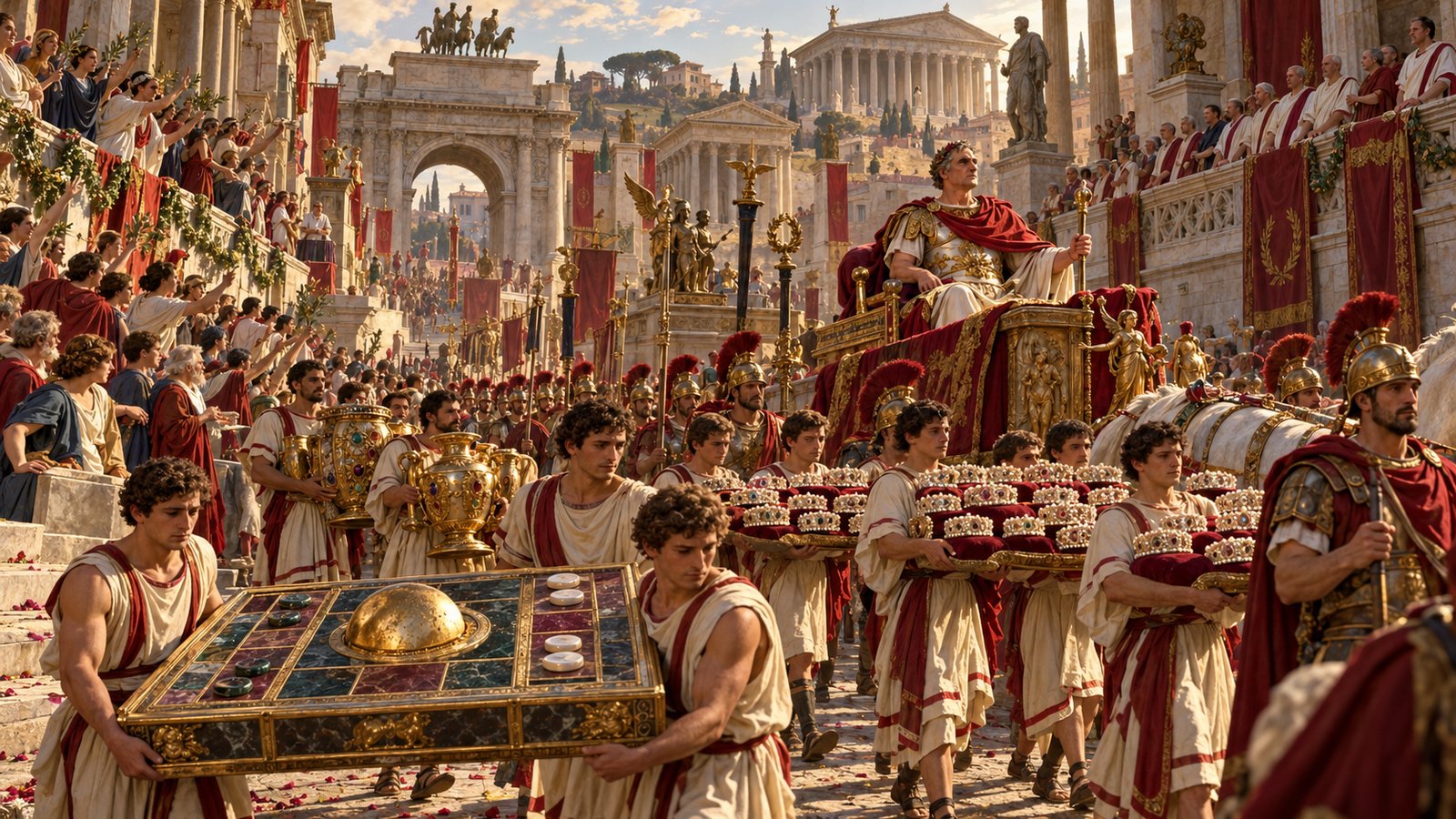
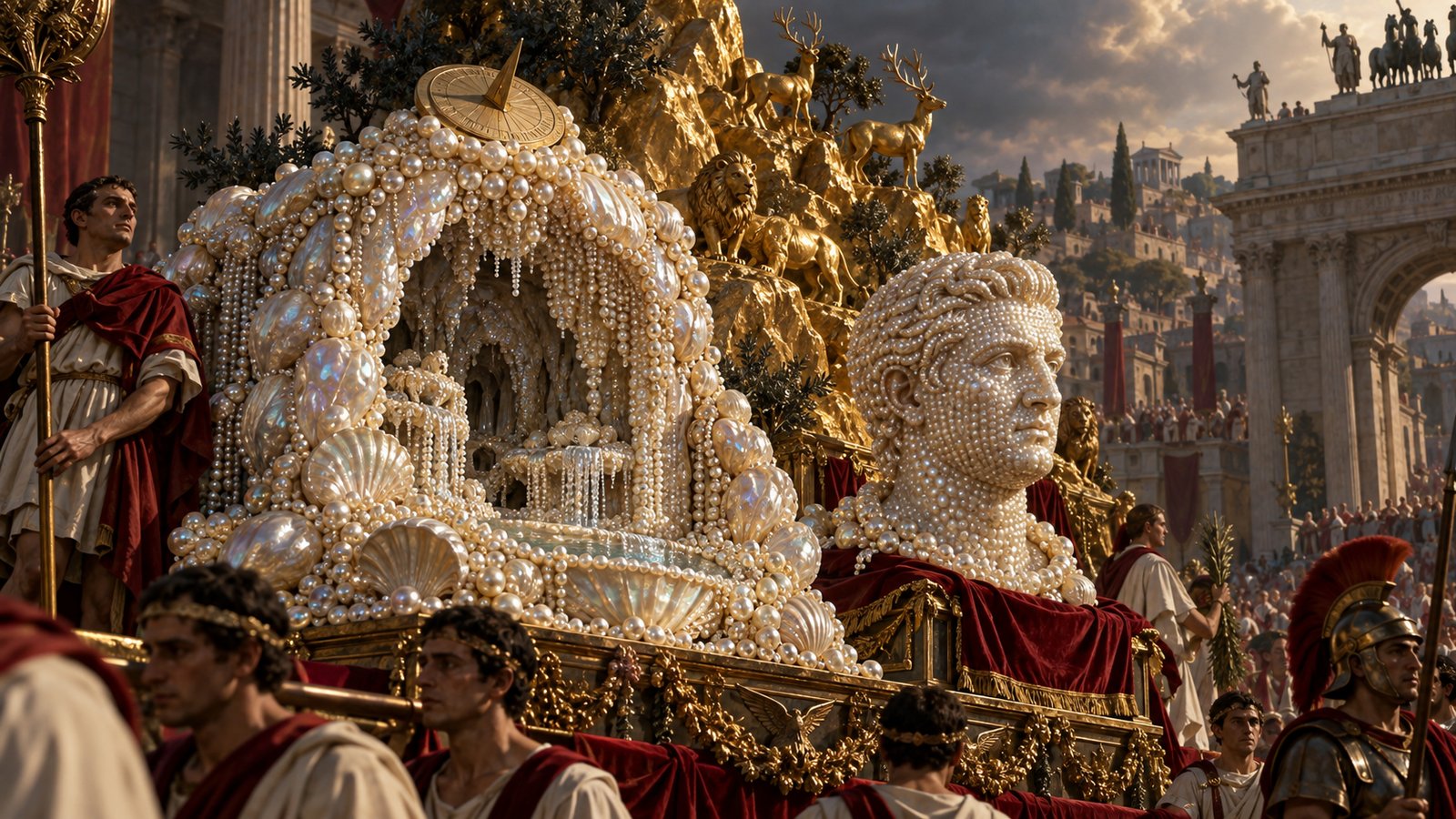
A pearl grotto led the eye toward one famous face
Among the displays was a square mountain of gold populated with deer, lions, and fruit, with a golden vine wound around it. Another construction imitated a grotto in pearls and carried a sundial on top. Nature, landscape, time, and animals had been rebuilt from substances that advertised command over resources.
Then came Pompey’s portrait. Pliny lingers over the handsome growth of hair swept back from the forehead. Recognition depended on that familiar arrangement. The pearls did not need to reproduce every feature with modern precision. They needed enough likeness to let a crowd identify the commander inside the vocabulary of captured wealth.
The choice made Pompey’s face the climax of a material argument. Crowns could represent conquered rulers, and vessels could represent treasure, but the portrait joined the treasure to the victor’s person. It suggested that the value moving through the streets culminated in him. Pliny’s response is acid: austerity had been defeated, while extravagance celebrated the truer triumph.
That criticism differs from the practical failure in Pompey’s elephant procession at the city gate. There, living trophies met the hard width of Roman architecture. Here, the display succeeded perfectly as spectacle. Its failure came later, when the same visual choice exposed Pompey to an interpretation he could not answer.
Pliny turned the portrait into an omen after the fact
Pliny asks whether Pompey’s title “the Great” would have survived among an earlier, tougher generation if his first triumph had looked like this. He mocks pearls as a material Pompey himself could not properly wear and contrasts the portrait with the trophy Pompey placed in the Pyrenees. One image marked military reach in a landscape. The other made a face valuable by pricing its substance.
Then the criticism changes register. The pearl head was detached from a body. After Pompey’s murder in Egypt, that formal fact could be read as a cruel omen. The procession had once shown a complete political identity through a portable face. Pliny’s hindsight made the same face prefigure violent reduction.
This is not neutral evidence that spectators in 61 BC predicted Pompey’s end. It is Pliny’s retrospective design. He arranges triumph and death so that material splendour becomes morally legible. The portrait is powerful in his narrative because its meaning reverses without changing its shape.
Pliny still records the triumph’s public distributions: 200 million sesterces to the state, 100 million to commanders and quaestors who guarded the coasts, and 6,000 to each soldier. Those sums stop the episode from becoming a simple story about decoration. Pompey’s victory redistributed money as well as taste. The point is that the pearl face competed with those civic and military achievements in public memory.
The article on the command that gave Pompey the Mediterranean shows how law concentrated extraordinary power before the victories. Pliny shows a later stage: power returned as objects, and objects reshaped reputation. The cabinet entered a temple. The crowns crossed the city. The portrait survived as a sentence against the man it once praised.
Pliny extends the consequences into the imperial household. Caligula wore slippers sewn with pearls; Nero put pearls on sceptres, actors’ masks, and travelling couches. Cups, household objects, and open-bezel rings also entered the argument. Pompey had not personally invented every later fashion, but his public spectacle gave Pliny a benchmark against which later extravagance became difficult to condemn. A triumph authorized imitation because it linked luxury with victory, the Capitol, and the safety of the state.
That is the portrait’s final political work. It outlived the cheering crowd as an example. The costly likeness advertised Pompey’s mastery in 61 BC, then supplied Pliny with a genealogy of excess more than a century later. Material display could preserve fame, but it preserved evidence for hostile readers too.
Sources
Pliny the Elder, Natural History, 37.11–17.