
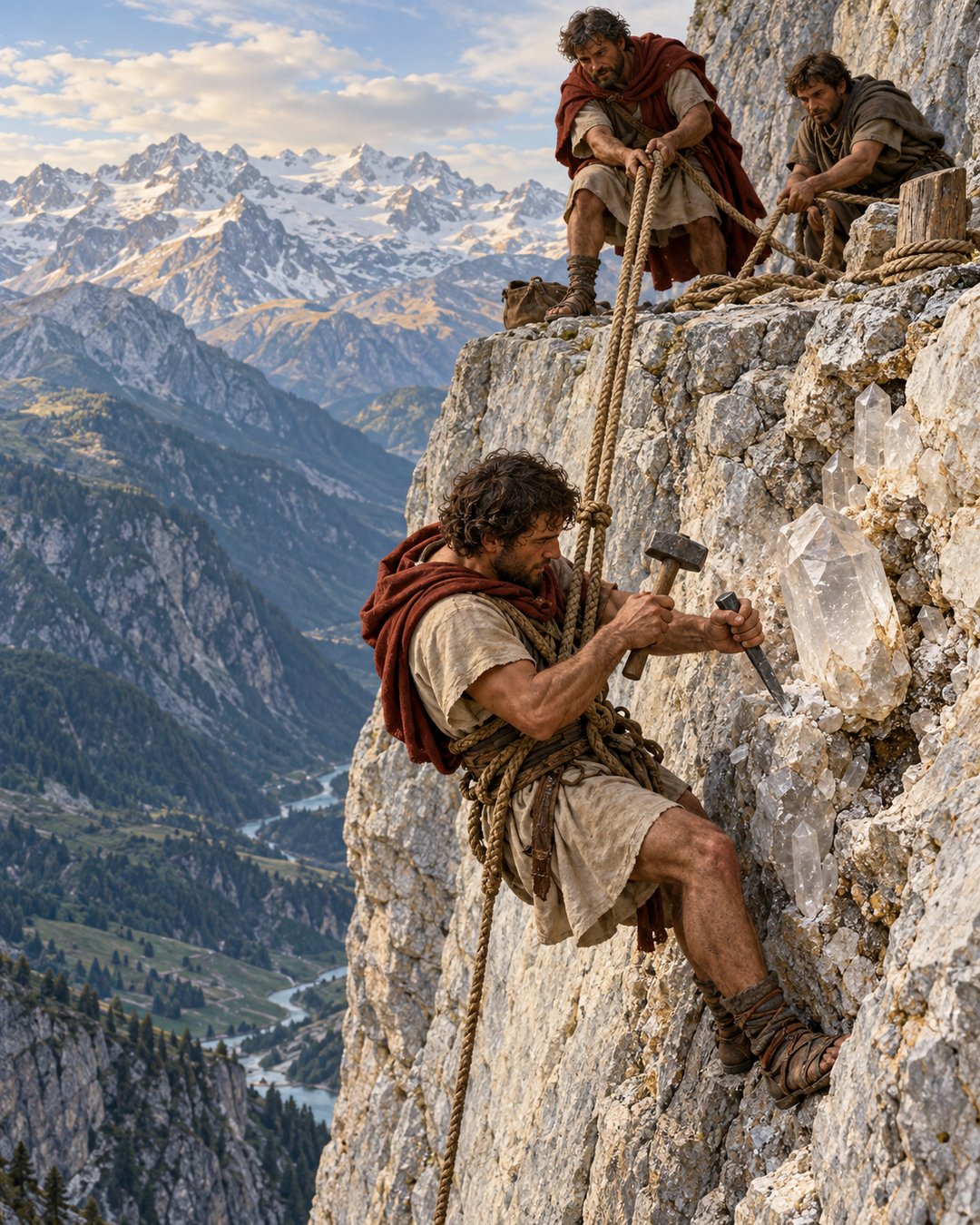
A finished crystal cup hid the most dangerous part of its history. In the Alps, Pliny the Elder says, rock crystal formed in places so inaccessible that men had to remove it while suspended from ropes. Before the clear vessel reached a Roman table, someone had read signs in the mountain, descended against exposed rock, and brought a heavy, brittle mass back without shattering it.
Pliny misunderstood crystal’s geology, treating it as moisture hardened by exceptional freezing. But his catalogue preserves a sharper practical story about supply. Experts knew where to look. Buyers distinguished clouding, trapped moisture, brittle cores, red stains, fibres, and tiny “salt-specks.” Weight increased value, perfect pieces were left unengraved, and damage could not be repaired. Luxury began in terrain and judgement long before it became display.
Cold gave Pliny an explanation for clear stone
Pliny believed rock crystal formed through a cause opposite to the heat he associated with another luxury material. Intense freezing hardened it. The Greek name seemed to support the idea that crystal was a kind of ice, and its occurrence near deeply frozen snow made the explanation persuasive within his natural history.
He assembled reports across a broad geography. Indian crystal was preferred. Poorer material came from around Alabanda and Orthosia in Asia Minor and from neighbouring districts and Cyprus. Excellent crystal, he says, appeared in the Alps. Juba added islands in the Red Sea facing Arabia, while Cornelius Bocchus described an unusually heavy piece uncovered when wells were sunk in Portugal.
Those reports did not fit one neat environment. Xenocrates said ploughs turned crystal from soil in Asia Minor and Cyprus, contrary to the belief that it belonged only among rocks. Torrents could carry pieces downhill. Sudines claimed it appeared only in south-facing places, while Pliny insisted that well-watered districts did not produce it merely because they were cold.
The physical form deepened the puzzle. Crystal showed hexagonal faces, unequal terminal points, and surfaces so smooth that Pliny thought no craft could equal them. Natural regularity looked manufactured, yet its irregular ends resisted a simple workshop analogy. His theory was wrong, but it came from attempting to reconcile shape, temperature, location, and use.
A one-hundred-fifty-pound mass became a public offering
Scale turned geological curiosity into prestige. Livia, the wife of Augustus, dedicated in the Capitol a mass of rock crystal weighing about 150 pounds. Its importance depended partly on remaining a mass: the offering let viewers confront quantity before any artisan divided it into smaller objects.
Other reports measured crystal by capacity. Xenocrates said he had seen a vessel that held six gallons. Authors also mentioned an Indian vessel holding four pints. Such numbers made rarity imaginable. A clear stone large enough to become a substantial container seemed to push against the limits of what nature usually supplied.
Roman fascination with size did not erase practical use. Pliny says crystal could not stand heat and was rejected except for cold drinks. The belief followed his freezing theory, but it also assigned the material a social place. A cup displayed clarity, coolness, and cost at the moment it touched the hand.
The value resembles the material theatre around a false sardonyx assembled from three stones, but crystal presented a different commercial problem. The fraudulent sardonyx imitated layered appearance through joining. The best crystal claimed value through continuity: one clear, heavy natural body without a hidden join or repair.
Ropes connected the mountain face to the luxury market
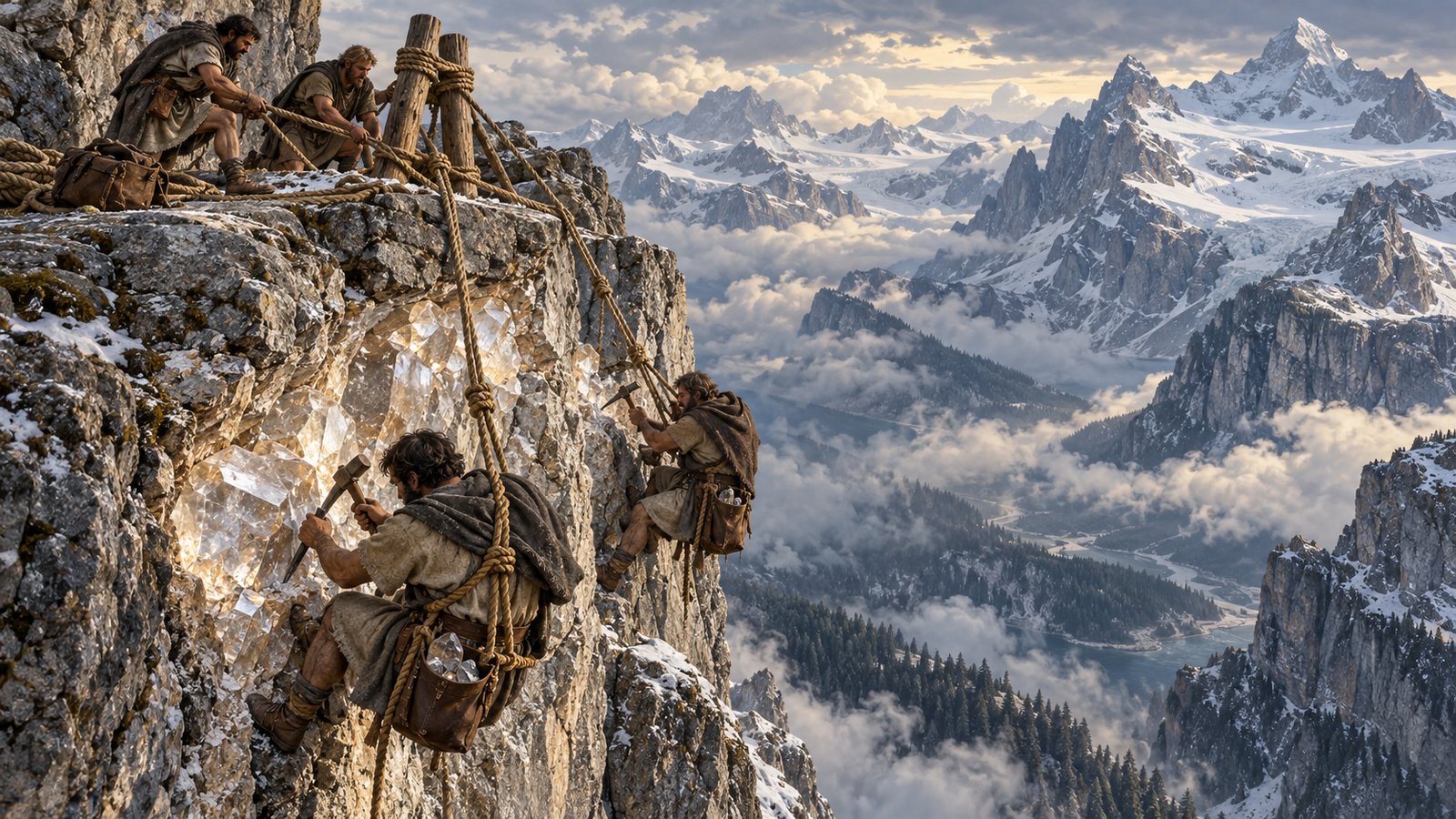
Pliny draws a boundary between reports and what he personally affirms. In Alpine rock, he says, crystal generally formed in places so inaccessible that men had to be suspended from ropes to remove it. The sentence changes the scale of the account. After continents and enormous vessels, attention narrows to a human body hanging against stone.
The work required more than courage. Experts recognized signs indicating the presence of crystal. Pliny does not list those signs, but their mention implies practical knowledge that belonged to searchers and extractors rather than to dinner guests. A mountain did not present a polished object. Someone had to distinguish promising rock, choose a route, rig support, and separate the find without ruining it.
Rope was therefore part of the material’s value even though it disappeared from the finished cup. The danger and labour were not visible in the transparent surface. Nor were transport, sorting, and the losses caused by breakage. The object arrived at Rome as if clarity were its whole story.
That hidden chain parallels the work behind Roman stone sawing with abrasive slurry. In both cases, the desired surface depended on an unglamorous mechanism. Marble required moving grit between iron and stone. Alpine crystal required knowledge, anchorage, rope, and controlled removal before an engraver could begin.
Clouds, fibres, and salt-specks decided what happened next
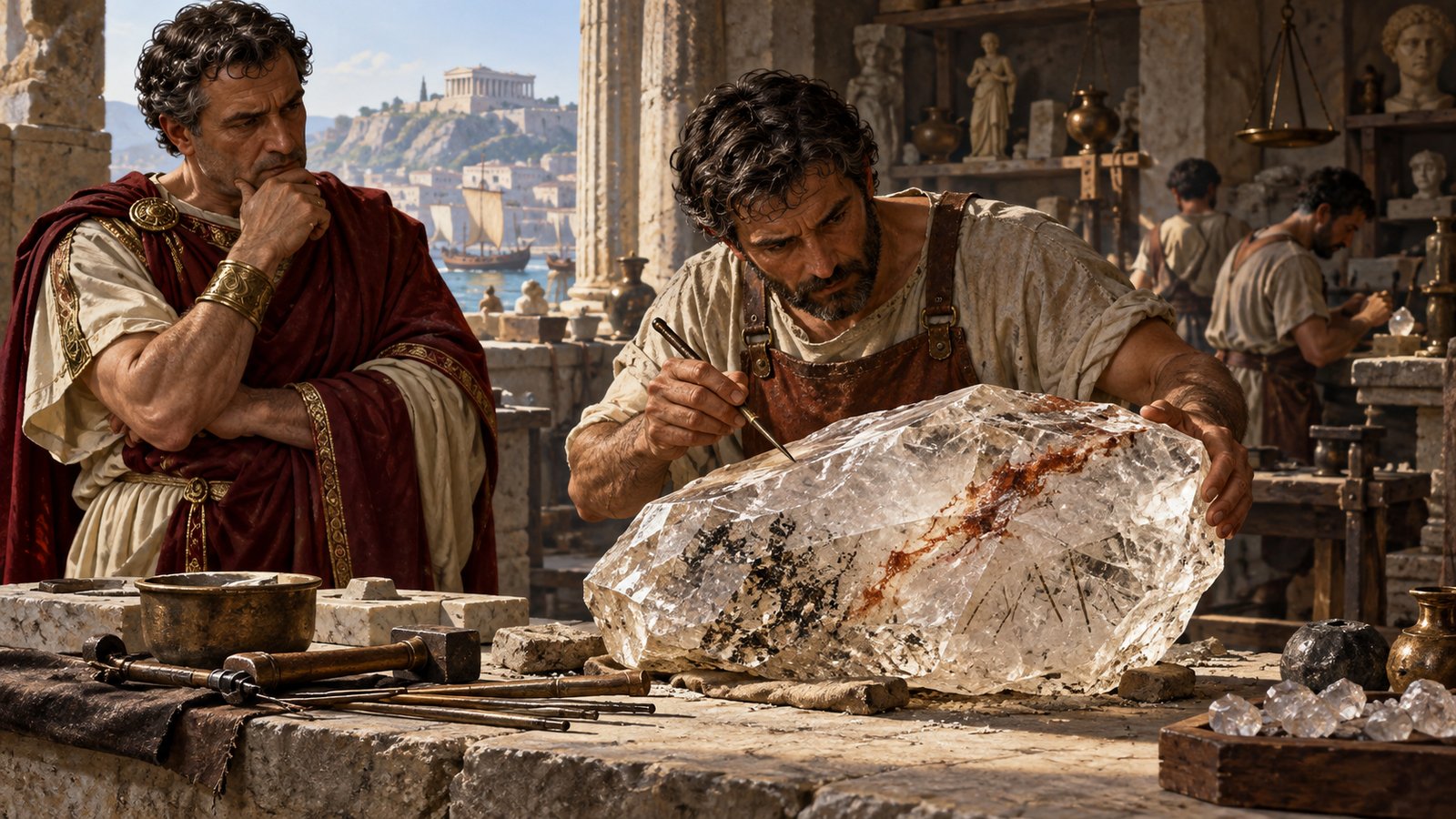
Once extracted, crystal faced inspection. Pliny lists rough excrescences resembling solder, cloudy areas, moisture trapped inside, hard but brittle cores, and small defects called salt-specks. Some pieces showed bright red rust. Others contained fibre-like marks.
An engraver could conceal certain faults. Cutting was not only decorative; it could manage evidence. A patterned surface might redirect attention from an inclusion, while the form of a vessel could avoid a damaged region. Craft added value partly by deciding what the buyer would not see.
Perfect pieces followed the opposite strategy. They were preferably left unengraved and called acenteta, “lacking a core.” Their colour resembled clear water rather than foam. Nothing needed to distract from the material because transparency itself demonstrated quality.
Weight also entered valuation. It rewarded the survival of a large mass through extraction and transport, but it did not override defects. A heavy cloudy piece and a smaller clear piece answered different desires. Pliny’s catalogue shows a market using several tests at once: size, clarity, internal structure, colour, and the possibility of working the object.
A crystal could focus sunlight or absorb a fortune
Crystal moved beyond drinking vessels. Pliny says doctors considered a crystal ball the most effective means of focusing the sun’s rays to cauterize tissue. The same transparency that pleased a collector could concentrate heat in a medical procedure. His earlier claim that crystal could not tolerate heat sits awkwardly beside this use, a reminder that his book preserves observations and theories that do not always align.
Luxury prices were less restrained. A respectable married woman who was not rich paid 150,000 sesterces for a single dipper. Pliny presents the purchase as addiction. Cost separated the vessel from ordinary utility: many materials could lift a cold drink, but only this one joined transparency, natural rarity, and the risk of total loss.
Nero supplied Pliny’s final spectacle. When he learned that all was lost, the emperor smashed two crystal cups. Pliny interpreted the act as vengeance against his generation, because no one else could drink from them. Rock crystal, once broken, could not be repaired by any method he knew.
Glass had come to imitate crystal remarkably well, yet imitation increased the value of the natural material rather than reducing it. Similar appearance made difference more important. The Roman buyer paid not merely for clarity but for an origin story: snow and mountain in Pliny’s theory, inaccessible rock in his observation, expert signs, rope extraction, hidden defects, and irreparable risk.
The transparent cup was therefore not visually honest in any simple sense. Its clarity concealed work, danger, and selection. Pliny’s hanging miners restore those missing steps. They show that Roman luxury could depend on bodies placed where elite owners would never see them—between a cliff face and the empty air.
Sources
Pliny the Elder, Natural History, 37.23–29.