
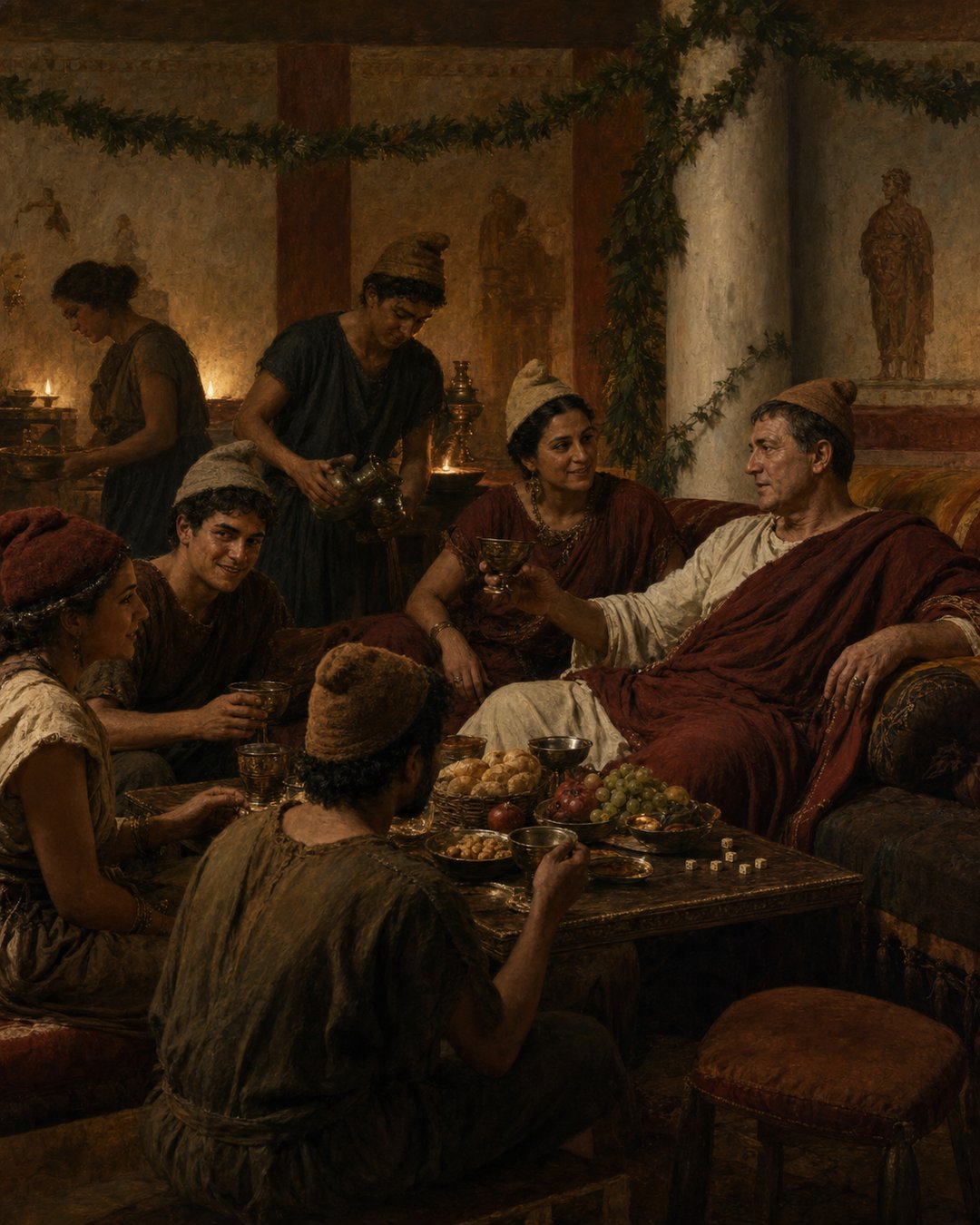
Saturnalia can look, at first glance, like Rome taking a holiday from being Rome. The festival brought feasting, gifts, dice, jokes, loosened behavior, and famous reversals of household order. A society that cared intensely about rank allowed itself to imagine the world turned upside down.
That is exactly why the festival mattered. Saturnalia did not mean hierarchy had vanished. It meant hierarchy was strong enough to survive being mocked for a limited time. Rome practiced disorder inside a ritual frame, then returned to order with the memory of the experiment still warm.
The calendar created a safe boundary
A reversal is less dangerous when everyone knows when it begins and ends. Saturnalia belonged to December and to the god Saturn, whose mythic associations reached toward an older age of abundance and ease. The festival created an interval with different expectations.
Macrobius preserves later discussions of the festival because Romans themselves found its customs worth explaining. The temporary nature was essential. A joke at the table, a relaxed rule, or a burst of gambling could be tolerated because it did not claim to rewrite the city permanently.
Household reversal made hierarchy visible
The most famous Saturnalian image is the household turned upside down: masters serving, enslaved people speaking more freely, and the ordinary tone of command softened. This is not evidence that Roman slavery became gentle for a week. It is evidence that the normal order was so stark that reversal was instantly recognizable.
That recognition gave the custom its power. If no hierarchy existed, reversal would mean little. Because hierarchy mattered every day, a temporary inversion could feel electric. The feast made the structure visible by bending it.
Gifts turned social ties into objects
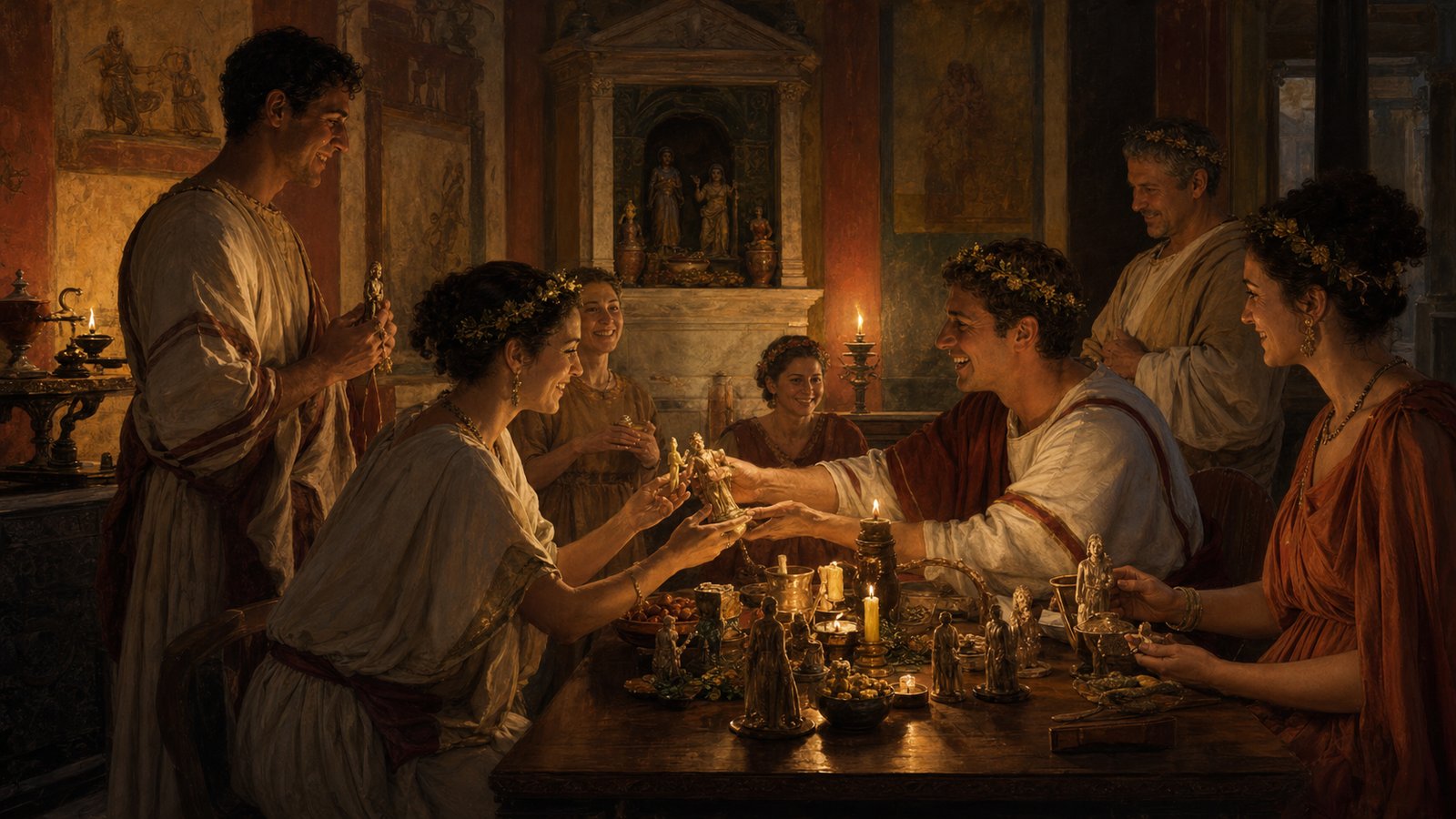
Martial’s Saturnalian gift poems show a world of small exchange, wit, obligation, and display. Candles, figurines, food, books, and other tokens could carry affection or social calculation. A gift was rarely just a gift in Rome. It could signal friendship, dependence, taste, satire, or status.
The festival’s exchange culture softened ordinary competition without erasing it. People gave, joked, compared, and remembered. Even festive generosity moved through a society trained to notice who owed what to whom.
Dice mattered because chance mocked control
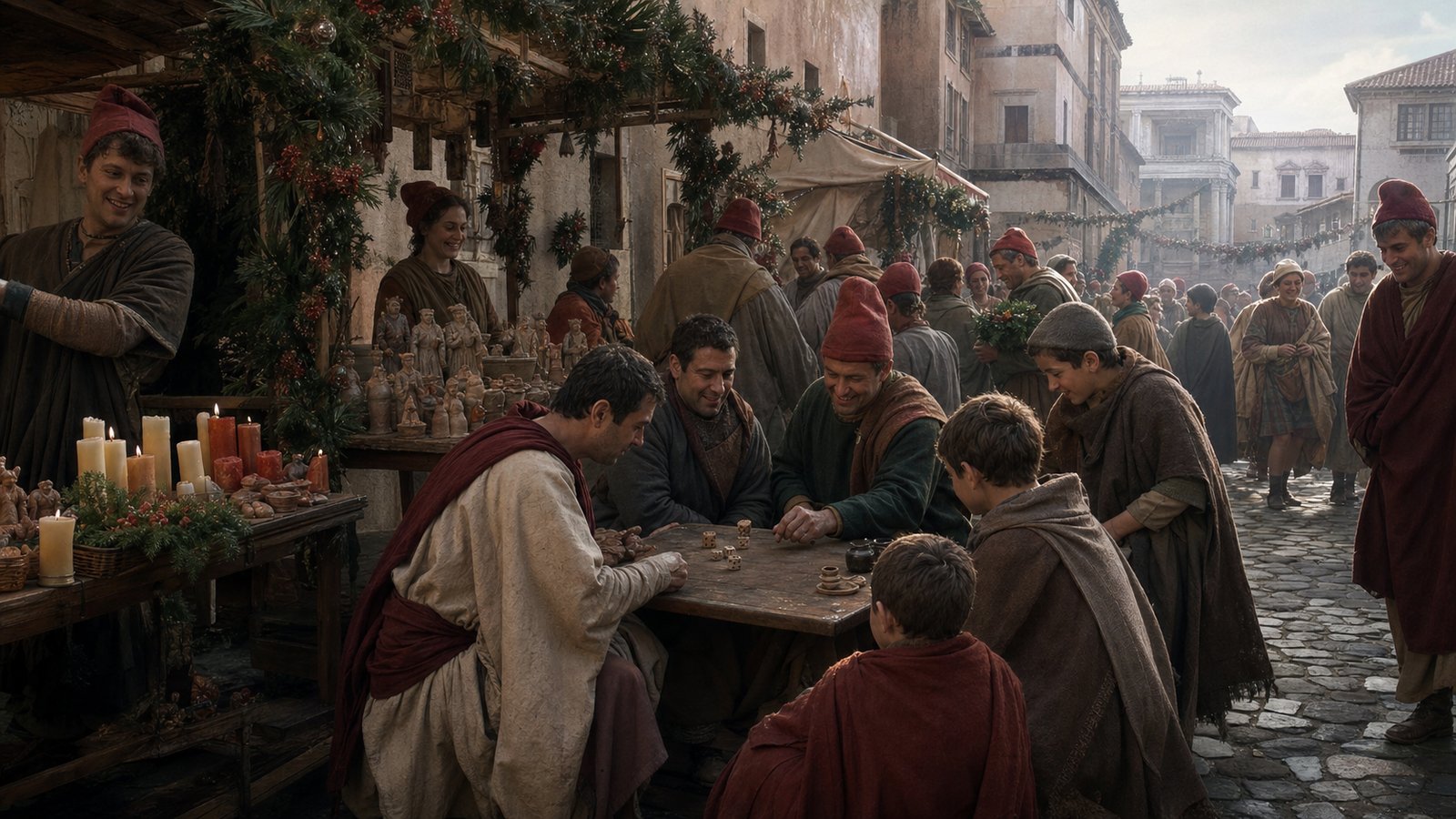
Roman moralists and laws often looked suspiciously at gambling, yet Saturnalia gave dice a festive license. Suetonius even preserves Augustus in the orbit of such seasonal play. Chance was attractive because it briefly humiliated calculation. Rank could not fully command the throw.
That did not make the festival democratic in a modern sense. It made it theatrical. For a few days, luck could sit at the table as a guest. The sound of dice gave Romans a way to laugh at the limits of discipline while still keeping the laughter inside a recognized season.
The pileus hinted at freedom without granting it
The simple cap associated with freedom could appear in Saturnalian imagination, adding another layer of symbolic reversal. Such details are powerful because they touch the nerves of Roman society: slavery, citizenship, manumission, authority, and dependence.
A symbol can be both playful and serious. A cap worn in festival mood did not abolish legal realities. It reminded everyone that Romans understood those realities well enough to joke near them. That closeness is what makes Saturnalia uncomfortable as well as charming.
Disorder strengthened order by being contained
The festival’s paradox is that controlled disorder can reinforce the control it appears to challenge. After Saturnalia, the household resumed its normal grammar. Offices, status, commands, debts, and legal distinctions returned. The temporary exception confirmed the ordinary rule.
This does not mean the festival was fake. People really ate, laughed, gambled, exchanged gifts, and enjoyed relief. The pleasure was real. But the frame was real too. Saturnalia allowed release without letting release become revolution.
Rome needed pressure valves
A city of sharp distinctions needs ways to manage tension. Public festivals, games, processions, and household rituals all helped Rome stage emotions that might otherwise become dangerous or dull. Saturnalia gave the city a sanctioned language for excess.
That is why Saturnalia let Rome practice disorder. It let Romans experience a world loosened from the usual knots, but only long enough to feel the difference. The festival did not overturn Rome. It taught Rome how to turn itself upside down, laugh, exchange gifts, throw dice, and then carefully stand upright again.
The humor worked because the participants understood the normal script. If a master served at table, the joke depended on everyone knowing that this was unusual. If an enslaved person spoke more freely, the charge of the moment came from the fact that speech was normally constrained. Saturnalia borrowed its energy from the order it briefly bent.
This makes the festival morally complicated. It gave relief, but it did not remove the conditions that made relief necessary. A holiday can expose a society’s tensions without solving them. In Rome, the laughter around Saturnalia could be generous, sharp, nervous, and self-protective all at once.
The small objects mattered for the same reason. Candles, figurines, caps, dice, and garlands made the altered season visible. They told people when ordinary expectations had loosened. A visitor did not need a decree explained in detail; the material signs of the festival announced a different mood.
Yet the signs also helped contain the mood. When objects and dates mark an exception, the exception becomes easier to end. The cap can be put away. The dice can be set down. The household can return to its usual grammar. The ritual frame turns disorder into memory instead of permanent change.
This is why Saturnalia remains so revealing. It shows a strict society admitting that strictness needed release. Rome did not forget hierarchy during the festival. It displayed hierarchy, mocked it, sweetened it with gifts, and then restored it with a clearer sense of how much pressure it carried.
The festival also protected memory of a different imagined age. Stories of Saturn’s old reign could make abundance and ease feel ancient rather than subversive. Romans could enjoy the fantasy without having to build a new society from it.
That balance is what made the holiday durable. It allowed laughter near dangerous subjects—slavery, command, status, luck, and freedom—while surrounding the laughter with custom. Saturnalia gave disorder a costume, a calendar, and a way home.
The end of the festival was as important as the beginning. When normal obligations resumed, the temporary freedom became a remembered contrast rather than a new constitution. That return gave the preceding days their edge: everyone had felt a different rhythm, and everyone knew why it could not simply continue.
For a Roman household, that rhythm could be heard in practical details: different voices at dinner, small gifts changing hands, dice clicking on a table, and jokes that would have sounded dangerous in another week. The festival made those details permissible by naming them seasonal.
Sources & Further Reading
- Britannica, Saturnalia
- Macrobius, Saturnalia
- Martial, Epigrams, Book 14
- Smith Dictionary, Pileus
- Suetonius, Augustus, 71
- Ovid, Fasti, 1
- Britannica, Roman law and slavery
- Cambridge Core, Roman Festivals
- Macrobius, Saturnalia, 1.10