
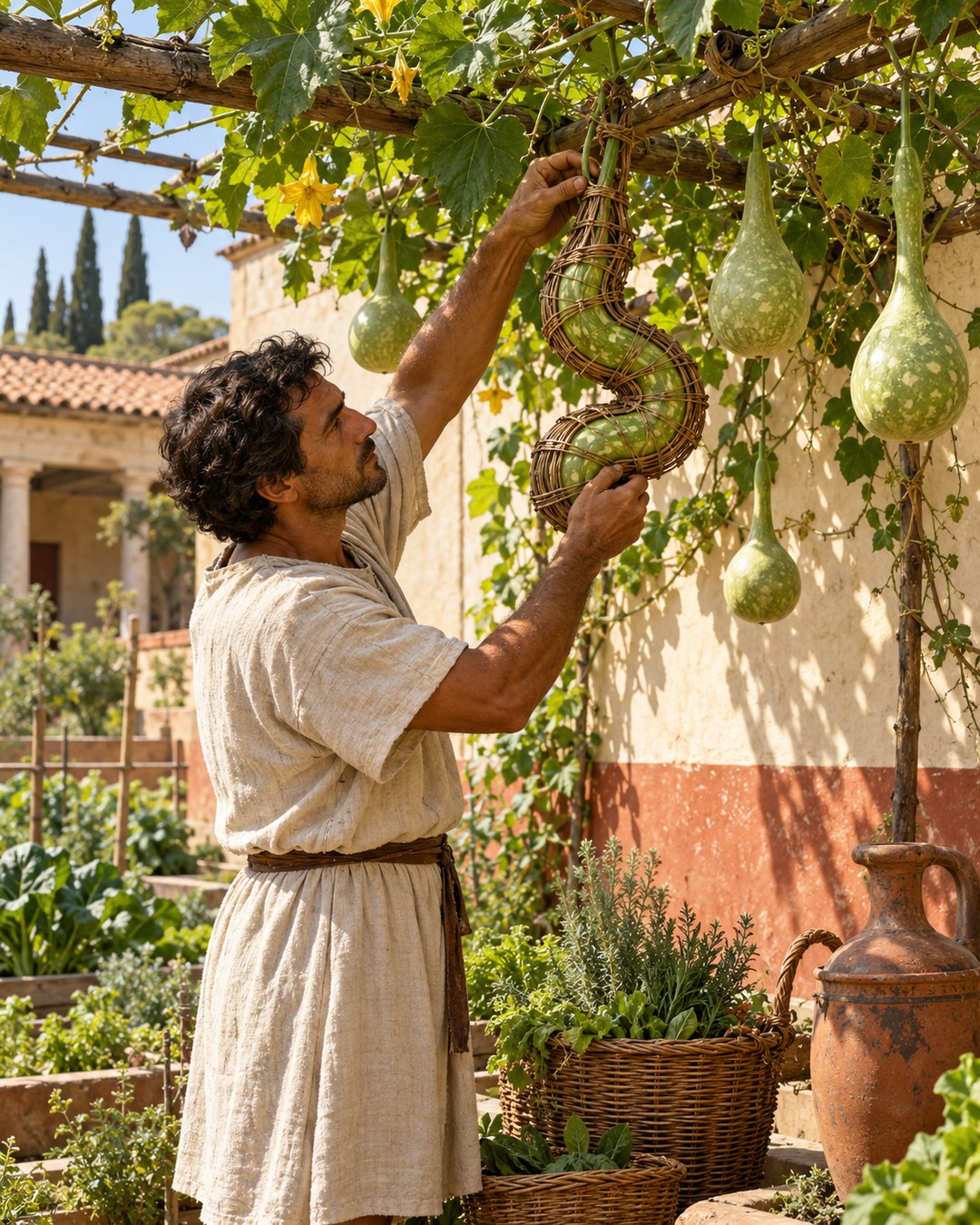
A Roman gardener could make a gourd grow like a coiled serpent. The trick was not carving the ripe fruit. After the blossom fell, the young gourd went inside a sheath of plaited wicker. As it enlarged, the fruit accepted the path laid down around it.
Pliny the Elder’s description is playful enough to sound like garden theatre, but the wicker mould belonged to a larger system of control. Gourds climbed walls and roofs because their stems could not stand alone. Hanging changed their length, flavour, and seeds. Maturity hardened the rind until food could become a jug, jar, or container for the next crop. Shape was only one result of directing growth through time.
A weak climber could cover a roof
Pliny classifies gourds among plants whose ripe rind becomes woody. While growing, however, they were thirsty, tender, and unable to support themselves. They disliked cold and responded to water and manure. Gardeners sowed them in holes about eighteen inches deep between the spring equinox and midsummer.
Pliny offers several calendars. The Parilia was considered especially suitable, while some growers began gourds on March 1 and cucumbers on March 7, continuing through the festival of Minerva. These dates located ordinary garden work inside both weather and civic time.
The deep planting hole, chosen season, water, manure, and protection from cold all came before visible shaping. The spectacular coil depended on routine cultivation succeeding first. A wicker mould could redirect healthy expansion, but it could not rescue a weak vine from poor soil or a badly timed start.
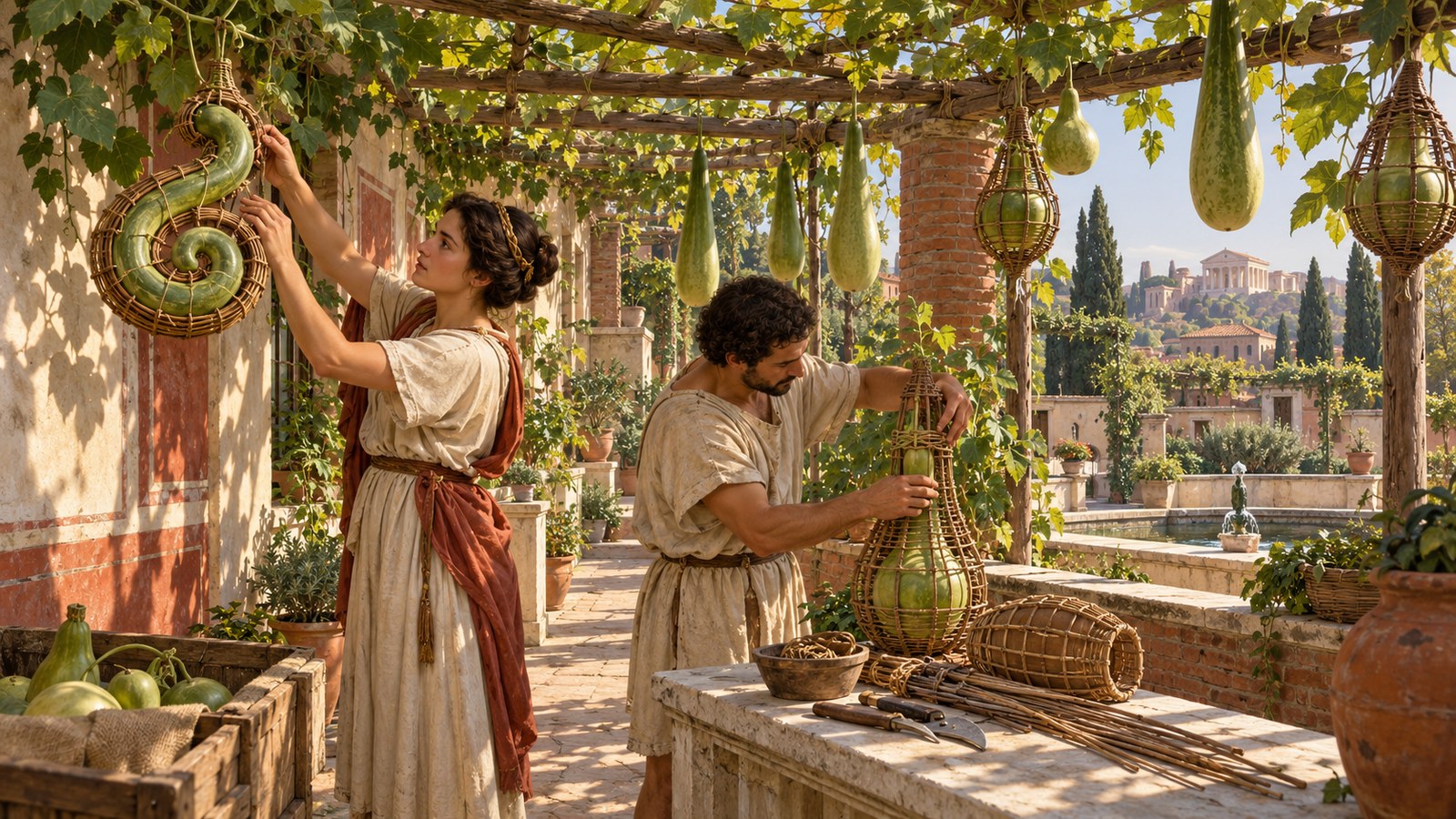
Once established, the shoots climbed rough walls rapidly and could reach the roof. Vines spread across vaulted frames and trellises, producing light shade below. The plant’s weakness and reach were complementary. It could not stand upright by itself, but architecture turned that dependence into height.
Pliny separates roof gourds from those grown along the ground. In the roof type, a surprisingly thin stalk held a heavy fruit that a breeze could not stir. The image records more than size. A fruit suspended overhead experienced gravity, air, and space differently from one resting against soil.
Wicker made growth follow a drawn line
After flowering, a gardener could enclose the developing fruit inside plaited wicker. The sheath did not merely protect it. It forced the gourd into the shape available, often a spiral resembling a coiled serpent. The final object preserved the resistance between expanding flesh and a rigid woven boundary.
This was controlled distortion, not a separate species. Pliny groups gourds with cucumbers in their readiness to accept imposed form. A tube could lengthen a cucumber; a wicker path could bend a gourd. Gardeners understood growth as pressure that could be redirected rather than stopped.
Left free and hanging, a gourd might reportedly reach three yards. That extraordinary length makes the mould easier to understand. A fast-growing fruit offered time and material for intervention. The worker shaped it gradually by managing the space into which it could expand.
The method joined basketry to horticulture. Someone first had to weave a form strong enough to hold its curve, open enough for air, and large enough not to destroy the fruit. The gourd then completed the object from inside. Neither gardener nor plant worked alone.
Hanging altered food before drying altered function
Shape mattered at the table as well as in display. Pliny says longer and thinner gourds were more agreeable to eat. Those left hanging were considered more wholesome and contained fewer hard seeds. Training the vine upward could therefore change the fruit’s culinary value.
Green rind was thin and scraped away before serving. Pliny calls the gourd pleasant and useful in several preparations, although he warns that its rind was not digested. The edible stage occupied a limited interval, after growth but before the shell became fully woody.
Seed selection looked backward into the parent fruit. Seeds nearest the neck were associated with long gourds; those near the bottom also produced length, though less reliably. Seeds from the middle produced round fruits, while side seeds produced thick, shorter ones. Whatever its biological accuracy, the scheme shows gardeners mapping future form onto the interior of a harvested specimen.
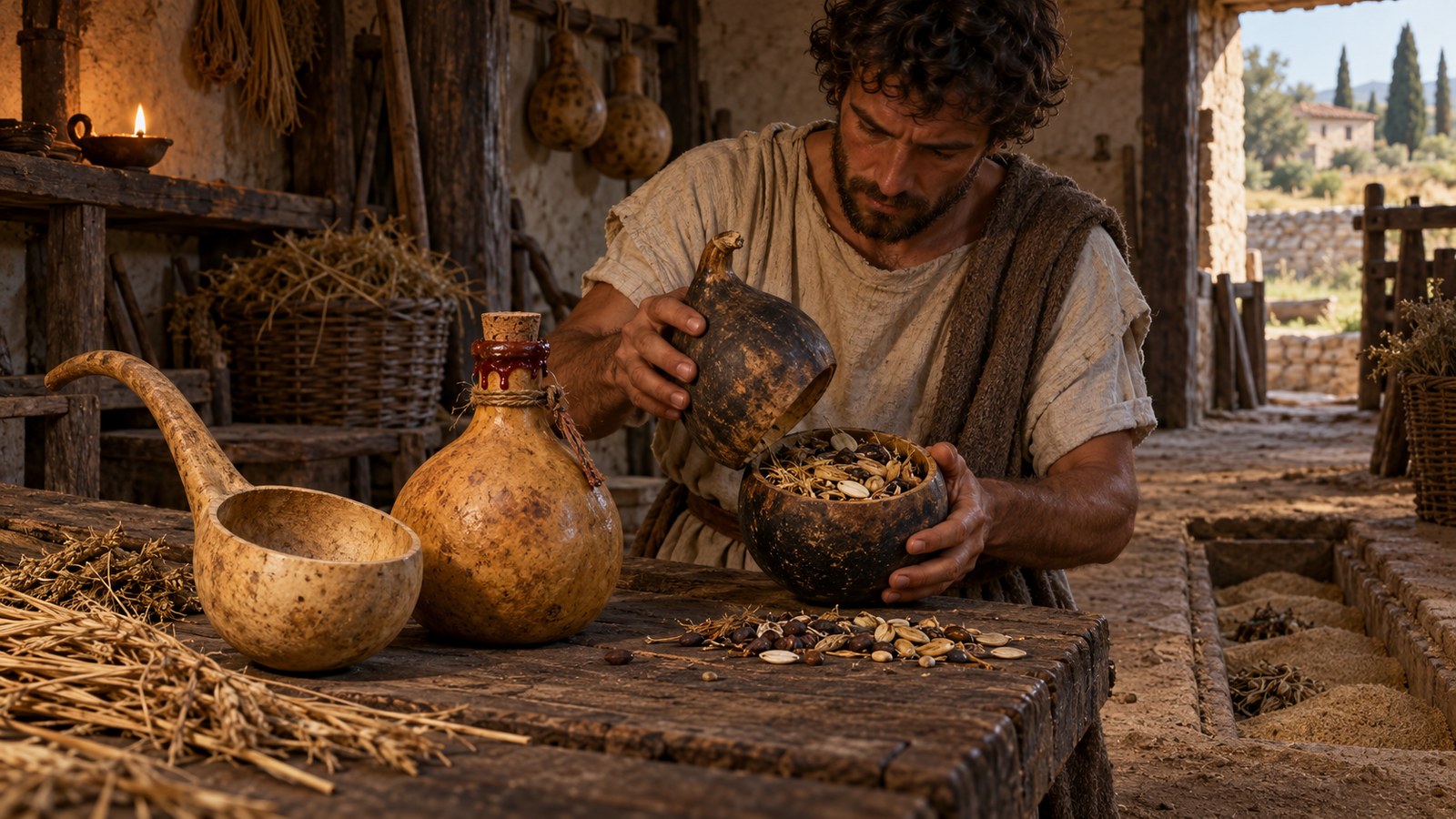
The seed was dried in shade and soaked before sowing. Gourds reserved for seed remained uncut until winter, then were smoke-dried. Their hollow bodies became storage for the farm’s supply of garden seed. One season’s fruit thus held the practical beginning of another.
Waiting until winter separated seed gourds from fruit chosen for immediate cooking. Smoke then supplied a dry environment after the vine had finished its work. The container and its contents were preserved together, keeping a household’s selected planting stock in a form that could be recognized and handled.
This attention to patient selection contrasts with the long experiment in turning wild asparagus into Ravenna’s giant cultivated shoots. One story stretches choice across years; the other locates expected shape inside a single parent fruit. Both reveal Roman gardeners trying to make recurrence predictable.
A mature shell moved from kitchen to bath and cellar
As the rind hardened, the gourd crossed into another category of object. Pliny says gourds had recently begun to replace jugs in baths. They had long served as jars for storing wine. Lightness, a narrow neck, and a woody shell allowed a cultivated fruit to perform work usually assigned to pottery or metal.
The transition did not require a factory separate from the garden. The same decisions that shaped food could prepare a vessel. A hanging gourd tended toward length and fewer seeds. A wicker sheath could create a deliberate curve. Drying removed vulnerable flesh and left a container whose form had been established while alive.
Food preservation followed other routes. Gourds and cucumbers could be held in brine nearly until the next crop. Another method put green gourds in a shaded trench floored with sand, then covered them with dry hay and earth. The layers controlled moisture and temperature without turning the fruit into a dried shell.
Those alternatives reveal several desired futures for one harvest. A gourd might be eaten soon, kept green, selected for seed, smoke-dried as storage, or hardened for liquid. Maturity was not simply ripeness followed by decay. It was a branching point managed through salt, shade, smoke, suspension, and burial.
Roman agriculture often used by-products to solve another part of the farm’s work. The account of olive lees sealing a threshing floor against weeds and ants shows waste becoming maintenance material. The gourd made the shift more visibly: cultivated flesh became durable equipment.
The serpent-shaped specimen may have attracted the eye, but its deeper importance lies in the gardener’s confidence that living material could be instructed. A basket supplied the curve. A trellis supplied height. Gravity supplied length. Smoke, brine, sand, and hay supplied different kinds of survival.
None of these techniques required monumental machinery. Their sophistication came from sequence. The sheath went on after blossom fall. Seed fruit stayed until winter. Paste is irrelevant here; pressure came from growing tissue against woven rods. The right intervention at the wrong stage would fail.
Pliny’s gourd therefore belongs to the history of design as much as food. The gardener did not impose a picture on a dead surface. He built a boundary and waited for growth to fill it. By harvest, the plant had become the record of its supports—and, with enough drying, a tool that could outlast the vine.
Sources
Pliny the Elder, Natural History, 19.22–24.