
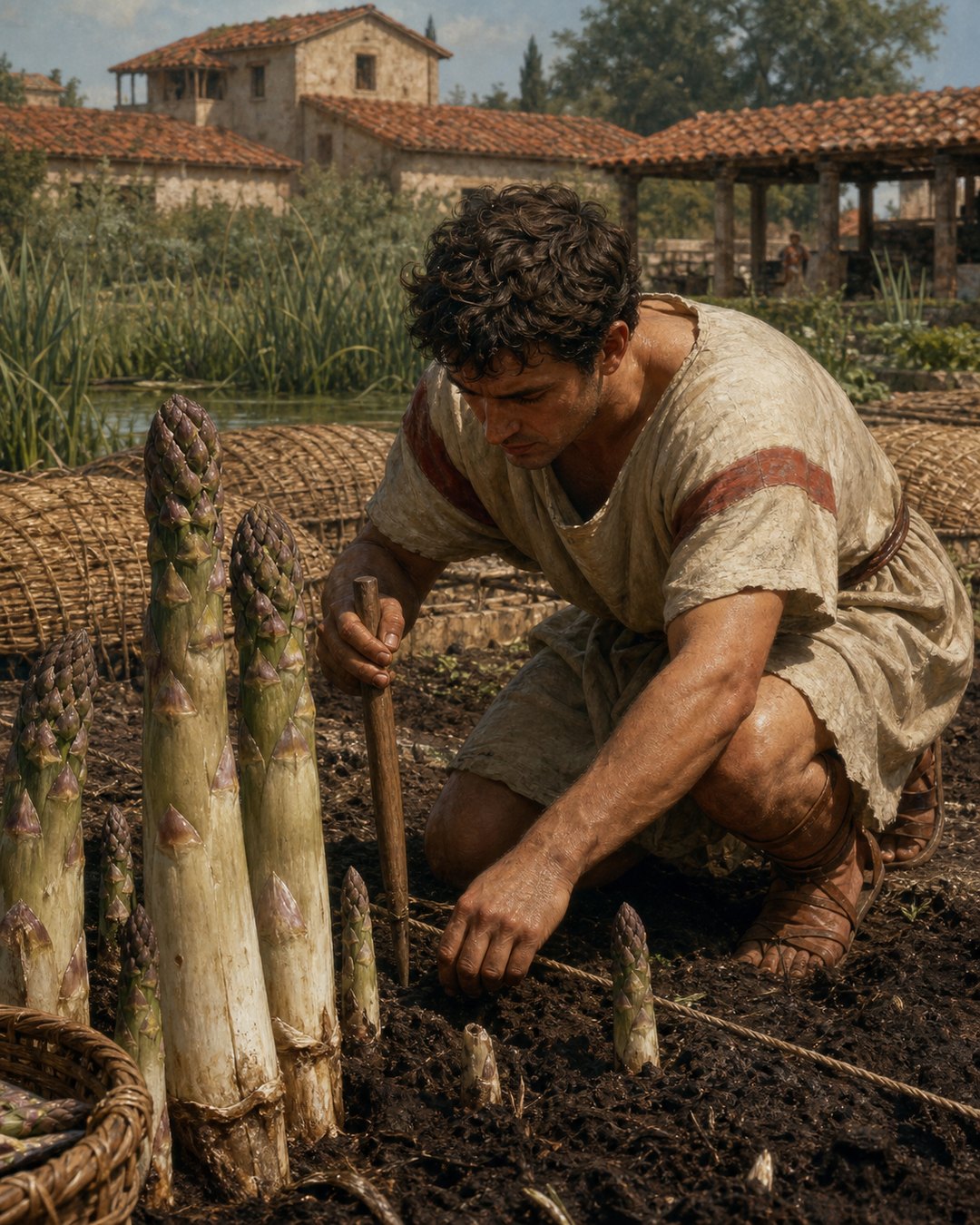
Pliny the Elder begins his account of asparagus with a complaint about appetite. Nature, he says, made the plant grow wild for anyone to gather. Cultivation changed that freedom into a luxury. At Ravenna, the most famous heads were so large that only three made a Roman pound. The boast sounds like a detail from an extravagant dinner, but the cultivation instructions that follow point away from the table and down into the soil.
A Roman asparagus bed asked for years rather than weeks. Cato’s method, preserved and discussed by Pliny, started with damp or heavy ground, seeds placed six inches apart, and two or three seeds dropped into each dibble hole. The grower manured, weeded without tearing up the young plants, covered them with straw for winter, burned the growth in the third spring, and kept harvesting with attention to the hidden crown below. After nine years, the aging plants were lifted, divided and replanted a foot apart.
The remarkable crop at Ravenna therefore belonged to a chain of decisions: where the roots could settle, when the bed could be disturbed, how fire reset old growth, where a knife or hand met the shoot, and when an established planting had to be rebuilt. Pliny’s mixture of moral irritation and practical detail lets us see a familiar vegetable as Roman agricultural infrastructure in miniature.
Three Heads to a Pound Announced a New Kind of Appetite
Before giving instructions, Pliny frames cultivated asparagus as evidence of social division. Wild shoots could be gathered at random, but the garden variety required ownership, labour and delayed reward. He places it beside oversized kale, stored snow and ice, and other foods that wealth had separated from ordinary access. His target is not the plant itself so much as the effort spent making nature answer an expensive appetite.
Ravenna supplies the number that makes the transformation visible. Its cultivated heads, Pliny says, weighed three to a pound. He presents their size as a monstrosity of gluttony, yet the same sentence also preserves the reputation of a growing district. The city’s kitchen gardens had developed conditions and practices associated with an unusually heavy product.
That contrast matters. A wild spear picked during a walk and a giant market head could belong to the same botanical family while embodying different systems of work. Cultivation concentrated attention on the root-clump, standardized the bed, postponed full use and produced a recognizable regional specialty.
The shift recalls Fulvius Hirpinus turning gathered snails into a managed farm. In both accounts, a food available outside formal cultivation becomes the object of enclosure, selection and repeated care. The luxury begins before cooking, in the decision to make a living thing reliably abundant.
Six-Inch Spaces Protected a Crop Hidden Underground
Pliny calls asparagus the cultivated vegetable requiring the most delicate attention. The reason becomes clear when he describes its form. A large mass of roots sits deep below the visible shoot. The green stem emerges thin, lengthens and develops its grooved tip, but most of the plant’s future remains out of sight.
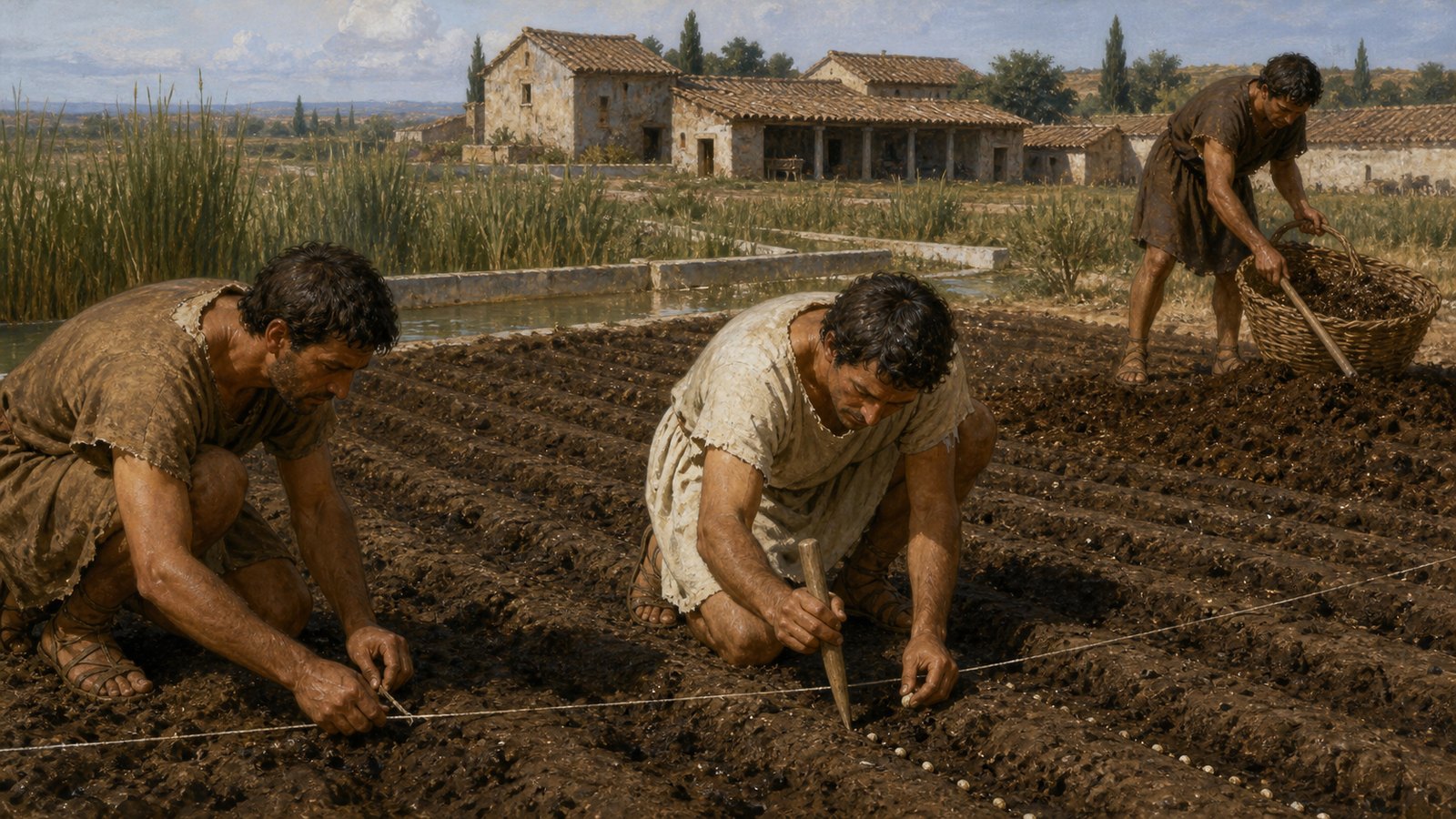
Cato’s seed method tried to protect that future from the beginning. The site should have damp or heavy soil. Seeds went into dibble holes set six inches apart in both directions, with two or three seeds in each hole. The measured pattern kept feet away from the young planting and gave the grower a line to work along without trampling what could not yet defend itself.
Pliny treats Cato’s attention as a sign of novelty. Asparagus is the final subject in Cato’s agricultural book, and no included subject receives more care. Pliny infers that systematic garden cultivation was only beginning to establish itself when Cato wrote. Whether or not every later gardener copied the recipe, the text preserves an early Roman effort to domesticate patience.
The plant could also be propagated by established root-clumps. Pliny’s account moves between seed and crown because the bed was not a single-season patch. Its value accumulated underground. A careless hoe stroke might damage years of future growth before the loss became visible above the soil.
Straw, Dung and Fire Carried the Bed Through Three Springs
Sowing came after the vernal equinox in Cato’s prescription. The new bed needed plenty of dung and frequent cleaning with the hoe, but the work demanded restraint: weeds had to come out without the asparagus coming with them. In the first winter, straw covered the plants. Spring brought uncovering, hoeing and loosening of the bed.
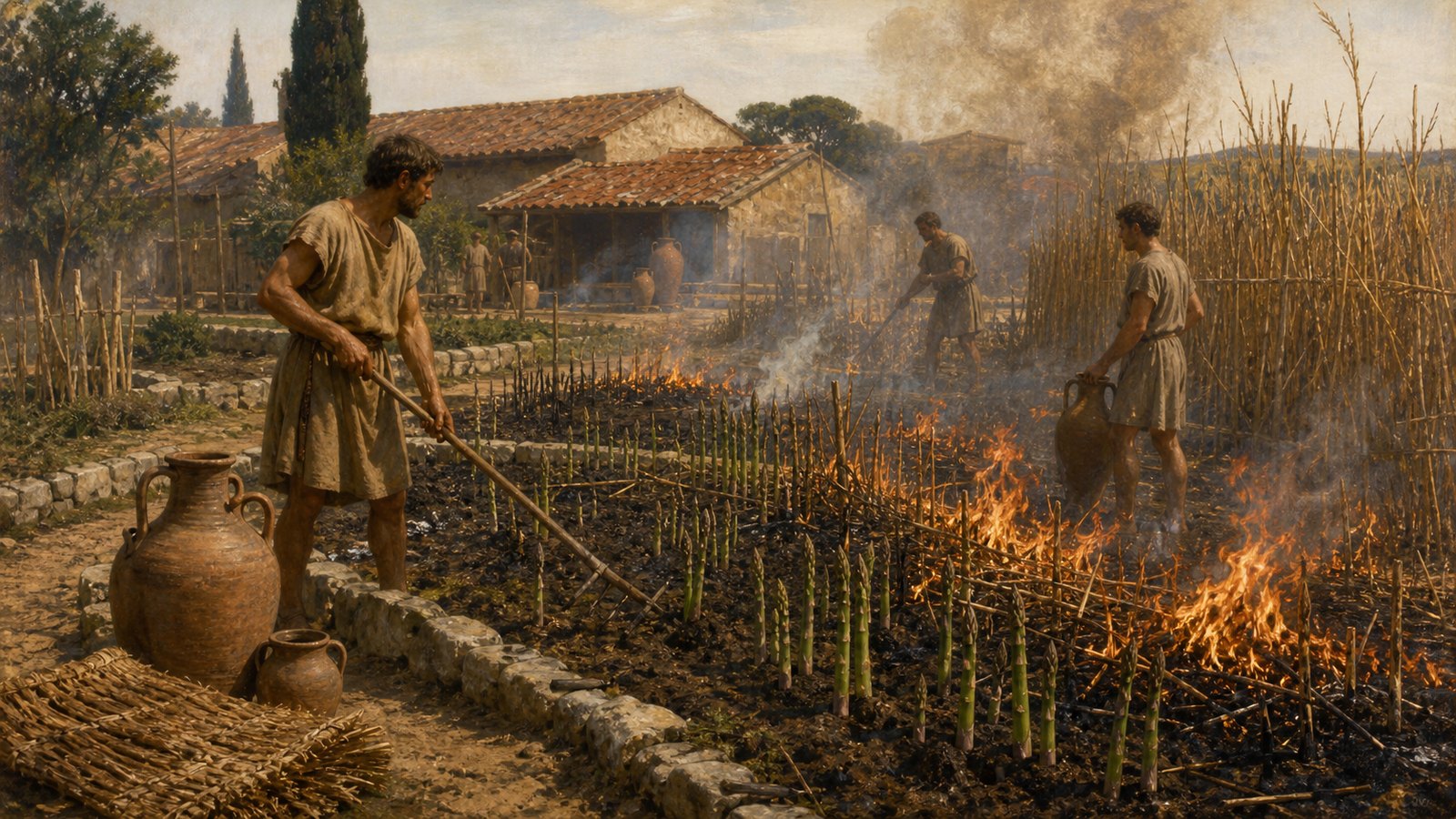
The third spring introduced a more dramatic tool. Cato advised setting fire to the old plants, and Pliny says the earlier asparagus is burned, the better it thrives. Reed-beds suited the crop partly because they burned quickly. Fire removed spent top growth while the established root system remained capable of sending up new shoots.
This was controlled renewal, not field destruction for its own sake. Timing separated useful burning from damage. The grower also avoided hoeing before the spears appeared because unseen roots might be disturbed. Above ground, flame could clear the bed; below ground, iron had to wait until the plant revealed where it was.
Roman cultivation often joined blunt force to fine judgment. fruit-tree grafting joined clay, bark and a careful cut; the asparagus bed joined dung, straw, fire and delayed hoeing. Neither process depended on one ingenious device. Success came from applying ordinary materials in the right sequence.
A Broken Shoot Could Sacrifice the Crown’s Future
Harvesting did not end the need for caution. Cato advised plucking the heads close to the root. If a shoot was merely broken, Pliny says, the plant ran to stalk and died off. The valuable point of contact was therefore near the crown, even though that brought the hand or tool close to the structure that had to survive for later harvests.
Cutting continued until the plants ran to seed. The grower then burned the dried growth and, after the new asparagus appeared, hoed and manured again. Harvest, seed, fire and soil work formed a cycle rather than separate annual jobs. The bed paid back its establishment only if repeated gathering did not exhaust the organism producing the spears.
Pliny also records a later adjustment to Cato’s seed method. Growers soaked seed in dung so the roots intertwined into tufts, then planted those tufts a foot apart after the autumn equinox. The change did not abandon the long-lived crown. It tried to manufacture a transplantable one more deliberately.
Sheep dung received a specific recommendation because other manure encouraged weeds. That detail brings the garden’s competition into focus. Fertility could strengthen the crop and its rivals at once. Choosing manure, like choosing the moment to hoe, meant managing everything else that wanted the same patch of soil.
The Ninth Year Did Not End the Crop—it Rebuilt It
Cato’s clock reached its longest named interval after nine years. By then the plants were old. The remedy was not simply to abandon the bed, but to separate the crowns, work and manure the ground, and replant the tufts at one-foot intervals. A productive patch could be renewed by dismantling the underground community that had made it productive.
Pliny says those replanted crowns could continue bearing for ten years. The claim turns asparagus growing into a generational plan within a garden. A worker might sow, protect and burn a bed, harvest it across many seasons, then reorganize the old roots for another long run. The large spear on a plate compressed that calendar into a mouthful.
Ravenna’s soil appears at the end as asparagus’s favourite kitchen-garden ground. Pliny does not provide a modern agronomic experiment or an accounting ledger, and his moral language should not be mistaken for one. What he gives is a chain of observed or inherited practice associated with a famous result: deep roots, close measurement, winter cover, spring fire, clean harvest and periodic division.
The three-head pound was thus more than a joke about rich diners. It measured how far cultivation had moved the plant from anonymous wild growth. Pliny wanted readers to notice the appetite that demanded such asparagus. His instructions let us notice the gardeners who spent nine years making it possible.