
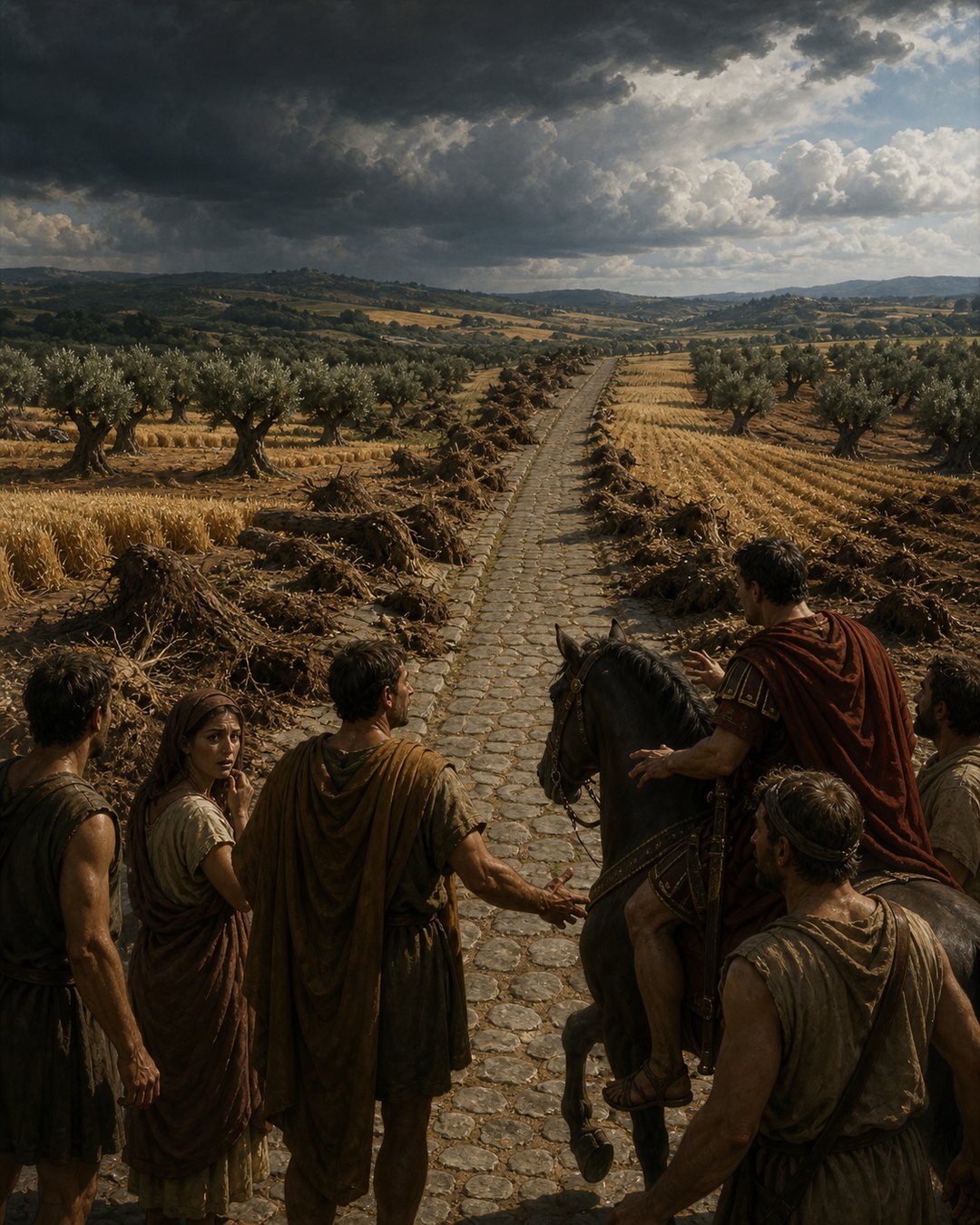
Near the end of his discussion of tree diseases, Pliny the Elder records an event that defeats ordinary gardening language. In the territory of the Marrucini, he says, an entire olive grove belonging to the equestrian Vettius Marcellus crossed a public road. The crops on the opposite side crossed back and occupied the grove’s former place. Pliny dates the exchange to the fall of Nero.
He calls it a prodigy that would eclipse everything previously heard. Yet the moving grove does not stand alone as an isolated wonder. It closes a carefully arranged catalogue: figs growing beneath leaves, fruit appearing on trunks, trees changing colour or species, a fig springing from a laurel, a palm on Jupiter’s altar, and a tree near Cumae sinking into the earth before civil war. Some phenomena are labelled accidents, some ordinary changes, and some portents only when their direction, location or timing made them ominous.
That sequence is the real story. Pliny writes natural history, but his trees inhabit civic space and historical memory. An abnormal branch can remain horticulture; a palm on the Capitol can announce victory; an olive grove crossing a public road at an emperor’s fall can become the climax of an age. The text shows Romans not simply seeing signs everywhere, but arguing through categories about when nature’s irregularity became public meaning.
Tree Disease Opened the Door to Political Memory
Pliny reaches prodigies after listing injuries, rival plants and diseases. Shade, dense foliage, ivy, mistletoe and competing roots can damage trees. That practical context matters because marvels enter a chapter already concerned with departures from healthy growth. The extraordinary is introduced beside diagnosis, not in a separate book of ghost stories.
His first examples stay close to morphology. Figs have appeared beneath leaves. A vine and a pomegranate have borne fruit on the trunk rather than a branch. A vine has carried grapes without leaves, and olives have remained after a tree shed its foliage. These are surprising arrangements of familiar parts.
Pliny distinguishes marvel from portent. An olive can revive after being burned, and fig trees gnawed by locusts can bud again. Trees can change from black to white, especially when raised from seed. He explicitly says such changes do not always have portentous meaning. Observation requires sorting before interpretation.
That hesitation separates his catalogue from the formal handling of omens before Roman battles. Military auspices belonged to institutions and decisions. Pliny’s tree chapter begins with physical anomalies, then shows historical storytellers attaching some of them to public events.
A Better Tree Becoming Worse Made Change Ominous
Direction could turn botanical change into a warning. Pliny treats sour fruit appearing on a sweet tree, or sweet on sour, as portentous. He calls it serious when a cultivated tree changes into an inferior wild form: an olive into a wild olive, or a white grape or green fig into a black variety.
The category is not modern genetics or plant pathology. It is a hierarchy of useful, cultivated and valued forms. A change read as decline carried a moral shape before any interpreter attached it to a named war. The tree seemed to move downward through a human ranking of nature.
Place and arrival supplied another kind of meaning. At Laodicea, Pliny says, a plane tree changed into an olive when Xerxes arrived. The transformation became historical because it coincided with the presence of a ruler. The tree’s identity and the political moment were remembered together.
Pliny points readers to entire authorities full of such material. Aristander’s work teemed with Greek prodigies, while Gaius Epidius collected Roman cases, including trees that spoke. Natural history here preserves a map of earlier testimony. Pliny does not say he watched the trees. He shows how reports accumulated, were attributed and entered learned memory.
A Sinking Tree Sent Readers to the Sibylline Books
Before the civil wars of Pompey the Great, a tree in the territory of Cumae was said to sink into the ground, leaving only a few branches visible. Its movement was vertical rather than across a road, but it already joins landscape, political crisis and an image of order disappearing beneath the earth.
Pliny says a statement was found in the Sibylline Books: the event portended human slaughter, and slaughter would be greater the nearer such a sign occurred to Rome. The archive of dangerous prophecy gave the local anomaly a scale. Distance from the city became a measure of threatened bloodshed.
This is a different angle on the fifteen priests who guarded Rome’s Sibylline collection. The books did not simply predict a named future in advance. In Pliny’s telling, consultation supplied an interpretive statement through which an already reported prodigy could be connected to collective danger.
The Cumae tree also prepares the reader for the walking grove. Both violate the expected stability of rooted life. Both are fixed to crises of Roman power. By placing them late in the sequence, Pliny escalates from misplaced fruit to landscape behaving as though the earth itself had entered history.
The Capitol Turned Stray Growth into a Civic Sign
Some prodigies depended on growing in the wrong place. Pliny mentions trees appearing on statues and altars, and one species growing on another. At Cyzicus before a siege, a fig grew on a laurel. At Tralles during Caesar’s civil wars, a palm rose from the pedestal of the dictator’s statue.
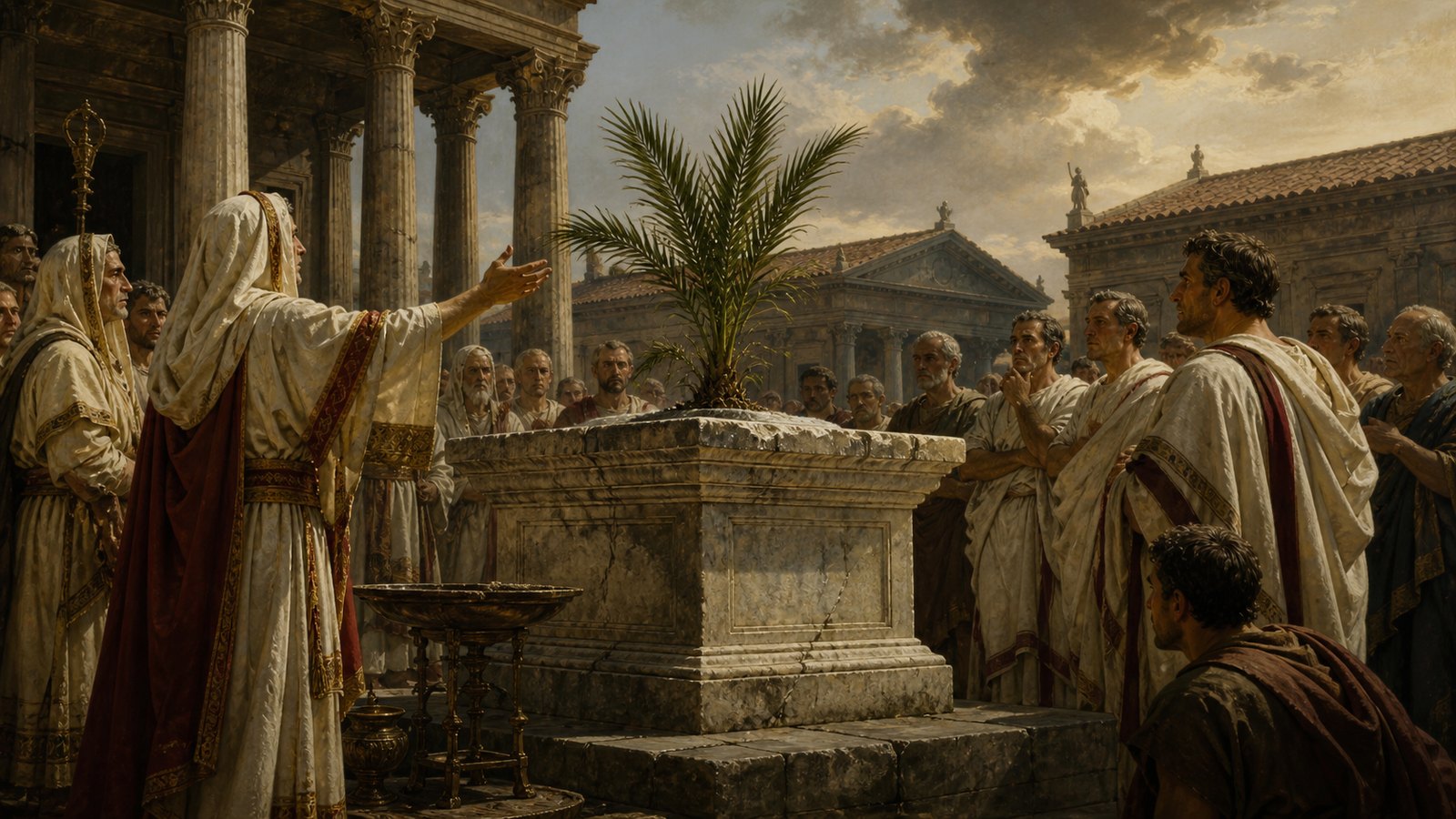
Rome’s Capitol supplied an even denser sequence. During the war with King Perseus, a palm grew on the altar of Jupiter. It was taken to portend victory and triumphs. When storms later brought the palm down, a fig tree sprang up in the same place.
Pliny attaches the second growth to the censorship of Marcus Messala and Gaius Cassius. Citing Piso, he says that period dated the overthrow of the sense of honour. A species change on an altar became a moral chronology: triumphant palm gave way to fig, and political memory supplied a story of decline.
The altar mattered as much as the plant. A seedling in a ditch might remain a curiosity. The same growth in Jupiter’s sacred civic centre demanded interpretation because it occupied a place already charged with Rome’s relationship to divine protection and victory. Location turned botany into public speech.
The Walking Grove Closed the Catalogue by Crossing Every Boundary
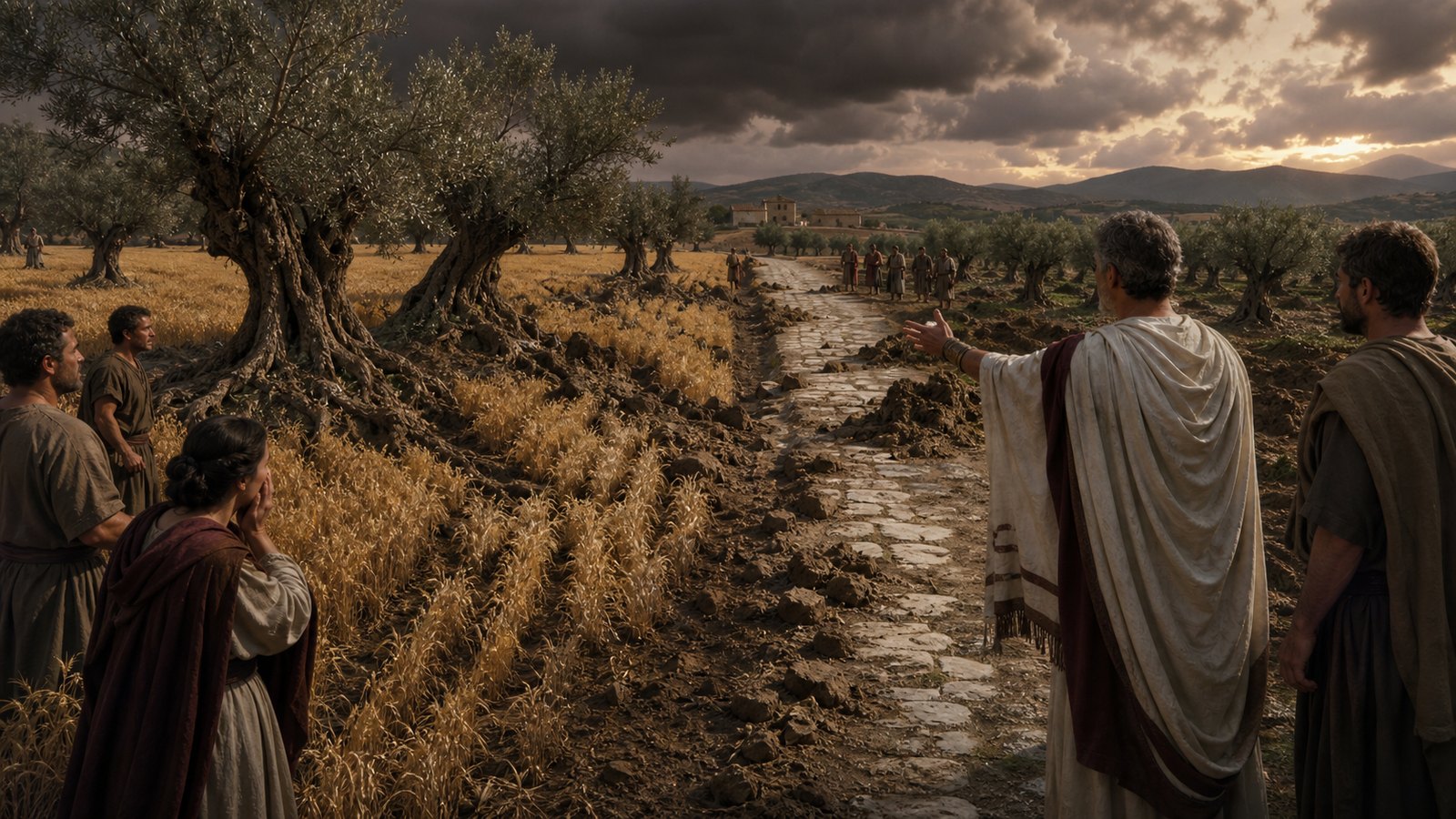
Pliny saves his strongest claim for his own era. In the territory of the Marrucini, an olive grove owned by Vettius Marcellus, a leading member of the equestrian order, crossed the public highway. Crops on the other side crossed in the opposite direction and took its place. He sets the event at Nero’s fall.
Every detail increases the violation. This was not one fruit in an odd position but an entire grove. The owner was named and socially placed. The boundary crossed was a public road, a durable line through property and movement. The exchange was reciprocal, as though two cultivated landscapes deliberately changed estates.
Pliny offers no mechanism, measurements or eyewitness chain. That absence should govern how the story is repeated. Natural History is evidence that Pliny transmitted the claim and ranked it above earlier prodigies, not evidence that a modern observer must accept a migrating root system. Its historical value lies in the architecture of the report: named proprietor, precise region, public boundary and imperial rupture.
Nero’s fall gave the movement its final force. An emperor had lost his place, and the countryside was remembered as losing its place too. The grove’s impossible journey mirrored a world in political transfer without Pliny needing to state an explicit interpretation.
By the end of the chapter, the difference between marvel and omen is visible. Nature can recover from fire, change colour or fruit strangely without announcing history. A prodigy emerges when an anomaly is ranked as decline, planted in sacred or civic space, linked to an interpretive archive, or synchronized with crisis. The olive grove crossed a road in Pliny’s sentence because it had already crossed the boundary between horticulture and Roman memory.