
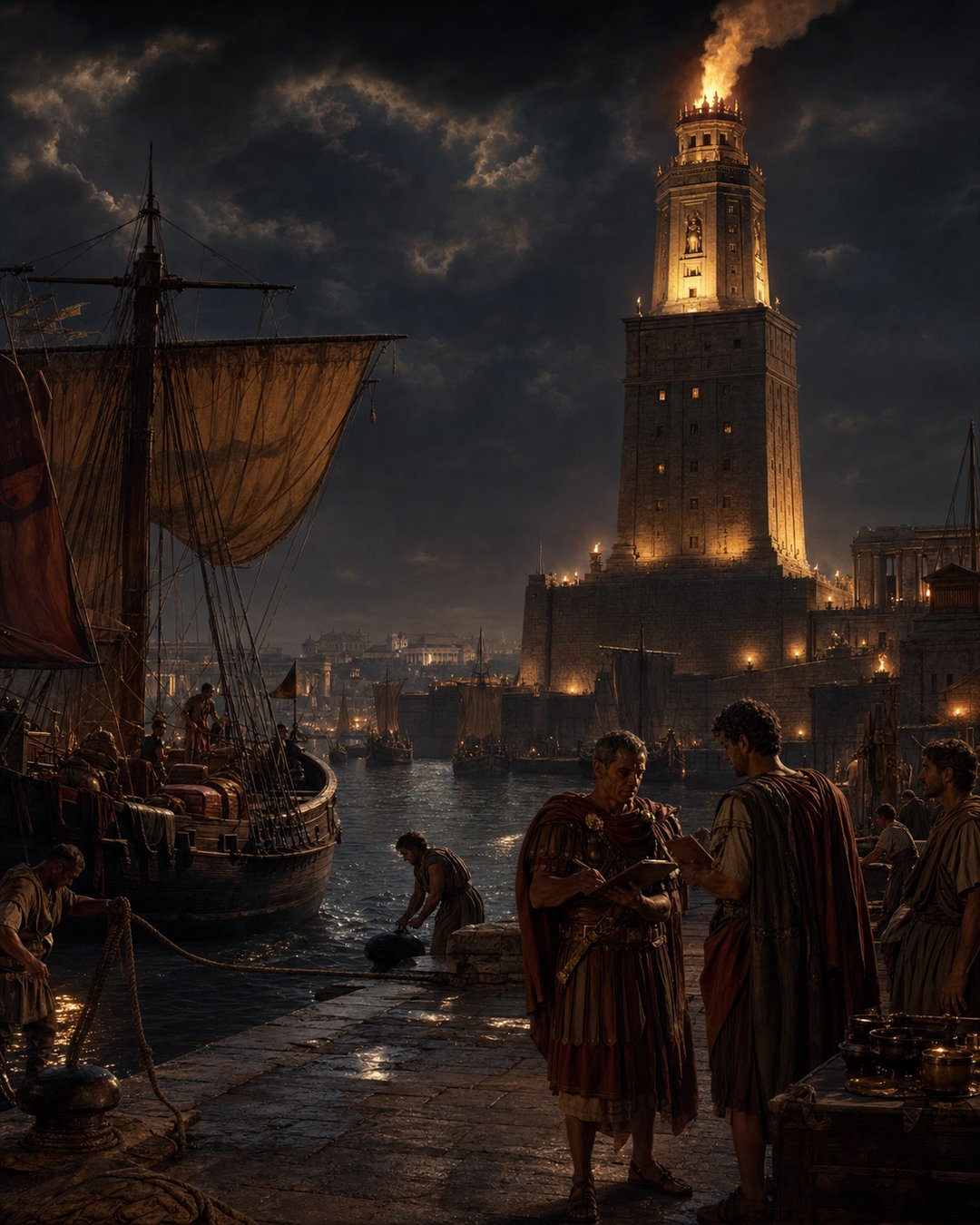
A lighthouse is a simple idea only from a safe distance. Raise a fire where sailors can see it, and the coast becomes less mysterious. But in the Roman world, that raised light did more than help ships find harbor. It made the sea feel watched, expected, and partly governed.
Roman power did not end at the shoreline. Grain, oil, wine, soldiers, letters, officials, merchants, and taxes all depended on crossings that could fail in darkness or weather. A beacon could not command the wind, but it could turn arrival into something more legible. It told a ship that the harbor was not only a place. It was an institution.
The dangerous moment was arrival
Open water was frightening, but the coast could be just as dangerous. Reefs, shoals, currents, crowded approaches, harbor walls, and darkness all made the final part of a voyage tense. A ship that had survived the sea still had to enter the right place safely.
This is where a lighthouse mattered. It gave sailors a fixed point when everything else moved: water, sail, cloud, fear, and human judgment. The light did not remove risk. It organized risk. It made the approach to harbor a shared visual problem instead of a private guess in the dark.
The Pharos turned guidance into monument
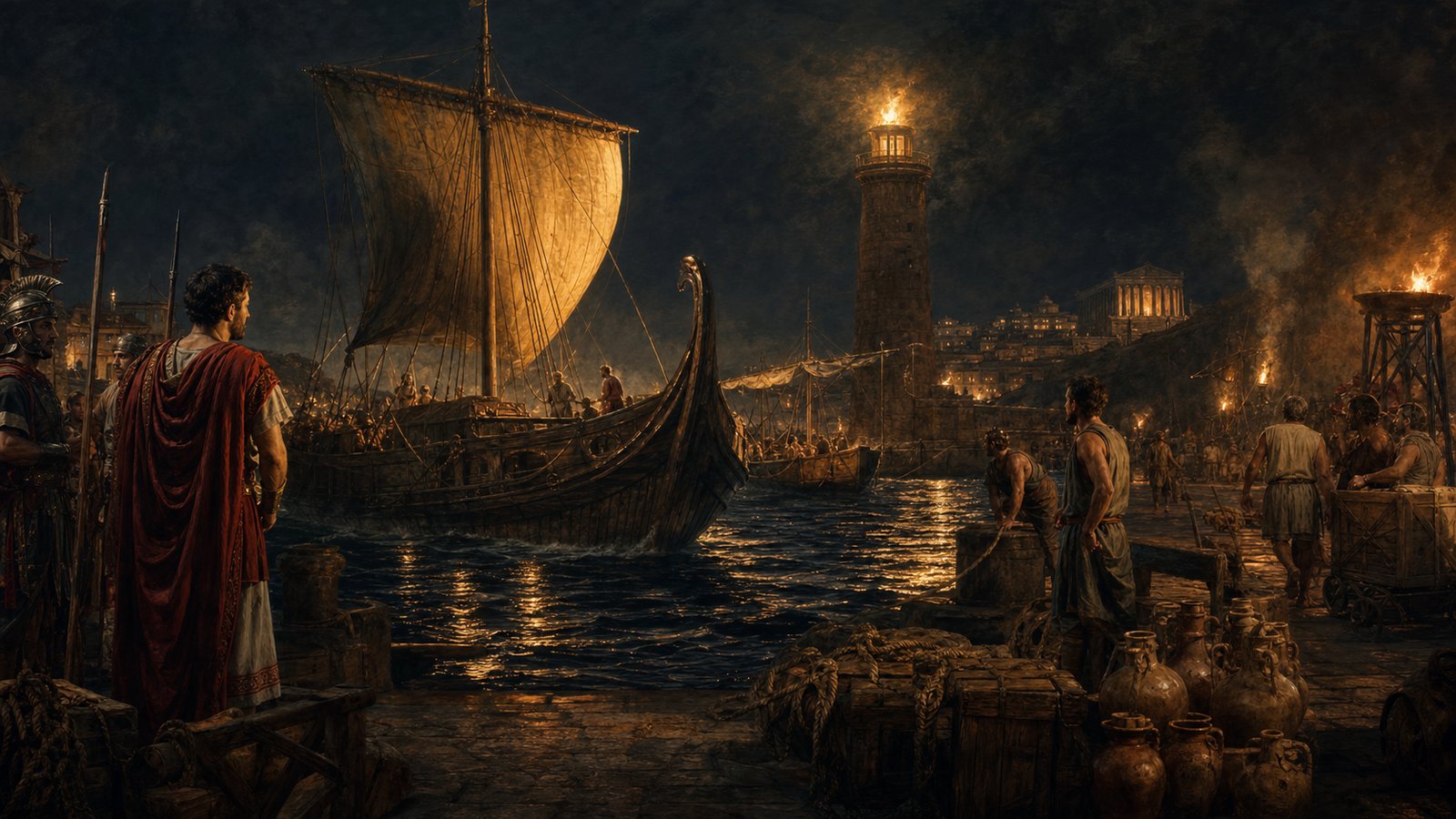
The most famous ancient example was the Pharos of Alexandria. Strabo describes the island and tower as a landmark useful for ships approaching Alexandria, and later memory turned the structure into one of antiquity’s great wonders. Its fame came from more than height. It joined practical navigation to royal and urban display.
That combination is important. A tower that guides ships also advertises the city that built and maintained it. The flame says, come this way. The masonry says, someone powerful expected you to need this help. The harbor becomes a theater of arrival, with the state or city visible before the quay is reached.
A beacon made commerce feel repeatable
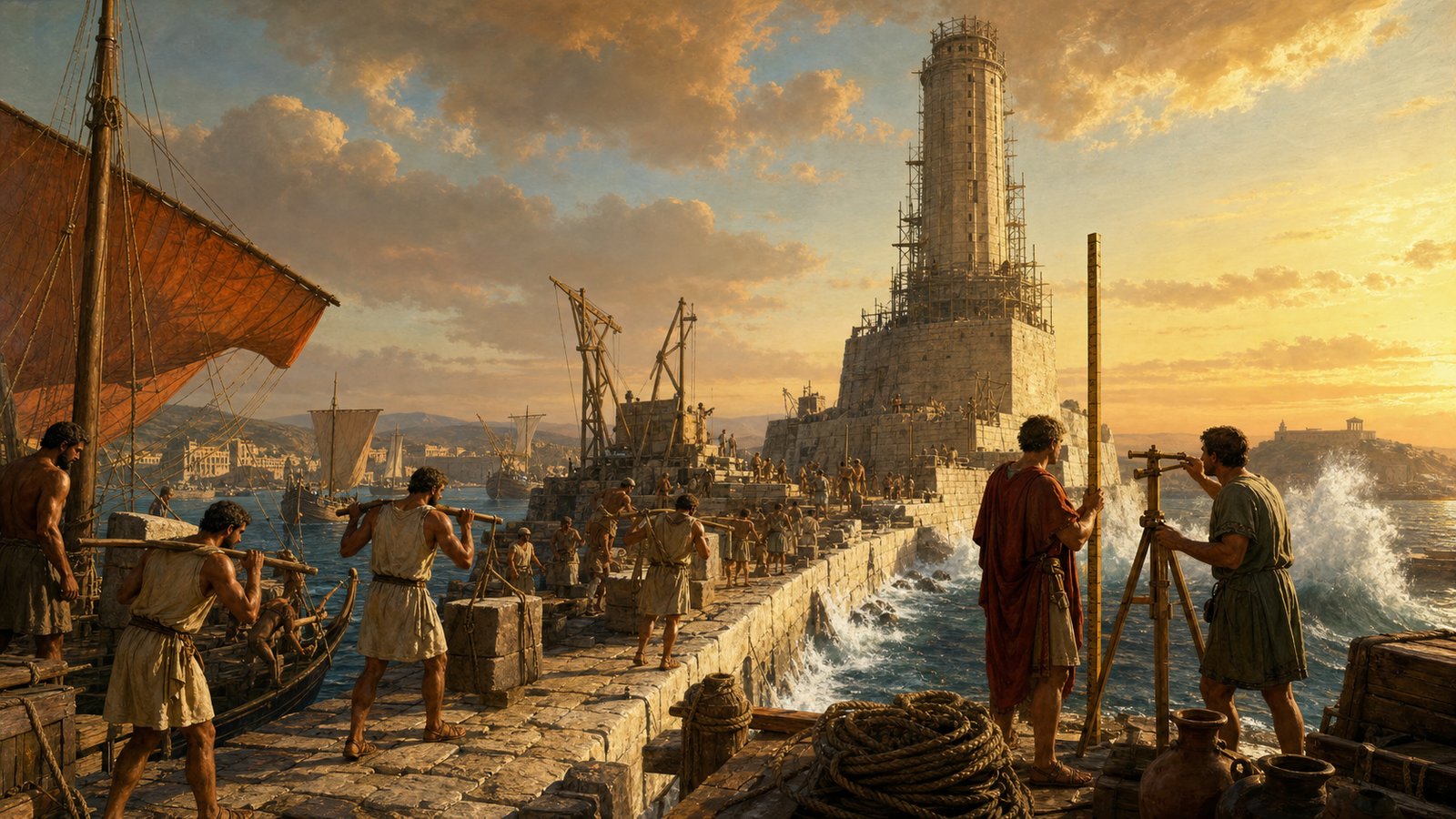
Mediterranean trade depended on repeated arrivals, not heroic one-time voyages. Grain fleets, merchants, oil cargoes, and passengers needed ports that could be found again and again. A lighthouse helped create that repetition by giving movement a recognizable end point.
That mattered for Roman supply. Rome’s appetite reached far beyond its fields, and maritime cargoes had to pass through systems of port, warehouse, road, river, official attention, and private profit. A beacon at the edge of that system made the first promise: the route has a receiving point.
Harbor architecture spoke the same language
Lighthouses belonged with moles, quays, warehouses, basins, cranes, customs spaces, and roads. At Ostia and Portus, maritime movement was translated into storage, accounting, and inland transport. The beacon was only one element, but it announced the whole grammar of managed arrival.
Imagine a night approach: a dark hull rising and falling, wet rope in a sailor’s hand, the smell of pitch and salt, a light above the harbor wall, and men waiting near warehouses with tablets and lamps. That scene is not romantic decoration. It is the empire as routine logistics.
The Tower of Hercules shows the idea’s durability
At A Coruña, the Tower of Hercules preserves the memory of Roman lighthouse building in a particularly concrete way. UNESCO recognizes it as a Roman lighthouse, later restored but still rooted in ancient coastal signaling. Its survival matters because it turns the abstract idea of maritime infrastructure into stone still standing by the Atlantic.
The tower reminds us that Roman reach was not only Mediterranean in imagination. Coastlines, promontories, Atlantic routes, and provincial harbors all could be made more usable by visible markers. The edge of the empire was not always a wall. Sometimes it was a light.
A lighthouse did not conquer the sea
The Roman state could not make storms obedient. It could not abolish shipwreck, piracy, bad judgment, or rotten timber. Lighthouses should not be treated as magic machines that made travel safe. Their importance was subtler: they reduced uncertainty at crucial points.
That reduction was political. A government, city, dynasty, or port authority that maintained a beacon participated in every successful arrival it helped make possible. Sailors might curse the weather, praise the gods, and bargain with merchants, but the built light still entered the chain of trust.
The sea became part of administration
Roman administration often worked by making movement repeatable. Roads made land routes legible. Milestones measured distance. Ports gathered cargo. Lighthouses did something similar at the watery threshold. They turned a dangerous edge into a managed approach.
That is why Roman lighthouses made the sea feel governed. They did not tame the Mediterranean or Atlantic by force. They marked places where human order reached into darkness, where a flame told sailors that beyond the waves stood a harbor, a warehouse, an official, a market, and a city waiting to turn arrival into Roman business.
The strongest evidence is not only literary admiration for famous towers, but the physical logic of repeated use. A beacon had to be fed, repaired, seen, trusted, and interpreted by people whose cargoes mattered. Its value grew every time a captain used it to align ship and shore.
There is a human humility in that. Even an empire that carved roads through mountains and built arches for victory still needed a fire in the night. Roman power became durable partly because it admitted practical dependence: on sightlines, maintenance, local knowledge, and ordinary sailors who could read a light correctly.
The lighthouse therefore belongs beside roads and aqueducts as infrastructure of expectation. It made movement feel less accidental. A ship still had to arrive, but the harbor was no longer silent darkness. It spoke through flame, stone, and repetition, and that speech made the coast part of a governed world.
A beacon also changed responsibility. If a port raised and maintained a light, it implied that arrival was not left wholly to luck. Someone had chosen the site, supplied fuel, watched the structure, and cared enough about traffic to make darkness less absolute. That care could serve merchants, officials, soldiers, tax collectors, and hungry cities at the same time.
The result was a kind of coastal confidence. Sailors still prayed, captains still judged, and storms still punished mistakes, but the harbor announced itself before the ship touched land. Roman order often worked in exactly this way: not by eliminating danger, but by placing useful signs, structures, and routines at the places where danger became predictable.
That is the quiet power of a lighthouse. It turns a hostile edge into a known approach and makes every successful arrival feel less accidental. In the Roman world, that mattered because ships carried more than cargo. They carried proof that distant places could be connected again tomorrow.
Sources & Further Reading
- World History Encyclopedia, Lighthouse
- Britannica, Pharos of Alexandria
- Strabo, Geography, 17.1.6
- Britannica, Alexandria
- UNESCO, Tower of Hercules
- Ostia Antica, warehouses
- World History Encyclopedia, Ostia
- Pliny the Elder, Natural History, 36
- Cambridge Core, Trade in the Ancient Mediterranean