
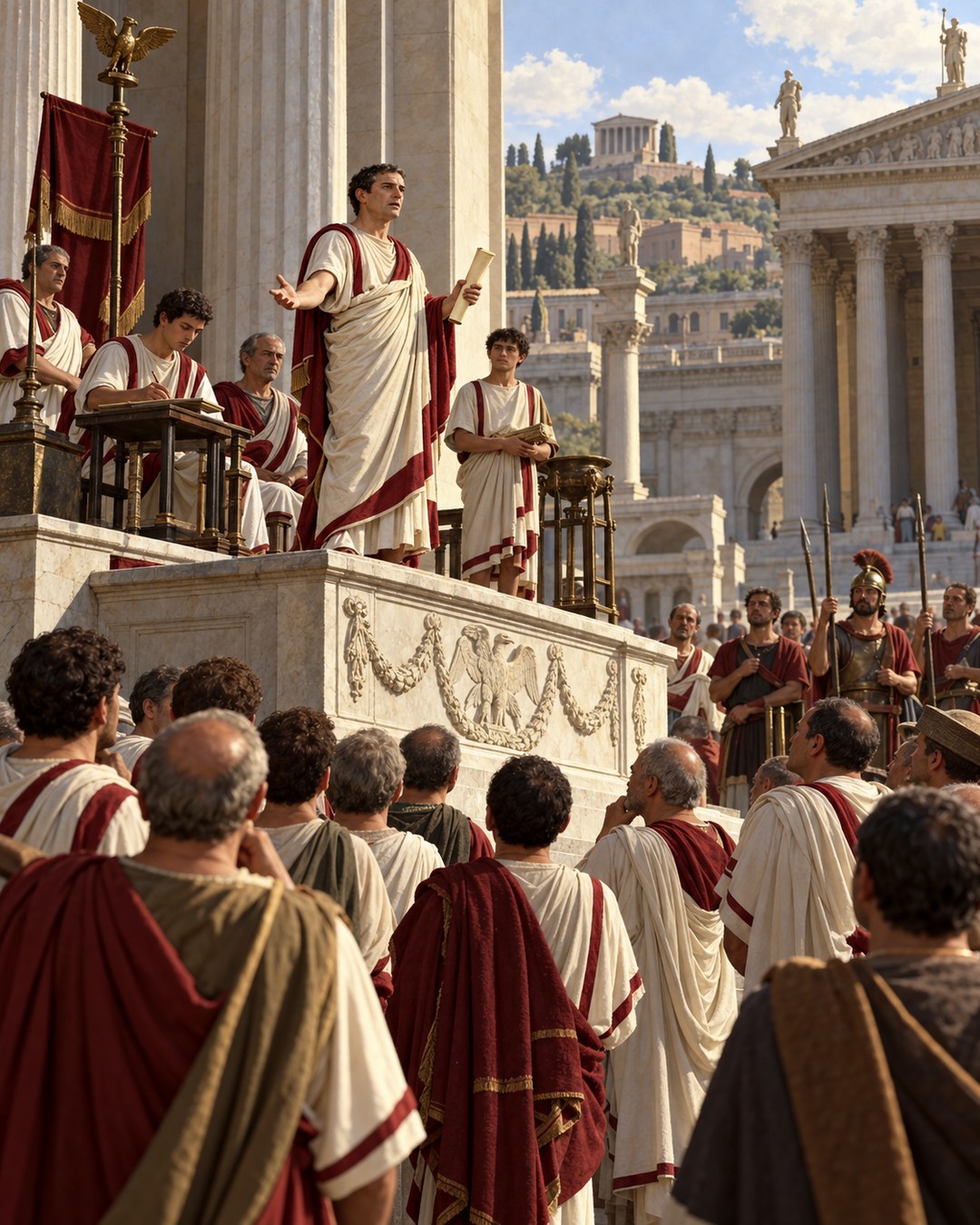
Before a Roman measure became law, someone had to ask a question. Aulus Gellius treated that proposal—the rogatio—as the source of the whole legislative process. The people or the commons answered, and only then could an enactment exist.
Yet the answer’s proper name depended on more than approval. The jurist Ateius Capito defined a law as a general decree. A measure governing the community could be a lex; one adopted specifically by the commons was a plebiscitum; one aimed at an individual was more precisely a privilegium.
Roman political language did not always obey those clean divisions. Old records used the terms loosely, and even Sallust called an individual measure a law. Gellius’s chapter is therefore not a fixed glossary. It is a map of how a proposal moved through an assembly—and of how technical vocabulary yielded to public habit.
The magistrate’s question began the process
Gellius asked what four words meant: lex, plebiscitum, rogatio, and privilegium. They could all appear around public decisions, but they did not identify the same stage, audience, or scope.
The most basic term was rogatio. Gellius called it the head, origin, and fountain of the process. A magistrate put a proposal to the people or to the commons. Without that act of asking, neither body could pass a decree.
The word therefore described the procedural beginning rather than automatically naming the finished rule. It could concern everyone or one person. It could be addressed to the full people or to the commons. What united those possibilities was the question placed before a voting body.
That sequence kept three issues separate. First came the proposer, a magistrate able to address the assembly. Next came the audience, either the people in Capito’s inclusive sense or the commons without patrician families. Last came the reach of the answer, general or individual. Gellius’s vocabulary becomes clearer when those three questions are asked in order rather than compressed into the single modern word “law.”
This made Roman legislation responsive in grammatical form. The magistrate did not merely announce that a measure existed. He asked for authorization from a defined assembly. The resulting category depended on who answered and what the proposal covered.
Gellius does not provide a ballot procedure or a scene of a particular vote in this chapter, so those details should remain outside the reconstruction. His evidence is conceptual: public action began with a formal appeal, and the appeal made the later enactment possible.
That emphasis differs from Pliny and Trajan’s exchange about provincial trials, where an official question moved upward to an emperor and a written response guided administration. Here the question moved from a magistrate to a civic body whose answer created a public decree.
A general rule met Capito’s definition of law
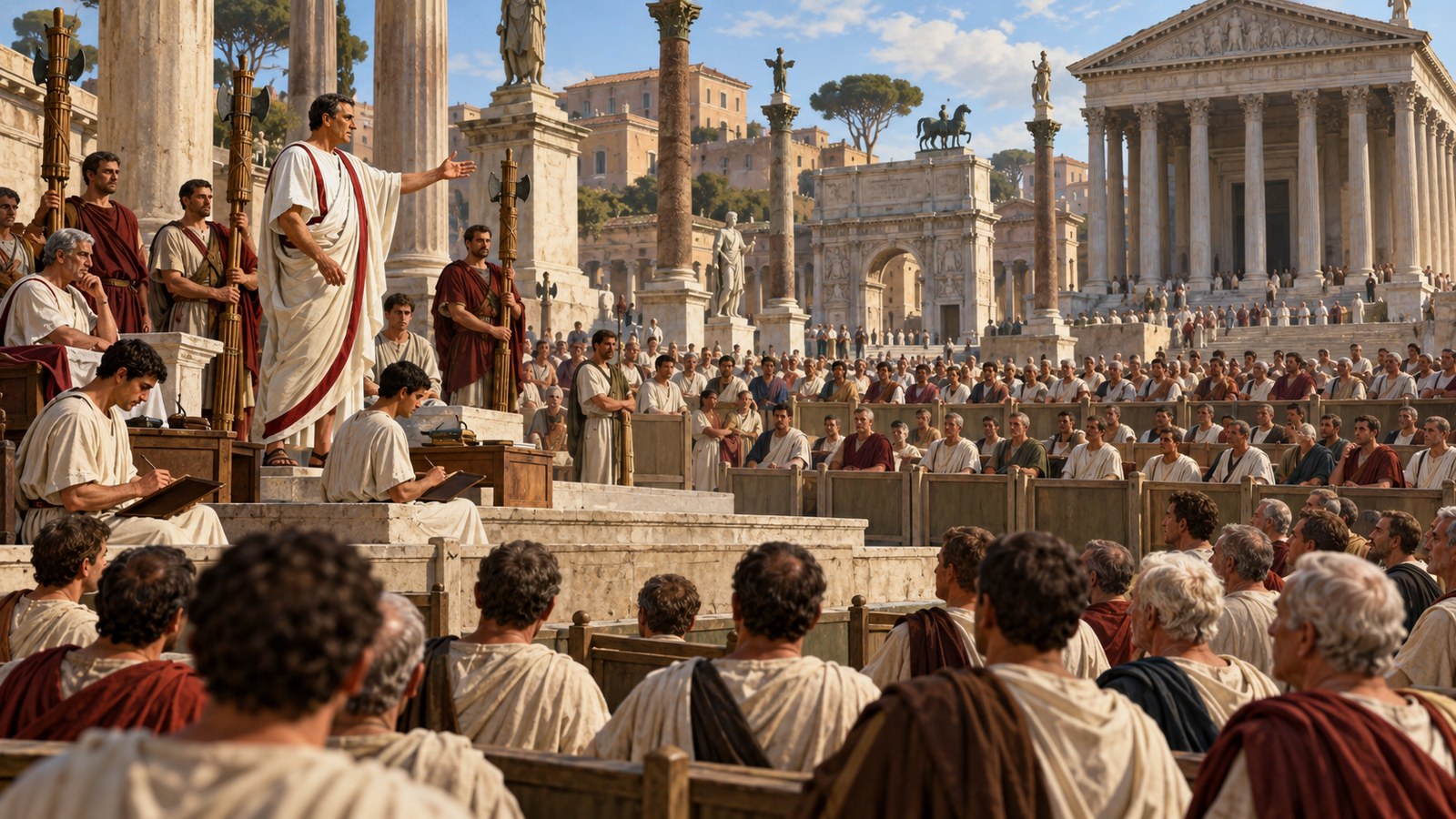
Ateius Capito supplied the strict definition quoted by Gellius. A lex was a general decree of the people or commons made in answer to a magistrate’s proposal. “General” did important work in that sentence.
The rule had to address the community rather than merely dispose of one person’s case. The body adopting it might be the full people or the commons, but the measure’s reach distinguished law from a private decree in Capito’s classification.
That definition did not make every assembly decision insignificant if it lacked general scope. It changed the technically proper label. Roman politics often required decisions about named commanders, exiles, defendants, and officeholders. Capito’s vocabulary placed those acts beside general law without pretending they were identical.
Scope therefore mattered as much as authority. The same public machinery could produce a rule for a broad class or an intervention concerning one individual. The vote alone did not erase the difference.
The distinction helps explain why Gellius chose famous counterexamples. Proposals concerning Pompey’s military command, Cicero’s recall, and the killing of Clodius plainly mattered to the state. Their political weight did not make them general in form.
Roman legal history often appears as a parade of laws bearing names. Gellius directs attention beneath the label. Before accepting “law” as a precise description, a reader should ask who was addressed, who voted, and whether the decree established a general rule or settled an individual matter.
One person’s measure became a privilegium
Capito’s definition pushed measures about individuals into another category: privilegia. Gellius explained the word through an older use of priva for separate or individual things.
The examples make the classification concrete. A command for Pompey attached public authority to one named man. Cicero’s recall concerned one exile. A decree related to Clodius’s killing responded to a particular political crisis. Each could command votes and carry consequences without becoming general legislation in the jurist’s strict sense.
The modern sound of “privilege” can distract from Gellius’s point. He was explaining singular scope, not merely a benefit. A measure directed against an individual could belong to the same category of specially framed action as one directed in that person’s favour.
Individual measures reveal the flexibility of an assembly. The community did not legislate only through abstract rules. It could intervene in exceptional careers and conflicts. Technical vocabulary tried to preserve the difference between exception and norm.
A similar problem of classification appears when Amisus relied on treaty status while Trajan assessed its benefit society. The outcome depended on identifying the governing category before applying a broad imperial policy. Gellius’s terms perform that sorting at the level of Roman enactments themselves.
Nothing in the chapter says the distinctions prevented political manipulation. What the text supports is a linguistic boundary. Calling an individual decree a privilegium made its limited target visible even when the whole community had participated in adopting it.
The commons were not the whole people
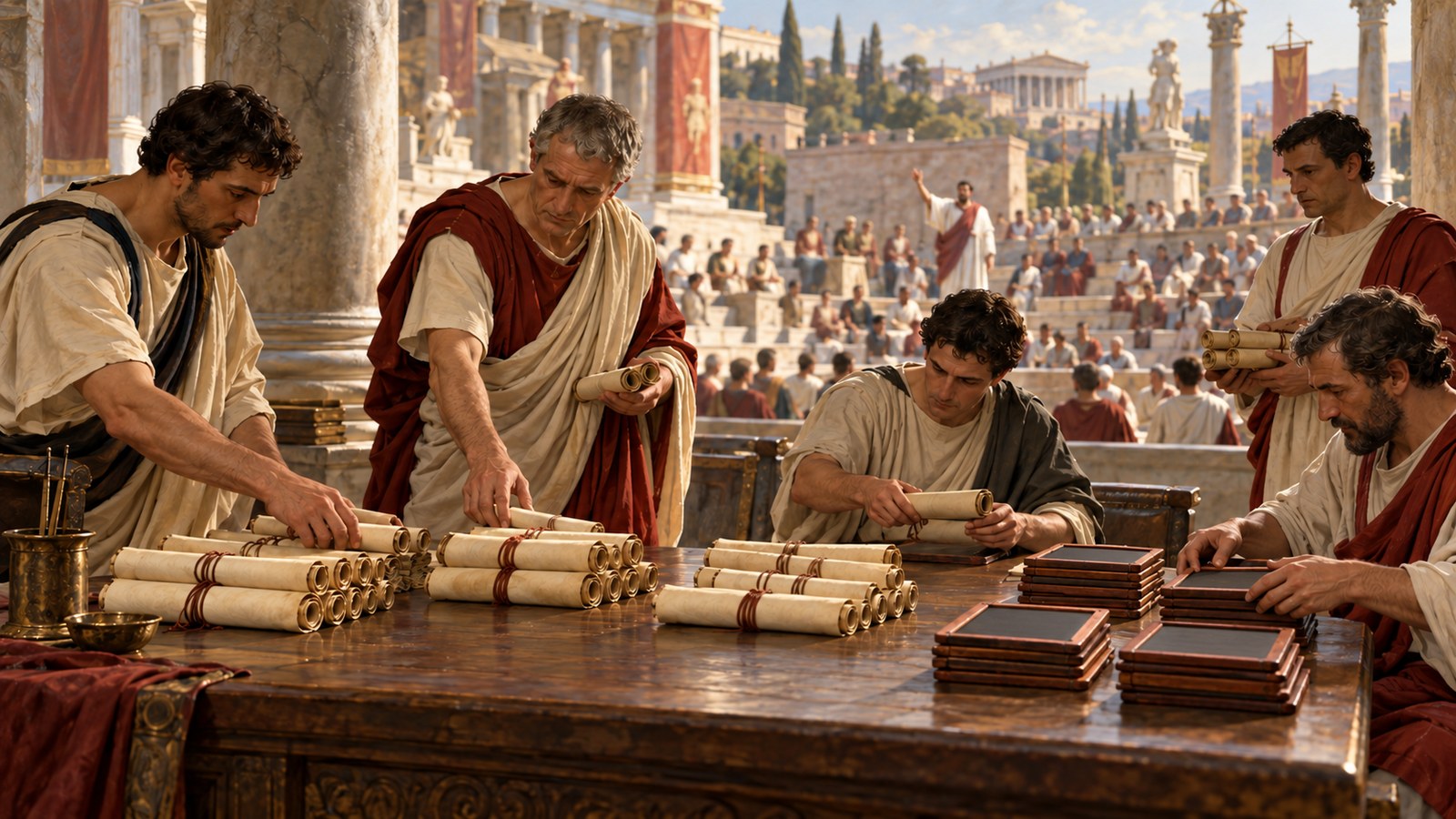
Capito also separated plebes from populus. In his account, the people embraced every part and order of the state. The commons excluded patrician families. The identity of the voting body therefore changed the enactment’s proper name.
A plebiscitum was adopted by the commons rather than the full people. It could still meet the general quality included in Capito’s definition of law, but its institutional source remained distinct.
The vocabulary records a layered citizen body. “The Romans decided” is too blunt for the procedure Gellius describes. A magistrate asked a particular collective, and the composition of that collective belonged to the legal description of its answer.
At the same time, old records did not consistently maintain the scheme. Gellius observed that lex could be used for decrees of the commons and for individual measures. Rogatio could become a loose name for several kinds of action rather than only the initiating question.
Sallust provided the telling example. Although Gellius regarded him as careful with words, Sallust called the individual measure concerning Pompey’s return a law. Custom overrode the technical distinction.
This slippage does not make Capito’s analysis useless. It makes it diagnostic. The jurist supplied categories with which to examine political acts; historical writers supplied evidence of how Romans actually spoke. Their disagreement shows formal precision and common usage operating together.
A Roman public measure could thus carry several identities. It began as a question. It received authority from the body answering. It gained a technical name from its scope. Then ordinary language might flatten those distinctions and call the result a law.
Gellius preserved the friction because words shaped how public power was understood. One question could lead to a general rule, a decree of the commons, or an act aimed at one person. The vote made each authoritative; the vocabulary explained what kind of authority had been made.
Sources
Aulus Gellius, Attic Nights, 10.20.