
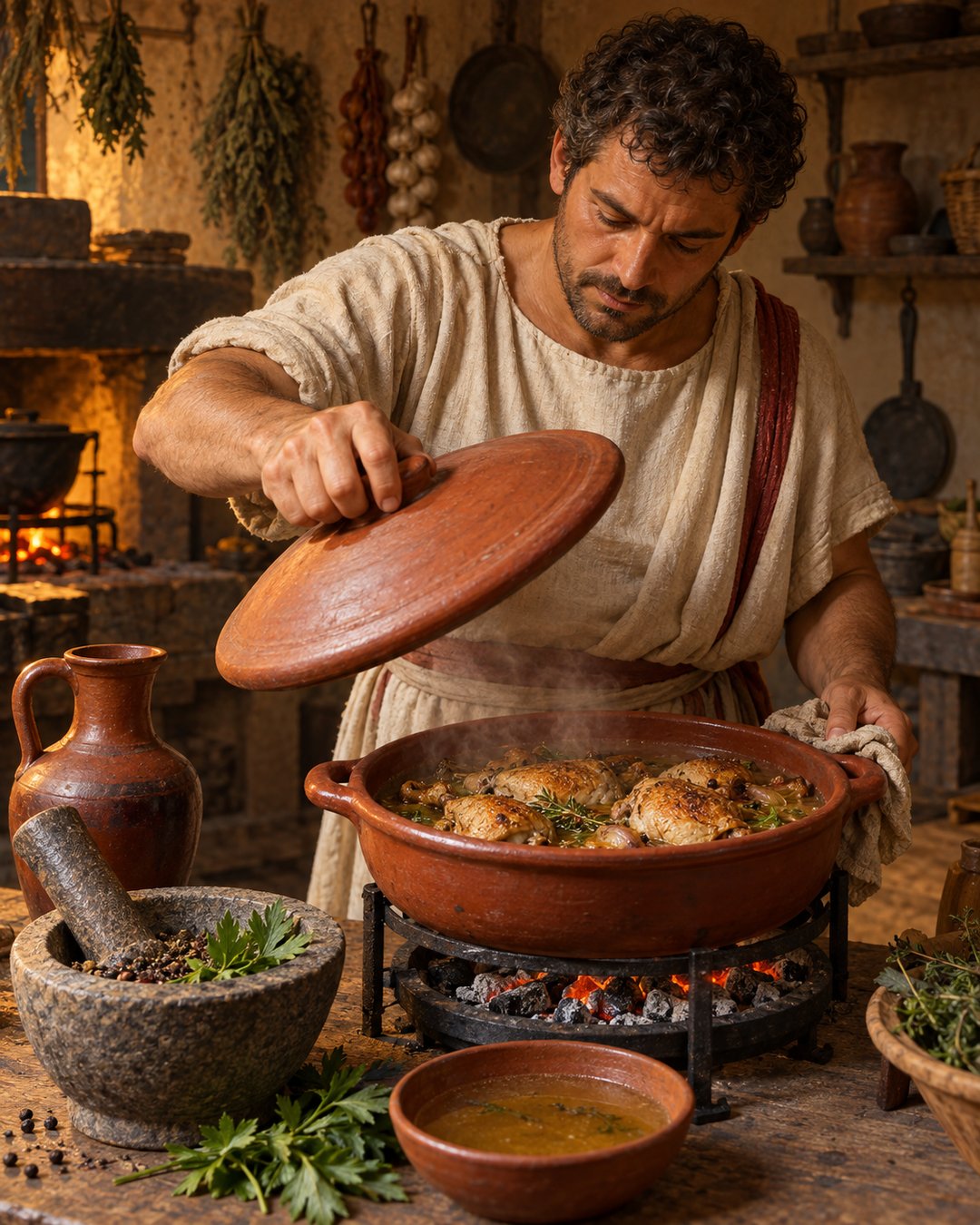
A chicken entered the recipe as a whole bird and left it in quarters, darkened by frying, wet with wine and broth, and fragrant with pepper, lovage, caraway, and laser. Between those states, the cook used at least four kinds of work: careful butchery, grinding, dry heat, and a slower finish in an earthen casserole.
The dish appears in the collection attributed to Apicius as recipe 237, Pullum Parthicum, or chicken in the Parthian style. Its name promises distance, but the surviving directions do not tell a story about a Parthian guest, caravan, or palace. They give actions. Dress, quarter, crush, moisten, fry, transfer, pour, add, braise, pepper, serve.
That sequence is the useful evidence. It shows a Roman recipe operating less like a modern card with exact weights and temperatures than like instructions exchanged among people who already understood their kitchen. The text names the decisions that distinguish this bird from another. The missing measurements were left to practiced hands.
The bird was prepared before the flavor began
The opening command is easy to hurry past: dress the chicken carefully and quarter it. An editorial note explains the preparation as plucking, singeing, emptying, washing, and trimming. The compact verb therefore concealed a chain of messy operations performed before the mortar or wine appeared.
Care mattered because feathers, pinfeathers, innards, soot from singeing, and uneven cuts could affect everything that followed. A cook who received a live or newly killed bird did not begin with four clean supermarket portions. The recipe assumes familiarity with transforming an animal into workable meat.
Quartering then changed the geometry of the dish. Four pieces exposed cut surfaces and made the chicken easier to arrange in a pan and casserole. The text does not specify a jointing diagram, the bird’s weight, or an exact frying time. Those silences are not permission to invent them. They reveal which knowledge the compiler expected a competent cook to supply.
The first stage also separates this recipe from the extravagance attached to the name Apicius in literary anecdotes. In the story of Apicius sailing for supposedly superior prawns, appetite becomes spectacle. Here the drama is practical. A bird has to be cleaned and divided before any eastern-sounding label matters.
A mortar turned separate aromatics into one seasoning
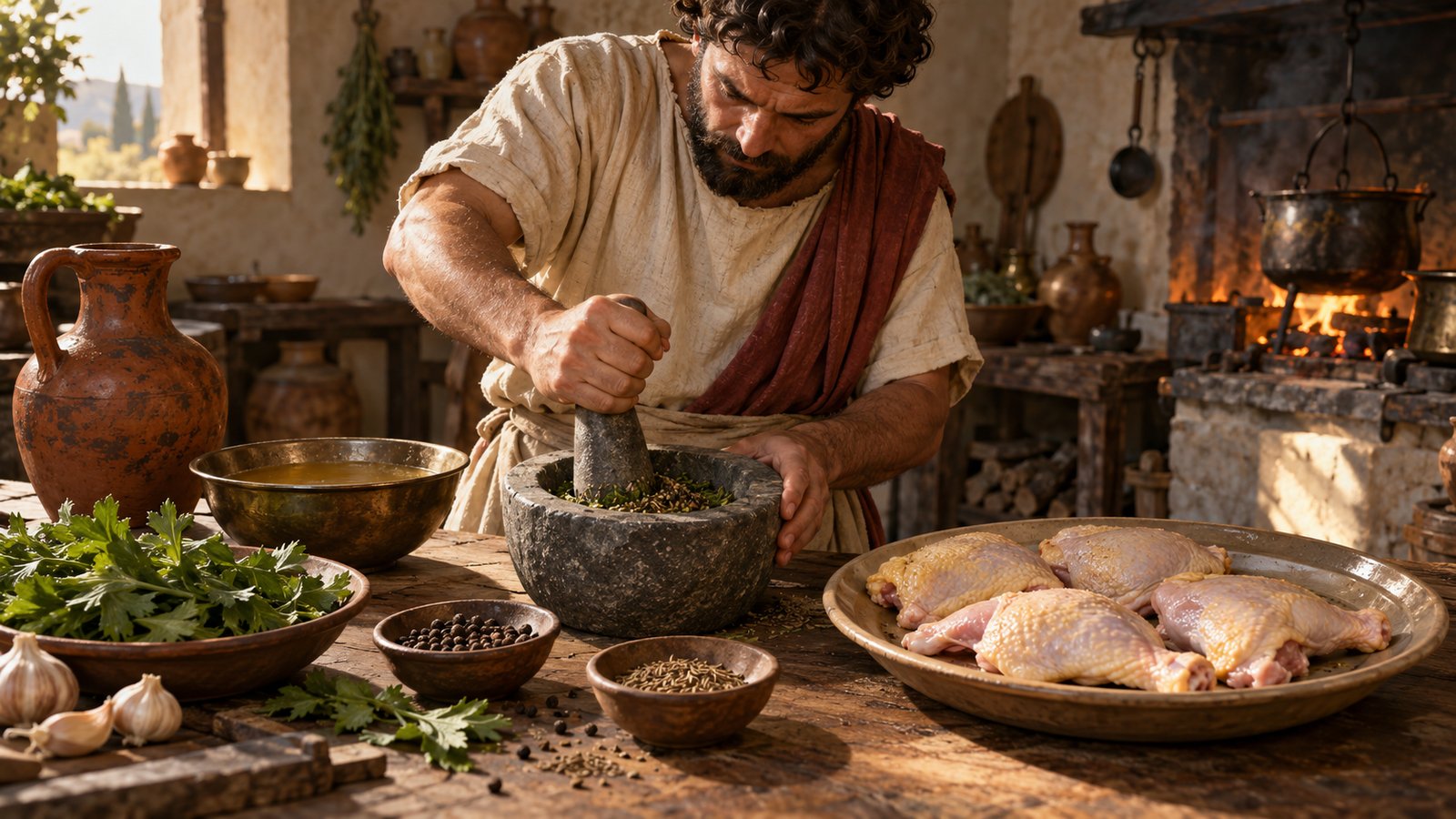
The recipe next orders pepper, lovage, and a little caraway to be crushed. The wording preserves both a core and a limit. Pepper and lovage define the aromatic base; caraway is present in a smaller quantity. A textual note warns that one reading gives cheese where another gives caraway, so absolute certainty about that small ingredient would exceed the edition.
Crushing did more than reduce size. It broke the dry ingredients into particles that could be dispersed through liquid. Broth moistened the mixture, and wine was added to taste. The mortar therefore became the point where solid aromatics and liquid seasoning first met.
No quantity is supplied for pepper, lovage, broth, or wine. “To taste” gives the cook explicit control over one addition, while the other amounts remain implicit. This is not a recipe for a novice working without sensory judgment. The cook had to watch the paste, smell it, and decide when its strength and looseness suited four pieces of chicken.
Broth also complicates any attempt to imagine a single sharp spice flavor. It carried salt and savor according to its own preparation. Wine contributed acidity, fruit, and dilution. Pepper brought heat and perfume; lovage added an assertive herbal note. The seasoning was a blended medium before it touched the bird.
The process resembles another Apician transformation, though the result is entirely different. the recipe that hid anchovies under eggs and steam also depended on changing texture and combining ingredients in stages. Roman elite cooking could make complexity through handling, not only through rare materials.
Frying and braising did different jobs
After the seasoning is mixed, the chicken is fried. Only then does it move into an earthen dish. The order prevents us from flattening the method into “boiled chicken with spices.” The cook first applied direct heat to the quartered bird, then returned moisture for the finish.
Frying could firm and color the exterior while driving off some surface water. The ancient text does not describe browning chemistry or specify fat, pan shape, or heat level, so those details should remain modern interpretation rather than quoted instruction. What can be said securely is that frying preceded the casserole.
The transfer mattered. The edition names the vessel as a Cumana and identifies it as an earthenware casserole suitable for the purpose. Pottery held heat differently from thin metal and could carry the chicken from the initial frying stage into slower, wetter cooking.
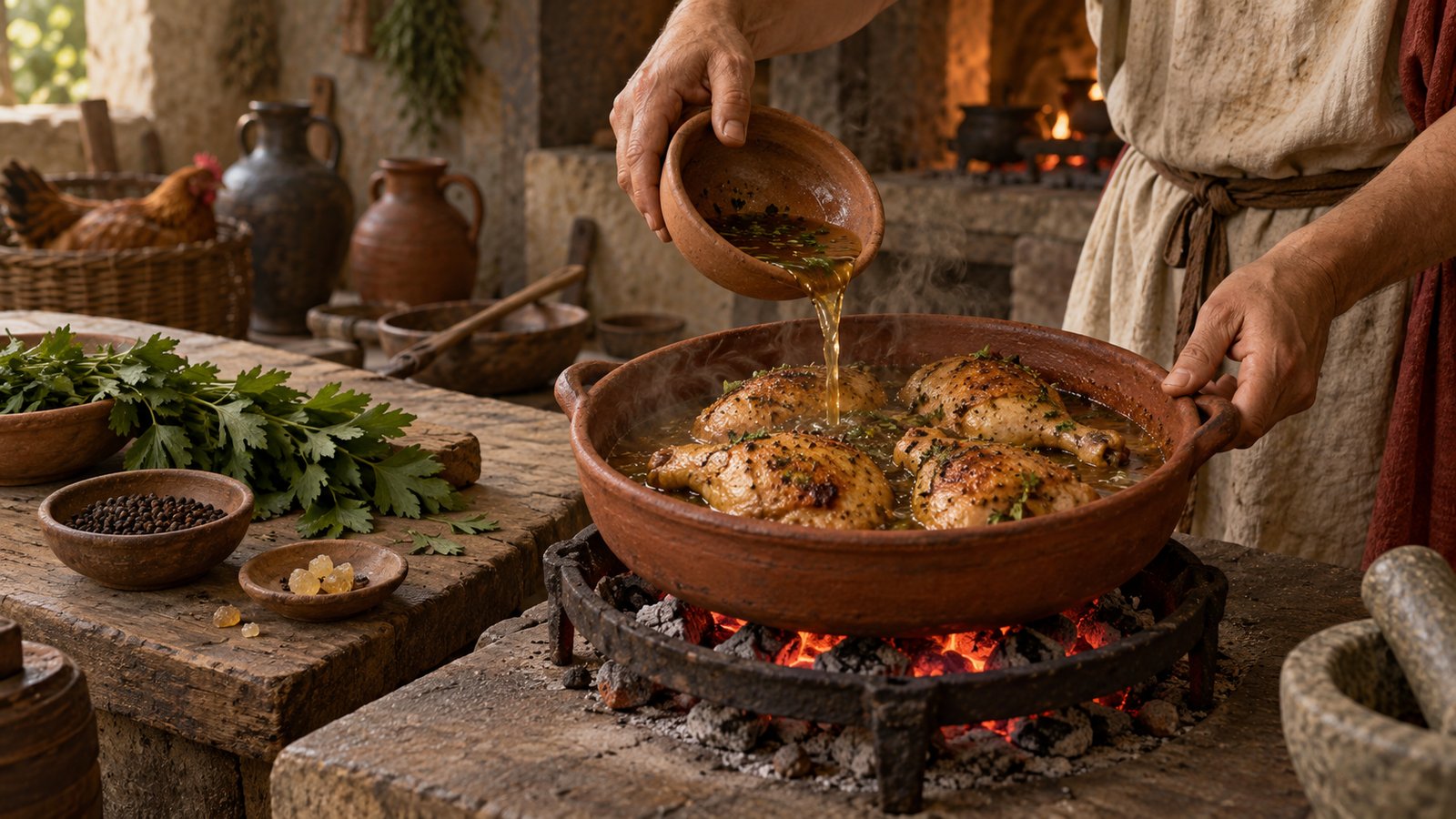
Once the pieces sat in that vessel, the crushed seasoning was poured over them. Laser and more wine were added. Laser was the strongly flavored plant product associated in Roman cooking with silphium or its substitutes. The recipe does not explain its trade route, price, or botanical identity here. It treats laser as something the cook knows how to dose.
The instructions then tell the cook to let the chicken assimilate the seasoning and braise it to the proper point. That verb of assimilation is the bridge between sauce and meat. The mixture was not merely poured on at the last instant. Time and moist heat were expected to carry it into the dish.
“Parthian” survives as a label, not a passport
The title naturally invites a geographical story. Parthia was Rome’s great eastern rival, and a Roman diner could hear the name as foreign, luxurious, or fashionably distant. Yet recipe 237 does not say that the dish arrived from a named Parthian cook or that its ingredients were uniquely Parthian.
An editorial note records an older opinion that the phrase might describe a particular small Asian chicken rather than a style of sauce. That interpretation is part of the recipe’s later scholarly history, not a fact established by the ancient instructions. The safest reading keeps the uncertainty visible.
What the text proves is narrower and more interesting than a confident origin myth. A Roman culinary collection preserved a dish under an eastern label, and its working identity came from a recognizable procedure: prepared quarters, crushed aromatics loosened with broth and wine, frying, casserole transfer, laser, braising, and final pepper.
The last instruction returns to the ingredient that opened the spice mixture. When the chicken is done, pepper is sprinkled over it before service. Pepper therefore appears twice: ground into the wet seasoning and renewed on the finished surface. The diner encountered both the cooked blend and a fresh aromatic edge.
No oven temperature, clock time, or serving count closes the recipe. “To a point” asks the cook to judge doneness, while “serve” assumes the surrounding meal without describing it. The recipe ends where skilled observation and household routine take over.
Pullum Parthicum survives because a short text retained the skeleton of a process. It does not let us reproduce one guaranteed ancient taste. It does let us follow the kitchen logic: cut the bird for handling, build a liquid spice paste, use frying and braising in sequence, and finish with the aroma that began the dish.
Sources
Apicius, Cookery and Dining in Imperial Rome, Book 6, recipe 237, “Chicken Parthian Style.”