
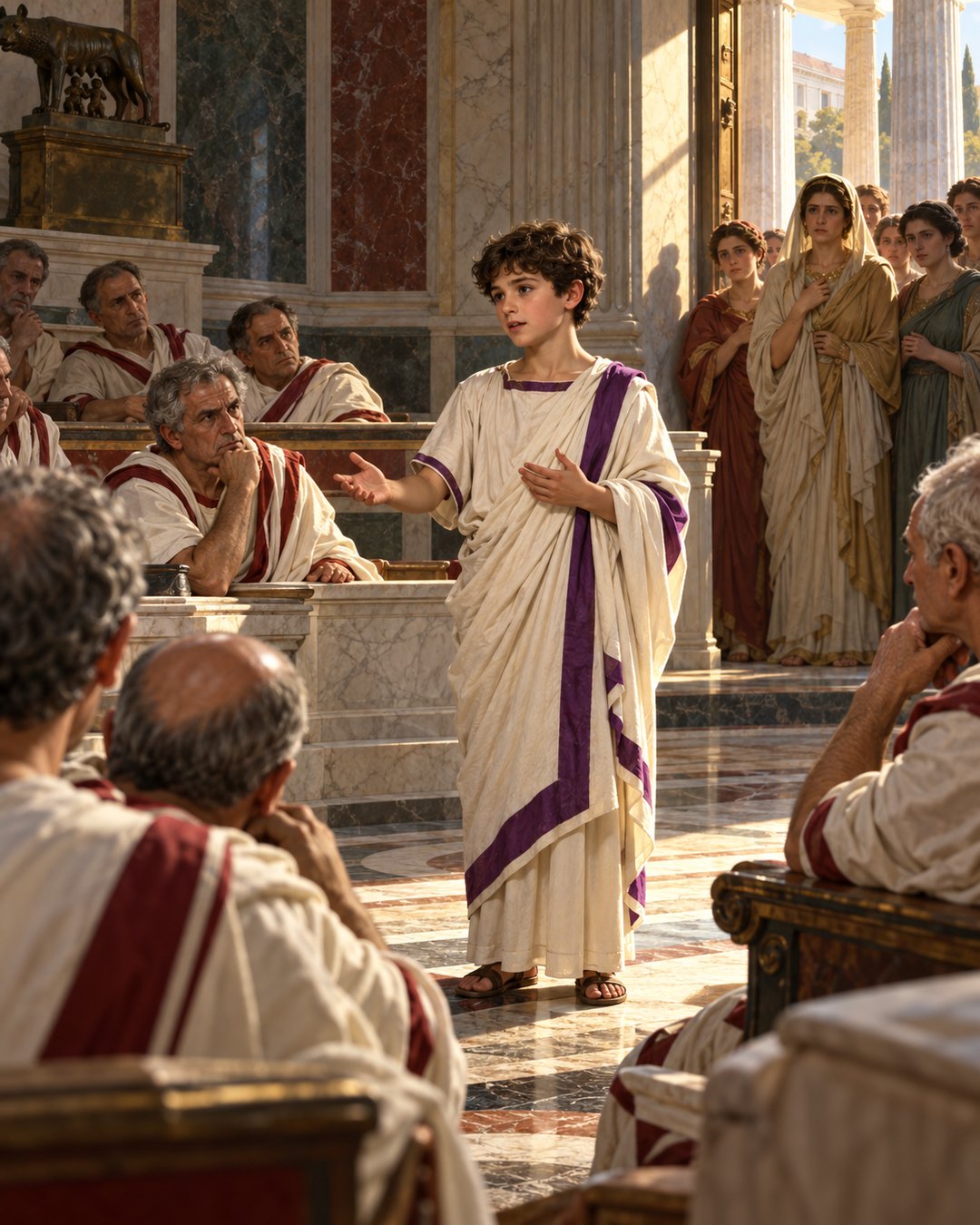
The senate had postponed an important question and ordered everyone present to keep silent until a decision. One witness went home with unusual access to the secret: a senator’s underage son. When his mother pressed him for the subject of the debate, the boy did not reveal it. He invented another problem so provocative that a crowd returned to the senate the next morning.
Aulus Gellius tells the story of Papirius Praetextatus as an old Roman anecdote associated with a speech of Marcus Cato. Gellius admits that he did not have Cato’s text before him and gives what he calls the bare tale. That source warning matters. The episode is a polished story about discretion, curiosity, and institutional memory, not a transcript of a documented debate.
Within that story, however, secrecy behaves with remarkable precision. The real subject stays in the chamber. The invented subject travels through a household and among Roman matrons, then comes back as a public petition. Papirius protects information by releasing a substitute designed to explain his silence without surrendering the truth.
Children once crossed the senate threshold
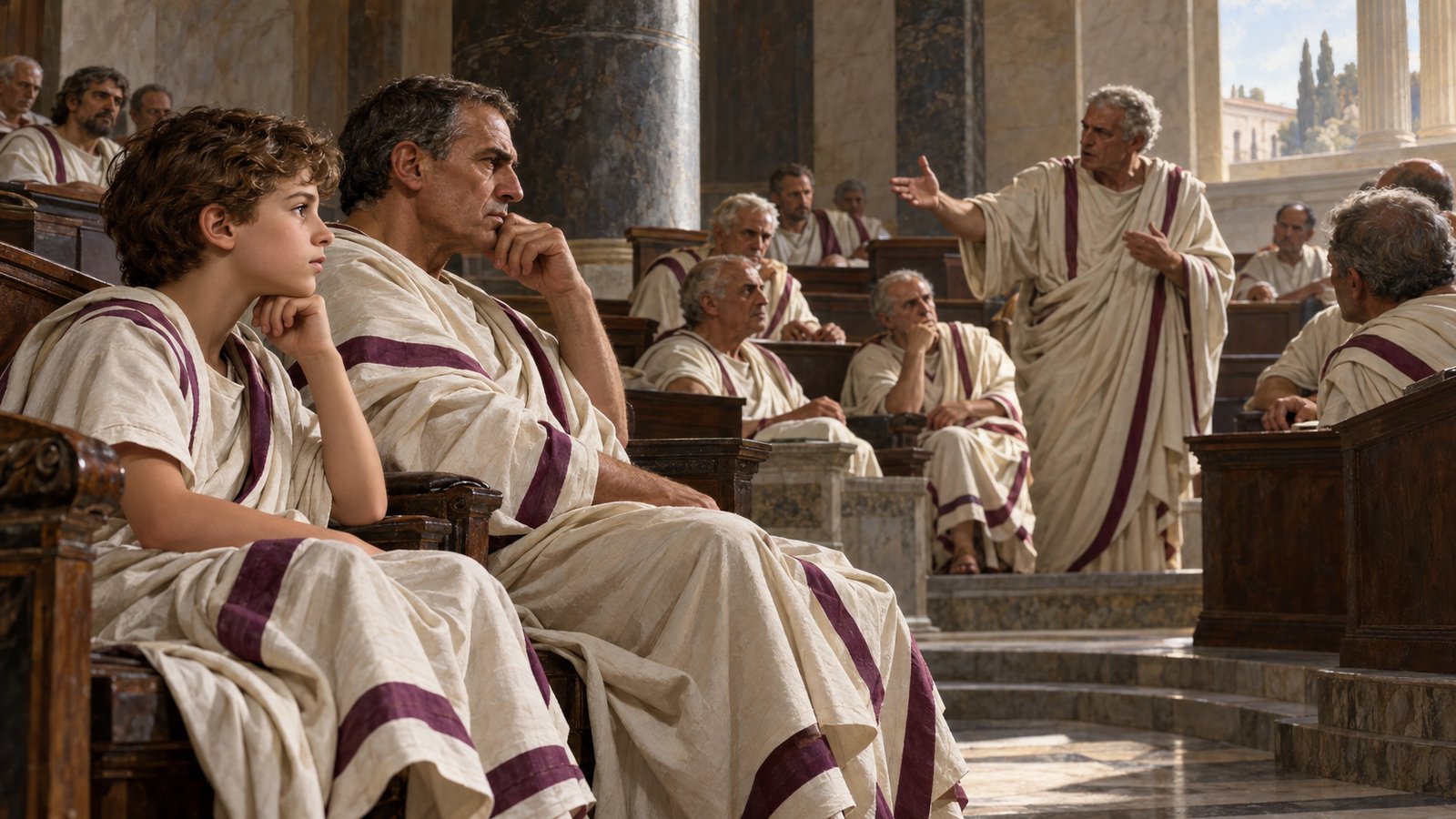
Gellius begins with a custom he places in Rome’s earlier past. Senators could enter the house with sons who had not yet reached adulthood. The practice put political education beside paternal supervision. A boy did not hear about senatorial conduct only afterward; he watched the order, voices, pauses, and decisions from inside.
That privilege also created a vulnerability. On the day in question, an important matter was debated but not concluded. The senators postponed it to the next day and voted that nobody should disclose the subject before the decision.
Papirius had attended with his father. At home, his mother asked what the Fathers had considered. He answered correctly that it was a secret and that he could not tell her.
The refusal increased rather than ended her interest. Gellius says the secrecy itself and the boy’s silence sharpened her curiosity, and she questioned him more insistently. The institutional command had reached the household, where no lictor or presiding magistrate stood ready to enforce it. Keeping faith depended on the young witness.
Papirius built a secret that wanted to travel
Under pressure, Papirius chose a falsehood with two balanced alternatives. The senate, he said, had been deciding whether it would be better for the state if one man had two wives or one woman had two husbands.
The invention was not random noise. It sounded like a public rule about households, and either outcome could be imagined as an immediate threat or opportunity. Its symmetry made it easy to repeat. The boy’s answer therefore satisfied the demand for a subject while protecting the actual discussion.
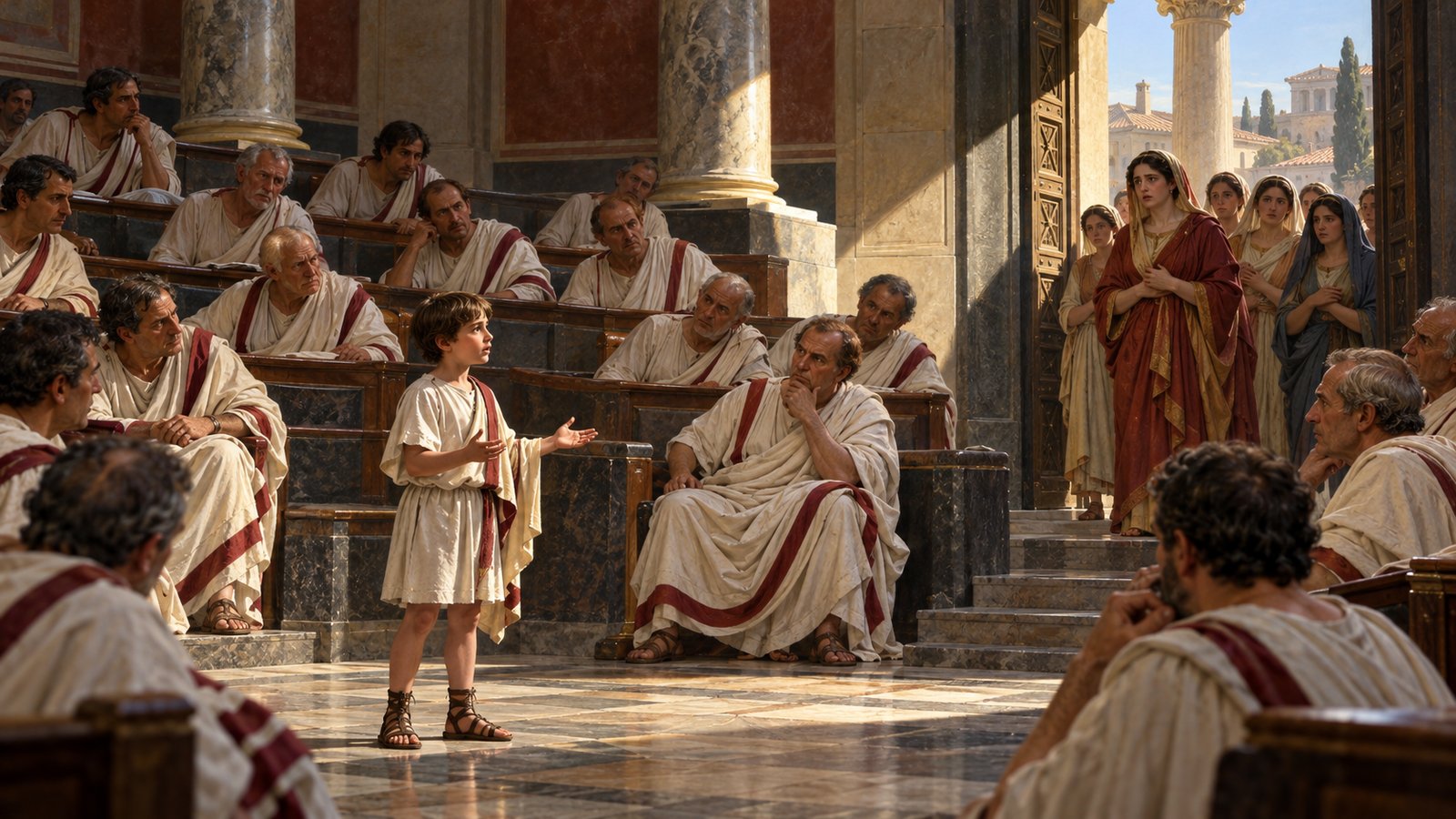
His mother reacted with alarm and carried the report to other matrons. By the next day, the story had gathered a crowd. The women came to the senate in tears and petitioned that one woman should have two husbands rather than one man two wives.
Gellius presents this for comic effect, and his gendered picture of female curiosity belongs to the anecdote’s own literary framing. It should not be mistaken for a neutral survey of Roman women. The mechanism of the story does not depend on accepting its stereotype as fact: a credible-sounding claim escaped one household, moved through a social network, and returned transformed into collective action.
The crowd revealed the leak without revealing the debate
The senators arriving at the house were baffled. They saw a public demand but did not know the private chain that had produced it. The false story had become visible evidence that something claiming senatorial authority was circulating.
Papirius stepped into the center and narrated the sequence. He explained what his mother had demanded, what he had answered, and how the strange petition had begun. By confessing the fabrication, he could end the panic while still leaving the original matter untouched.
This differs from the anonymous political communication explored in the senate’s experiment with secret ballots. Papirius did not conceal his own role permanently. He delayed truthful explanation until disclosure could protect, rather than expose, the institution’s command.
The anecdote also distinguishes secrecy from silence. A bare refusal had failed to close the household conversation. The boy’s substitute redirected it. That tactic created a larger disturbance, but it kept the protected subject beyond reach. The senate learned of the pressure because the invented claim returned in spectacular form.
The senate changed access and preserved the exception
Gellius says the senators honored Papirius for cleverness and loyalty. They also changed the rule. Other boys could no longer enter the house with their fathers; Papirius alone retained the privilege.
The response joins praise to risk control. The boy passed the test, but the crowd demonstrated that a custom relying on every child’s discretion exposed confidential business to repeated pressure at home. The senate did not conclude that all young witnesses were equally trustworthy because one had succeeded.
The sole exception made Papirius a living reminder of the reason for the rule. Gellius links his surname, Praetextatus, with his discretion while he was still of an age to wear the purple-bordered toga. The garment marked youth and status; the story made it mark tested silence.
Roman institutions often preserved distinctions by attaching them to people, offices, and repeated procedure. The effort to distinguish two branches of the Cato family through a library text shows Gellius doing comparable work with names and memory. Here a surname holds together a child, a costume, an exception, and a lesson about confidential access.
The story’s neatness should keep us cautious. Gellius explicitly lacked Cato’s wording, and the scene is shaped as an entertaining moral anecdote. What it reveals most securely is the kind of Roman lesson worth retelling: access imposed duty, discretion could be demonstrated under family pressure, and one breach-shaped scare could justify closing a political space to everyone except the witness who had proved himself.
Papirius’s age is essential to that lesson. An adult senator who kept silent would merely have followed the order. The boy faced a second authority inside his own household, and the story treats his answer as a test of whether civic confidence could survive intimate questioning. His success does not come from resisting his mother forever. It comes from choosing words that preserve the senate’s command until he can explain himself before the institution that issued it.
The invented alternatives also mirror deliberation. “One man with two wives” and “one woman with two husbands” sound like paired proposals awaiting a choice. Papirius did not claim that a law had passed. He supplied an unresolved question, which made the next day’s petition seem urgent. The form of senatorial business gave credibility to fiction without revealing the real motion.
When he finally speaks in the chamber, the boy restores sequence. He identifies the pressure, the false answer, its circulation, and the resulting crowd. That chronological account allows the senators to separate the petition from any authentic proposal. Truth repairs the public consequence of the lie while the original secret remains protected.
The access rule changes because the tale has exposed a repeatable weakness, not because Papirius himself failed. This is why the exception matters. It rewards loyalty while acknowledging that institutional design cannot assume every future child will improvise so successfully. The senate preserves the person who proved the custom could work and removes the custom that made another test inevitable.
Sources
Aulus Gellius, Attic Nights, 1.23.