
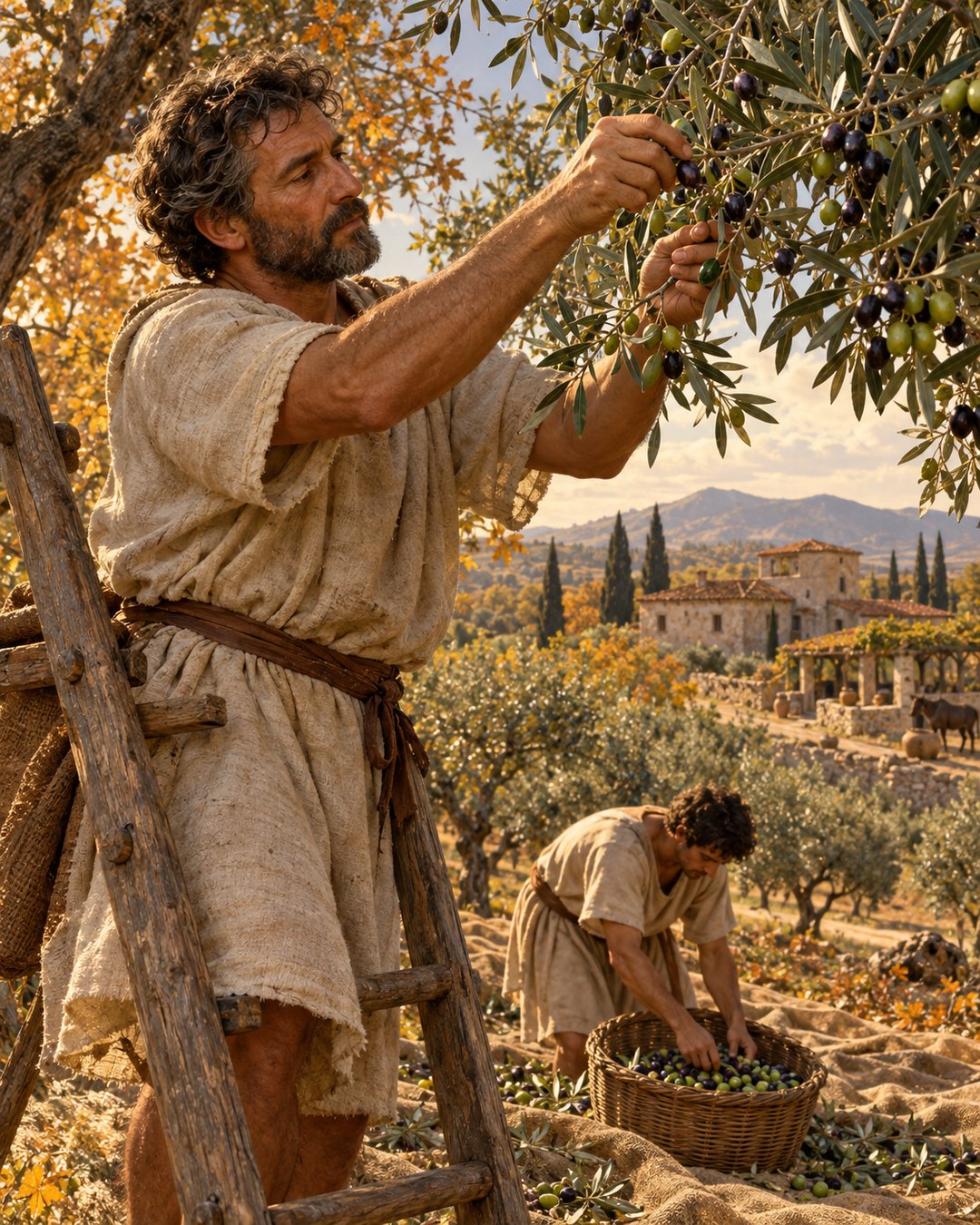
The safest tool in Varro’s olive grove was an uncovered hand. Fruit within reach of the ground or a ladder was to be picked, not shaken down, and the fingers were better left bare. A hard glove could bruise the berry, tear bark from the branch, and expose the damaged wood to frost. What looked like protection for the worker created danger for both the oil and the tree.
That warning opens a tightly connected account of harvest risk. A bruised olive lost moisture and yielded less oil. A heavy blow could remove the shoot carrying the following year’s crop. Fruit left in a floor pile could heat and turn the oil rancid. Even the dark liquid draining from the press could either help the farm or leave ground black and barren, depending on quantity.
Varro’s sequence therefore does more than describe olive picking. It traces a crop through hands, reeds, piles, vessels, rough millstones, and waste liquid. At every stage, the right amount of force, delay, or residue mattered.
The hand protected fruit, bark, and bud
Varro begins by dividing the tree according to reach. Olives accessible from the ground or from ladders should be picked rather than brought down by shaking. The distinction is physical and immediate. A picker can separate fruit deliberately; a shaken branch makes the fall itself part of the processing.
The berry carried the first cost. Varro says bruised fruit dries out and does not produce as much oil. The instruction gives a practical reason for gentleness without requiring a modern account of chemistry. Less damage before pressing meant more of the expected product remained available at the mill.
Bare fingers were preferable even to gloves when the gloves were hard. The covering could press or scrape the olive, but the harm did not stop at the fruit. Varro also warns that a hard glove could tear bark from the branches and leave them vulnerable to frost. A device intended to separate hand from branch could make the contact rougher.
This creates a double horizon for the picker. The olive in the hand belonged to the current harvest. The bark and living branch belonged to the tree’s continued production. Speed that protected neither was not efficient by Varro’s measure.
The same attention to controlled handling appears in the wicker forms used to shape growing gourds. Both instructions treat a cultivated plant as material that responds to touch over time. The worker does not merely collect an object; the worker changes what the plant can still become.
A reed reached high fruit without spending next year
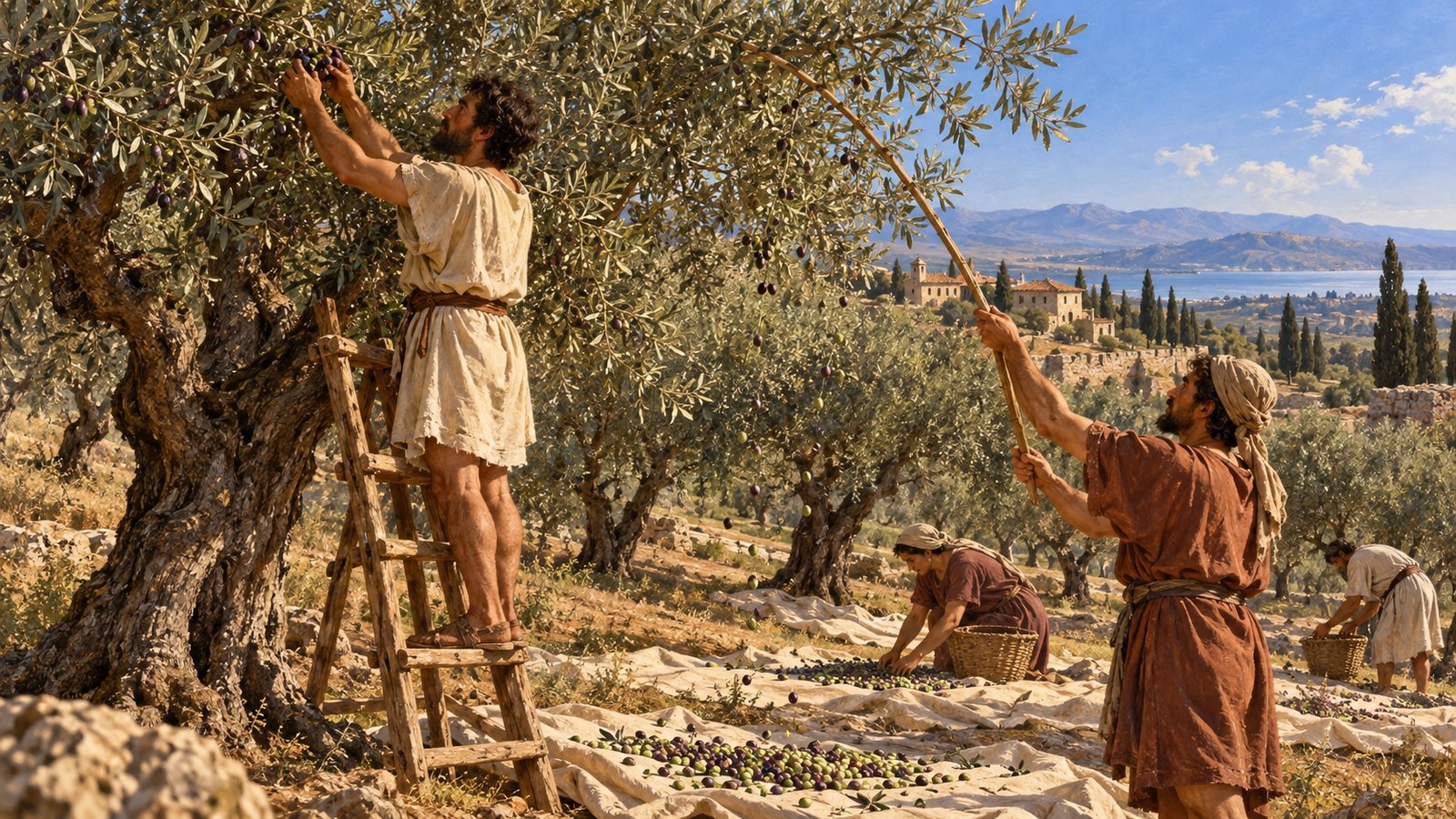
Some olives remained beyond the hand. Varro allows those to be beaten down, but he narrows both the implement and the target. A reed was better than a pole because a heavier blow created damage serious enough to require what his translator calls the work of a tree-doctor.
The worker was also not to strike the olive directly. Varro explains that a direct hit could pull away the shoot with the fruit. The immediate gain would then carry a delayed loss: the torn shoot meant no fruit from that growth in the next year.
He connects this mistake with the observation that olives bear poorly or appear to fail every other year. The passage does not reduce every variation in a harvest to one cause. It does show that workers understood how their own blows could imitate or worsen alternation by removing future-bearing growth.
The reed was therefore more than a lighter stick. It was a way to limit transmitted force when height made hand-picking impossible. The technique accepted that some contact had to be indirect while refusing to treat every downward olive as a success.
Varro’s mention of a tree-doctor gives the heavy blow a second cost. Damage did not merely reduce an abstract total; it created repair work after harvest. The lighter implement saved labour by avoiding an injury before a specialist had to confront it, while the intact shoot kept its chance to bear.
Seen from beneath the canopy, the harvest involved separate decisions on a single tree: fingers for reachable fruit, ladders to extend that reach, and reeds where the hand still could not go. The categories were defined by the tree’s geometry rather than by one universal tool.
Floor piles turned waiting into a controlled stage
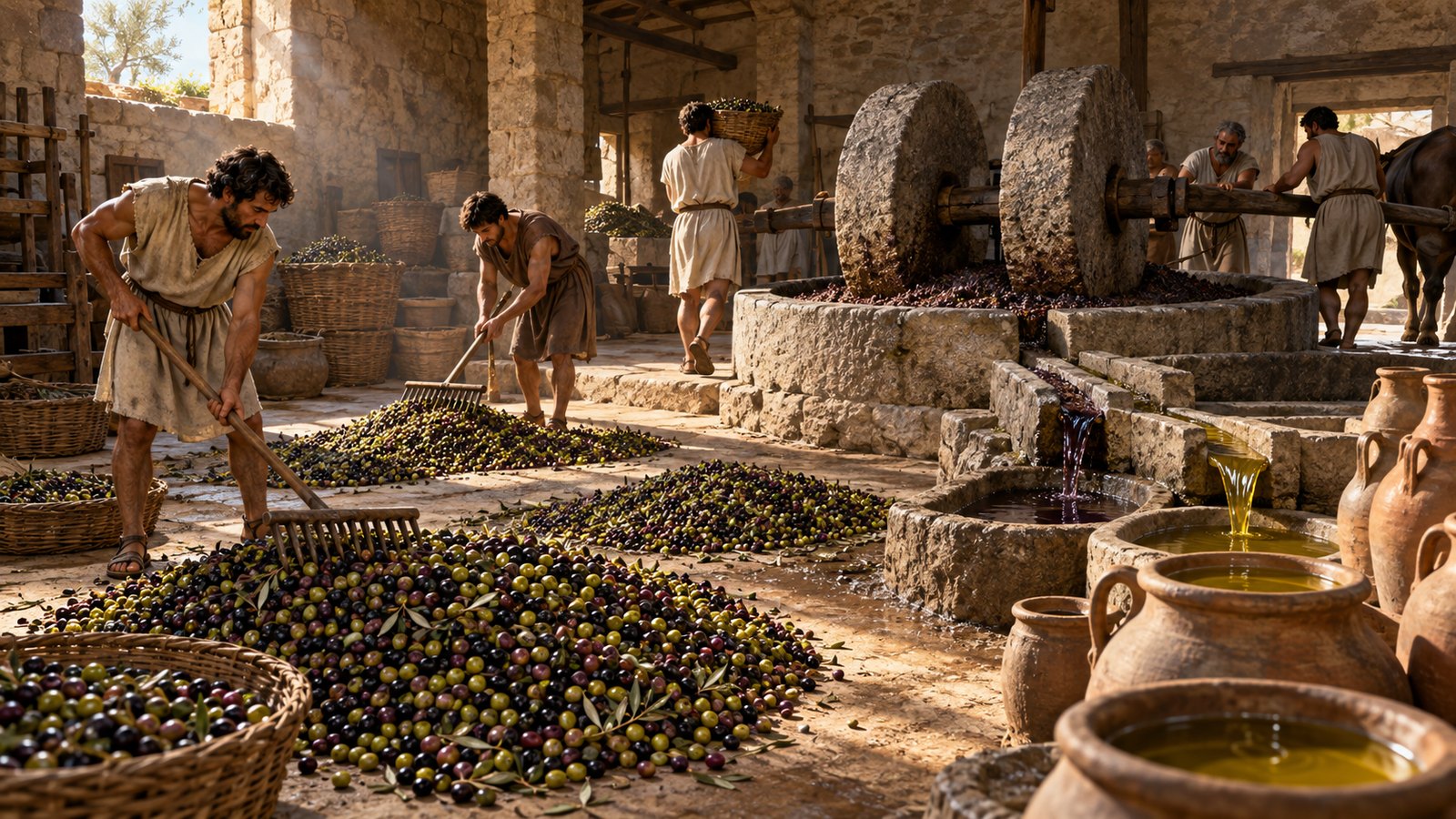
Once gathered, the olives divided again. Varro says part went to food and part was destined to release oil. The oil fruit commonly arrived at the farmstead in daily lots and was heaped on a floor so it could mellow a little.
The piles were not an undifferentiated reserve. Varro says they passed in the same order through jars and olive vessels to the trapetum, an olive mill fitted with hard stones roughened on their surface. Arrival order mattered because delay altered the material before the stones touched it.
A little time was acceptable; too much was destructive. Olives left too long in the heaps spoiled from their own heat, and the resulting oil became rancid. If the mill could not receive them promptly, Varro’s remedy was to move the piles about and air them.
That instruction makes waiting into work. The fruit was not safe merely because it had reached the floor. Someone had to preserve circulation, remember sequence, and recognize when a mellowing heap was becoming a hot one. The bottleneck at the mill could be managed, but not ignored.
The contrast with the deliberate aging of manure in separate pits is revealing. One farm material improved through managed time; another deteriorated when retained too long and too hot. “Leave it in a pile” was never a complete Roman agricultural rule. The material determined whether waiting ripened, rotted, or heated the result away.
The press produced a useful liquid that could also sterilize soil
Varro closes by naming two products of the olive: oil and amurca, the watery, bitter liquid separated during pressing. Oil needed no introduction to his readers. Amurca did, because he thought many people failed to recognize its value.
The evidence for that failure was visible outside the press. Varro says people let amurca flow onto fields, where large quantities blackened the earth and made it barren. The by-product was not harmless simply because it was no longer the desired oil.
Quantity changed its role. In moderation, Varro calls the liquid useful for many purposes and especially valuable in agriculture. He mentions pouring it around the roots of trees, chiefly olives, and applying it where noxious weeds grew.
The same substance could therefore be waste, treatment, or poison to production. The passage does not supply one safe universal dose, so no precise recipe should be invented from it. Its point is operational: uncontrolled discharge concentrated harm, while measured use redirected the residue.
The harvest chain ends where it began, at the tree and its future. Bare fingers preserved the branch. A reed limited the violence needed for high fruit. Ordered, aired piles protected the oil from heat. Controlled amurca returned part of the pressing process to roots or unwanted growth without flooding the ground.
Varro’s grove was not divided into a romantic harvest and a mechanical mill. It was one continuous system in which small injuries accumulated. A glove, a pole, a delayed heap, or an overflowing channel could erase value already present in the crop. Care meant carrying the next consequence in mind before the current task was finished.
Sources
Marcus Terentius Varro, On Agriculture, 1.55.