
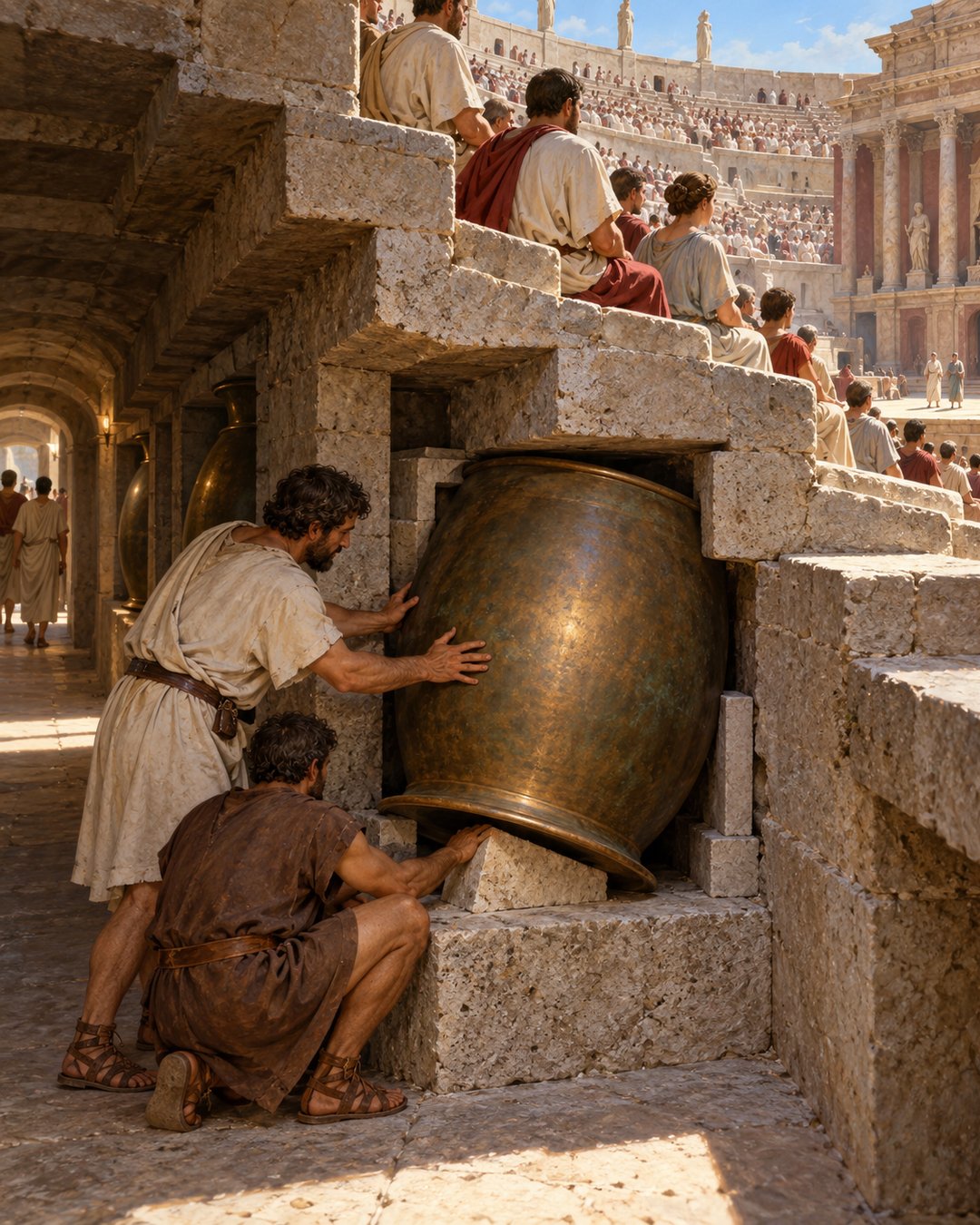
A Roman theatre could hide a row of musical instruments inside its seats. Vitruvius called for bronze vessels made to calculated pitches, turned upside down in separate niches and lifted on wedges toward the stage. They were not scenery and no performer struck them. The actor’s voice was meant to find them.
When a spoken or sung note met the vessel tuned to it, Vitruvius expected the metal to answer by resonance. The reinforced sound would then travel toward the audience with greater clarity and what he described as a fuller, sweeter tone. Architecture did not merely avoid swallowing the performance. Properly arranged, it joined the performance.
The proposal links musical theory to masonry in unusually concrete fashion. Pitch determined the vessel; theatre size determined the number of rows; passages beneath the seats opened toward the cavities. Even the cheaper substitute—earthen jars—had to preserve the same harmonic principle.
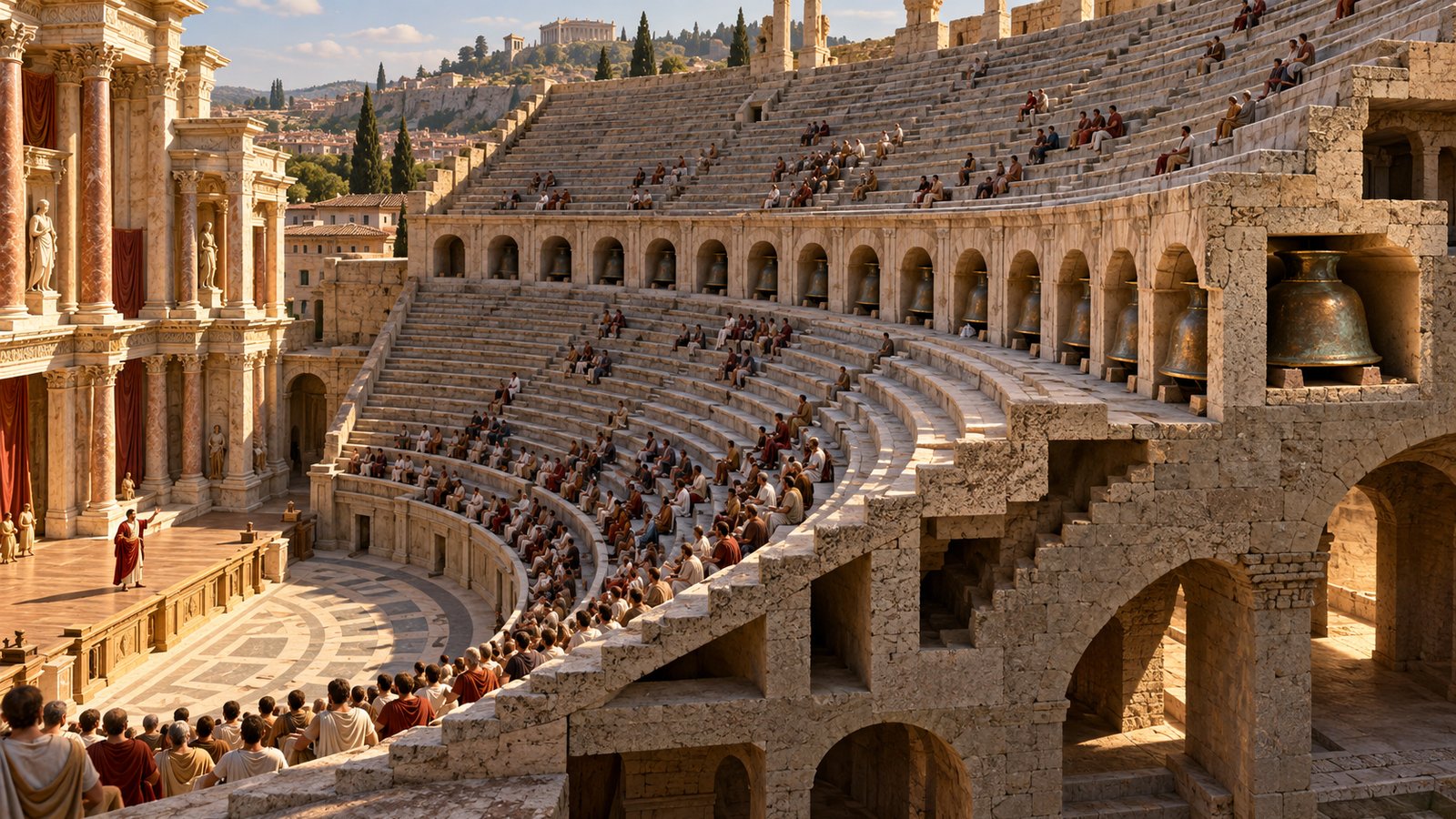
Thirteen niches turned one seating curve into a scale
Vitruvius begins with vessels fabricated according to the mathematical principles of music. Their relationships extended through defined intervals as far as the double octave. This was not advice to scatter attractive bronze bowls wherever a builder found spare space. Each resonator belonged to a system.
For a smaller theatre, thirteen niches were spaced at equal intervals halfway up the seating. Vitruvius assigns a sequence of fourth-octave notes across them, moving symmetrically from the sides toward a central pitch and out again. The curved audience wall therefore carried an ordered acoustic pattern behind its visible stone.
That symmetry mattered because a theatre did not send every sound along one straight corridor. A voice rose from the stage into a broad fan of seats. Repeating corresponding pitches on either side gave the resonant system a place across the curve rather than concentrating all help at one point.
The niches belonged between the seats, not in ornamental structures above them. Their location made the seating bank thick enough to serve as acoustic housing. Spectators saw steps, aisles, and rows; behind those surfaces, builders could reserve cavities for objects whose value depended on emptiness around them.
This interior use of the seating complements the porticoes Vitruvius placed behind a theatre. The portico managed rain, crowds, rehearsal, and drainage outside the auditorium. The resonators managed the vulnerable path between stage and ear inside it. One building answered two different failures with two different pieces of geometry.
An upside-down vessel needed air, a wedge, and an opening
The individual vessel had strict physical conditions. Vitruvius says it must not touch a wall. Contact would have restricted the free response of the bronze and made the surrounding masonry part of the vibration in an uncontrolled way. Isolation was built into the niche.
The vessel stood inverted rather than open like a domestic bowl. On the side facing the stage, a wedge at least half a foot high lifted it. The tilt aligned the resonant cavity toward the source while keeping the object stable inside its recess.
An opening connected each niche to the lower seating walk. Vitruvius gives dimensions: two feet long and half a foot high. Sound therefore did not have to pass through solid stone or rely on cracks left by workmanship. The architecture deliberately gave the cavity a mouth.
These instructions reveal why “bronze jars improved Roman acoustics” is too small a summary. Bronze alone did nothing. A vessel pressed against a wall, set upright without the prescribed relation to the stage, or sealed behind masonry would not reproduce the installation Vitruvius described. Material, orientation, clearance, and aperture formed one device.
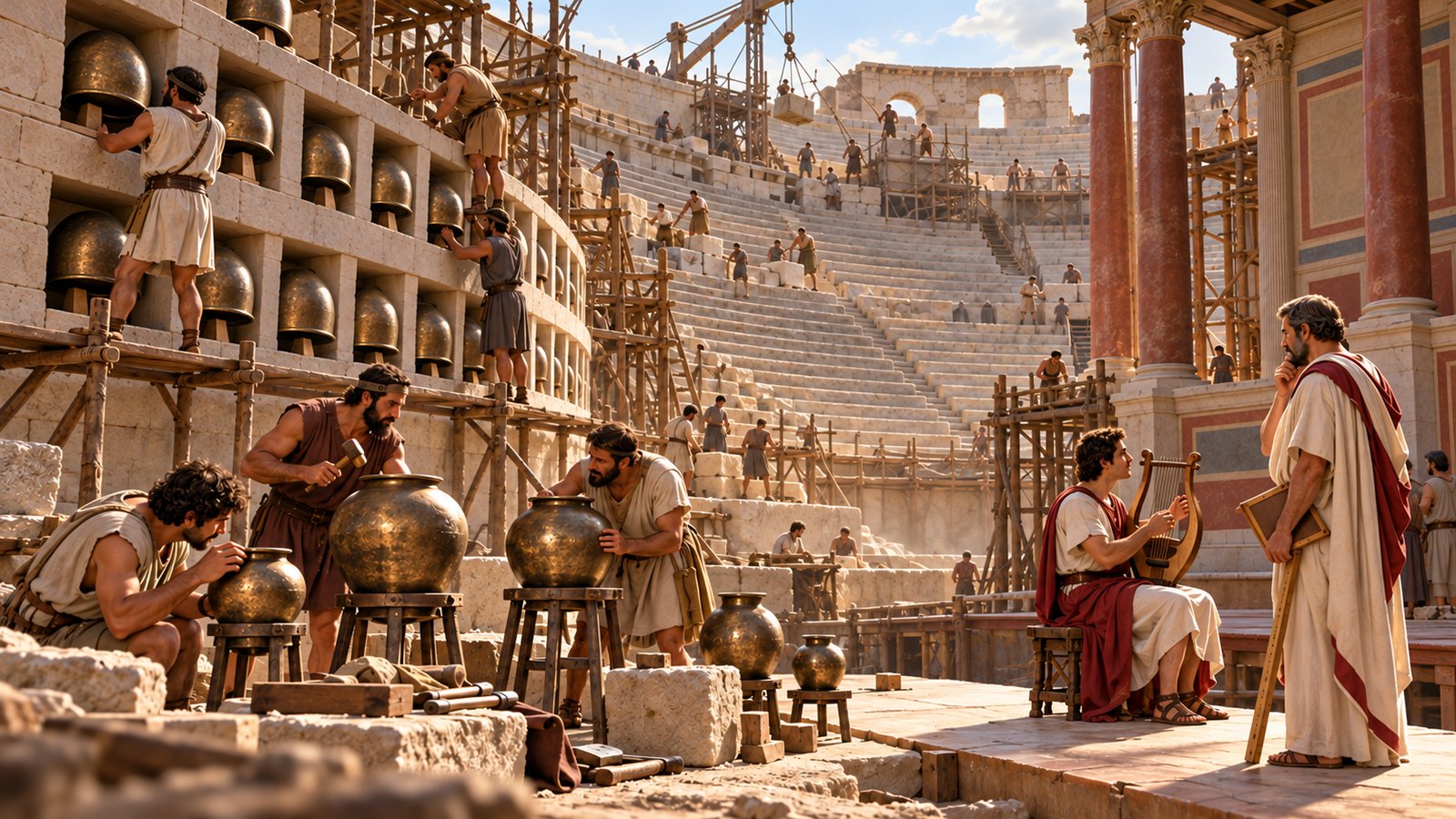
The wedge also gives the invisible system a practical building sequence. Masons had to form the recess and its opening; metalworkers had to supply the correctly proportioned vessel; installers had to set it without contact and raise the stageward side. Acoustic design crossed trades.
Three horizontal ranges separated three musical systems
A large theatre demanded more than the single line of thirteen. Vitruvius expands the plan into three horizontal ranges. The lowest received enharmonic pitches, the middle chromatic pitches, and the highest diatonic pitches.
The terminology came from Greek musical theory, which Vitruvius had already explained before turning to installation. Readers did not receive a loose metaphor about harmony. They received tables of named notes and corresponding positions, with a central vessel and paired pitches distributed across the theatre.
The lowest range included a central vessel assigned to the proslambanomenos, the added note at the bottom of the system. Higher and lateral positions carried other notes according to their genera. The arrangement converted an abstract ladder of intervals into a map a builder could follow.
Vitruvius does not claim that every syllable awakened every vessel. He describes selective response: when the voice came into contact with the matching pitch, the tuned object answered. A speech or melody moving through different tones could therefore encounter different points of reinforcement.
The design depended on proportion rather than sheer loudness. Adding more untuned metal would not create a larger version of the same effect. A large auditorium received additional harmonic coverage through new ranges, not simply heavier vessels.
That care for horizontal level recalls the Roman builder’s use of hanging weights and measured lines. In both cases, a finished surface concealed a disciplined set of references. One controlled visible alignment; the other fixed relationships the audience would hear rather than see.
Resonance had a budget as well as a theory
Bronze on this scale cost money. Vitruvius acknowledges that a community might not have the resources for the complete metal installation. His alternative was not to abandon acoustic planning but to commission earthen vessels made according to the same principle.
Clay changed durability, prestige, and probably the exact craft of tuning, yet the governing demand remained: proportions had to produce the intended notes. The cheaper material was acceptable only as a tuned resonator, not as a decorative pot hidden under a bench.
This concession places the system between ideal theory and municipal choice. A patron or town could decide how much bronze to purchase. The architect still had to preserve the relationship among cavity, opening, placement, and pitch. Economy altered material without erasing design.
No surviving theatre should be assumed to have contained the complete scheme merely because Vitruvius wrote it down. His chapter is prescriptive. It proves that a Roman architectural author could imagine and specify such an installation, not that every audience sat above thirteen or thirty-nine resonators.
What survives most securely is the reasoning. Speech in a vast open structure was a material problem. Stone could organize spectators, but it could also dissipate a voice. Vitruvius answered by making the building listen at selected frequencies and speak those frequencies back.
The hidden vessels show a side of Roman monumental architecture that façades miss. The important bronze was not always a statue in sunlight. Sometimes it was an inverted hollow object, carefully separated from the wall, doing its work only when a performer found its note.
The prescription also disciplines modern reconstruction. A row of amphorae under seats is not automatically Vitruvius’s system, and any cavity in a theatre is not automatically an acoustic niche. Identification would need to answer the details he supplies: regular placement, a suitable opening toward the auditorium, room to isolate an inverted vessel, and a level belonging to a larger harmonic layout. His specificity is useful precisely because it limits easy claims. The chapter gives investigators a construction hypothesis with several linked tests, not permission to label every hollow space a resonator.
Sources
Vitruvius, On Architecture, 5.5.