
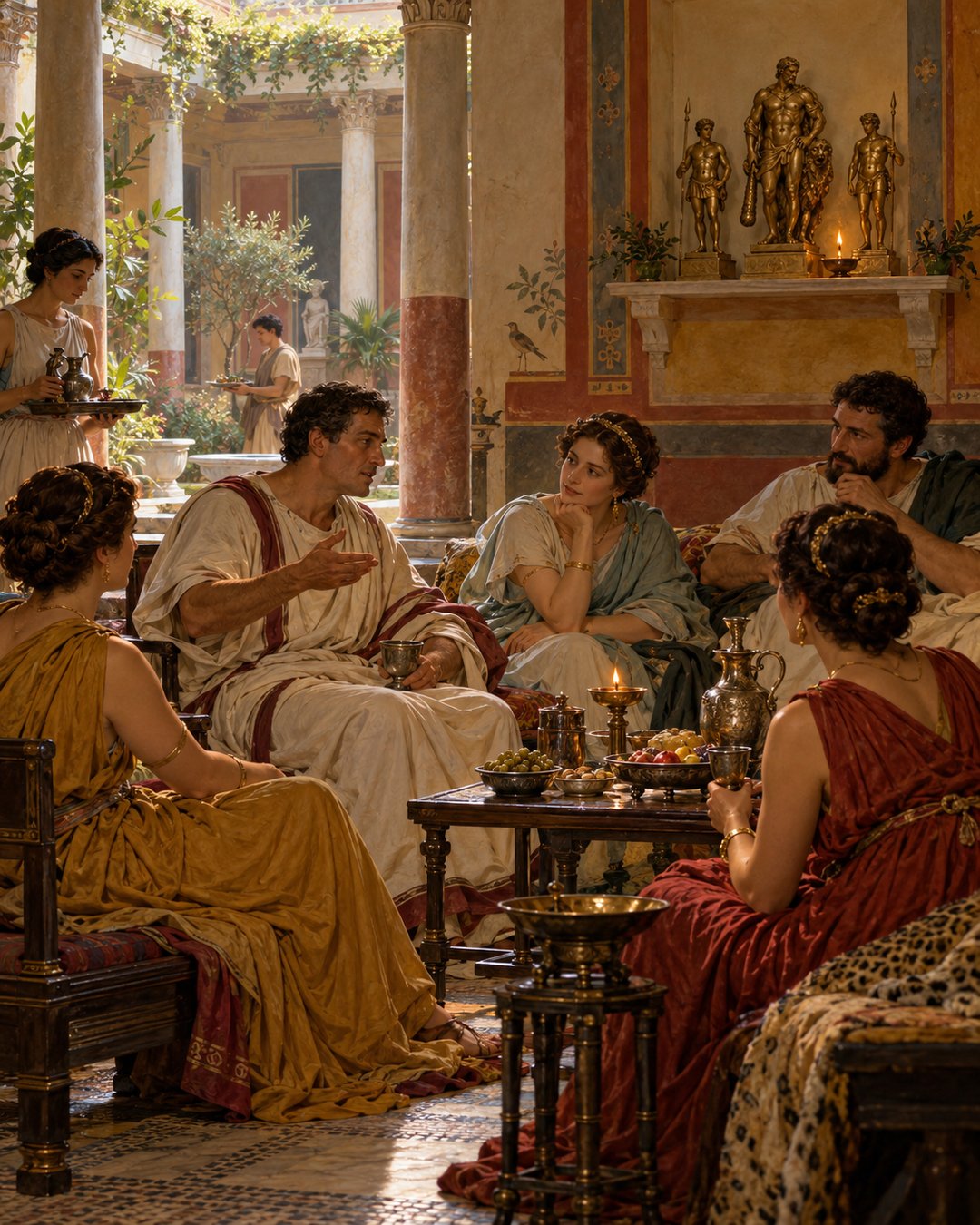
A Roman speaker could call on a god with two syllables and reveal more than surprise. In the early writings Aulus Gellius examined, women did not swear by Hercules and men did not swear by Castor. The rule lived inside ordinary speech rather than on a monumental inscription.
Pollux complicated the pattern. The formula edepol, understood as an oath by Pollux, became common to both women and men. Varro believed it had once belonged to women alone and that male speakers adopted it after the old boundary was forgotten.
Gellius’s short chapter is therefore about three kinds of memory at once. Sacrifice explained one exclusion, literature documented another, and habitual speech preserved a change whose users may no longer have understood its ritual past.
Hercules joined speech to access at the sacrifice
Gellius considers the women’s side easier to explain. Women abstained from sacrifice to Hercules, and they also avoided invoking him in an oath. The spoken formula mirrored a boundary in ritual participation.
That explanation does not make every cult of Hercules identical across every place and century. Roman religious practice varied, and Gellius was discussing what he found in early literary usage. His claim is evidence for a remembered norm, not a census of every utterance.
Still, the link is precise. An oath was not a decorative mythological reference. Calling on a deity made the god a witness or guarantor of speech. Exclusion from a sacrificial relationship could therefore shape which divine name sounded proper in a woman’s mouth.
The formula also made social training audible. Speakers learned what sounded normal from families, performances, legal settings, markets, and jokes. A girl did not need to read a priestly handbook to notice which exclamations women around her avoided.
That oral discipline differs from the treaty oath sealed through a flint-stone sacrifice. The treaty ceremony concentrated obligation into a formal public act. Gellius’s examples let ritual categories leak into countless minor moments of conversation.
Because the oath could be uttered casually, repetition helped preserve the distinction. Each familiar formula renewed a line between speakers even when no sacrifice was occurring in front of them.
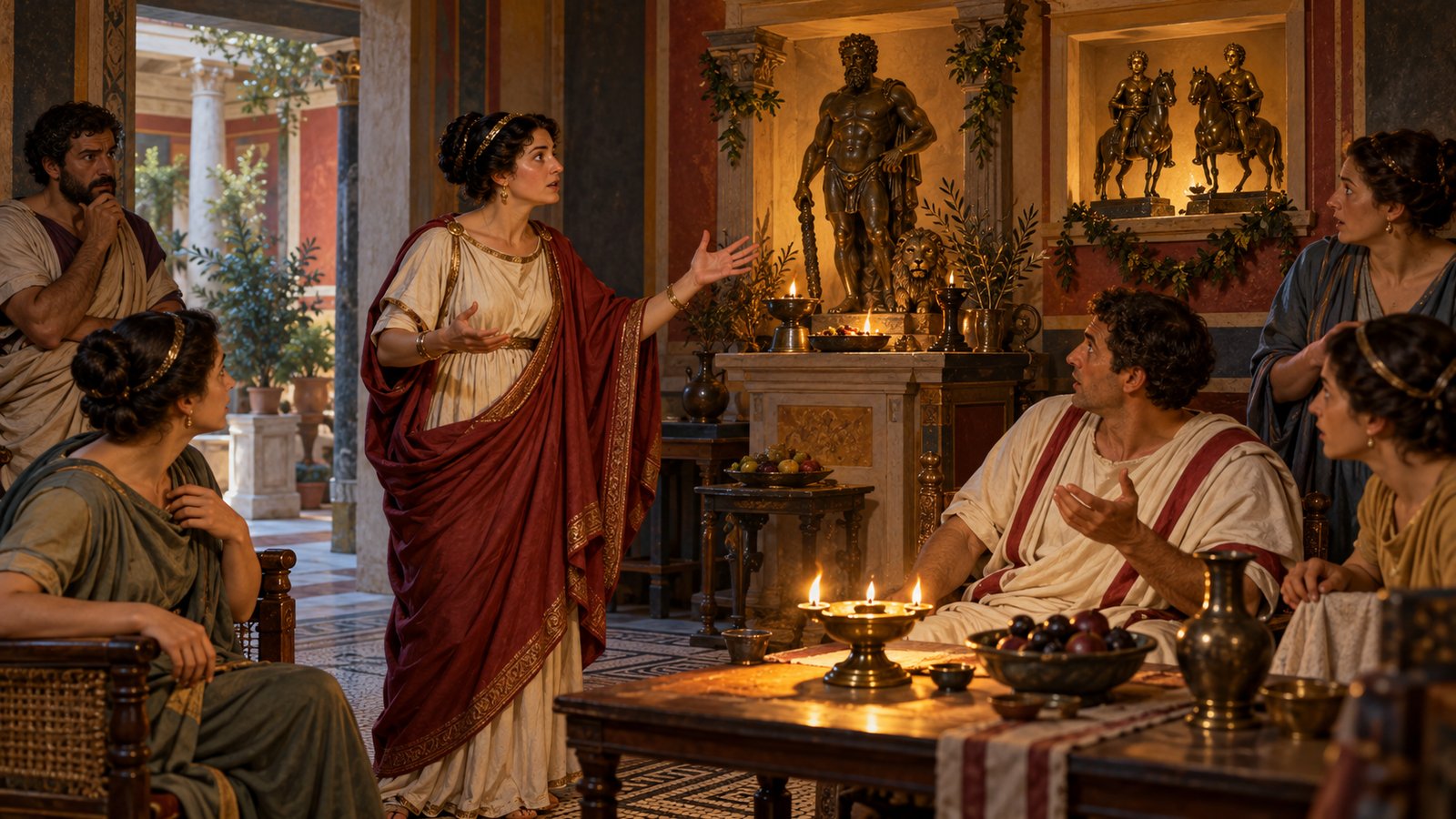
Castor left Gellius with evidence but no easy cause
The male avoidance of Castor was harder for Gellius. He could state the literary pattern confidently but did not offer a cause equivalent to women’s exclusion from Hercules sacrifice.
That hesitation is valuable. Ancient authors did not always possess the origin of the customs they described. Gellius distinguishes a pattern he believes he can document from an explanation he cannot securely recover.
His archive was linguistic. Among writers he considered good authorities, he says one cannot find a woman using the Hercules formula or a man swearing by Castor. Literature becomes a corpus of usage.
The method has limits. Surviving writing favors elite genres, edited speech, and stylized dialogue. Silence in that record cannot prove that no Roman man ever invoked Castor in any street, camp, or household. It can show that educated authors recognized the expression as marked or improper.
That distinction between attested norm and universal behavior keeps the chapter useful. Gellius reports how speech was sorted in cultural memory, not a recording of every voice.
Castor and Pollux were twins, but their oath formulas did not behave as a pair. A man avoided Castor while an invocation of Pollux eventually became available to him. Mythological kinship did not force linguistic symmetry.
The uneven result warns against reconstructing Roman practice from divine family trees alone. Usage accumulated through cult, initiation, habit, comedy, and correction. Closely linked gods could occupy different places in grammar.
Pollux crossed the line when speakers forgot its history
Edepol was the exception that exposed change. Gellius says the Pollux oath was common to both sexes. Varro, however, claimed that the earliest men used neither Castor nor Pollux in this way.
The compressed form helped it travel. A speaker did not need to pause and narrate the Dioscuri, the mysteries, or a rule of ritual access. The expression could function as a ready-made burst of emphasis, copied for its sound and social usefulness.
That convenience creates a familiar linguistic tension. A phrase may become more common as knowledge of its components becomes less common. By the time a grammarian explains the pieces, ordinary speakers may no longer feel that they are making a deliberate theological choice.
According to the explanation Gellius quotes, the Pollux formula originated among women and came from the Eleusinian initiations. Men gradually adopted it through ignorance of ancient usage until repetition made it customary.
We cannot independently watch that transition unfold from one conversation to the next. What matters is Varro’s model of language change. A rule can weaken without any authority formally repealing it. Speakers hear a useful expression, detach it from its old setting, and normalize it.
Ignorance here is productive. The loss of ritual explanation did not erase the oath; it widened its speakers. A fossil survived by changing function.
The movement resembles neither a treaty nor the collective oath that bound Cato’s olive-harvest contractors. Those formulas served defined obligations. Edepol could operate as a flexible exclamation, making it especially easy to copy without instruction.
Varro’s appeal to the Eleusinian initiations also reminds us that Roman speech could preserve material understood through Greek ritual. The formula’s history, as he reconstructed it, crossed cultural and gender boundaries before Gellius ever placed it in a miscellany.
Gellius does not tell us which particular text first showed male edepol, or when its broadened use became unremarkable. His evidence is comparative: the Pollux expression occurs across speakers, while the Castor expression remains absent from male literary speech.
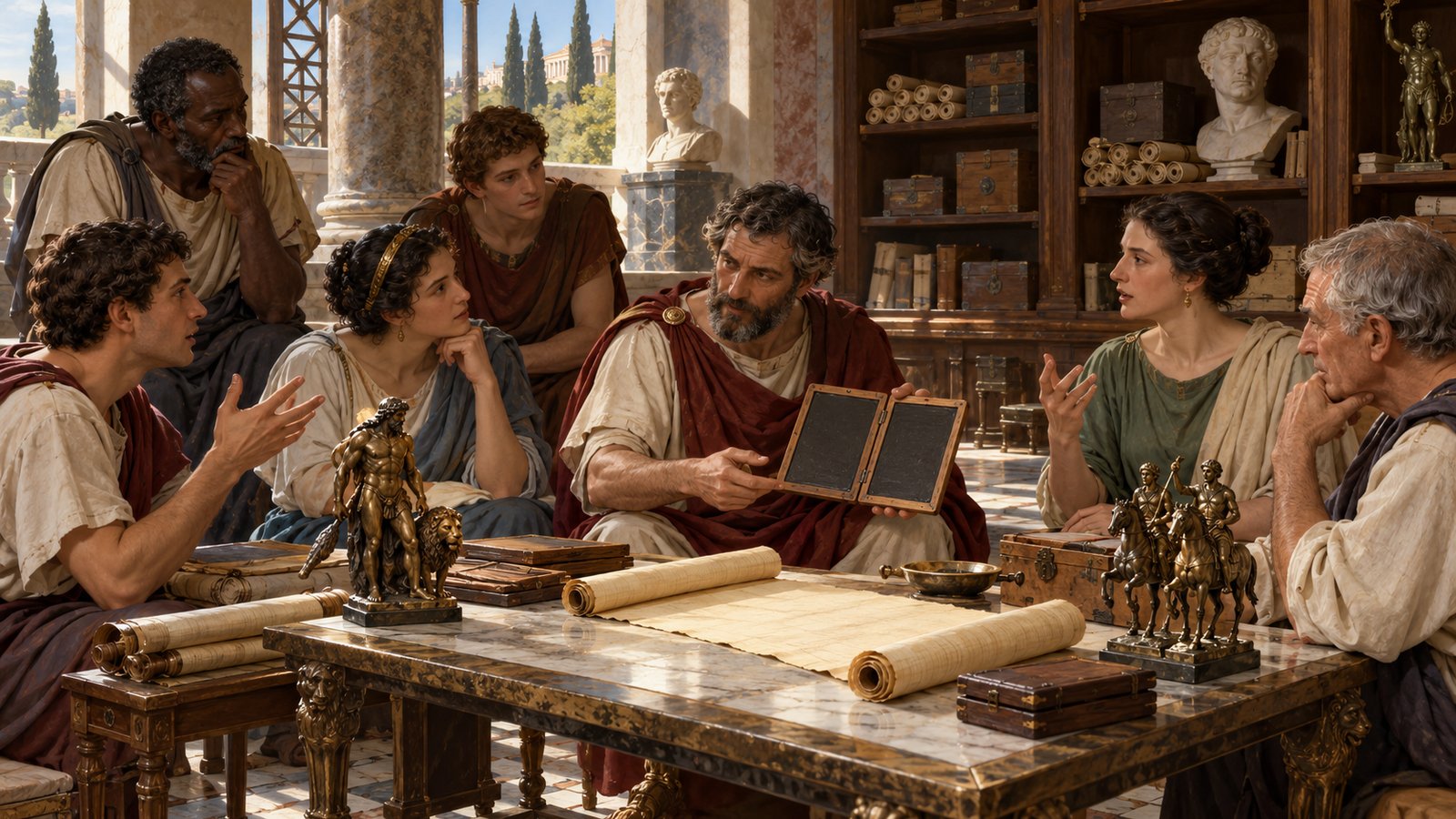
Comedy and conversation likely helped such expressions travel, although Gellius’s chapter does not reconstruct a specific route. Once male usage stopped sounding strange, each new repetition concealed the older boundary more completely.
Yet Castor did not follow Pollux across. Gellius finishes by insisting that no male use of the Castor oath appears in ancient writing. One twin’s formula broadened while the other retained its gendered mark.
The chapter’s scale is tiny, but that is its strength. Grand ritual rules are easy to notice when temples, priests, and sacrifices survive in the evidence. A clipped oath shows how religion also occupied reflexes of speech.
Such reflexes could signal identity to a listener before the sentence was complete. A playwright assigning an oath to the wrong kind of speaker risked making a character sound strange; a grammarian could notice the anomaly; a later copyist could preserve the evidence without preserving the original social explanation.
This makes Gellius’s category of “good writers” important. He was not counting inscriptions or interviewing speakers. He was policing literary usage through a selected canon. The boundary he reports is simultaneously religious custom and educated stylistic expectation.
Varro’s historical explanation belongs to that same learned project. He tried to recover an origin behind a formula whose current distribution no longer matched it. Even if every step cannot be independently confirmed, the attempt shows Roman scholars treating ordinary particles as evidence for institutional memory.
Every invocation carried several times at once: the speaker’s immediate emotion, the literary convention learned from others, and an older ritual logic that might already be obscure. Hercules, Castor, and Pollux divided Roman voices not through one coherent diagram but through habits that remembered at different speeds.
Sources
Aulus Gellius, Attic Nights, 11.6; Marcus Terentius Varro, explanation quoted by Gellius.