
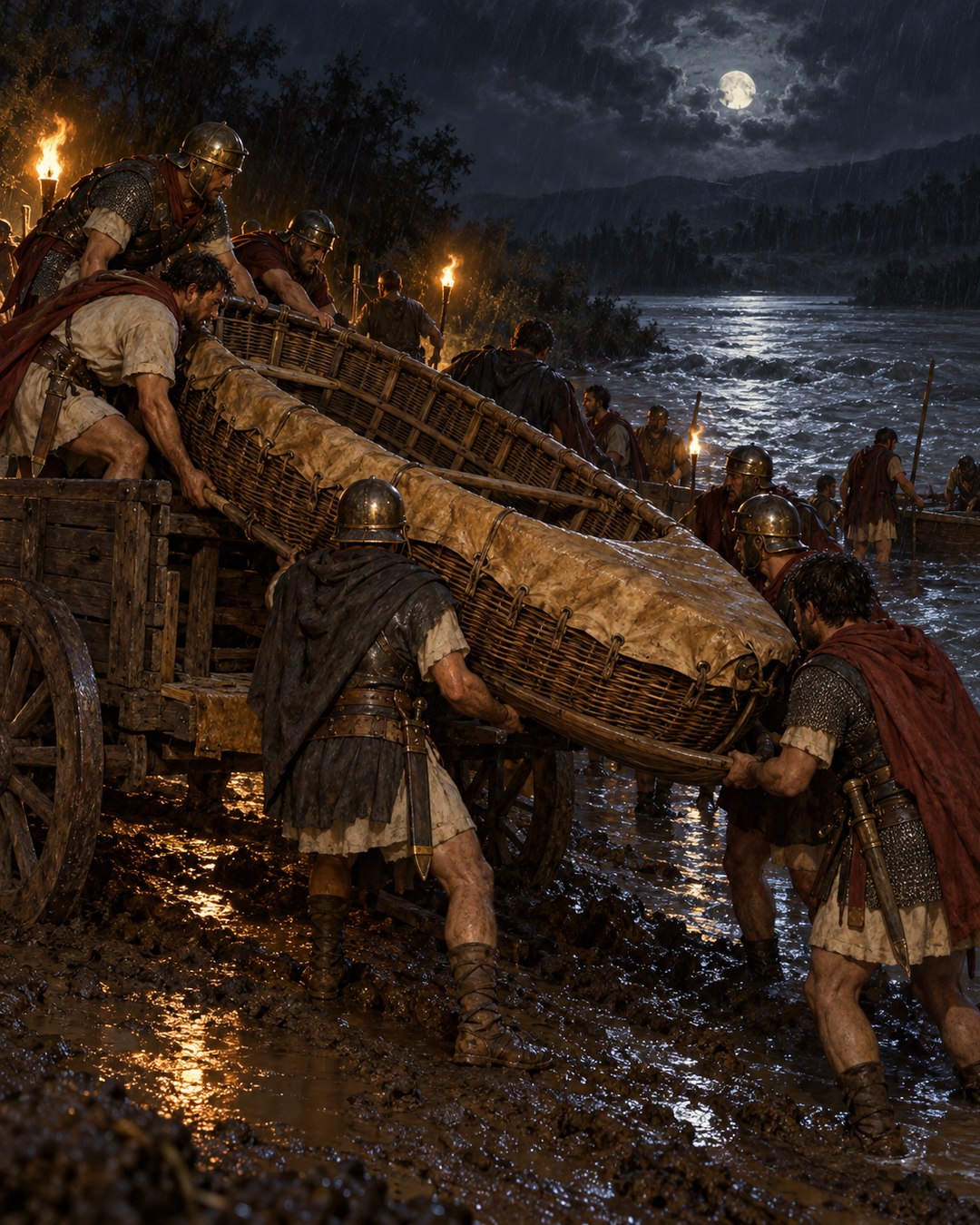
Caesar’s bridges near Ilerda were gone, the river crossings were watched, and food was becoming the sharper weapon. His answer began with boats that looked too light for the scale of the crisis. Their keels and ribs used slender timber. Wicker formed the rest of the hull, and hides kept the water out.
The design came from memory. Caesar says that experience in Britain had taught him the type a few years earlier. The craft could be built away from the guarded bank, loaded onto wagons, and moved twenty-two miles in a single night. Portability mattered before buoyancy did.
The boats did not replace a permanent bridge. They carried the first soldiers to a hill on the opposite bank, where a position could be fortified before the enemy noticed. Once that bridgehead existed, a legion crossed and workers began from both sides. Two days later, the improvised craft had created the conditions for a durable road over the river.
Floodwater turned two bridges into a food crisis
The operation belonged to a larger emergency in Caesar’s account of the campaign around Ilerda. Heavy storms raised the Sicoris and broke both bridges through which his army communicated with the country beyond. The rivers did more than obstruct marching. They separated soldiers from grain, convoys, and foraging parties.
Caesar describes his opponents, Afranius and Petreius, as holding the easier logistical position. They had supplies available, while his own army watched scarcity grow. Grain prices rose. Livestock gathered from farther areas could offer a temporary substitute, but the flow of ordinary provisions had been interrupted.
The imbalance affected information as well as stomachs. Reports reached Rome portraying Caesar’s situation as nearly finished. People congratulated Afranius’s circle, and some hurried toward Pompey so they would not appear to have waited for the outcome. A broken crossing could therefore generate political momentum far from the river.
The physical trap explains why a simple boat was not a small detail. Passes were guarded by enemy infantry and cavalry. Bridge work at an obvious point could be observed and attacked before it produced a usable span. Caesar needed to place force on the far side before committing workers to a fixed structure.
The same campaign logic appears in the attack on Uxellodunum’s water supply: movement and endurance depended on controlling a narrow material connection. At Ilerda, the connection was not a spring but access across floodwater. Whoever governed it governed the army’s time.
Caesar’s narrative naturally presents his own response as rapid and competent. It does not give a workshop inventory, the number of boats, or the losses involved in testing them. Those absences matter. What it does preserve is a sequence precise enough to show why the craft were chosen: they could be made light, moved secretly, launched quickly, and used before the enemy adjusted.
British construction made the hulls portable by wagon
Caesar identifies the boats through knowledge acquired in Britain. The statement does not mean that every material or worker crossed from Britain to Spain. It means that a form encountered in one theater entered the commander’s practical repertoire and could be reproduced with local timber, wicker, hides, carts, and labour.
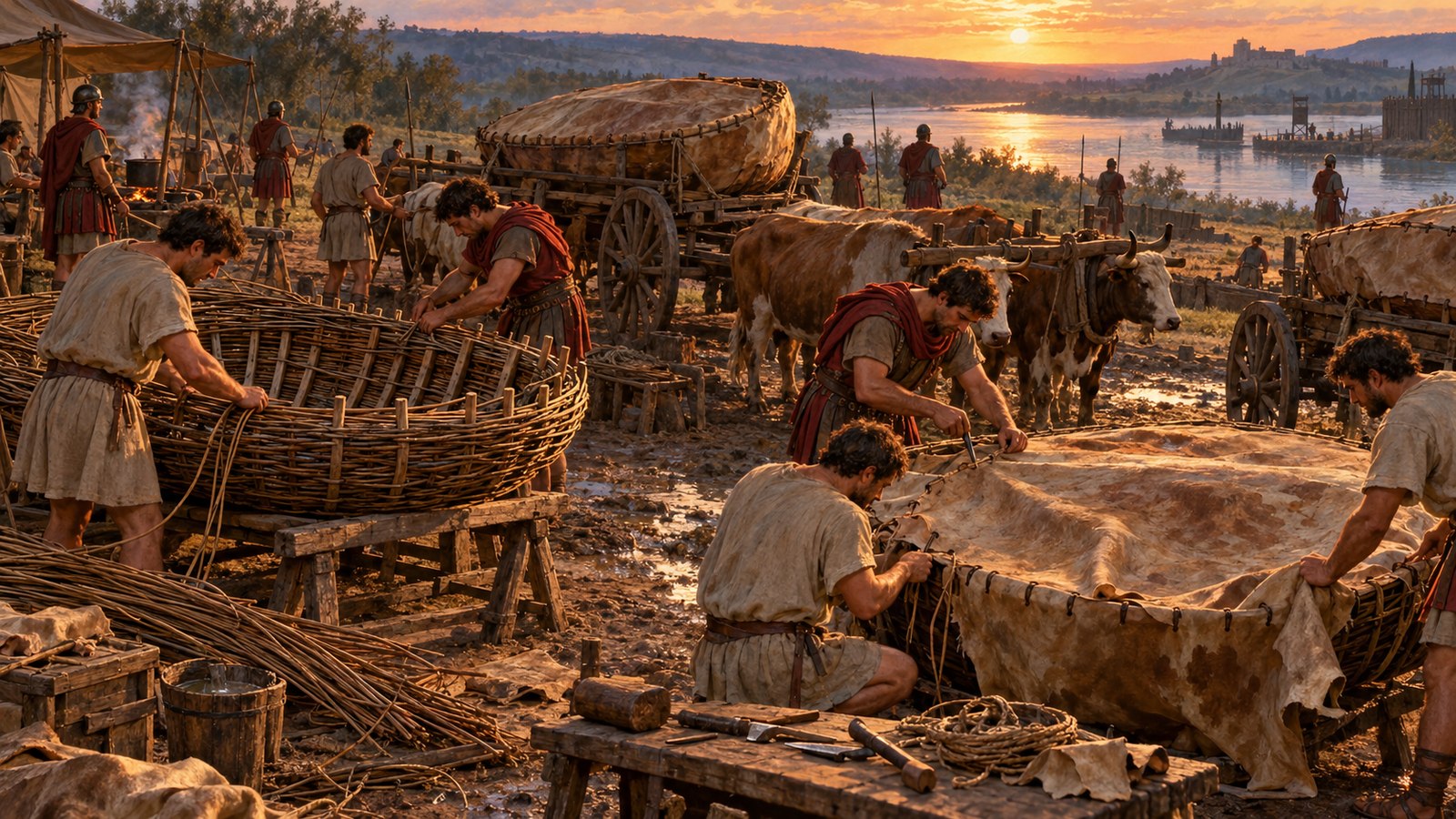
The construction order starts with a skeleton. Light wooden keels and ribs gave the craft shape without the mass of thick planking. Wicker-work filled the spaces between structural members. Hides created the outer covering that made the woven body serviceable on water.
Each material answered a different problem. Timber kept the hull coherent. Wicker spread the skin over a broad form while remaining light and workable. Hides supplied a flexible barrier. None alone was a boat. Together they made a vessel whose most important dimension may have been its weight on land.
That landward requirement distinguishes the craft from ordinary river shipping. Caesar says the completed boats travelled twenty-two miles by wagon in one night. A conventional heavy hull might have demanded a visible boatyard beside the water or a difficult downstream route. These could arrive as cargo.
The wagons also connected craft knowledge to army transport. The same organization that moved grain, tools, baggage, and siege materials could carry a temporary fleet. A boat ceased to be tied to the bank where it was built.
Roman soldiers already had to convert carried materials into working infrastructure. Marius’s forked poles reorganized personal loads; these wagons reorganized a river crossing. Both cases show equipment chosen not only for what it did at rest, but for how it travelled before use.
The source does not explain the waterproofing seams, frame dimensions, carrying capacity, or steering method. Images of the operation should therefore avoid pretending to preserve a measured naval plan. The secure details are the light ribs and keels, wicker body, hide covering, wagon journey, soldiers, river, and tactical result.
A temporary crossing created a permanent bridgehead
At the river, the first passengers were not bridge builders working unprotected in open water. Soldiers crossed and suddenly occupied a hill adjoining the bank. High ground gave the landing a defensible anchor. Caesar says it was fortified before the enemy perceived the operation.
Surprise converted fragile transport into territorial control. The boats only had to carry enough force quickly enough for the far bank to stop being wholly hostile. Once the hill held, the crossing could accumulate strength rather than begin from zero on every trip.
A legion followed. That escalation reveals the difference between reconnaissance and bridgehead. The far side now held a formation substantial enough to protect sustained work and contest an enemy response.
Bridge construction then began from both banks. The captured position shortened the tactical distance even if it did not shorten the river. Workers no longer had to project the whole structure out from one exposed shore. Caesar reports completion in two days.
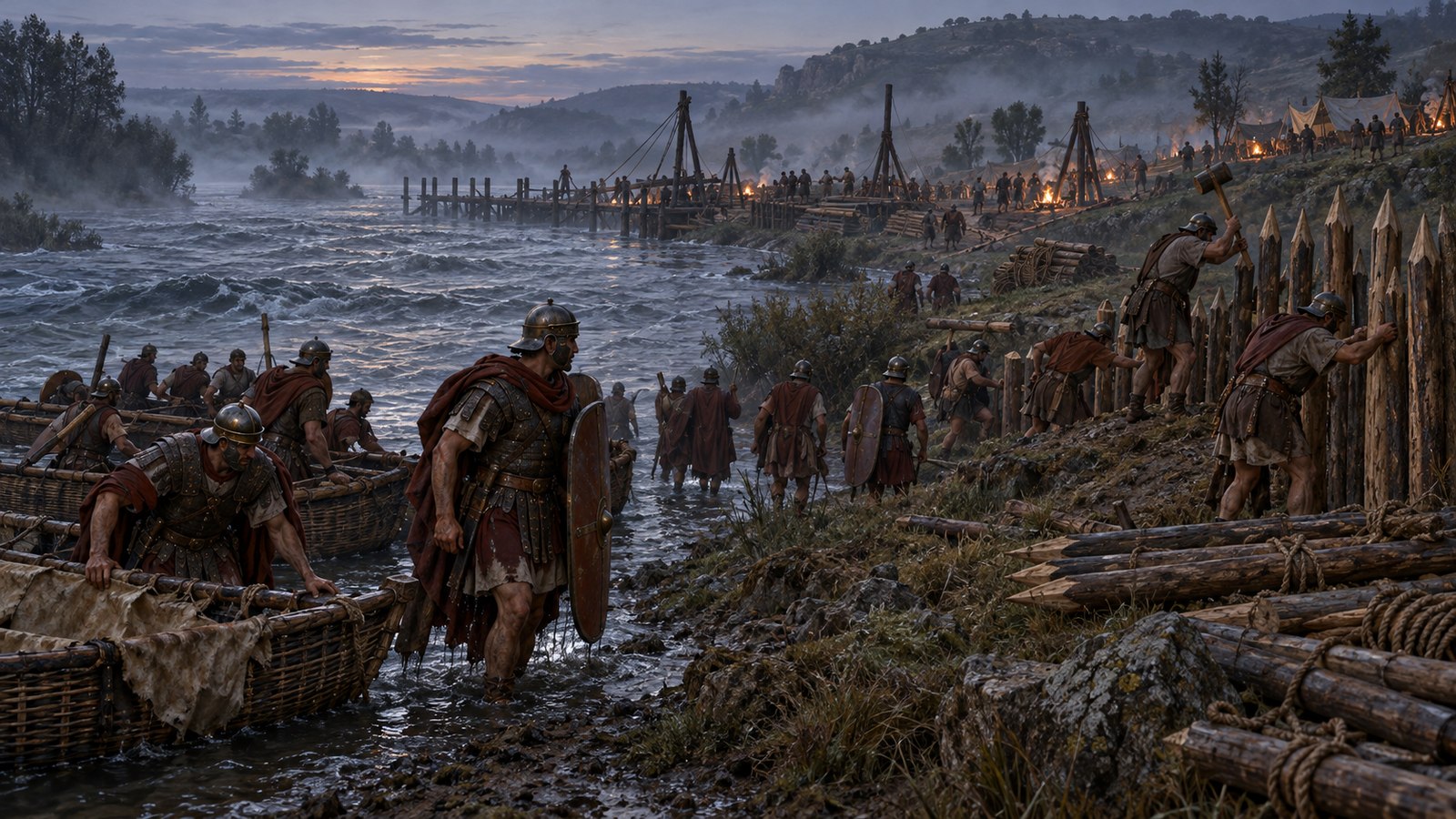
The permanent bridge changed the scale of movement. Convoys and foragers who had been cut off could return safely. Preparations for carrying provisions resumed. Cavalry crossed, struck dispersed enemy foragers, divided to protect captured animals and resist reinforcements, and returned over the bridge.
The sequence should not be compressed into a miracle of engineering. Flood, hunger, guarded routes, remembered design, dispersed construction, wagon transport, night movement, boat crossing, hill fortification, legion transfer, bridge work, convoys, and cavalry action were separate links. Failure at any one could have left the army on the wrong side of the logistical balance.
Nor were the hides invulnerable. Flexible coverings could tear; wicker could deform; overloaded craft could swamp. Their advantage came from accepting temporary limits. They were not asked to become warships or carry the whole supply system indefinitely. They were asked to open the first protected passage.
That is why the twenty-two-mile wagon journey deserves as much attention as the launch. The operation moved the point of construction away from enemy observation and moved the finished answer back to the obstacle at the chosen time. The boats crossed the river because they had first crossed the land.
Caesar’s account makes improvisation look sudden, but it rested on stored experience. Britain supplied the remembered form; Spain supplied the crisis; army workshops supplied the materials; wagons supplied mobility; infantry supplied security; engineers supplied the bridge. Innovation here was recombination under pressure.
When provisions began moving again, the wicker hulls had already completed their most valuable service. They had turned a flooded boundary into a foothold, and a foothold into two days of bridge building. Light craft did not solve the campaign by themselves. They restored the army’s ability to make heavier solutions.
Sources
Julius Caesar, Civil War, 1.48–55.