
Aulus Gellius did not describe Athens’s first public library by room size, shelf plan, or lending rule. He described where its books went. Pisistratus reportedly founded the collection. Athenians enlarged it. Xerxes carried it to Persia after taking the city. Much later, Seleucus Nicator sent it back.
That chain of custody turns library history into political history. A collection could be public in one generation, war booty in another, and an object of royal restitution in a third. The same books changed meaning as control changed hands.
Gellius then leapt from Athens to the far larger collection associated with the Ptolemies in Egypt and to its wartime burning. His compressed chapter is not a modern institutional history. It is evidence for how a Roman compiler imagined the life of collections: rulers gathered them, citizens enlarged them, armies displaced them, kings returned them, copyists multiplied them, and fire could erase them without a formal order.
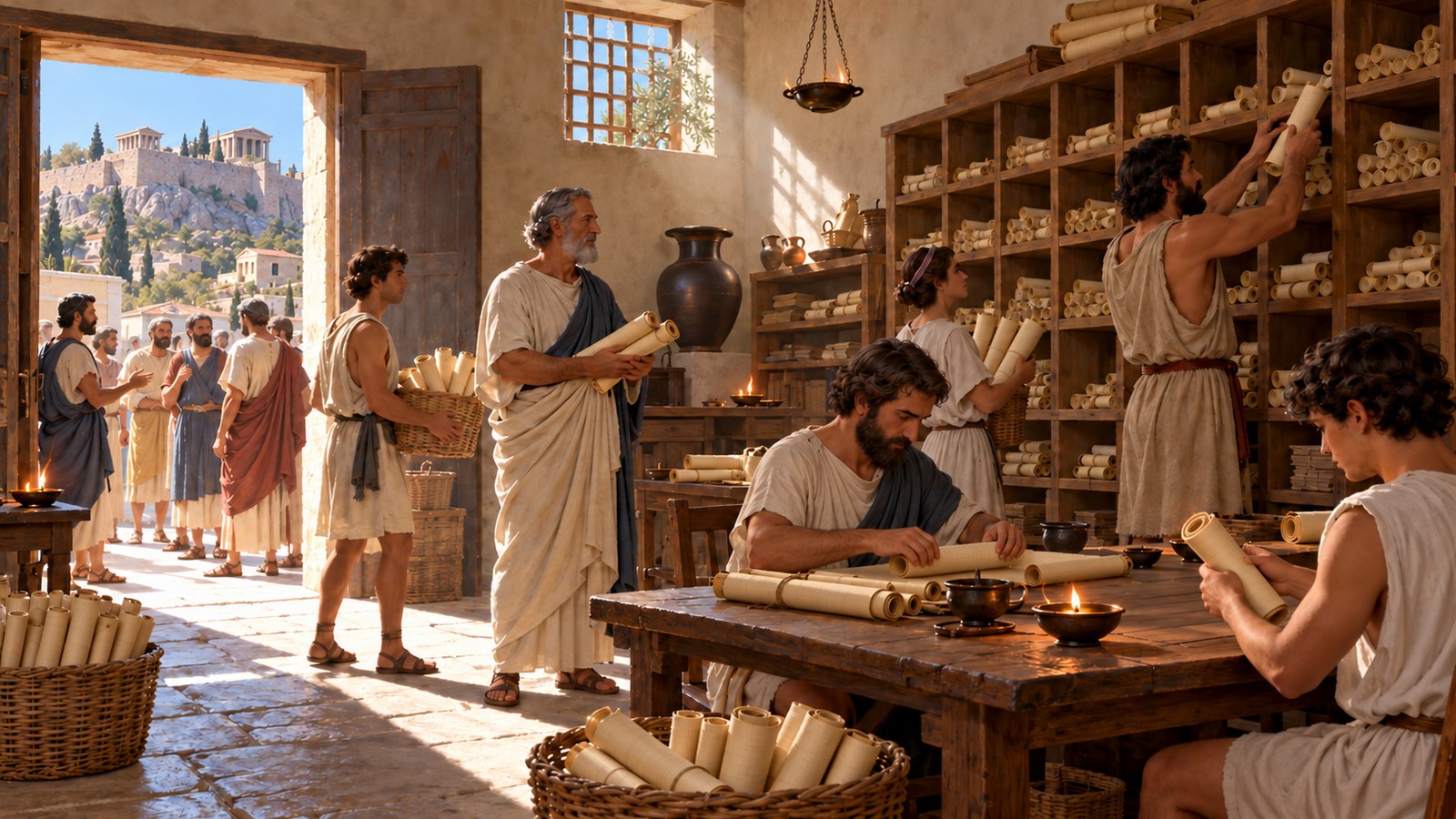
Pisistratus’s collection became public before it became famous
Gellius presents Pisistratus as the first person to establish a public library at Athens. He marks the claim as report rather than personal verification, and his wording should be preserved. “Is said” is not the same as an archive inventory dated and signed by the founder.
The description of the contents is broad: books relating to the liberal arts. Gellius supplies no catalogue, author list, material count, opening hours, or definition of who qualified as the public. The label tells us what later memory valued about the foundation, not every rule by which it operated.
Pisistratus’s role also complicates an easy opposition between tyranny and culture. In the story, a ruler creates access to a learned collection. The political form of the regime and the public character of the books occupy the same sentence.
The library did not remain only the founder’s monument. Gellius says Athenians themselves added to it with considerable diligence and care. A single act of establishment became a collective process of enlargement.
That distinction matters because founding and maintaining are different achievements. A room can be dedicated once; a collection requires selection, acquisition, copying, repair, and arrangement over time. Gellius gives those unnamed Athenian efforts only a phrase, but the phrase prevents Pisistratus from owning the whole story.
The focus on growth differs from Pliny the Elder’s intensely personal system of reading and dictation. Pliny accumulated notes by refusing to waste time. The Athenian account concerns a collection made public and enlarged beyond one reader’s lifetime.
We should not picture a modern municipal building or standardized codices. The texts would have belonged to a manuscript culture in which copying created another object by hand. “Adding” a book might mean acquiring a roll, commissioning a copy, receiving a gift, or transferring material from another holder. Gellius does not choose among those routes.
Conquest turned a civic collection into movable spoil
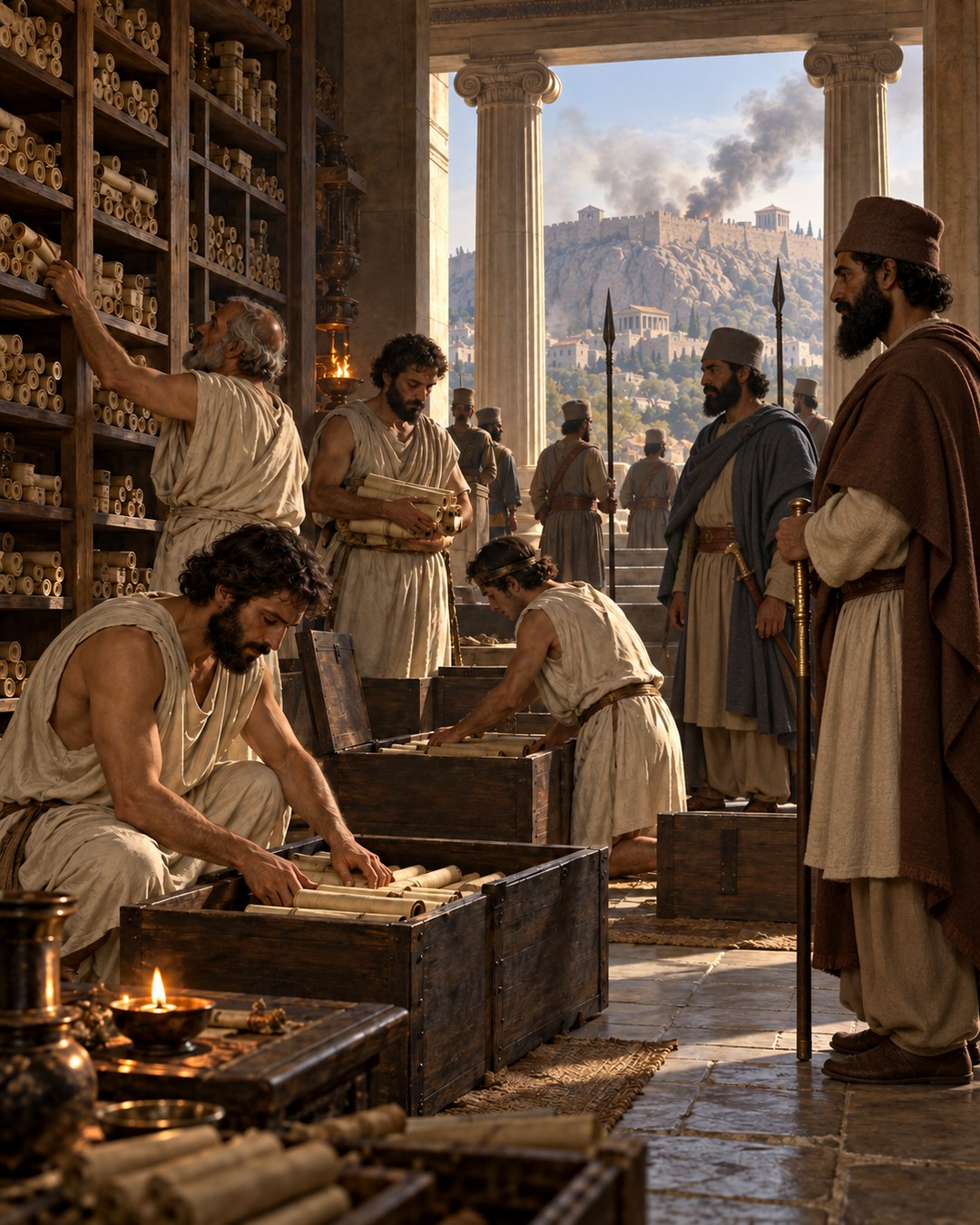
The next stage begins when Xerxes took Athens. Gellius says the city was burned except for the citadel and that the whole collection was removed to Persia.
Books are lighter than temples, walls, or bronze monuments, but a large collection is not effortless cargo. Rolls require containers, handling, transport, and decisions about what stays together. Gellius gives no convoy scene. His phrase “whole collection” creates a total transfer in narrative form.
That completeness deserves caution. Ancient numbers and claims about total loss often compress untidy realities. Some texts could have existed in other copies; some rolls might have been lost, dispersed, or replaced. The important historical fact within Gellius’s chapter is the tradition that conquest changed custody on a collection-wide scale.
Removal made knowledge into a trophy. Destroying a library would deny its use. Carrying it away preserved the objects while redirecting access and prestige toward the conqueror’s realm.
The movement also reveals the double nature of manuscripts. Their words could in principle be copied, but each roll remained a physical thing that could be packed, damaged, stolen, sold, gifted, or returned. Intellectual content did not float free of transport.
War therefore acted on the collection through logistics. Someone identified the books, gathered them, and moved them east. Even if Gellius’s compact version smooths over the operation, it remembers scholarship as vulnerable to the same roads and imperial power that moved treasure and captives.
That vulnerability echoes Galen’s loss of books in a Roman fire. Galen’s disaster exposed dependence on unique personal copies. The Athenian story makes the threatened unit public and civic, then converts loss into displacement rather than immediate destruction.
Seleucus’s return made restitution part of royal memory
Gellius says that a long time afterward Seleucus, surnamed Nicator, had all the books taken back to Athens. Again, the absolute language serves a clean arc: collection, seizure, exile, restoration.
The interval matters. The king who returned the books was not simply undoing his own recent raid. Restitution reached across political generations. The collection had outlived the regime that removed it and acquired a history separate from any one owner.
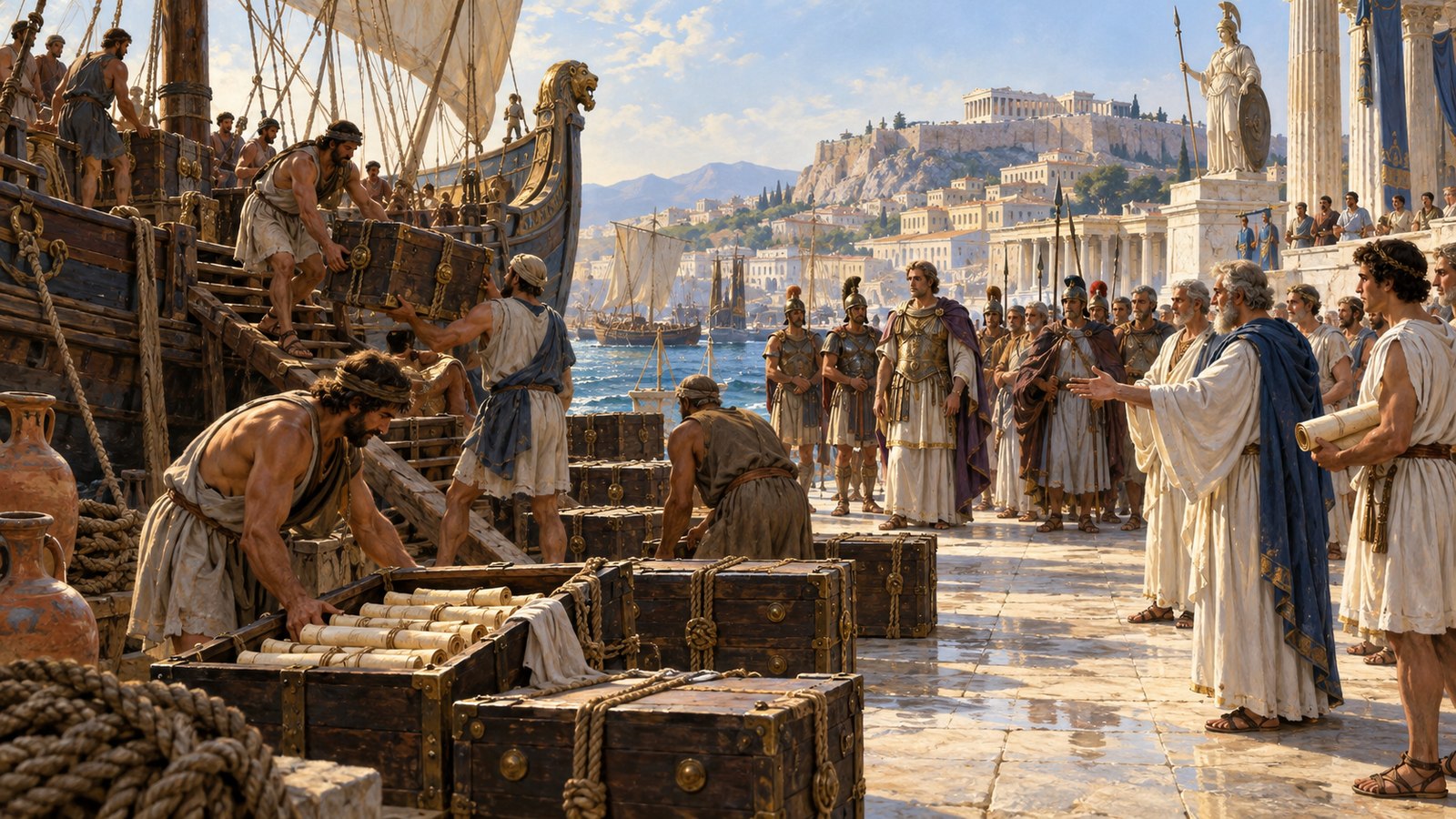
Sending the books back created another form of prestige. Xerxes appeared as conqueror and remover; Seleucus appeared as restorer. Both royal identities were attached to movement of the same cultural object.
For Athens, return did not erase interruption. A restored roll came with a second history: not only what its text said, but where conquest had taken it. The library could symbolize survival because custody had been broken and reassembled.
Gellius then makes a dramatic comparison with Egypt. Under the Ptolemies, he says, nearly seven hundred thousand volumes were acquired or produced through copying. The paired verbs matter. Libraries grow both by obtaining objects and by making new manuscript witnesses.
The number is part of an ancient report, not a figure we can audit from this chapter. It communicates enormous scale. Gellius’s Athens is remembered through a sequence of owners; Alexandria is remembered through abundance and sudden exposure to war.
He attributes the Alexandrian burning to auxiliary soldiers during Rome’s first war with the city and explicitly denies deliberate order or intent. In his telling, a collection built by royal policy and scribal labour did not require a policy of destruction to suffer catastrophe. Operational fire was enough.
Modern histories debate the dates, scale, and stages of damage to Alexandrian collections. Gellius’s statement should not be expanded into the claim that one blaze erased every book in every Alexandrian library forever. His chapter records one Roman author’s compressed account and his insistence that the fire he described was accidental.
That caution strengthens rather than weakens the article’s main point. Gellius himself organizes the material around verbs of custody: establish, add, remove, carry, take back, acquire, copy, burn. None is a description of reading a particular text. Together they describe the conditions that decide whether reading remains possible.
A library’s public identity could not protect it from conquest. A famous founder could not maintain it after death. A vast count could not make it fireproof. Survival depended on repeated human decisions—copying, transport, return, rebuilding—and on the accidents those decisions could not control.
The chapter also makes Gellius part of the chain. He preserved the account in a miscellany for later readers, with all its confident totals and careful qualifications. The Athenian rolls are not available to us as one intact returned shelf. What survives here is a story about their movement.
That is the paradox of the chapter. The books matter, but the individual titles vanish. Political memory keeps founders, conquerors, restorers, numbers, and flames more readily than catalogues. Gellius lets us see how antiquity remembered a library when it could no longer simply walk through its doors.
Sources
Aulus Gellius, Attic Nights, 7.17.