
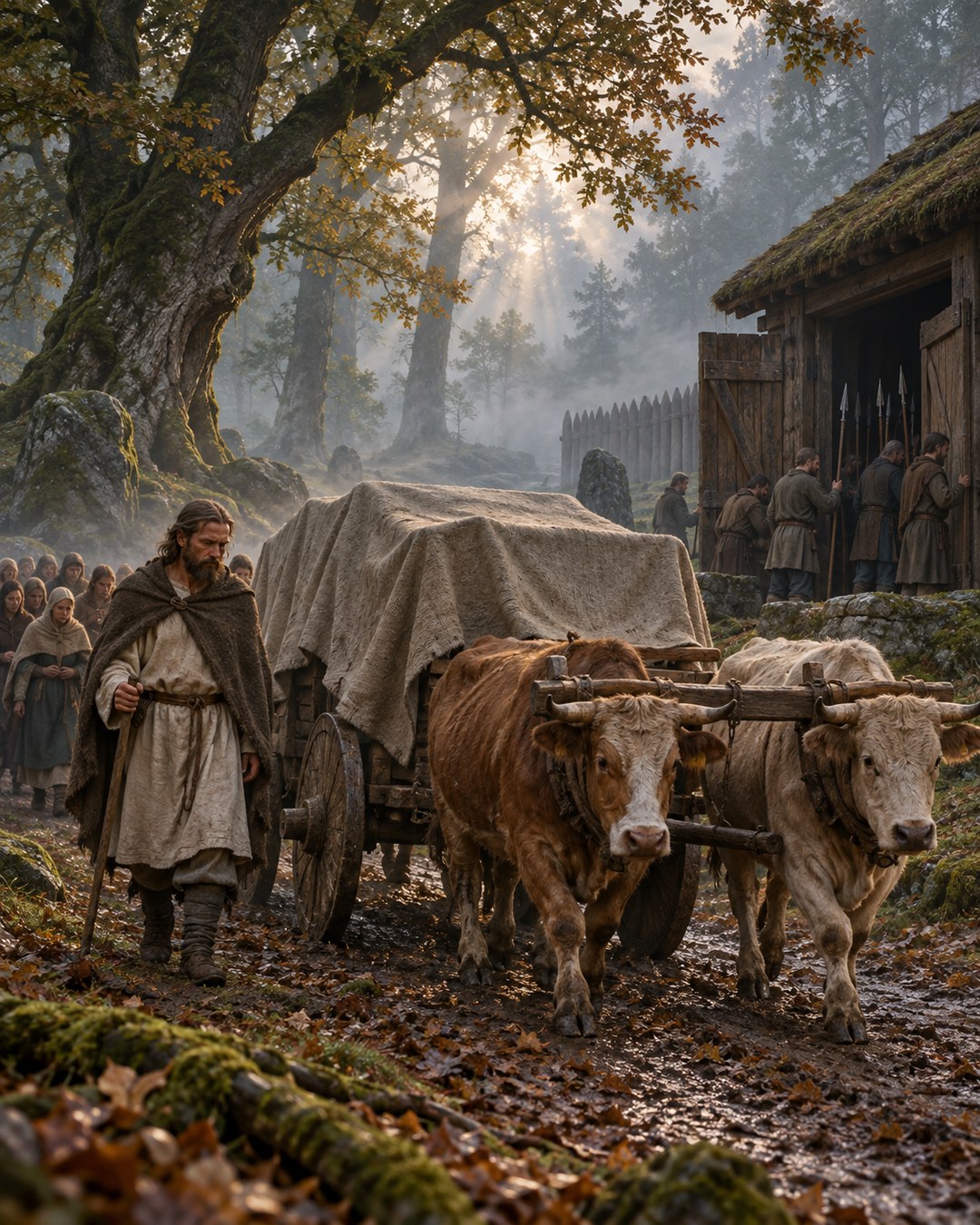
Tacitus placed a covered vehicle inside a grove on an island in the ocean. Only one priest could touch it. When he judged that Nerthus was present, cows drew the vehicle out among seven peoples, and ordinary conflict stopped. Weapons were put away, iron was locked up, and places the procession visited became places of celebration.
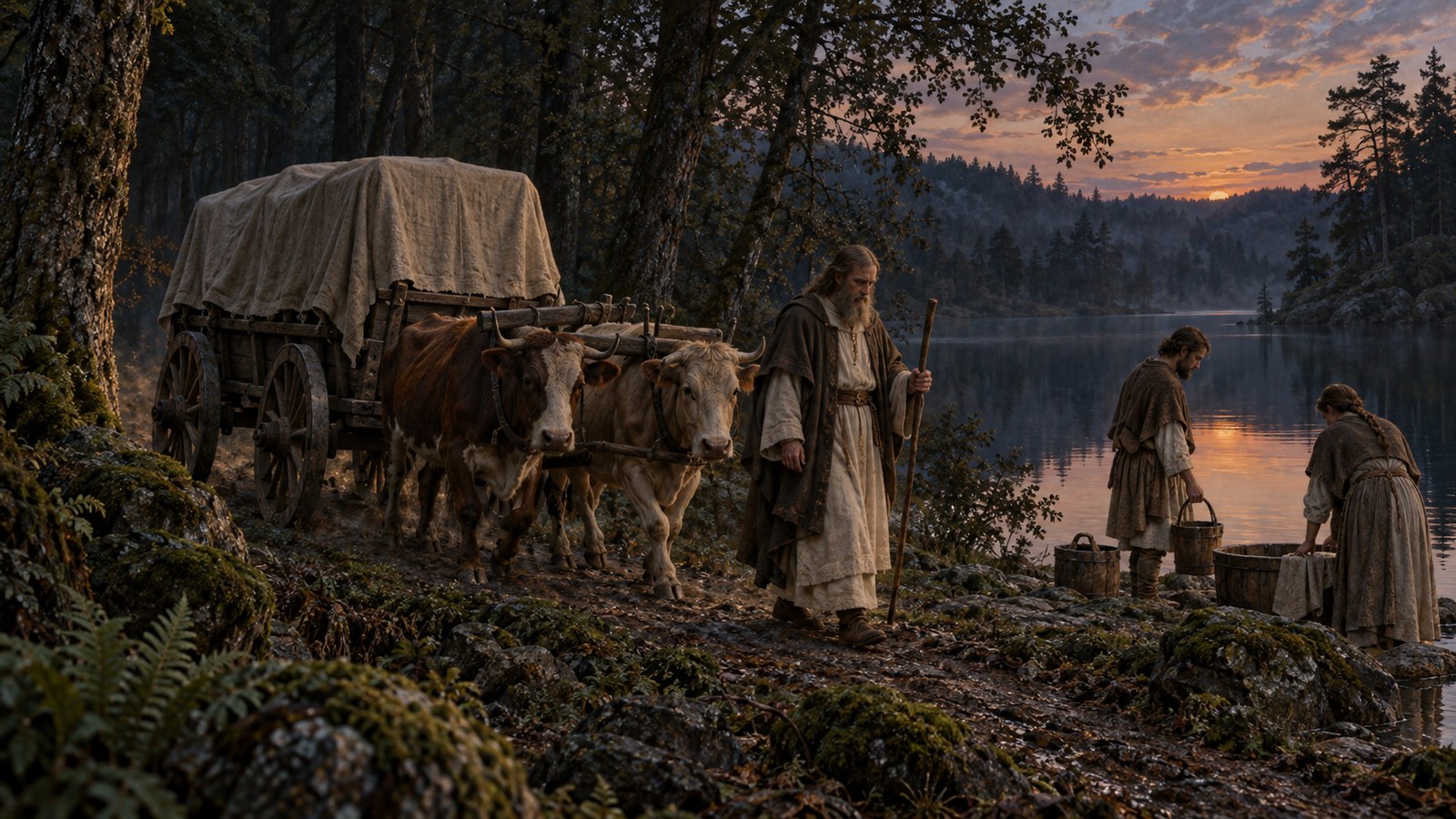
The road ended at a secluded lake. There the vehicle, its cloth, and the divine presence were washed. The enslaved attendants who performed that service were then, Tacitus says, swallowed by the same water. The final witnesses did not return.
This is not a transparent report from inside the cult. It is a Roman author’s compressed ethnographic account of communities beyond Rome. Yet the compression preserves a striking mechanism: sacred power was made socially effective by moving through public space while remaining physically hidden.
Seven peoples shared one guarded route
Tacitus begins with names. He groups the Reudigni, Aviones, Anglii, Varini, Eudoses, Suarines, and Nuitones together, describing them as protected by rivers or forests. Geography gives the list a frame before religion gives it a connection.
The seven groups did not become one state in his sentence. What they shared was worship of Nerthus. Tacitus interprets her for his Roman readers as Mother Earth, a gloss that makes an unfamiliar cult legible without proving that every local idea matched a Roman category.
He says the worshippers believed the goddess intervened in human affairs and travelled among the peoples. The two claims belong together. Divine involvement was not merely a belief stored in a sanctuary. It acquired a route, a vehicle, an escort, and a sequence of visits.
An island in the ocean contained the sacred grove. The location placed water around the sanctuary before the final lake appeared inside the ritual story. Access had layers: surrounding landscape, grove, covered vehicle, and priest.
The vehicle was consecrated and hidden beneath cloth. Tacitus does not describe a face, costume, statue material, wheel count, or decoration. The absence is important. Modern reconstruction should not fill the cloth with an invented idol and present it as source detail.
Only the priest could touch the vehicle. He also interpreted the decisive transition, perceiving when the goddess was present within the sanctuary. The rite therefore depended on an authorised reader of signs, not on a crowd seeing an image.
This guarded access differs from the Roman division of labour around a public prayer. There, several specialists protected a spoken formula from interruption. Here, one priest protected the threshold between hidden presence and public movement.
Cows carried a peace that warriors could not command
Once the priest recognised the moment, cows drew the vehicle and he accompanied it with deep reverence. The choice of draught animal kept the procession close to cultivated earth and patient traction rather than the speed and display of a war chariot.
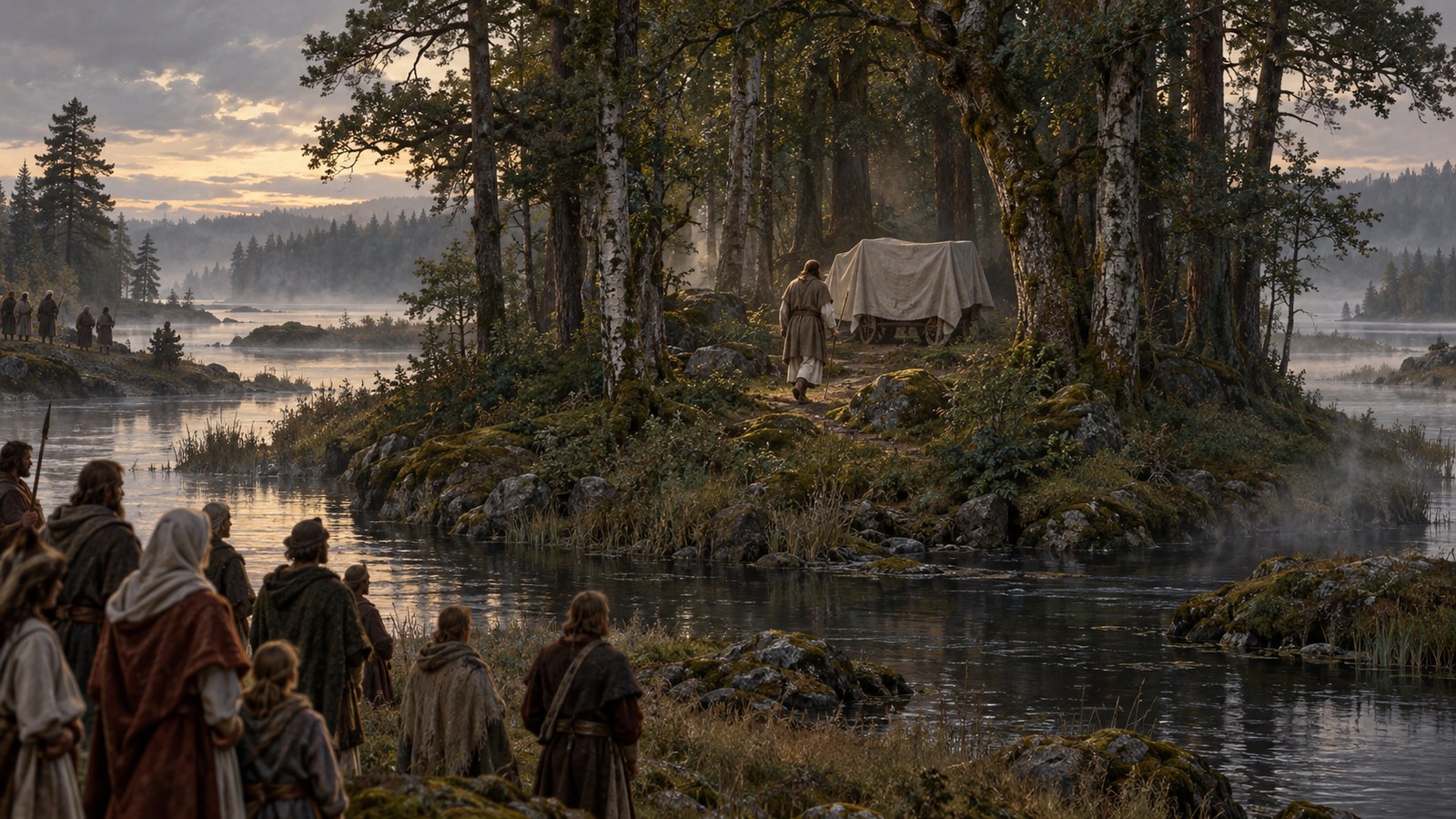
The covered object was therefore mobile but not visually exposed. People could know that the goddess was travelling without receiving a view of whatever rested beneath the cloth. Presence was announced by the procession’s effects.
Tacitus marks those effects with time and place. The days became joyful. Every place honoured by arrival and stay became festive. A route through separate communities briefly produced a shared calendar of reception.
Most strikingly, people did not go to war. They did not take up weapons. Iron objects were kept locked away. Peace was not described as a treaty negotiated between named leaders; it was a condition imposed by the goddess’s passage.
Locking away iron made the suspension material. The account does not say merely that hostile intentions softened. Objects capable of turning intention into violence became unavailable. Sacred time changed the permitted relationship between hand and metal.
The contrast would have been legible to Roman readers accustomed to ritual boundaries around military action. Yet Tacitus makes the custom foreign through its island grove, covered vehicle, cattle, and fatal washing. Familiar effects and unfamiliar procedure sit beside each other.
We should resist turning the scene into proof of a permanently peaceful society. Tacitus describes a bounded interval. Weapons returned after the rite. Precisely because conflict was possible, the temporary prohibition mattered.
The procession resembles the carefully narrated movement of Juno from Veii only at a distance. Juno’s transfer made conquest speak in Roman religious language. Nerthus’s circuit did not relocate the deity permanently; it joined communities and then withdrew.
The cloth made absence part of the public spectacle
A procession normally seems designed to make something visible. Tacitus’s vehicle did the opposite. Cloth denied the central sight while wheels, cows, priest, closed weapons, and celebrations displayed everything around it.
That arrangement shifted proof from object to consequence. Worshippers did not need Tacitus’s reader to inspect the goddess. The altered behaviour of whole communities marked her arrival. Peace functioned as the visible surface of a hidden presence.
The priest’s monopoly reinforced that structure. He alone could touch the vehicle and alone announced presence. Authority rested on proximity to what others could not handle.
At the same time, the rite moved beyond the grove. Secrecy did not mean immobility or private devotion. The sacred centre travelled through inhabited places and changed public conduct without surrendering its covering.
Tacitus gives no route map, duration, season, or order of communities. Nor does he identify who locked the iron, who enforced the ban, or what happened when someone resisted. Those gaps prevent us from converting a vivid paragraph into a complete institution.
His vocabulary also belongs to interpretation. “Mother Earth” and divine intervention are Roman-facing explanations. The communities named in the chapter left no explanatory voice inside his text. The account is evidence for Tacitus’s representation as well as for the ritual tradition he reports.
Still, details of handling form a coherent sequence. Hidden vehicle, restricted touch, priestly signal, cattle traction, peaceful visits, return, washing, and eliminated witnesses each regulate a different boundary. The rite did not rely on one prohibition; it stacked them.
The lake closed the circuit by removing its witnesses
After the goddess had enough of human company, Tacitus says, the vehicle returned to the temple. The phrasing gives withdrawal to divine preference, not to an announced timetable.
A secluded lake received the vehicle. There it was washed, along with the cloth and, in Tacitus’s wording, the goddess herself. Cleansing followed public contact and prepared sacred objects for concealment again.
Enslaved attendants performed the work. Their status matters because the most dangerous access was assigned to people without freedom to refuse. Ritual privilege and coercion met at the water’s edge.
The lake then swallowed them. Tacitus frames the deaths as immediate and uses them to explain the terror and sacred ignorance surrounding what only doomed men could see.
The killing, as Tacitus tells it, prevented knowledge acquired during washing from circulating. Whether read as reported practice, ethnographic horror, or literary closure, it seals the narrative mechanism with terrible efficiency.
Water performed several roles. It isolated the island, contained the secluded lake, cleansed the sacred equipment, and destroyed the attendants. The same element marked separation, renewal, and erasure.
That ending makes the earlier peace harder, not easier, to romanticise. A community could lock away weapons for the goddess while directing fatal force toward enslaved workers. Suspension of war did not abolish hierarchy or violence.
Tacitus closes with mystery: terror on one side, ignorance on the other. His readers are left outside the cloth and above the water, able to follow the route but not to see its centre.
The cart’s political effect was therefore inseparable from controlled incompleteness. Everyone could observe that iron vanished and celebration spread. Almost nobody could touch the carrier of those changes, and nobody assigned to expose it at the final washing returned to explain what he saw.
Sources
Tacitus, Germania, section 40.