
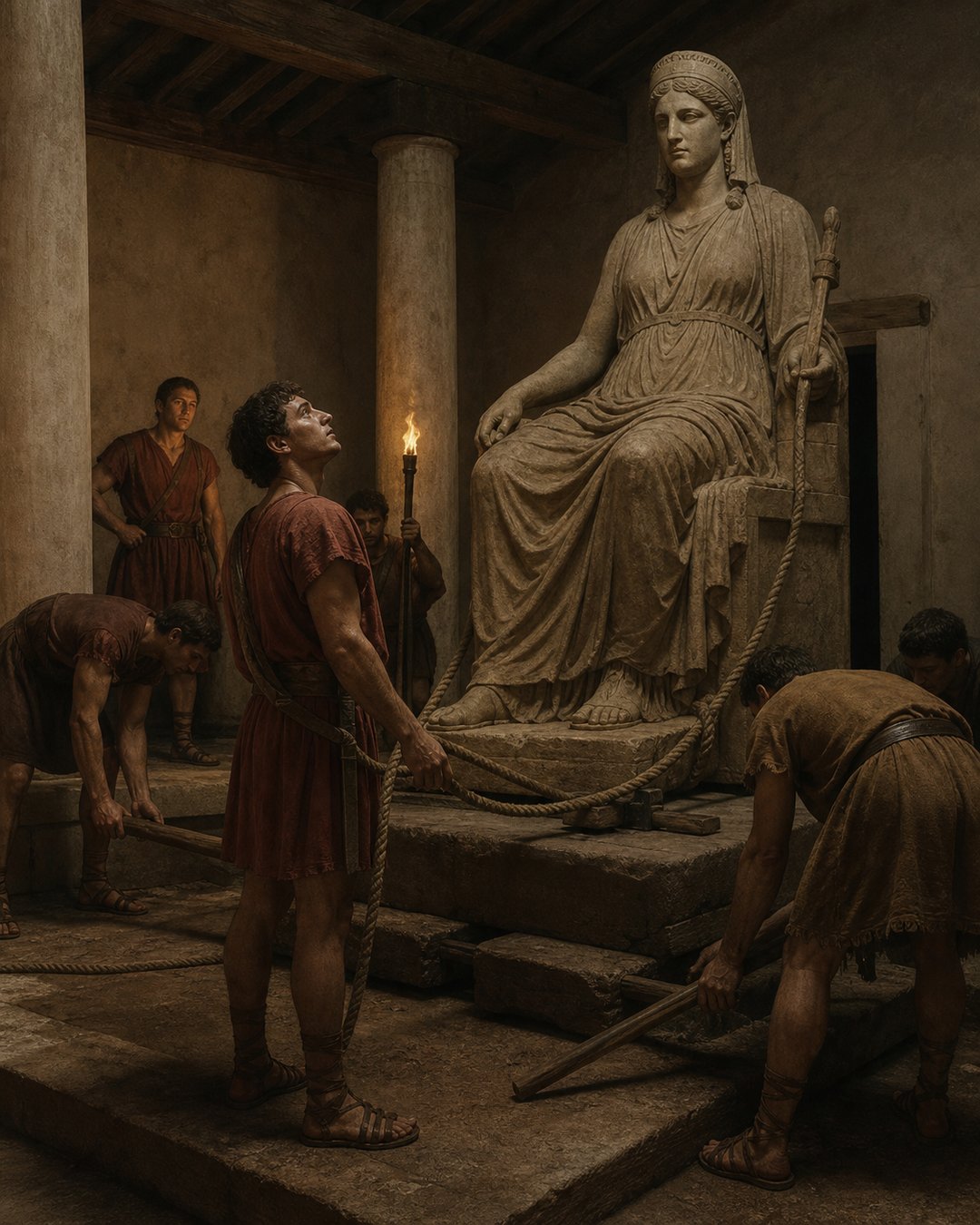
Veii had been conquered, but its great goddess could not be treated like an ordinary prize. Livy says the Romans selected youths, made them wash, dressed them in white and sent them into Juno Regina’s temple with profound reverence. Etruscan custom, as he understood it, had normally allowed only a priest from a particular family to touch the statue.
Then one of the young men asked the seated goddess a direct question: was she willing to go to Rome? The others cried that she had nodded. A later layer of the story made the answer even clearer and gave her a voice. What followed supplied physical confirmation. The image, Livy says, rose with machinery of trifling power and seemed light, as though it were willingly following its new bearers.
The episode is often remembered as a charming miracle at the end of a siege. Its deeper work was political and ritual. Rome possessed the temple because Roman arms had taken the city. The story of the answer transformed possession into consent. Juno did not merely cross into Roman hands; in Livy’s telling, she agreed to cross into Roman worship.
Conquest Stopped at the Edge of the Sacred
Veii’s fall came after what Livy called ten summers and winters of unbroken siege. The length of the struggle made the city’s capture an enormous Roman victory, but long resistance also sharpened the religious problem. A community’s protecting deity was bound to the place Rome had just destroyed as an independent power. Carrying away her image could look like another act of stripping the defeated city.
The procedure slowed that violence down. The chosen carriers did not rush through the temple as looters. Washing separated them from the dirt of siege and sack. White clothing marked the approach as ceremonial. Livy’s phrase about profound adoration placed bodily respect before physical control.
The restriction he attributes to Etruscan usage made the moment more delicate. If only a priest of one family normally touched Juno, Roman hands entered a boundary they did not own simply because the walls had fallen. Religious awe acknowledged that the image remained dangerous and significant under conquest.
This is a different narrative engine from Camillus’s return of the betrayed children at Falerii. There, restraint persuaded living citizens that Rome could deserve surrender. At Veii, ritual restraint helped the conquerors narrate a relationship with a deity whose former city could no longer speak for itself.
A Question Made the Whole Group Witnesses
Livy leaves the first questioner’s motive open. The youth may have spoken under divine inspiration or in youthful play. That uncertainty matters. The historian does not force the reader to accept a private revelation. Instead, he moves immediately to the group’s reaction: the rest shouted that Juno had nodded assent.
A solitary joke became a witnessed event because the room answered together. The question was simple enough for every carrier to understand. It also offered only one decision that mattered—stay or go. When the others declared that they had seen a nod, the transfer gained a human chorus before anyone tried to shift the stone.
Livy then marks a development in the tradition. The report that Juno actually spoke and said she was willing was, he notes, added afterward. That distinction prevents the episode from becoming a flat transcript of supernatural speech. It shows memory becoming more explicit. A perceived nod was eventually strengthened into words.
The layered account resembles the care needed when reading the omen in the story of the twenty-first sacrificial ox before Pydna. Roman narratives did not merely report that signs occurred. They also preserved disputes over timing, audience and interpretation. Juno’s answer gained force because the account showed how witnesses turned an ambiguous movement into a public meaning.
Light Machinery Became Evidence of Will
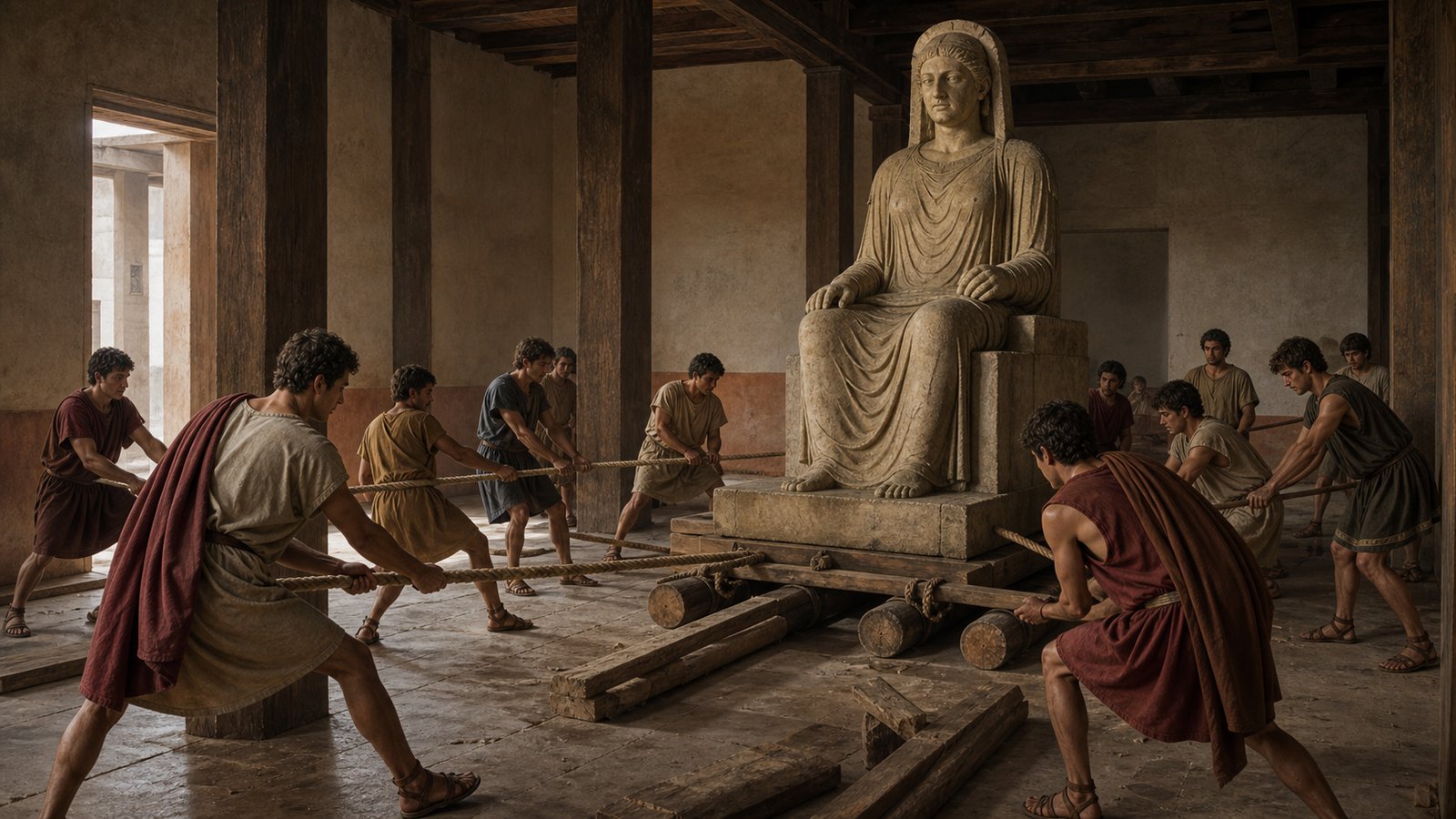
The statue still had to leave its base. Livy says machines of trifling power raised it, and that it proved light and easy to move. We should not convert that phrase into a modern engineering specification. He gives no weight, lever ratio, frame dimensions or number of carriers. The practical operation remains mostly hidden.
What he does reveal is the interpretation placed on effort. A heavy cult statue that resisted, cracked or toppled would have jarred against the proclaimed assent. Easy movement made the earlier answer visible through matter. The image behaved as a willing traveler ought to behave.
Simple lifting gear could have included ropes, timber, rollers or levers, but any exact reconstruction exceeds Livy’s words. The secure claim is narrower: readers were asked to connect unexpectedly slight force with divine cooperation. Mechanical success entered the religious argument instead of competing with it.
That is why the phrase “as if she willingly followed” carries more weight than the machinery itself. Rome did not need to deny that human hands and devices moved the statue. The story made those devices instruments through which willingness appeared. Technique and miracle occupied the same action.
The Aventine Completed Camillus’s Invitation
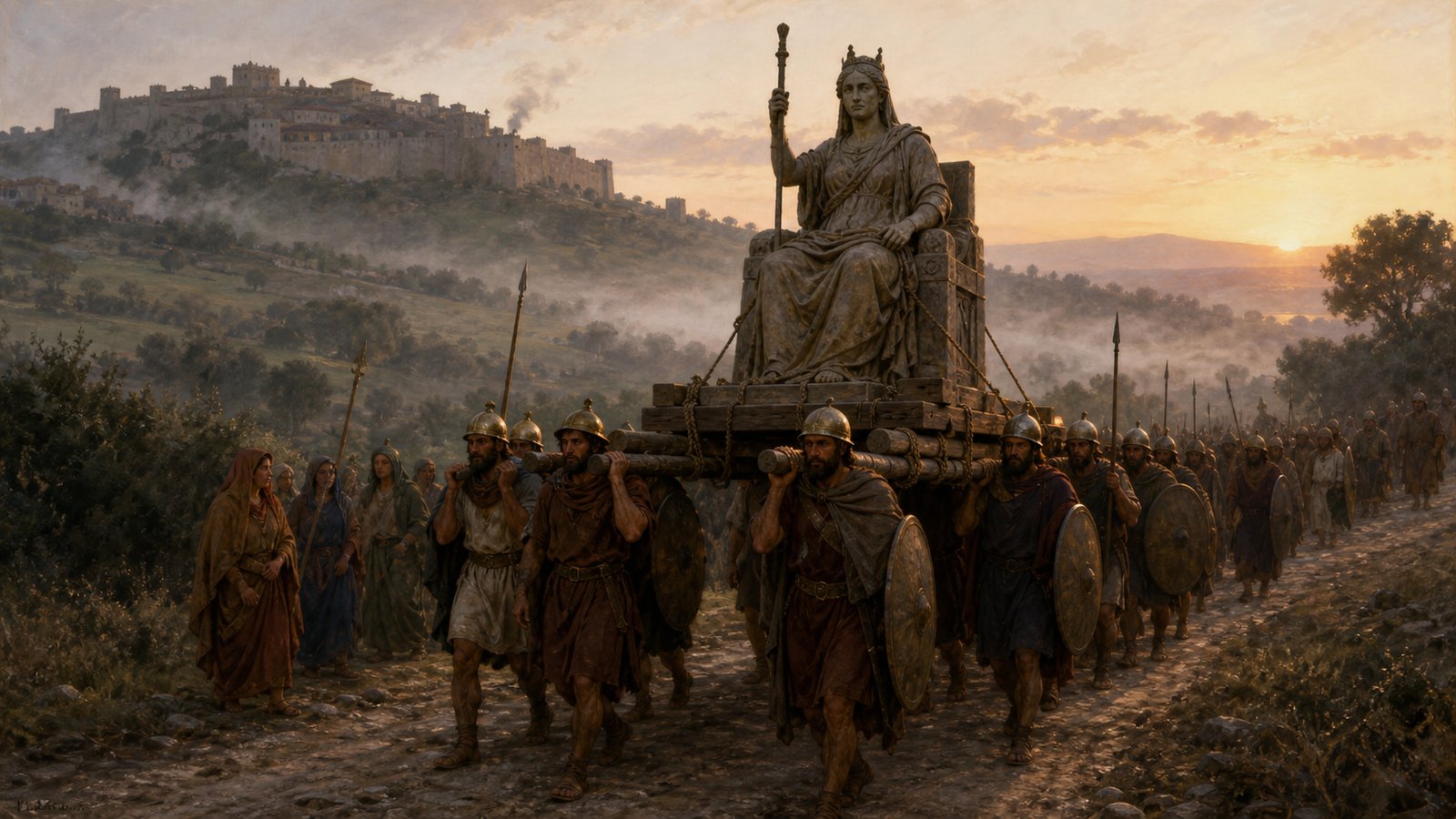
The journey ended safely on the Aventine. Livy calls it Juno’s eternal seat, the place to which Camillus’s vow had invited her. The verb behind the narrative logic is not simply “take.” The dictator had promised a destination and a cult; the goddess’s answer accepted that destination; the successful transport fulfilled the transfer.
Camillus later dedicated a temple there to Juno Regina. A new building converted a single dramatic removal into durable Roman practice. Worshippers did not need to return to conquered Veii to encounter the queenly goddess. Her Roman address made the victory present in the city’s sacred geography.
The movement also differed from destroying a rival cult. Juno’s power was not declared false when Veii lost. It was treated as real enough to court, house and honor. Rome’s expansion could absorb gods as well as territory, claiming that divine relationships had been reassigned rather than erased.
That absorptive logic also helps explain why sacred objects receive such precise physical attention in Roman stories. The pointed vessel discussed in the account of the Vestals’ water container mattered because form enforced ritual use. At Veii, washed bodies, white clothing, restricted touch and easy lifting gave form to a change in allegiance.
The Miracle Solved a Roman Problem
Livy was writing centuries after the capture of Veii, and his own wording warns that details accumulated. The speaking voice belonged to a later addition even within his account. The story cannot be used as a neutral record of what a stone statue physically did in 396 BCE.
It can be read securely as evidence for the problem Roman memory wanted to solve. Military victory explained how the image came under Roman control. It did not by itself explain why the goddess who had belonged to Rome’s enemy could become an honored guardian in Rome.
The answer was constructed through sequence. Respect came before touch. A question came before removal. Collective assent came before machinery. Easy movement came before safe arrival. A promised temple came after the journey. Each stage narrowed the space for interpreting the transfer as mere theft.
When Juno Regina reached the Aventine, the Romans could therefore tell two stories at once. Veii had been defeated by siege and artifice. Its goddess, however, had not been defeated. She had been invited, had answered and had followed. The distinction let conquest look like divine choice—and made a captured image into a Roman cult.
The account also preserved a boundary between what Livy asserted and what he merely transmitted. He treated safe arrival and the Aventine dedication as parts of the cult’s Roman history, while identifying the speaking voice as an embellishment. Reading those levels separately does not empty the scene of meaning. It shows the historian managing a tradition in which ritual success, collective memory and later wonder had grown around the same journey.
Sources
Livy, History of Rome 5.22.