
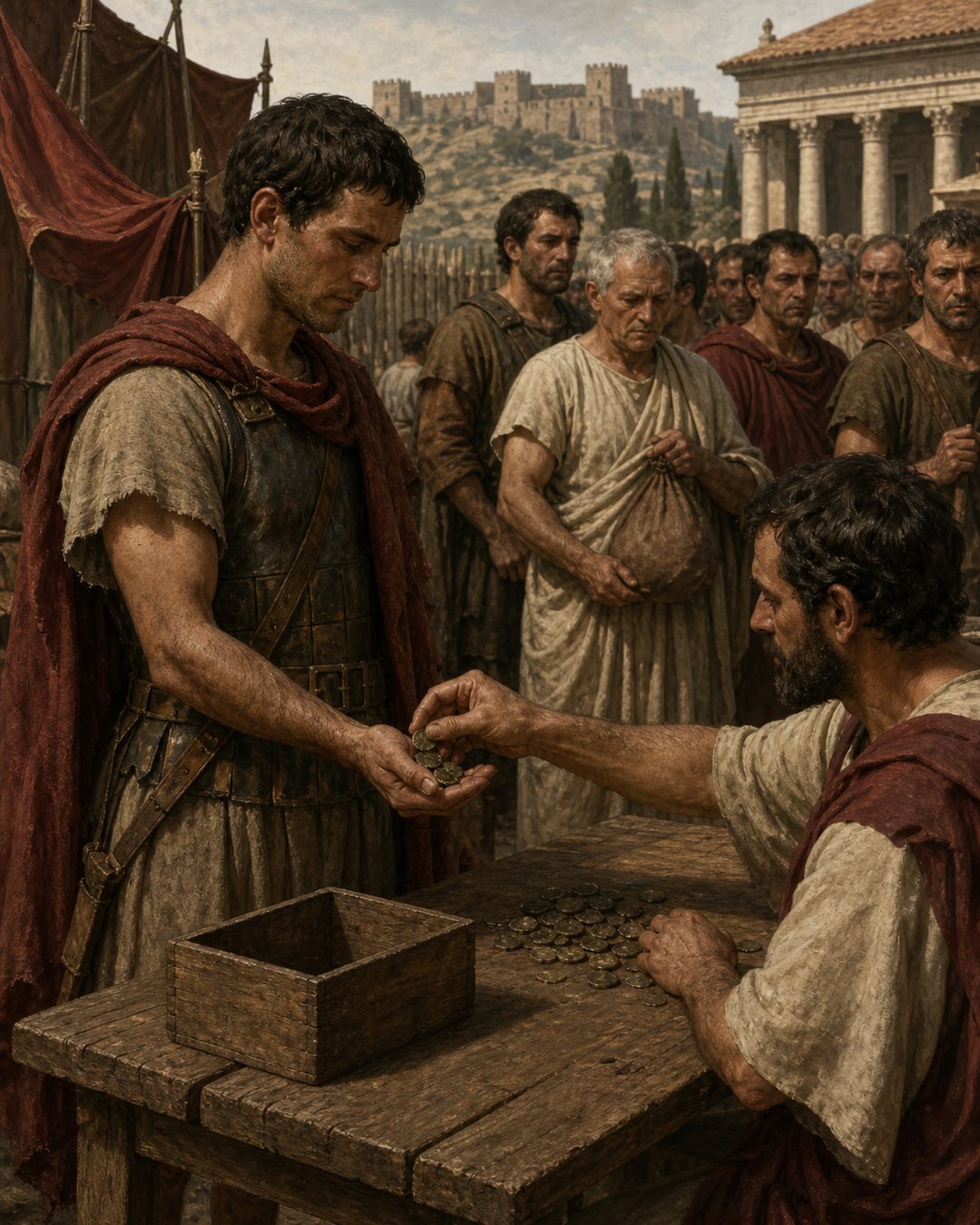
Rome’s Senate announced a benefit before the commons or their tribunes had demanded it: soldiers would receive pay from the public treasury. Until then, Livy says, each man had performed military service at his own expense. The news sent crowds toward the Senate house to seize the hands of departing senators and call them true fathers.
The joy had an obvious material cause. A citizen whose body was occupied by the commonwealth no longer had to watch his private property absorb the whole cost of absence. Yet the treasury did not create wealth. The tribunes asked the question hidden inside the applause: from what source could the money come except a levy on the people?
Livy’s answer is a revealing scene in the politics of collection. Patricians paid first according to assessed property. With no coined silver available, some made a show of hauling weighed bronze to the treasury in wagons. Leading plebeians followed by plan, praise attached itself to payment, and resistance turned into competition. Military wages and taxation arrived as one bargain.
Service Had Previously Followed the Soldier Home
The old arrangement made the costs of war difficult to separate from household resources. A citizen did not merely give days of labor and accept bodily danger. Livy says he served at his own expense. Equipment, food, lost work and neglected property pressed on the same private base from which the soldier had departed.
That burden could remain tolerable during a short seasonal campaign and become punishing when operations lasted. The developing struggle with Veii demanded persistence. An army that invested a nearby enemy city could not treat every absence as a brief interruption followed by an uncomplicated return to farm and workshop.
Public pay altered the timing of sacrifice. The citizen’s body still belonged to the campaign while he served, but the treasury supplied money during that separation. Livy makes the emotional calculation explicit: private property might remain unimpaired while bodies were devoted to the commonwealth.
The change complements the logistical discipline explored in the history of Roman marching camps. A standard camp made each day’s halt repeatable in space. Regular pay made longer service more bearable in the household economy. Both reduced the chance that duration alone would dissolve an army.
The Senate Offered the Benefit Before a Demand
Livy emphasizes that the decree arrived voluntarily. The tribunes had not introduced it, and the commons had not made it a subject of organized conversation. That timing allowed leading senators to present themselves as generous rather than cornered. They could claim foresight and affection instead of surrender to pressure.
The initial response rewarded that framing. People crowded the Senate house, grasped hands and declared that no one would spare body or blood for a country so liberal. Livy may heighten the harmony, but the political mechanism remains clear. A material concession produced public language about loyalty.
Offering pay also changed recruitment incentives. A man who expected compensation could imagine prolonged service without treating every extra day as an uncompensated drain. Livy later says the army sent toward Veii contained a large proportion of volunteers. He does not reduce those volunteers to wages alone, but he places the facts in the same sequence.
The arrangement differs from the spectacular personal wealth in Lollia Paulina’s jewel display. Here value mattered because it circulated through public obligation. The state collected from assessed property and redirected resources toward men whose service removed them from their own.
The Tribunes Found the Bill Inside the Gift
The tribunes refused the language of costless generosity. Treasury money had to be raised, and they expected a tax. In their argument, senators were generous to one part of the people at the expense of another. A veteran who had once served without pay might now be assessed to finance a younger man’s better terms.
That objection did not prove the wage useless. It exposed distribution. Serving citizens gained immediate protection for their households, while property owners supplied the fund according to assessment. Many Romans belonged to both groups at different moments, which made the balance more complicated than a clean division between taxpayers and soldiers.
The tribunes offered protection to anyone who refused to contribute. This moved the dispute from speech to enforcement. An assessment became politically real only when officials could collect it or when another official could shield resistance. Rome’s new military promise therefore tested civic authority at home before it supported operations abroad.
Livy preserves a later complaint that soldiers could return with bodies worn by hardship and find property damaged through absence, only to pay back military wages through taxation. Whether or not every calculation worked that way, the argument identified a recurring danger: a benefit can become a loan in disguise if its recipient bears a disproportionate share of funding it.
Wagons of Bronze Turned Payment into Theatre
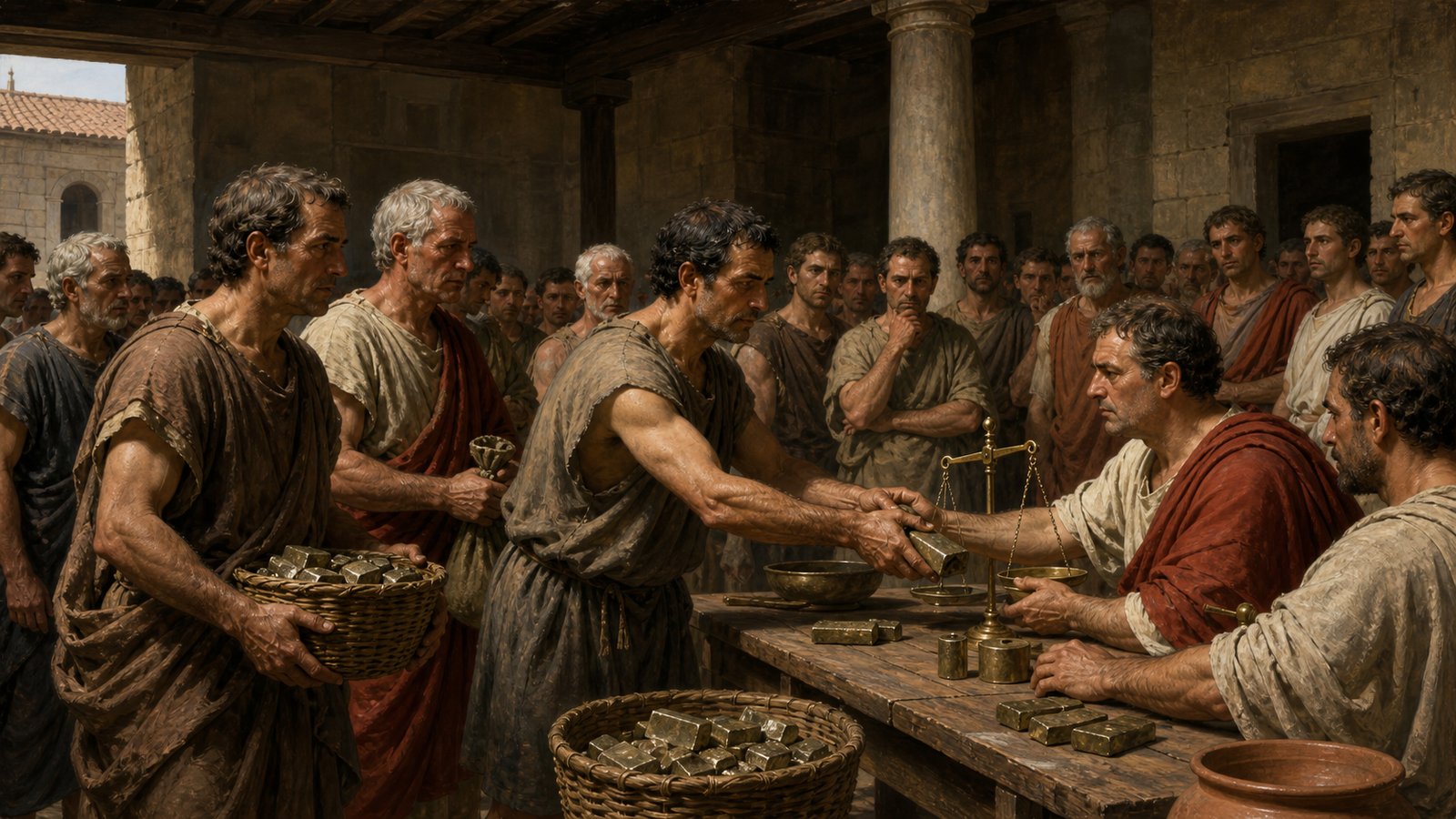
The patricians answered opposition with sequence and visibility. They paid first. Contributions were based on rated property, linking the levy to publicly recognized wealth. Because Livy says there was no coined silver, some brought weighed bronze in wagons. The bulk of the medium made compliance impossible to hide.
A wagon did more than transport metal. It staged fiscal capacity. Neighbors could see which households arrived early and heavily. The treasury became a civic theatre where payment attracted applause and refusal risked looking selfish while men of military age watched.
Leading plebeians friendly to the nobility contributed next according to a coordinated plan. Their participation prevented the act from remaining an exclusively patrician display. Once people saw contributors praised by senators and respected by potential soldiers, Livy says an emulation arose around paying the tax.
This is almost the opposite mechanism from the accounting described in the archive’s study of treasury ledgers. A ledger makes obligation durable after the crowd disperses. The wagons made obligation persuasive before accounting disappeared into records. One worked through administrative memory; the other through immediate visibility.
Pay Made Longer War Politically Possible
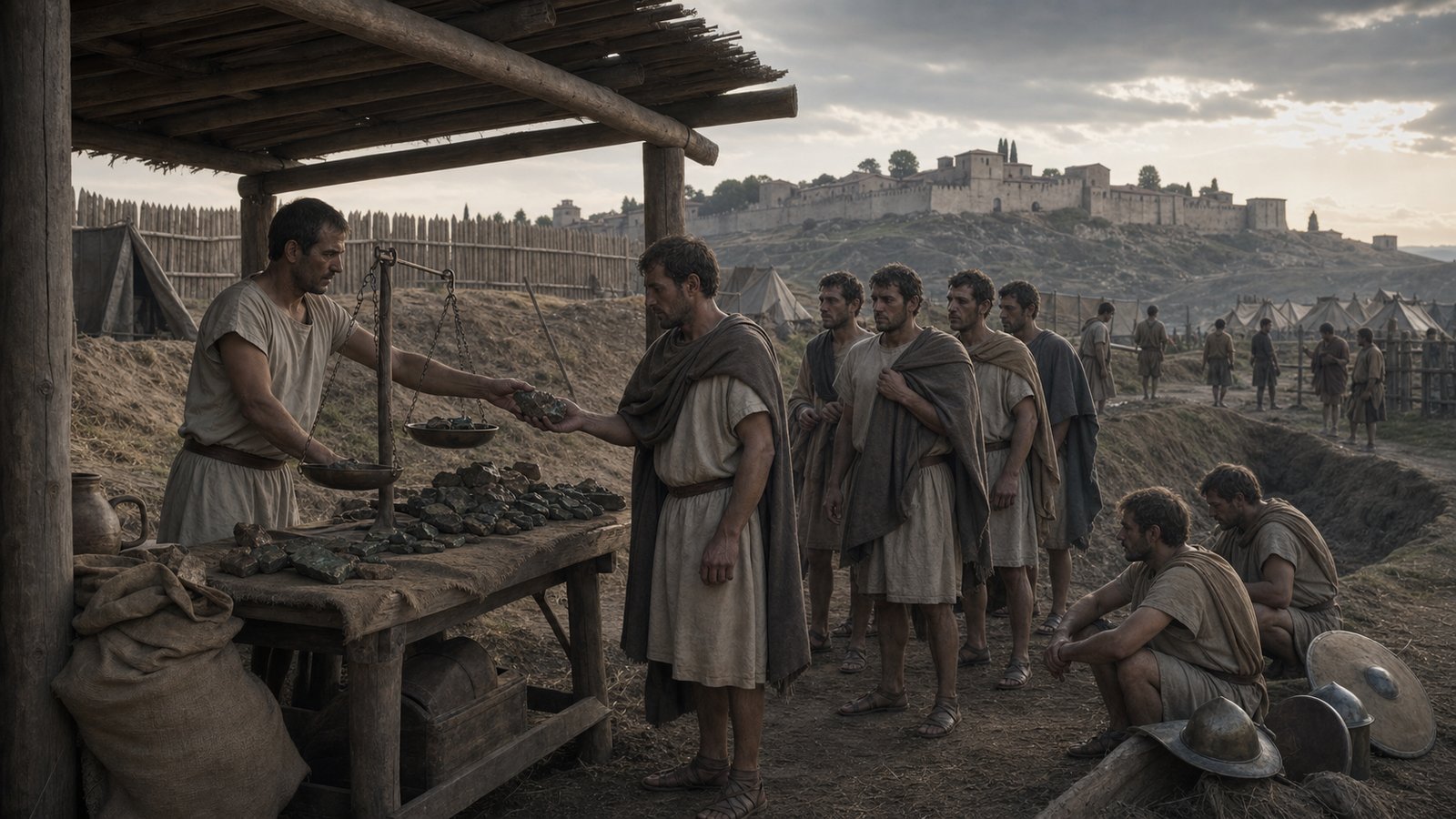
The law declaring war on Veii followed, and military tribunes marched out with a force Livy describes as largely voluntary. The sequence does not let us calculate a precise recruitment effect. It does show why pay belongs inside the history of Rome’s expanding capacity rather than in a side note about compensation.
Campaign endurance depended on more than courage. Men had to remain away from productive work, households had to survive that absence, and public authority had to gather resources from citizens not currently carrying shields. Soldier pay joined those pressures through the treasury.
The bargain was never frictionless. Tax resistance, elite choreography and the complaint of veterans all appear in Livy’s account. That friction is the point. Rome did not discover a free source of military power. It built a method for redistributing the costs of service and then fought over whether the distribution was fair.
When the weighed bronze reached the treasury, two transformations became possible. Metal assessed from property could become support for a soldier. A personal obligation to fight could become an expense recognized by the state. The applause outside the Senate house celebrated the second transformation; the tribunes forced Romans to look at the first.
Livy’s chronology belongs to Rome’s remembered early Republic, and his polished scenes should not be mistaken for surviving treasury accounts. He gives no pay rate, assessment table or total collected in this passage. Those absences matter. The episode supports the institutional sequence—public pay, political objection, property levy, elite-first payment and renewed campaigning—more securely than any modern attempt to calculate the exact bronze in each wagon.
Sources
Livy, History of Rome 4.59–60.