
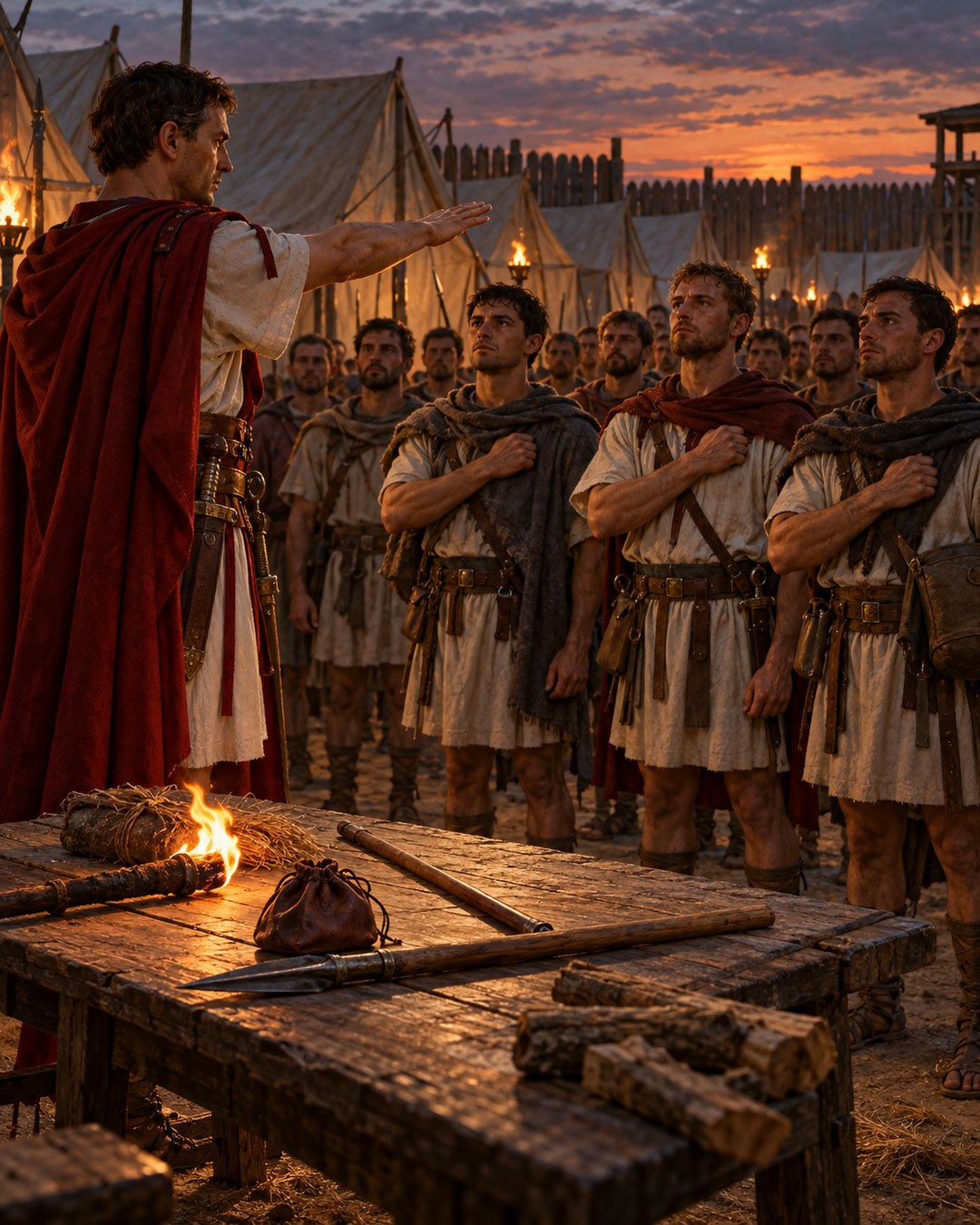
A Roman military oath preserved by Aulus Gellius did not say simply, “Do not steal.” It measured the offence. The words attributed to Cincius set a threshold of one silver sesterce in a day, drew a circle ten miles around the army, listed objects that could be taken, and imposed a three-day window for reporting other property.
The precision reveals a camp full of ambiguous movement. Wood, fodder, fruit, weapons, purses, and found objects crossed paths with soldiers who lived away from ordinary civic routines. Discipline had to distinguish provisioning, salvage, discovery, and deliberate theft.
Another formula in the same chapter governed attendance. Soldiers swore to answer the consul’s summons on an appointed day, unless death rites, disease, an unavoidable omen, sacrifice, violence, enemies, or a fixed legal obligation intervened. Even then, service resumed the next day.
Ten miles turned the camp into a legal landscape
Gellius says the wording came from Cincius’s work on military science. A tribune administered the oath, and a magistrate dictated it. The spoken formula attached each enrolled soldier to a common set of conditions.
It named the consuls Gaius Laelius and Lucius Cornelius. This was not a timeless maxim detached from command. The obligation identified the armies and the authorities to whom property could be delivered.
The rule reached through the army and ten miles around it. That radius matters because military life did not stop at a ditch or gate. Soldiers foraged, carried supplies, met civilians, moved between temporary positions, and encountered objects beyond the formal camp.
A geographic boundary made the rule portable. Wherever the army stood, the protected zone travelled with it. A soldier did not need a cadastral map of every settlement to know that conduct near the force remained inside the oath.
This mobile jurisdiction differs from Marius’s effort to make soldiers carry their own equipment. The forked pole reorganised weight on a march. Cincius’s formula organised claims over the objects encountered and carried.
The oath also named intention: theft done with malice aforethought, alone or together with others. Cooperation did not dilute responsibility. A group could not turn appropriation into acceptable camp custom merely by sharing it.
Value and time completed the first test. More than one silver sesterce in any single day crossed the stated line. The daily unit prevented a vague accusation from floating free of amount and interval.
A short list separated supplies from somebody else’s property
The preserved words then enumerate exceptions: one spear, a spear shaft, wood, fruit, fodder, a bladder, a purse, and a torch. The list feels miscellaneous because camp life was miscellaneous.
Wood fed fires and construction. Fodder sustained animals. A torch supplied light. Spear parts belonged to the material of war. Fruit could be consumed quickly. Bladders and purses were containers whose treatment required a stated rule.
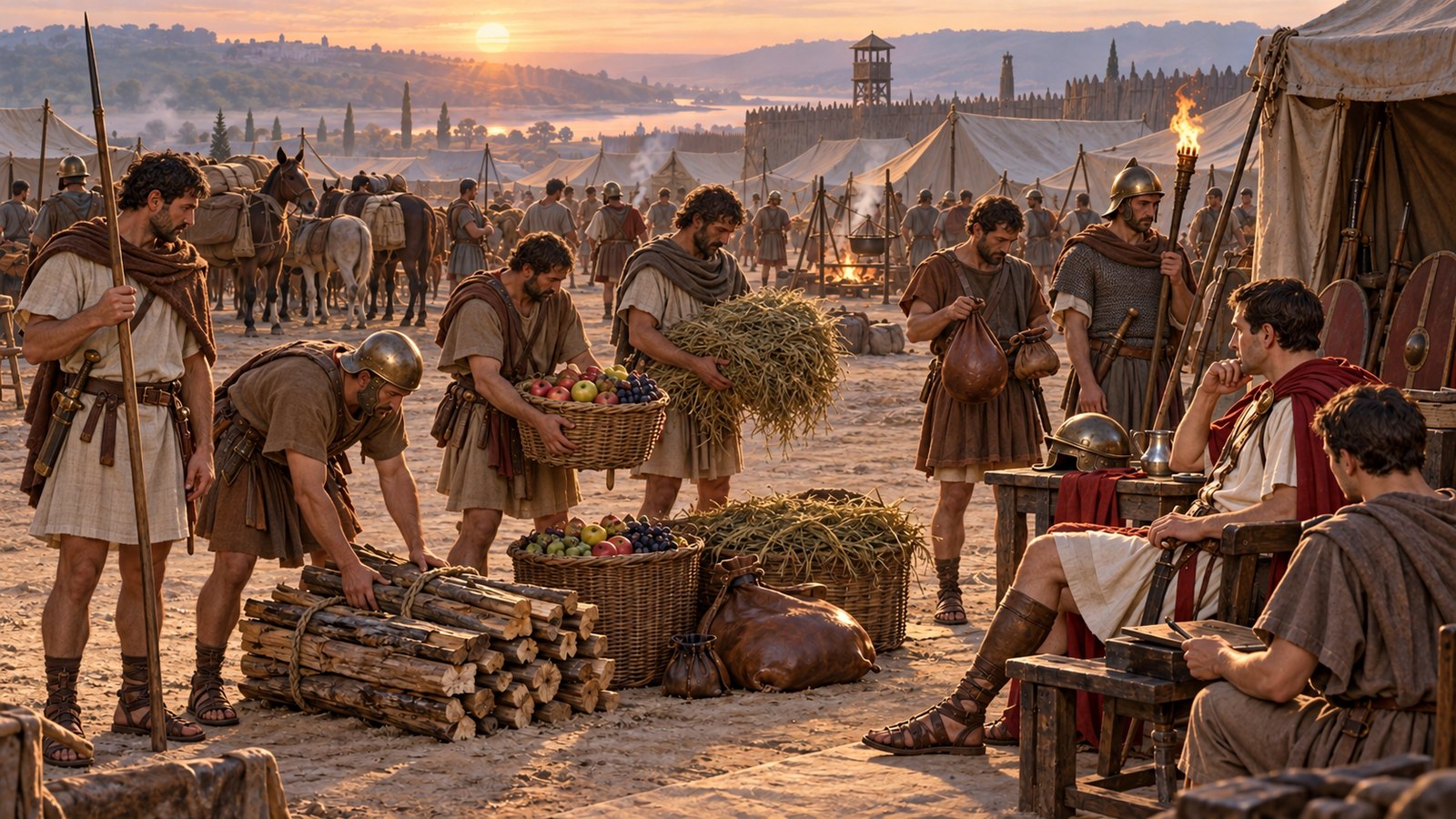
We should not expand the list by intuition. Its historical value lies in what the transmitted formula actually names. Each exception marks an object the rule’s authors expected soldiers to find, need, or dispute.
Everything else above the threshold followed a route. A soldier could bring it to either named consul or to a person appointed by one of them. Command supplied an official recipient instead of leaving the finder to negotiate privately.
The oath also allowed notification within the next three days. That window recognised that immediate delivery might be impractical while still preventing indefinite possession from becoming ownership.
Restoration to the person believed to be the rightful owner formed another path. The soldier was not forced to route every object upward if its owner could reasonably be identified.
These alternatives made compliance operational. Return, deliver, or report: each action created a way to resolve possession before suspicion hardened into an accusation.
The formula ends this portion with an appeal to doing what is right, but the moral phrase follows concrete instructions. Right conduct was not left undefined.
Death, disease, and omens could excuse a missed summons
Enrollment created a second clock. A day was fixed on which soldiers had to appear and answer the consul’s summons. The oath bound future presence, not only conduct after arrival.
Its exceptions show institutions colliding. A death in the family could require a funeral or household purification. The formula accepted that obligation but added a safeguard: the rite must not have been scheduled for the day merely to avoid service.
Dangerous disease excused attendance. So did an omen that could not be passed over without expiatory rites. Bodily incapacity and religious danger both interrupted the military timetable.
An anniversary sacrifice could also qualify when it could not properly occur without that person. The wording does not treat every preferred ceremony as sufficient. Necessity and personal indispensability matter.
Violence and enemy attack are blunt impediments. A fixed legal day involving a foreigner added a civic one. The army acknowledged that some obligations arrived with dates that the recruit did not control.
Yet an excuse did not dissolve enrollment. On the following day, the soldier had to report for service to the official who held the levy in the relevant district, village, or town.
The next-day requirement prevented a legitimate interruption from becoming an open-ended disappearance. Exception and return were parts of one rule.
A deserter was produced by missing both duty and explanation
Gellius preserves Cincius’s stark conclusion: a soldier absent on the appointed day without an accepted excuse was branded a deserter. The label followed a failed sequence.
First came enrollment. Then came a known day, a summons, a sworn promise, and a defined set of exceptions. Only after those elements could absence be sorted into excused delay or desertion.
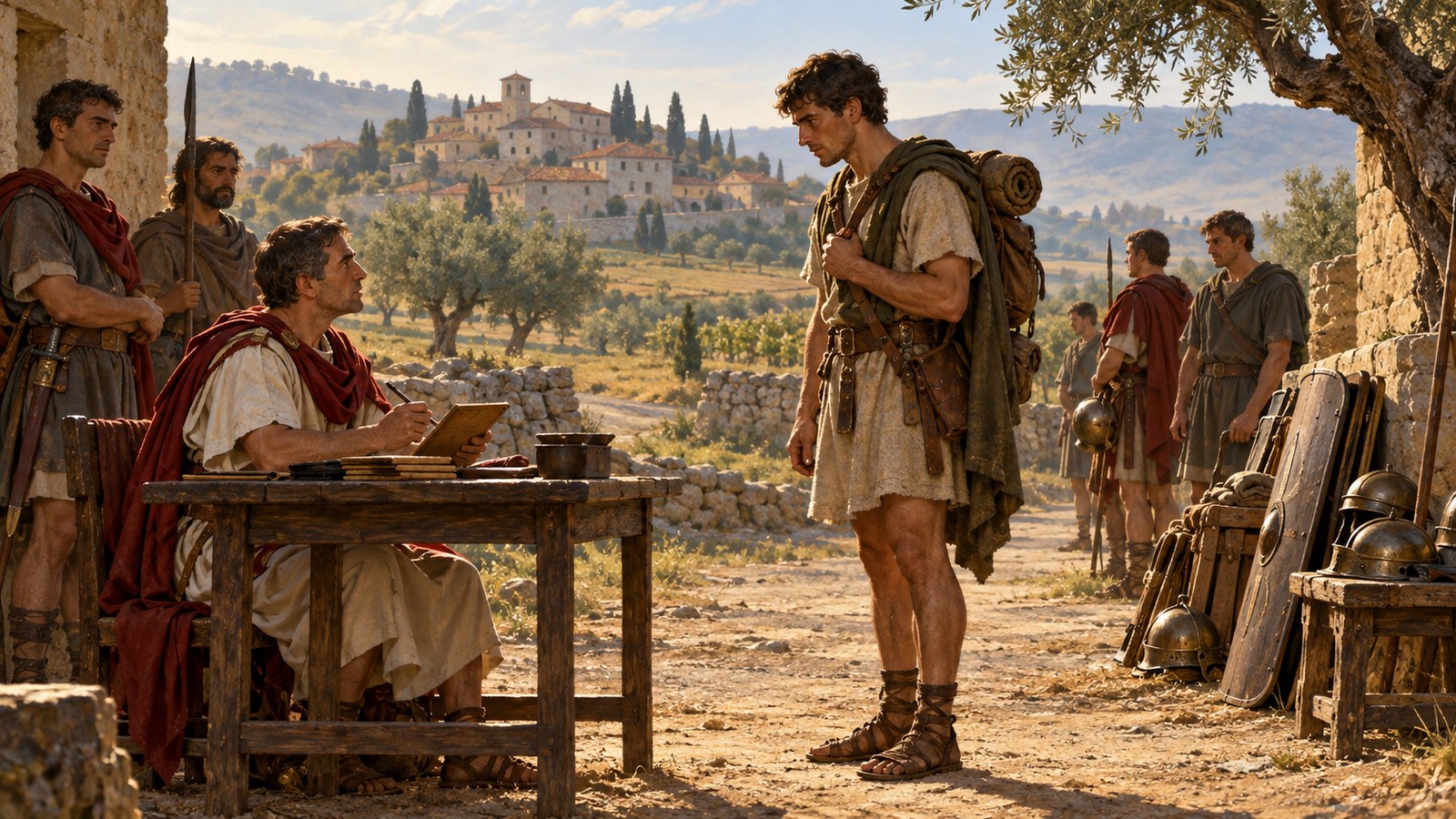
Theft and attendance rules share the same architecture. Each begins with conduct that could be ambiguous, supplies thresholds and exceptions, provides a corrective action, and leaves a harder category for cases outside those protections.
The one-sesterce threshold corresponds to the appointed day. The three-day report corresponds to next-day service. Named consuls correspond to the levy officer. Precision made later judgement possible.
This administrative machinery complements the seven-speared infantrymen placed among cavalry. Tactical integration managed bodies under immediate pressure. The oath managed trust before formations ever reached the field.
Gellius does not prove that every soldier obeyed or that every dispute was resolved fairly. He preserves a formula, and formulas show intended procedure more securely than lived outcomes.
Still, the wording pushes against an image of the Roman camp as a place where command meant only arbitrary force. Authority declared small limits, ordinary exceptions, and routes for correction because armies depended on repeated handling of property and time.
A silver sesterce sounds trivial beside battle. In the oath, that small amount helped define the boundary between tolerated use and punishable appropriation. Discipline began with things a soldier might hold in one hand.
The repeated limits also protected the formula from becoming pure discretion. An officer still interpreted events, but the oath gave soldiers shared words against which an accusation could be tested. Place, amount, intention, object, recipient, and deadline all had to be asked about.
That did not make military justice equal or gentle. It did make this corner of discipline legible. A missing purse and a missed summons were not identical breaches, and neither was judged without reference to the sequence that preceded it.
Cincius preserved administration at the scale where an army could fracture: ordinary objects, brief delays, and explanations that had to arrive on time. Gellius preserved the wording because those small clauses showed Roman institutions thinking before they punished.
Sources
Aulus Gellius, Attic Nights, Book 16, chapter 4, preserving Cincius, On Military Science.