
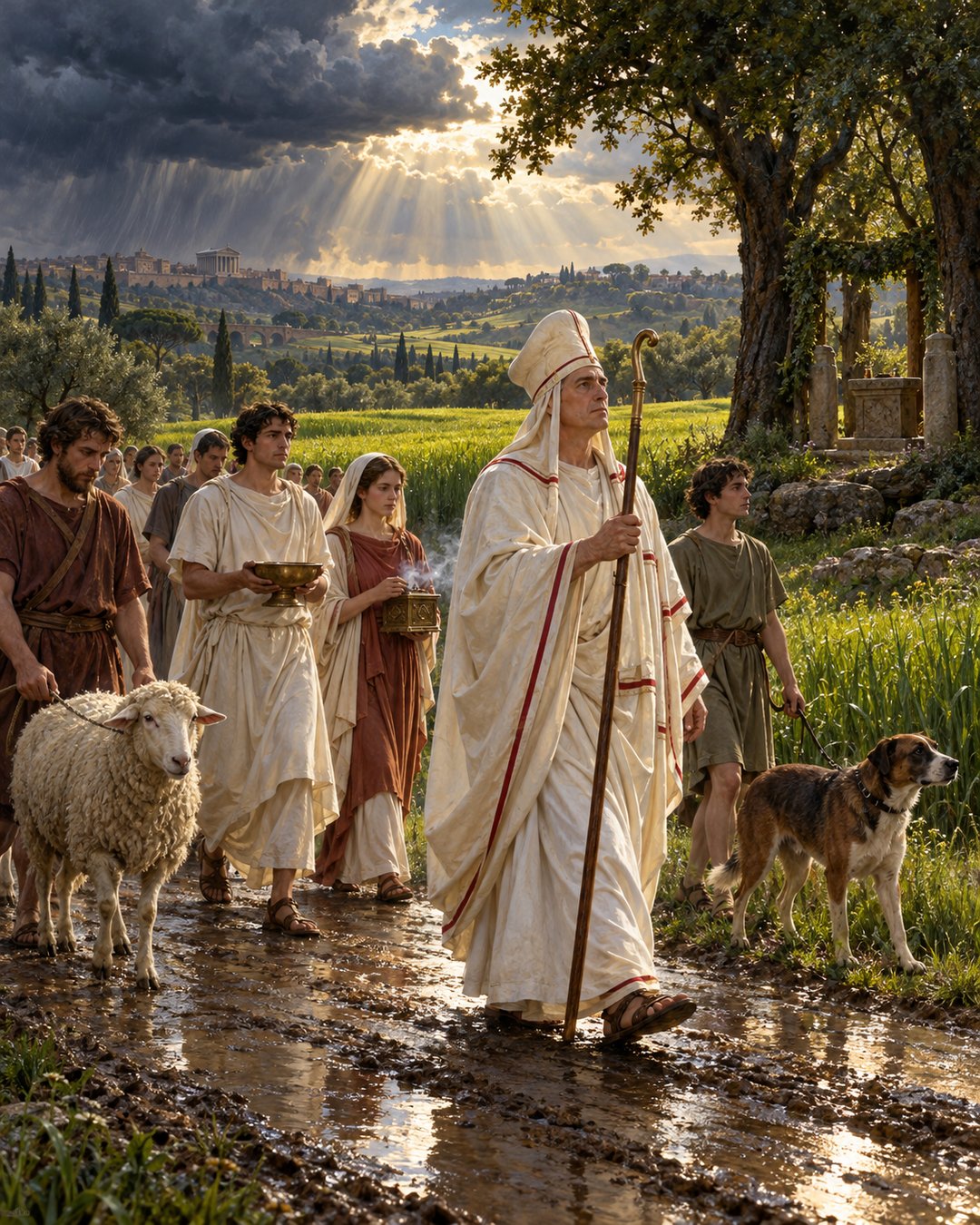
Six days before April ended, Ovid met a white-robed crowd filling the road between Nomentum and Rome. The group was not going to inspect a boundary or welcome a magistrate. The Flamen Quirinalis was leading it toward the grove of Robigo—Mildew personified—to burn the entrails of a dog and a sheep.
The danger was small enough to begin on a stalk and large enough to ruin a harvest. In the priest’s prayer, rain, wind, and frost were less destructive than the moment when sunlight warmed wet grain. A mark appeared, the farmer recognized the crop as lost, and labour already invested in the field could no longer rescue it.
The Robigalia gave that threat a date, a route, victims, and words. Its most revealing move was not a promise that destruction would disappear. The prayer asked Robigo to transfer her appetite: leave tender grain alone and consume iron weapons instead.
A road from Nomentum led into the crop calendar
Ovid fixes the encounter when April had six days remaining, the date later identified as April 25. Spring, he says, stood at its middle. The constellation of the Dog was rising, and rain supplied another seasonal sign.
Those observations made the rite agricultural before any victim reached the fire. Grain was growing but not yet ready for the sickle. The vulnerable interval lay between emergence and harvest, when weather could turn moisture into disease rather than nourishment.
Ovid presents himself as a traveller returning from Nomentum. The crowd in white blocked or crowded the middle of the road, turning an ordinary approach to Rome into a visible ritual route. The ceremony belonged to the city, but it faced outward toward fields whose yield sustained it.
The officiant was the Flamen Quirinalis, the priest attached to Quirinus. Ovid explicitly calls him Quirinus’s flamen even though the destination was the grove of Robigo. Roman ritual could connect a priestly office, a distinct divine power, a particular landscape, and a practical fear without reducing them to one identity.
That arrangement differs from the mixed substances used at the Parilia. There, ingredients prepared purification for herds and community. Here, procession and prayer confronted disease in grain at a precise point in the growing season.
The grove gave the encounter a destination outside the grain itself. Farmers did not carry every threatened stalk to an altar. A public party went to a recognized place and addressed the force thought capable of marking many fields.
Ovid does not offer a modern account of fungal infection. He preserves how a Roman calendar poet made crop loss intelligible through timing, observation, divine agency, and civic performance. Those categories are the evidence his passage can support.
The prayer described damage before asking for mercy
The Flamen’s words call Robigo scaly or rough with disease and ask her to spare the sprouting corn. He wants the smooth top of the crop to tremble above the ground and continue growing until the sickle can cut it.
This is not a generic appeal for prosperity. The prayer identifies the stage that matters. Seed has already become a visible plant, yet the grain has not completed the transformation that makes it harvestable.
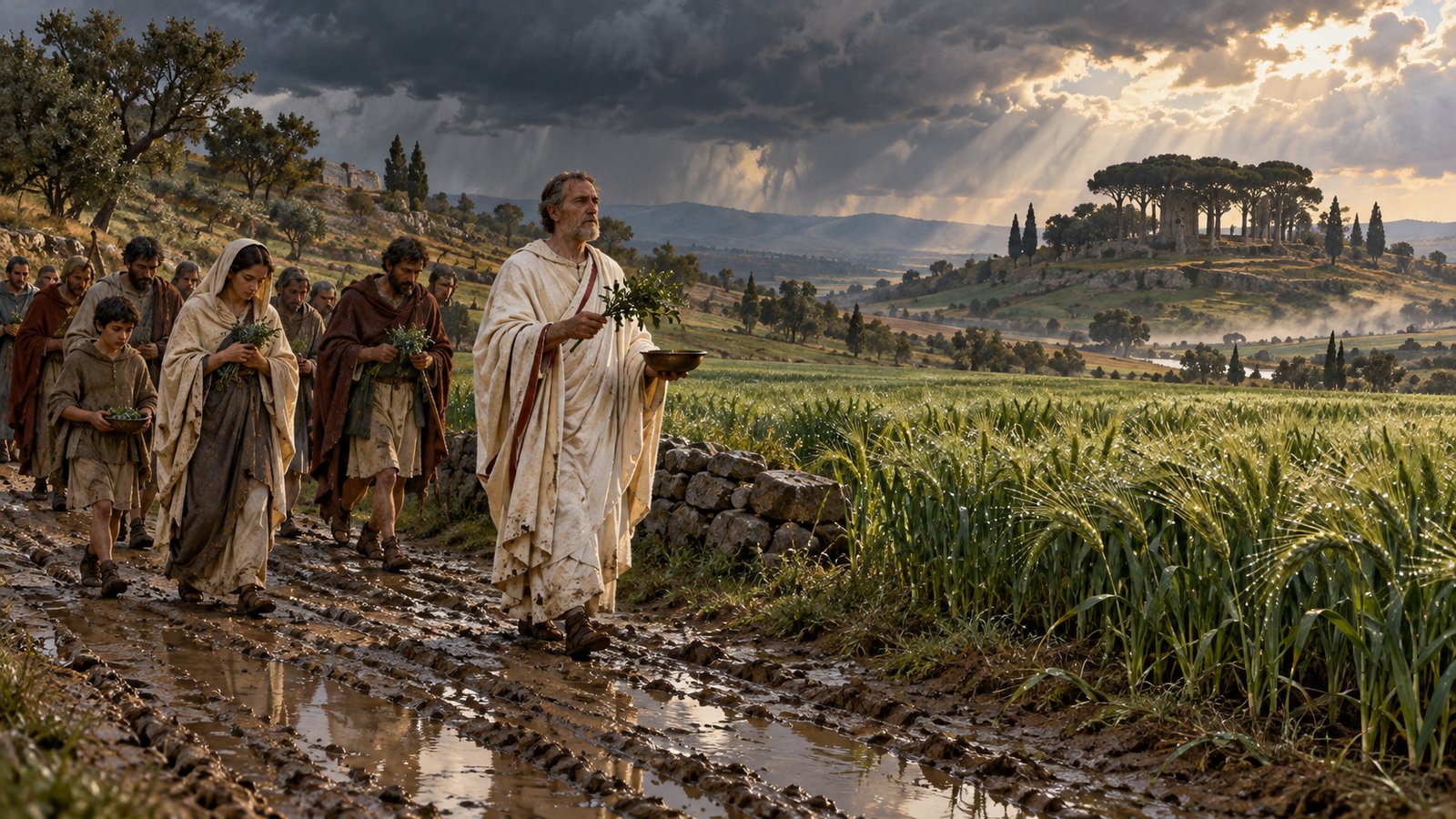
The priest then ranks threats. Winds, showers, and glittering frost can harm pale corn, but he says none does as much damage as Robigo when sun warms wet stalks. The line holds moisture and heat together. A field may survive separate weather events yet fail when conditions combine.
Once the goddess has set her mark on grain, the sad husbandman gives it up as lost. The image places recognition after damage. The farmer can see the result, but recognition is not cure.
The prayer therefore acts earlier, while the crop remains tender. It asks the dangerous power to keep her rough hands away, not because she is weak, but precisely because her capacity to harm is accepted.
That logic gives the ceremony tension. Worship does not pretend the threat is benevolent. The community honours a power in order to define what she must not touch.
The passage also keeps human work in view. A crop has been sown, nursed by favourable stars, and expected to meet a sickle. Mildew interrupts an entire sequence rather than damaging an isolated object.
Like the prepared spelt that entered Roman sacrifice, the grain here joins farming to ritual. The difference is temporal: the Robigalia addresses the plant before it becomes food or offering.
Rust was redirected from stalks to swords
The prayer’s sharpest turn asks Robigo to grip hard iron instead of tender crops. The Latin play joins plant disease and metallic rust under one destructive name, allowing the priest to imagine damage moved from one material to another.
Not every iron object is offered. Farm equipment should remain bright. Rakes, the hard hoe, and the curved ploughshare are to be polished because cultivation still needs them.
Weapons receive the unwanted corrosion. The prayer says the world is at peace, so harmful arms are unnecessary. Let swords rust; let one stick in its scabbard when someone tries to draw it after long disuse.
The contrast sorts iron by purpose. A hoe opens productive earth. A sword wounds. Both can corrode, but the ceremony asks that corrosion choose the tool whose failure would confirm peace.
This does more than decorate an agricultural request with politics. A secure harvest and idle weapons become mutually reinforcing images. Fields reach maturity because disease passes over them; swords become difficult to draw because nobody has needed to maintain them.
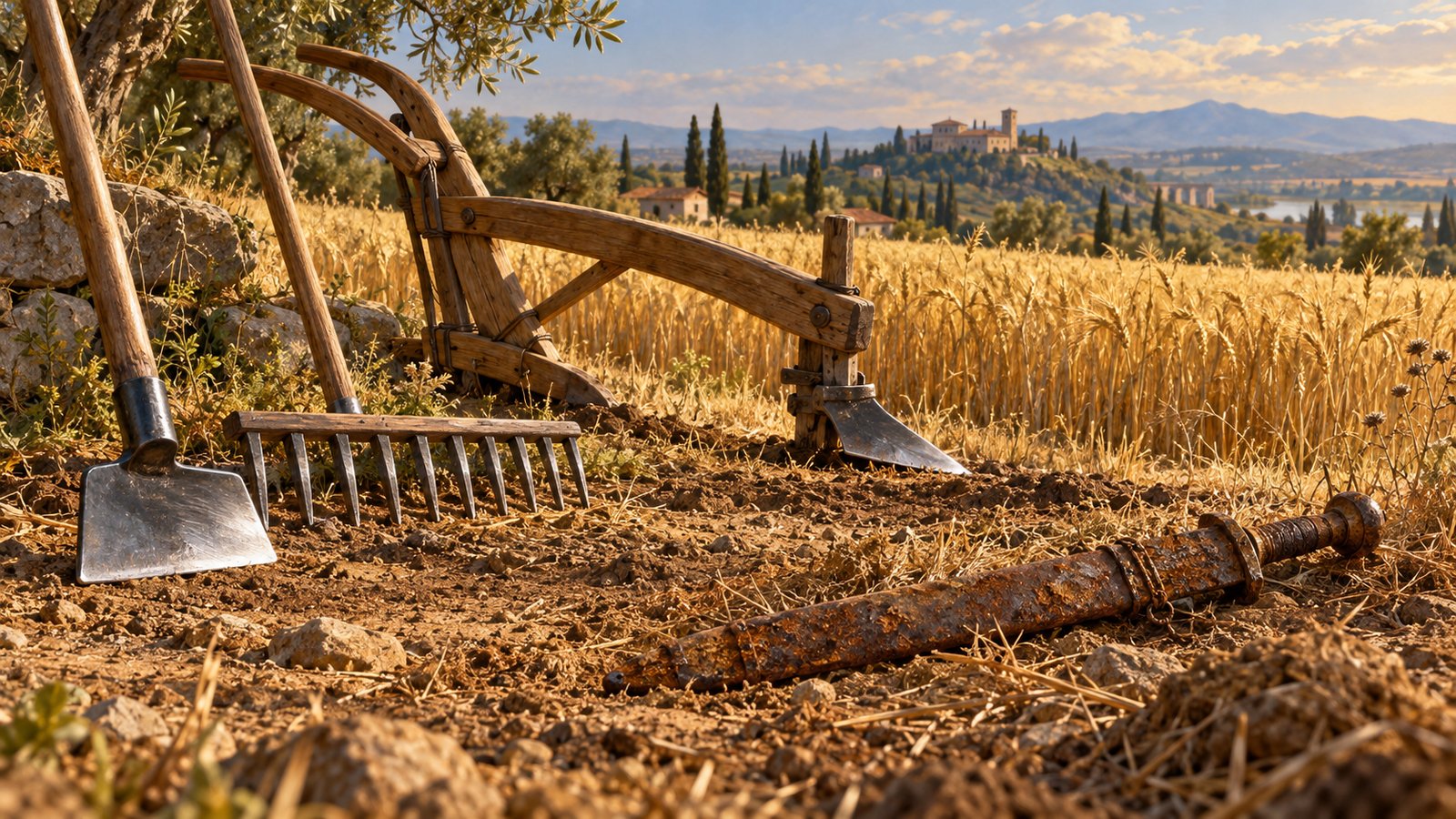
Ovid wrote under Augustus, and the language of a peaceful world belongs within that setting. Yet the ritual’s argument is concrete enough to exceed a slogan. It names the rake, hoe, ploughshare, sword, scabbard, wet stalk, and sickle.
The final wish is also carefully limited. May the farmer pay vows to Robigo in her absence. The ideal sign of divine favour is not an apparition. It is that the disease itself does not appear in the crop.
Absence becomes observable success. No marked stalk, no abandoned field, grain standing until harvest: those conditions allow the husbandman to fulfil what was promised.
A dog on the hearth answered a Dog in the sky
After the prayer, Ovid lists what he says he saw. The priest had a loose-napped cloth at his right side, a bowl of wine, and a casket of incense. Incense and wine went onto the hearth with the entrails of the sheep and the dog.
The dog was unusual enough for Ovid to ask why it belonged in the rite. His question makes the victim part of the explanation rather than an unexplained spectacle.
The Flamen answered with the Icarian Dog, the constellation whose rising the poem had already announced. Its appearance was associated in his explanation with parched ground and a crop that ripened too soon.
An earthly dog was placed on the altar in place of the starry Dog. Ovid’s priest gives one reason: the shared name. The association is verbal and celestial at once, binding victim, constellation, season, and feared effect.
The sheep’s entrails remain in the observed offering, but the passage spends its explanation on the stranger victim. That imbalance is useful evidence. What required interpretation was not every part of sacrifice, but the part a Roman traveller could find unexpected.
The Robigalia scene thus moves through several scales. It begins with a date in April and a constellation, narrows to wet tissue on a grain stalk, expands to a road procession and public priest, and ends at a hearth with wine, incense, and animal entrails.
Its protection is equally selective. The prayer does not ask that nothing decay. It chooses the harvest over the weapon and the farm tool over the sword. By giving mildew somewhere else to go, the ceremony made a crop disease express Rome’s preferred order of work and peace.
Sources
Ovid, Fasti, Book 4, lines 901–942.