
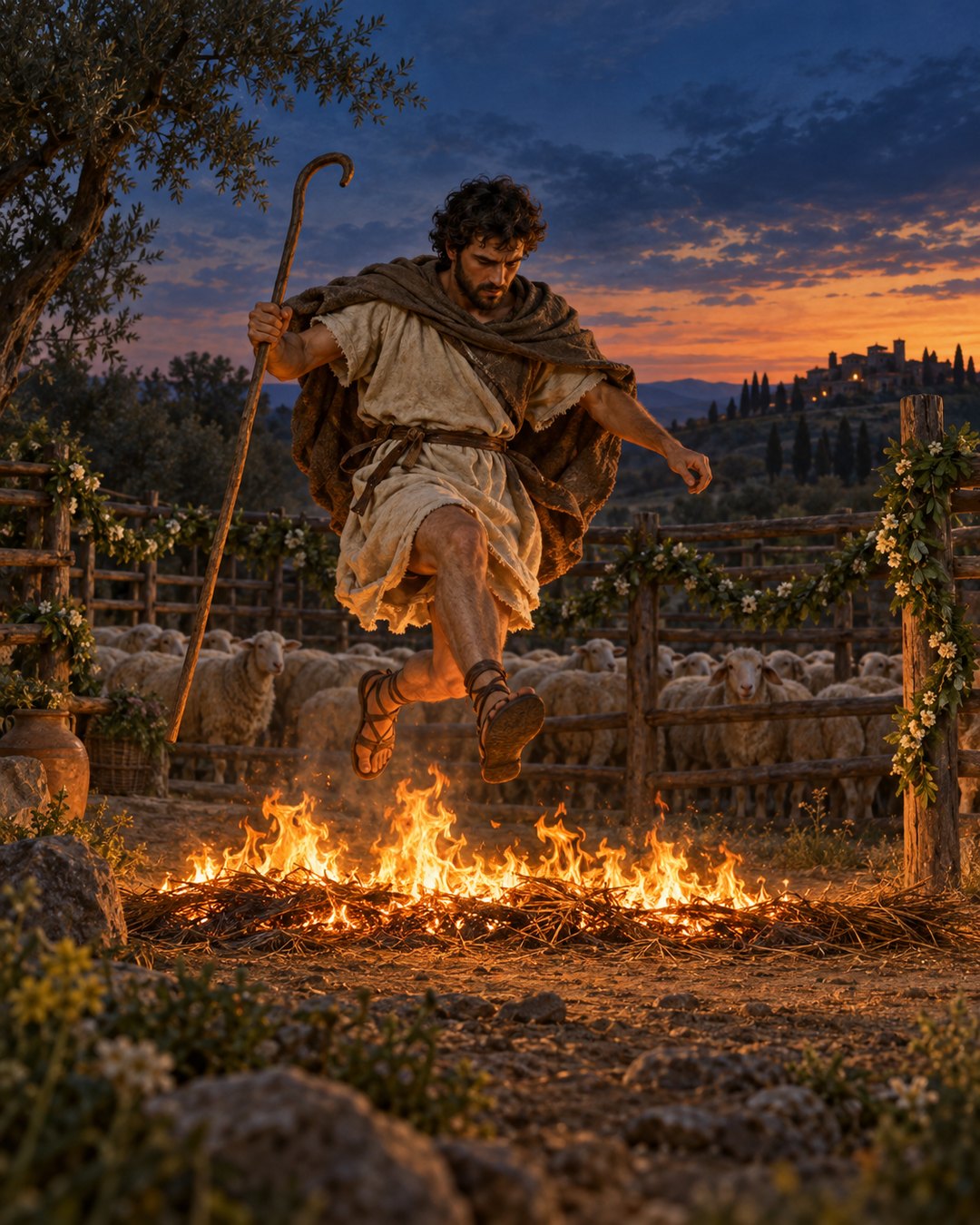
At twilight, the sheepfold had to change before the shepherd did. Water touched the ground. A branch swept it clean. Fresh boughs stood around the enclosure, and a long garland crossed the doors. Then blue sulfur smoke moved close enough to make the sheep bleat.
This is the practical opening of the Parilia in Ovid’s Fasti. The festival honored Pales and belonged to the pastoral calendar, but Ovid does not leave it as a name or a bonfire. He gives a sequence of materials and actions: clean the pen, decorate it, smoke the flock, burn selected woods, offer millet and milk, face east for a repeated prayer, drink milk and wine, and leap across burning straw.
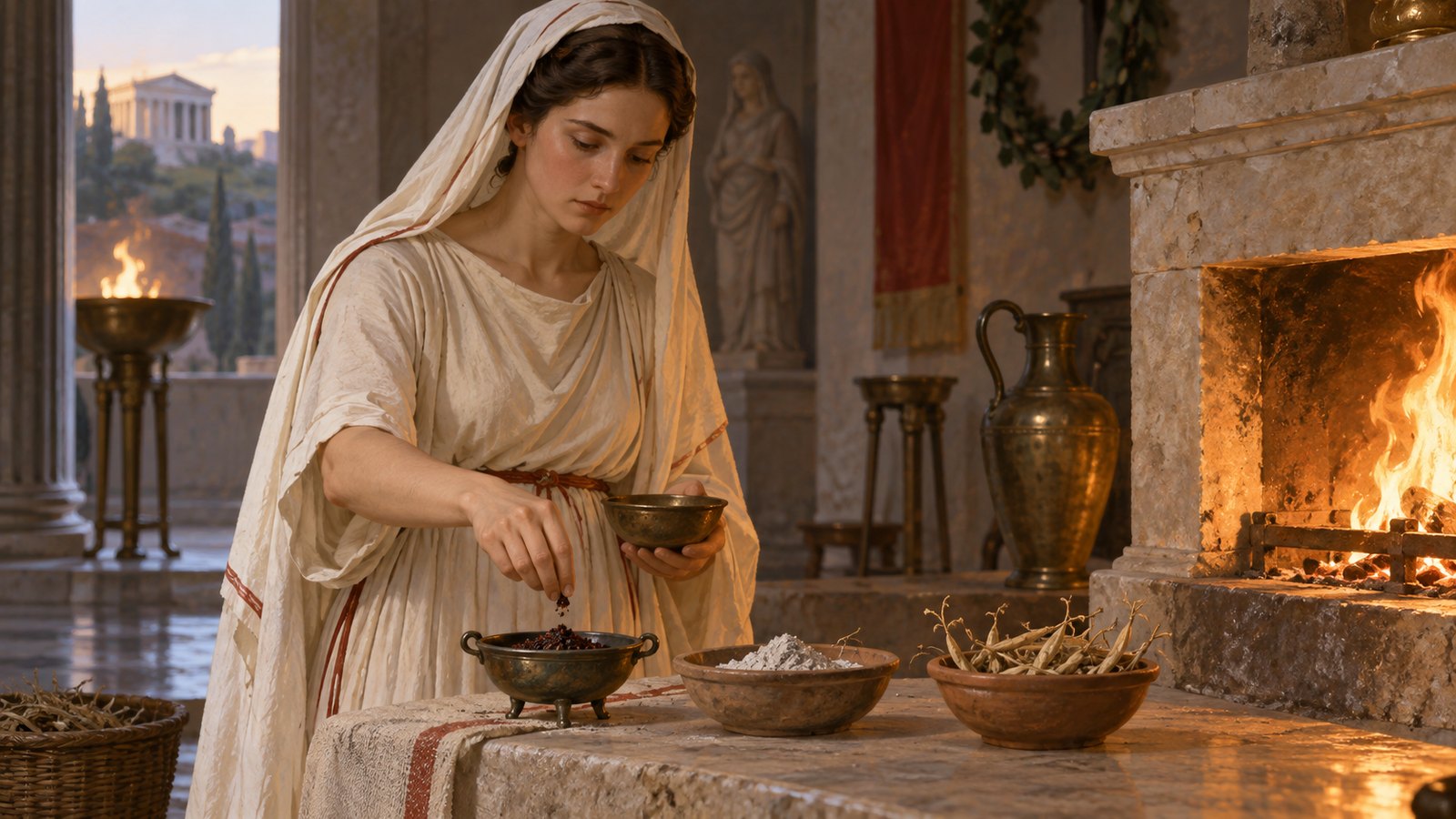
At the center is a substance obtained from the altar of Vesta. Ovid calls it a suffimen, a purifying fumigant, and lists three components: the blood of a horse, the ashes of a calf and the empty stalk of the hard bean. The mixture connects the shepherd’s enclosure to sacrificial remains preserved elsewhere in Rome’s ritual system.
The striking ingredients can distract from the structure. The Parilia was not one dramatic gesture. It was a controlled progression from enclosure to animal, from smoke to food, from possible fault to requested protection. Ovid remembers exactly what to do even when, at the end, he offers several rival explanations for why fire had this power.
Vesta’s Altar Supplied a Three-Part Purifier
Ovid tells the people to seek the suffimen from the altar of Vesta. Receiving it there matters because the shepherd does not manufacture every component in the sheepfold on the festival evening. Something already gathered and kept enters the local rite from a sacred center.
The recipe is compressed into one line of three materials. Horse blood comes first. Calf ashes follow. The third component is the empty stalk of a hard bean. Ovid gives no quantities, mixing vessel or recipe time. Claims about those details would go beyond his instructions.
The calf ash had an earlier place in his own ritual memory. Just before listing the official mixture, Ovid says he had often carried calf ashes and bean straw in full hands as chaste purifying things. He also remembers jumping flames laid out three in a row and being sprinkled from a wet laurel branch.
Those first-person details make the passage more than an outside description. The poet presents himself as someone who has handled the materials, crossed the fire and felt the water. Yet his memory does not replace instruction. It leads into the public command to obtain the suffimen from Vesta.
The arrangement recalls the importance of renewed sacred fire in Rome’s old March calendar, but the mechanism here is different. The Parilia carries preserved remnants outward and puts them to work in a pastoral enclosure. Vesta’s role is a point of supply; the sheepfold is where the purification unfolds.
The Sheepfold Was Washed, Swept and Marked
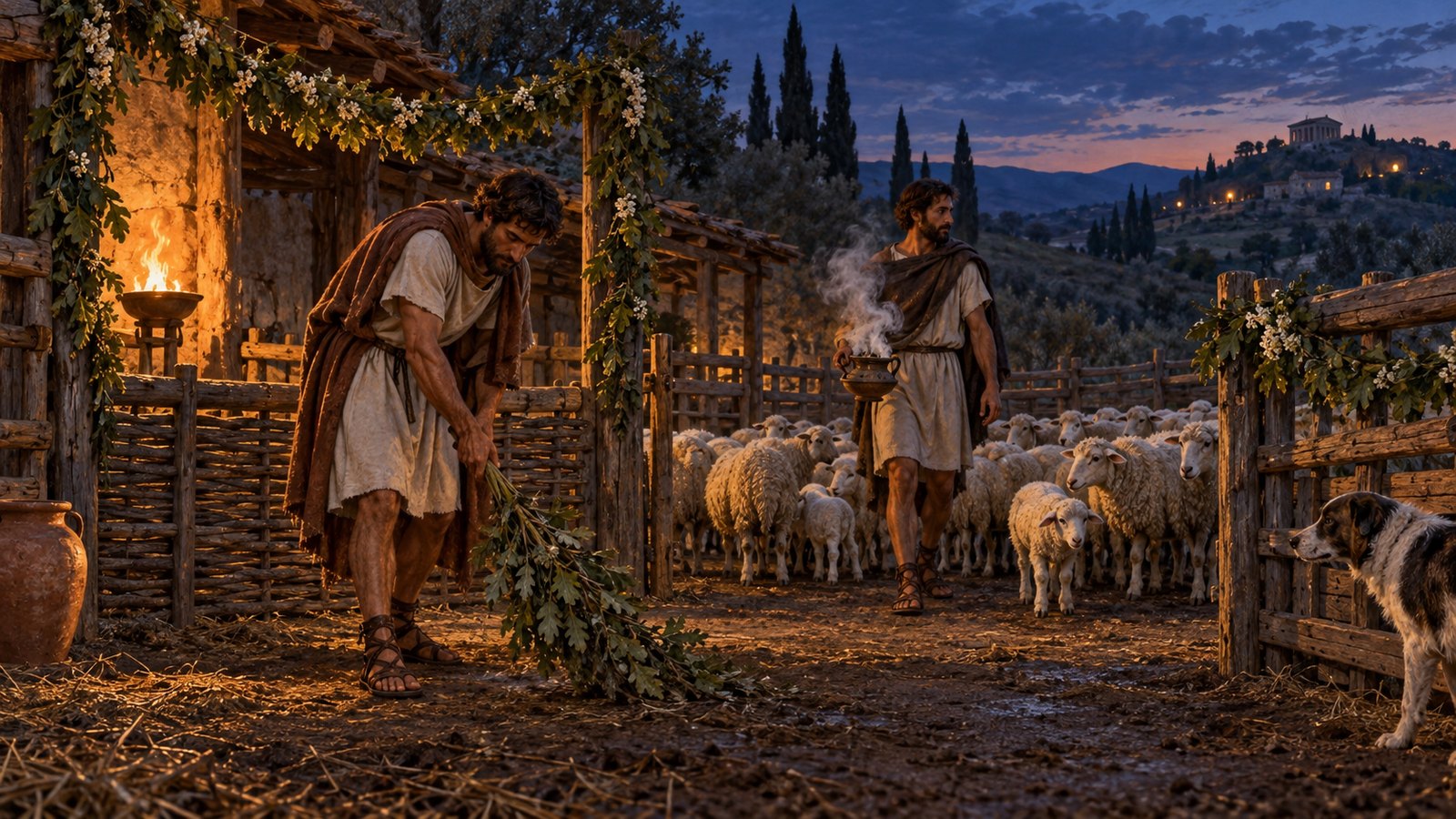
The shepherd begins at the first twilight with well-fed sheep. Before smoke reaches them, water is to sprinkle the ground and a branch is to sweep it. The order turns ordinary maintenance into the first stage of ritual preparation.
Decoration then redraws the enclosure. Leaves and fixed branches adorn the sheepfold, while a long garland covers the decorated doors. The pen remains a working place for animals, but its surfaces announce that this evening is not routine.
Ovid’s verbs keep attention low to the ground. The rite is not described from a distant temple facade. It happens at the threshold, across packed earth, beside rails and doors, among animals that have eaten. Cleaning and ornament identify the bounded space in which protection will be requested.
That attention to vessels, branches and water belongs to a wider material ritual world. The pointed vessel used for Vestal water likewise made handling part of sacred practice. In the Parilia passage, however, Ovid does not isolate one object. He stacks modest acts until the whole enclosure has been prepared.
The result is visual but not merely decorative. Sweeping removes what lies underfoot. Water marks cleansing. Boughs and garland mark the pen’s edge. Each act establishes where the next operation—the fumigation of the flock—will take place.
Blue Sulfur Smoke Reached the Animals
Pure sulfur produces blue smoke in Ovid’s instruction. The sheep are to bleat as the smoking sulfur touches them. This is one of the passage’s sharpest sensory details: color, smell and animal sound make purification observable.
The text does not say that the sheep were burned. Smoke is the active medium. It moves through the decorated enclosure and reaches living bodies, turning an invisible claim of cleansing into something shepherd and flock can both experience.
The fire itself takes several named fuels. Ovid calls for male olive wood, pine and juniper, with laurel that crackles as it burns. The list creates a fire assembled from distinct plants rather than any available heap of brush.
Sound continues the sequence. Sheep bleat under sulfur smoke; laurel snaps in the flame. Ovid’s ritual is materially busy, not silent symbolism. A shepherd can see whether the pen has been swept, whether garlands are fixed, whether smoke reaches the animals and whether the selected wood is burning.
This practical visibility helps explain why the suffimen should not be treated as the whole festival. Horse blood, calf ash and bean stalks are memorable, but they operate inside a larger cleansing environment built from water, foliage, sulfur and fire.
Millet and Milk Framed a Fourfold Prayer
Food follows fumigation. A basket of millet and millet cakes belongs among the offerings. Ovid explicitly calls this rural food pleasing to a rural goddess. The rite also presents food and a pail of milk to Pales.
After the food is cut, the worshipper stands for prayer facing east. Ovid later instructs him to wash his hands in living spring water and repeat the words four times. Direction, posture, clean hands and repetition give the spoken portion its own discipline.
The prayer is unusually concrete about possible errors. It asks forgiveness if the flock has grazed on sacred ground, if a shepherd has sheltered beneath a sacred grove, if a nymph’s pool has been disturbed, or if animals have eaten grass belonging to a grave. It does not insist that one known offense occurred. It covers risks that pastoral movement might have created.
Protection is equally practical. The speaker asks that disease stay far away and that sheep, dogs and shepherds remain healthy. The concerns fit the people and animals standing in the prepared enclosure. Purity is requested not as an abstract condition but as safety for a working flock.
The four repetitions also show why careful speech mattered. Other Roman rites assigned several people to protect the words of a prayer, but this passage has its own narrative engine: Ovid gives the worshipper a field-ready script embedded between smoke and fire. The body turns east, the hands are washed, and the same petition is delivered four times.
Ovid Preserved the Sequence but Debated the Fire
After praying, the shepherd drinks snow-white milk and purple wine from a wooden bowl. He then leaps over burning straw. The finish joins nourishment, color, a humble vessel and a physical crossing.
Ovid had already recalled jumping three rows of flame himself. The closing command returns the reader to that experience, but now every preceding stage is visible behind it: the suffimen from Vesta, the cleaned pen, the smoking sulfur, the selected woods, the millet, milk and repeated appeal.
Only then does Ovid ask where the custom came from. He offers more than one possibility for the purifying force of fire and water. Their divine origin might explain it. Fire might cleanse because everything begins from it, or because opposing elements work together. Pastoral stories and Rome’s own beginnings also enter his discussion.
He does not force these suggestions into one settled history. That hesitation is useful evidence. The poem can preserve confident ritual choreography while admitting uncertainty about origins. Practice has a firmer shape than explanation.
The Parilia therefore survives in the passage as a chain rather than a single image of people jumping flames. State-kept remnants arrive at a sheepfold. Ground and doors are prepared. Smoke reaches the flock. Rustic food feeds the goddess, a fourfold prayer names pastoral hazards, and a bowl of milk and wine precedes the crossing. Ovid may debate why the fire purifies, but he leaves little doubt about how many things had to happen before someone leapt over it.
Sources
Ovid, Fasti 4.721–806.