
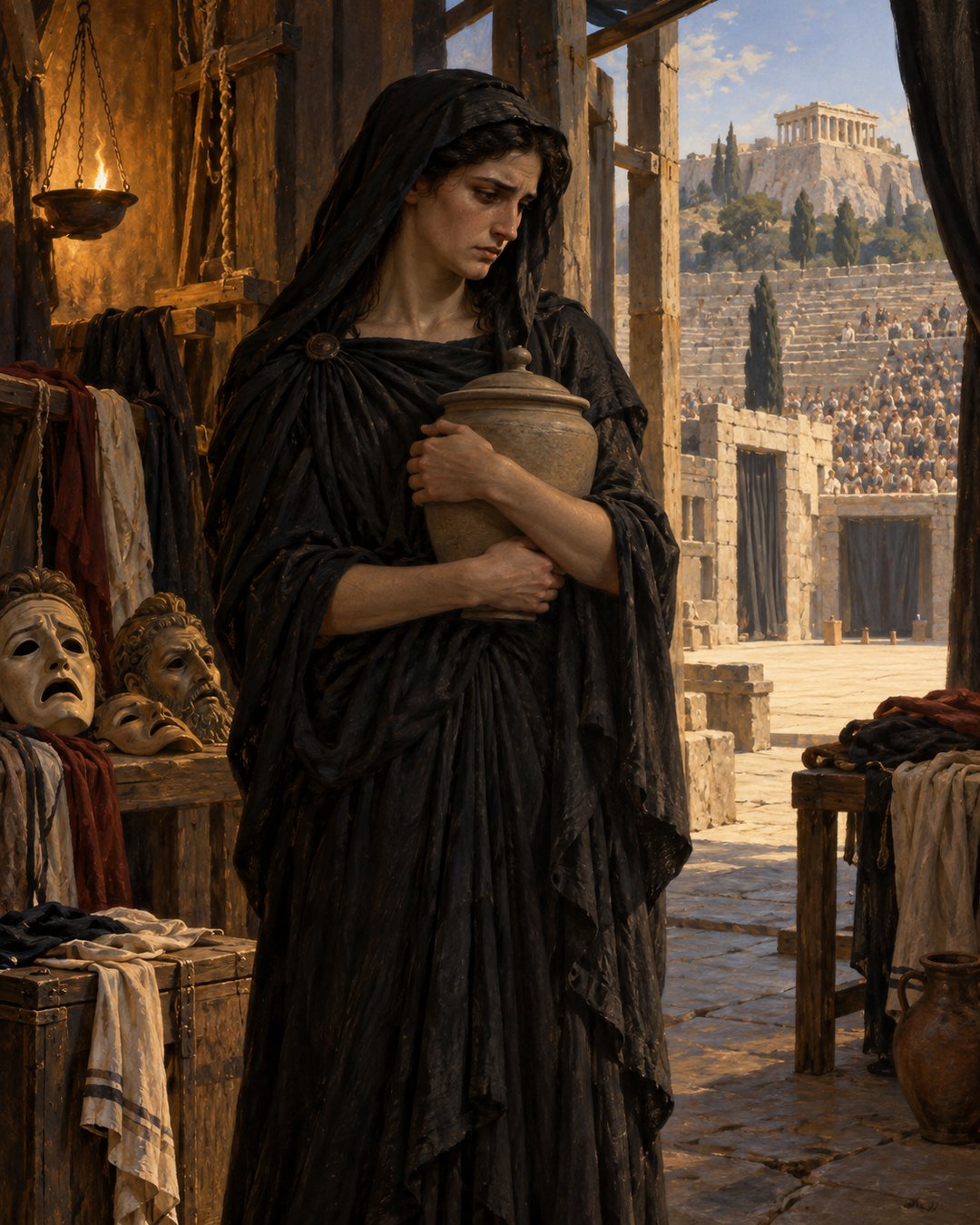
The urn in Sophocles’ Electra is meant to deceive the woman who carries it. She believes it contains the ashes of her brother Orestes and speaks her grief over remains that the drama’s audience knows are not really his. At one performance in Athens, the actor Polus made that false object real in a different way.
Polus had lost a son. When he returned to the stage after mourning, he did not carry the ordinary theatrical urn. Aulus Gellius says he took his son’s ashes and urn from the tomb, put on Electra’s mourning costume and embraced the remains during the lament.
The substitution did not alter the plot. Electra still believed she held Orestes. The actor still delivered words belonging to a famous tragedy. Yet the body inside the role had its own bereavement, and the vessel in his arms was no longer a harmless prop. Gellius says the place filled with genuine grief rather than its appearance.
This is why the anecdote remains unsettling. It does not simply tell us that Polus acted well. It makes us watch several layers align: a man plays a grieving woman; that woman mourns a brother who is alive; the actor holds the real remains of his dead son; and an audience encounters personal lament inside a rehearsed public form.
Gellius First Establishes Deliberate Skill
Before introducing the death, Gellius describes Polus as an actor of wide reputation in Greece. He excelled in clear delivery and graceful action, and he performed tragedies by famous poets with intelligence and dignity. Those qualities place technique before emotion.
The order matters. If Gellius began only with overwhelming grief, Polus might appear to have abandoned acting altogether. Instead, the reader first meets a disciplined professional: voice, movement, judgment and decorum have already made him notable.
Ancient tragic performance required visible choices. A role had to be carried through a large theatre with formal language, costume and controlled gesture. The discussion of how theatre masks made roles visible at a distance explains one part of that physical system. Gellius is interested in what happens when a practiced performer places private experience inside it.
He also says Polus often acted the tragedies of celebrated poets. This was not an amateur appearing once under the force of recent loss. It was a return to a familiar profession and to material he knew how to shape before spectators.
Skill is therefore not displaced when the urn changes. It becomes the frame capable of containing what follows. Clear delivery and graceful action remain present even when the emotion no longer needs to be imitated.
Electra’s Scene Already Depended on a False Urn
Gellius pauses to explain the plot requirement. Polus was to act Sophocles’ Electra at Athens. His part required an urn supposed to contain the ashes of Orestes. Electra, believing she carries her brother’s remains, laments the fate she thinks has overtaken him.
The object is deceptive within the play. Orestes has returned alive, but Electra does not yet know it. The urn gives physical weight to misinformation. She can hold, embrace and address what she takes to be proof of death.
A theatre audience occupies a different position. Spectators know they are watching an actor and a staged vessel. Those familiar with the plot also know Electra’s belief is mistaken. Her sorrow is true to the character’s knowledge while resting on a fiction visible to everyone outside that knowledge.
That layered awareness makes the scene more than a convenient occasion for weeping. The urn separates what the character believes, what the audience knows about Orestes, and what everyone ordinarily assumes about stage property.
Other ancient stories use illusion as a contest between representation and the eye. In the contest between Zeuxis and Parrhasius, painted surfaces trap different viewers. Polus’s choice works through touch and knowledge instead. The vessel looks appropriate because it is appropriate; only its private identity has changed.

The Tomb Supplied What the Prop Could Not
Polus had lost a son whom he dearly loved. Gellius does not give the son’s name, age or cause of death. He does not supply a chronology detailed enough to turn the family’s loss into a biography. The omission keeps the anecdote fixed on one decision.
After Polus felt that he had indulged his grief sufficiently, he returned to his profession. That phrase marks a threshold without claiming that mourning had ended. He judged himself ready to work, but the later action shows that bereavement remained available to him with extraordinary force.
For the Electra performance, Polus took the ashes and urn of his son from the tomb. Gellius describes an actual removal, not a memory exercise or a report that the actor imagined the child. The stage object and the funerary object became one.
The decision introduces a physical burden that rehearsal could not duplicate. The urn was not merely heavier with symbolic meaning. It held remains Polus knew, from a tomb he knew, belonging to the person whose loss had interrupted his work.
Gellius gives no account of permission, preparation backstage or the response of relatives. Claims about those matters would go beyond the passage. What survives is the exact chain he wants remembered: death, a period of grief, return to acting, removal of the urn, costume and performance.
One Embrace Joined Two Different Sons
Clad in Electra’s mourning garb, Polus embraced his son’s urn as though it contained Orestes. The gesture belongs simultaneously to the role and to the actor. Electra holds a brother; Polus holds a son. The same arms complete both actions without making the relationships identical.
This is the anecdote’s tightest mechanism. Polus does not interrupt the drama to announce his bereavement. He does not replace Sophocles’ words with his own eulogy. He keeps the role intact while changing the material fact at its center.
The audience sees Electra’s mourning costume and hears the expected lament. Whether every spectator knew the urn’s origin before or during the scene is not stated. Gellius’s point does not require us to invent a public announcement. The emotional event follows from what Polus knows and carries.
Because the plot itself concerns mistaken remains, the substitution creates no simple equivalence. Orestes is not dead; Polus’s son is. Electra will discover that the urn does not close her brother’s story. Polus cannot receive that reversal. His private knowledge runs against the play’s eventual recognition.
The embrace thus joins two griefs while preserving their difference. The role lends language and gesture to the actor. The actor lends the role a funerary object whose truth the fiction cannot absorb.

Gellius Changes the Category of the Lament
Gellius says Polus filled the whole place not with the appearance and imitation of sorrow, but with genuine grief and unfeigned lamentation. The contrast is explicit. Something usually classified as representation became, in his telling, an occurrence.
Yet it happened without ceasing to be theatre. Costume, script, character and audience remained. Gellius concludes that while it seemed a play was being acted, real grief was enacted. The balanced phrasing does not abolish performance; it makes performance the vehicle through which private sorrow enters a public space.
That conclusion raises a question his brief chapter does not answer. Was the event admirable because it intensified art, disturbing because real remains became theatrical property, or memorable because no clean boundary survived? Gellius labels the story noteworthy rather than offering a theory of ethics.
His framing does, however, prevent a sentimental simplification. Polus is not praised only for feeling deeply. He had already been established as a master of delivery and action. Nor is he presented as losing control. The substitution was prepared: he went to the tomb, took the urn, wore the costume and entered the scene.
The anecdote survives because every part is exact enough to carry tension. Athens supplies the theatre. Sophocles supplies Electra. The plot supplies Orestes’s false ashes. Polus supplies a real urn from his son’s tomb. Gellius supplies the final distinction between seeming grief and grief enacted before a crowd.
That distinction never becomes comfortable. The audience receives a polished tragic scene and something that exceeds polish. The words belong to Electra, the ashes to Polus’s son, and the lament to both role and actor. A prop could have represented loss. The real urn made representation answer to a loss that the play could neither cause nor repair.
Sources
Aulus Gellius, Attic Nights 6.5.