
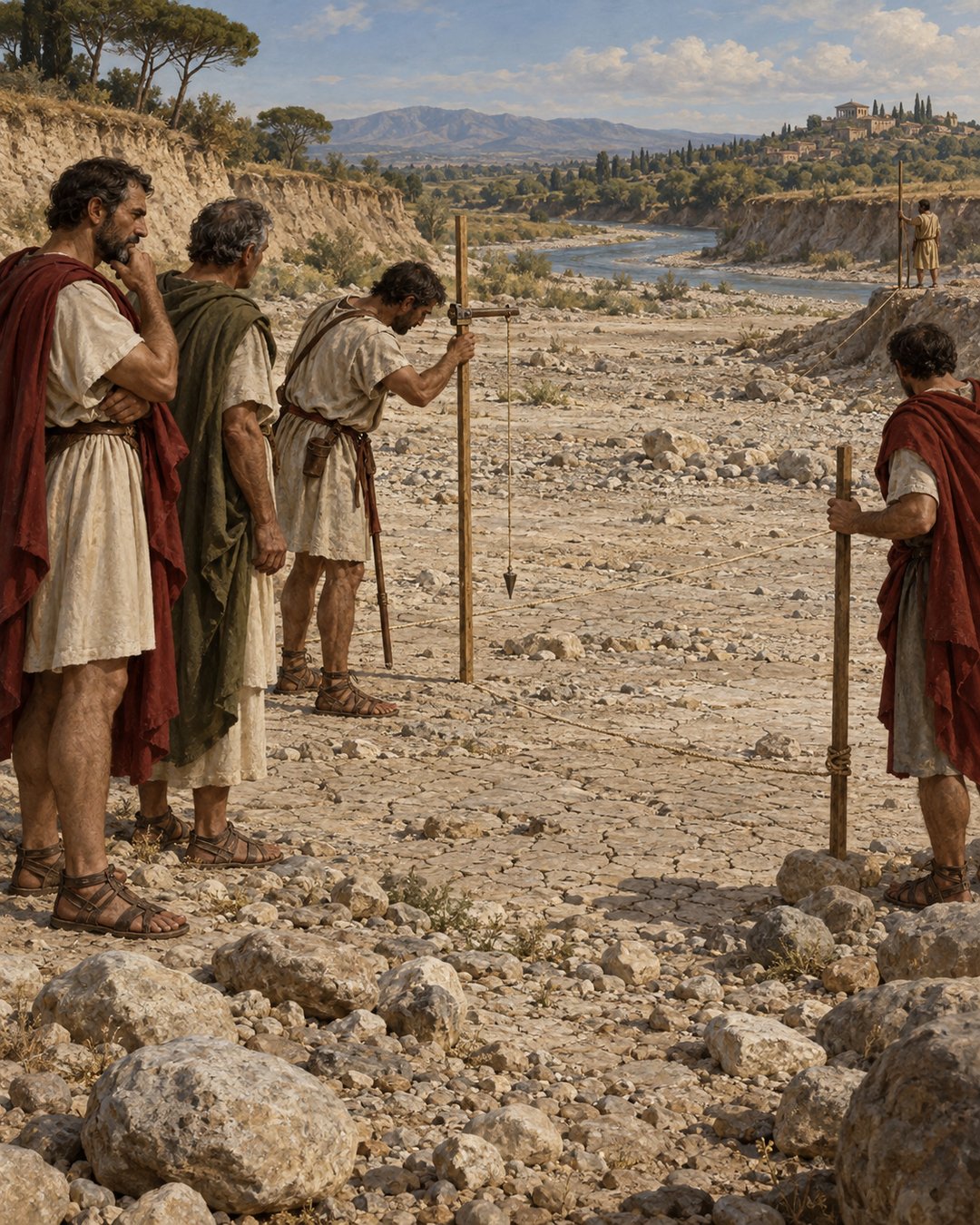
The river was no longer where the boundary expected it to be. Water had cut a new course, leaving stones and silt in a channel that yesterday had been public riverbed. Fields still faced one another across the dry hollow. The practical question was immediate: who now owned the ground between them?
The Institutes of Justinian answer by giving the old bed to the landholders on both sides, divided according to their interests along the banks. The new channel, meanwhile, takes on the public character of the river. Water has moved, but ownership does not merely drift after it.
This rule sits inside a compact sequence on rivers and land. Slow silt, a clod torn loose by violence, a new island, a divided current, an abandoned channel and a temporary flood all receive different treatment. The sequence is valuable because it shows Roman legal reasoning at ground level. Speed, attachment, position and permanence matter more than a loose claim that the river always wins.
The result is a set of legal clocks. Some changes happen too gradually to see. Some begin in an instant but require time before ownership changes. Some rearrange public and private space as soon as the current settles into a new course. Reading the rules together reveals a law built to distinguish movements that look similar from a distance.
Slow Silt and Torn Earth Followed Different Clocks
The first distinction concerns the pace of addition. Soil that a river adds by alluvion becomes part of the receiving land. The Institutes define alluvion with unusual precision: the addition is imperceptible, so gradual that a person cannot identify the exact increase from one moment to the next.
That definition does real work. There is no single detached object to return and no visible instant at which it crossed a line. The bank itself grows. Ownership follows the slow physical formation because the change cannot be separated into a series of observable transfers.
A parcel ripped away by the force of the stream is treated differently. The sudden movement is perceptible. The displaced piece clearly remains the property of the person whose land lost it, even after the current carries it against a neighbor’s ground.
Time re-enters the rule through attachment. If the parcel remains and becomes firmly joined to the neighbor’s land, the Institutes eventually treat it as part of that land. Violence does not produce an immediate transfer, but continuing physical incorporation can change the answer.
The contrast is sharper than a generic rule about river deposits. Alluvion belongs to the receiving bank because no detachable moment can be identified. Avulsed ground remains tied to its origin because both the object and the movement are visible. Only later attachment closes the gap between the physical landscape and the legal one.
An Island Turned Position into Ownership
The next problem is not a growing bank but new land surrounded by water. An island that rises in the sea belongs to the first occupant, the text says, because before occupation it belongs to no one. A river island enters a different geometry. Its neighbors already possess legally significant banks.
If the island lies in the middle of the stream, landholders on both sides share it. Their portions correspond to the extent of their riparian frontage. The rule imagines lines projected from established properties toward the land that has appeared between them.
If the island lies closer to one bank, only owners on that side receive it. Position therefore controls the class of claimants before frontage determines their shares. The island is not awarded to whoever first rows out, nor automatically divided equally among every nearby owner.
A separate sentence prevents the word “island” from doing too much. If the river splits into two channels around land that someone already owns and then reunites downstream, that owner does not lose the property. The current has made the parcel look like an island without making it ownerless.
This resembles the careful sorting used in the rule for bees that keep returning. In both settings, nature moves across human boundaries, but the law asks a narrower question before deciding that ownership has ended. Movement alone is not the test.
The Empty Channel Went to Both Banks
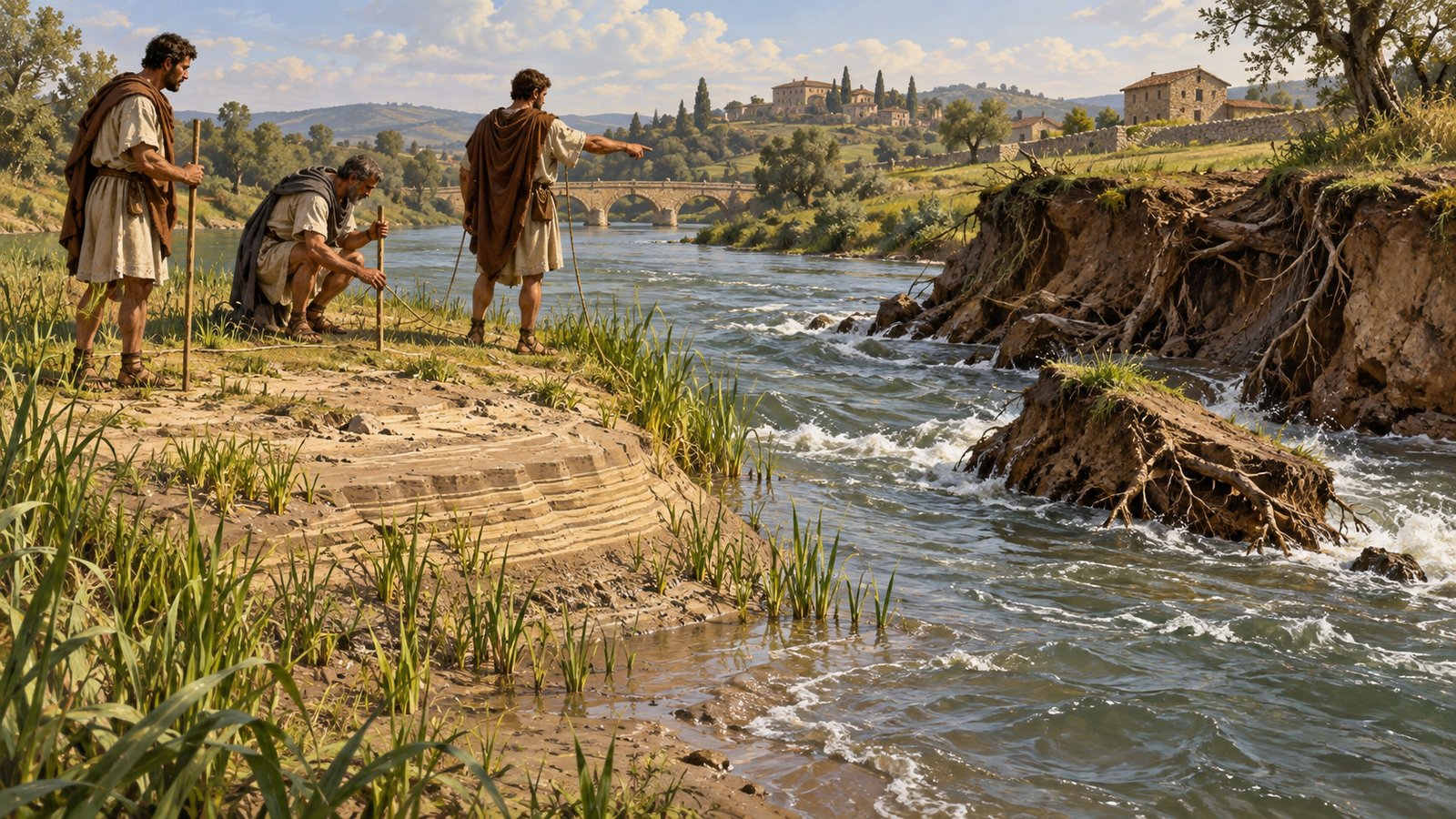
The most dramatic rule begins when a river entirely leaves its old channel and starts to flow in a new one. The empty bed does not remain indefinitely public merely because public water once covered it. It passes to the landowners on either side.
The allocation follows their riparian interests. That phrase keeps the solution attached to the existing pattern of frontage rather than awarding the whole bed to whichever owner enters first. Opposite properties advance into the former channel according to a boundary logic already visible in the island rule.
The new channel receives the opposite treatment. It becomes public like the river. Private land over which the current now runs no longer functions as an ordinary private strip while it serves as the river’s bed. The law relocates the river’s public character rather than freezing it onto the abandoned ground.
This is not the same mechanism as the division of treasure between finder and landowner. That rule balances contributions to a discovery. The river rule redraws a spatial relationship: public water occupies one corridor, while the corridor it deserted is absorbed from both sides.
The dry bed therefore records two changes at once. One piece of land has lost its public function; another has acquired it. The owners do not simply recover the exact soil the water took from them, and the state does not claim every place the river has ever touched.
A Returning River Reversed the Arrangement
Rivers can refuse the permanence that legal categories try to give them. The Institutes anticipate that problem. If the water later returns to its old channel, the channel it abandons for the second time passes to the landholders along its banks.
The text does not say that the owners displaced by the temporary new course automatically reclaim a geometrically identical parcel. It applies the bank-based rule to the channel now left dry. The relevant banks are those bordering that abandoned course.
This creates a reversible public corridor, not a promise that every private boundary will be restored to an earlier map. The river’s active channel carries public status. When that status moves, adjacent ownership claims are recalculated around the newly empty bed.
The rule also explains why total abandonment must be distinguished from erosion at an edge. A river that entirely changes course creates an old channel and a new one. Slow alluvion merely adjusts a bank. A torn parcel remains identifiable. Each physical pattern supplies a different legal object.
The law’s precision lies in refusing a single metaphor. The river is not always a thief, a boundary or a public road. It can add, detach, surround, abandon and return. The legal response begins only after the event has been named correctly.

Floodwater Did Not Rewrite the Map
The final contrast is temporary inundation. If land is wholly flooded, its legal nature is not permanently altered. When the water recedes, the soil clearly remains with its previous owner.
That sentence prevents a flood from being mistaken for a new river channel. Both may place running or standing water over private land. The difference is permanence. Floodwater covers land; a river that entirely abandons one bed and begins to run in another establishes a different corridor.
For a landholder watching water spread across a field, the visual difference might not be obvious at first. The legal difference depends on what the water does over time. Retreat confirms inundation. A stable redirected current supports the rule for an abandoned bed and a public new channel.
Taken together, sections 20 through 24 are less a list of curiosities than a diagnostic sequence. Was the addition too gradual to perceive? Was a parcel torn away but still identifiable? Did land arise between banks or merely become surrounded? Did the river abandon its course, or did floodwater only conceal a field?
The dry channel in the opening problem belongs to both banks because the river has genuinely moved. That answer is not an intuition about fairness. It is the end of a chain of distinctions, each tied to a physical fact that owners and adjudicators could inspect: silt, attachment, distance from a bank, continuity of title, the path of the current and the return of the water.
Sources
Institutes of Justinian, Book II, title 1, sections 20–24.