
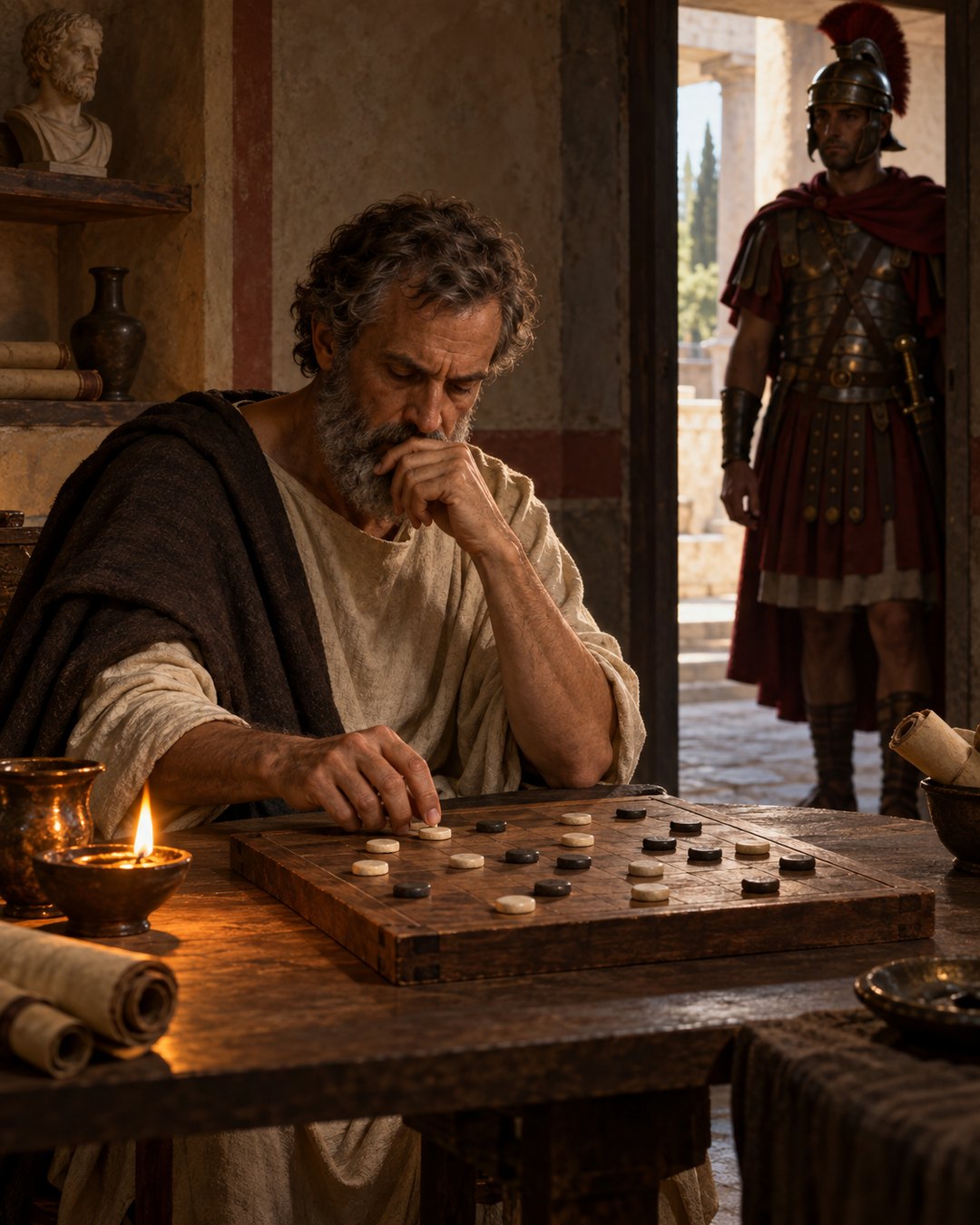
The centurion arrived before the game had produced a winner. Julius Kanus was sitting over a draughts board when the officer summoned a group of prisoners for execution. Kanus did not sweep the pieces aside. According to Seneca, he counted them.
Then he gave his opponent an instruction: after Kanus was dead, the other man must not claim that he had won. Kanus turned to the centurion and asked him to witness the score. He was one counter ahead.
It is a very small lead beside a death sentence, and that disproportion is the point. Seneca includes the scene in On Tranquillity of Mind, not in a handbook of Roman games. The board gives his argument something visible and countable. Caligula’s order can interrupt the match, but Kanus still decides what must be recorded before he rises.
The anecdote belongs to a sequence. Ten days earlier, the emperor had announced Kanus’s execution. After the game, grieving friends received a question about the soul. On the final walk, Kanus proposed observing the instant of death itself. Seneca builds composure from three different acts: a reply to power, a joke anchored in a score, and an inquiry no ruler could answer for him.
Caligula Fixed the Date, Not the Meaning
Seneca introduces Kanus after examples of philosophers meeting loss and threats. He says Kanus had engaged in a long dispute with Gaius—the emperor better known as Caligula. As Kanus was leaving, Gaius told him not to sustain any foolish hope: his execution had been ordered.
Kanus answered, “I thank you, most excellent prince.” Seneca does not pretend to know exactly what the words meant. He asks whether the reply exposed a cruelty under which death had become a kindness, mocked the emperor’s insanity, or welcomed death as freedom. The essay preserves ambiguity at the very moment a neat moral tale might erase it.
One fact is not ambiguous inside Seneca’s telling. Kanus did not expect a reprieve. Seneca remarks on Gaius’s reliability in carrying out this kind of order. The sentence therefore opens a measured interval, not suspense about whether imperial anger will cool.
Ten days passed. Seneca claims that Kanus spent them without despondency. That timespan matters because it prevents courage from being reduced to one quick retort. The condemned man had mornings and evenings in which to anticipate what was coming. His calm had duration.
The emperor’s menace fits the same theatrical world explored in Caligula’s command to gather shells as spoils. Yet here Seneca refuses to keep the ruler at the centre. Gaius supplies the deadline. Kanus supplies the scene’s lasting action.
One Counter Preserved an Unfinished Position
When the centurion arrived, Kanus was playing draughts. The translation gives no detailed board layout, opening strategy or rule for capture. Roman readers knew several games with counters, and Seneca does not pause to identify a technical variant. Treating this passage as a rulebook would demand evidence it does not offer.
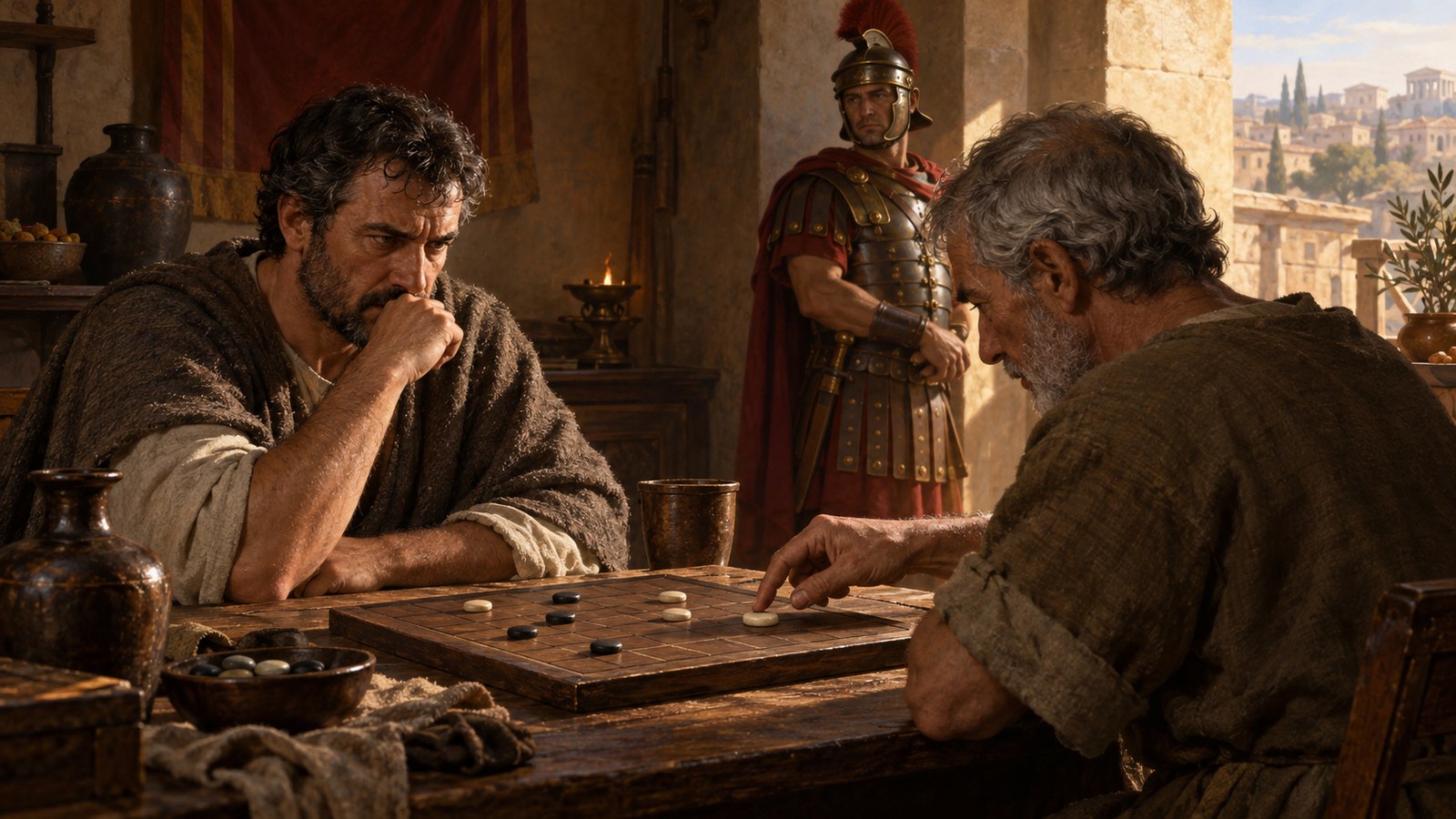
What it does offer is a position. Kanus counts his pieces and says he stands one ahead. The number is deliberately modest. He is not boasting of a crushing victory. He is preventing the interruption from allowing his companion to rewrite an unresolved game.
The centurion becomes an unlikely scorekeeper. His official role is to collect condemned people and take them onward. Kanus briefly recruits that authority for another purpose: witnessing the state of a board. The officer who represents the sentence must also acknowledge a single counter.
Seneca immediately asks whether Kanus was really playing with the board rather than merely upon it. The distinction explains why the anecdote is present. The game becomes material for an exercise in freedom of mind. Kanus cannot keep his seat, finish the match or reverse the order. He can determine the last significance of the pieces.
This is different from the archive’s reconstruction of encirclement games, where counters help explain play mechanics. In Kanus’s case, the known mechanism is rhetorical. Counting establishes a fact; the joke denies the executioner total control of the interruption; the witness keeps the opponent from claiming a false ending.
Grieving Friends Received a Question, Not Comfort
Seneca next moves away from the board to Kanus’s friends. They are sad because they are about to lose him. Kanus does not answer with a conventional farewell. He asks why they grieve when they have been investigating whether souls are immortal and he is about to know.
The line is not evidence that Kanus returned with an answer. It is evidence for the posture Seneca wants the reader to see. A philosophical problem normally approached through argument is about to become immediate experience for one member of the circle.
That shift makes the friends’ sorrow part of the demonstration. They understandably look at separation. Kanus, in Seneca’s construction, redirects attention toward inquiry. The reply does not make the execution harmless or the friendship trivial. It changes what occupies the condemned man’s mind.
Seneca says Kanus continued searching for truth and reasoning about his death until the end. This is stronger than simple fearlessness. Calm is represented as sustained intellectual activity. The waiting man does not merely suppress emotion; he gives himself a question that reaches beyond the emperor’s command.
The essay’s interest in controlling attention also appears in Seneca’s account of trying to work above a noisy bathhouse. There, shouts, splashes and a ball counter test concentration. Here, a counter on a board and the approach of death make the test immeasurably harsher.
The Final Walk Became an Experiment
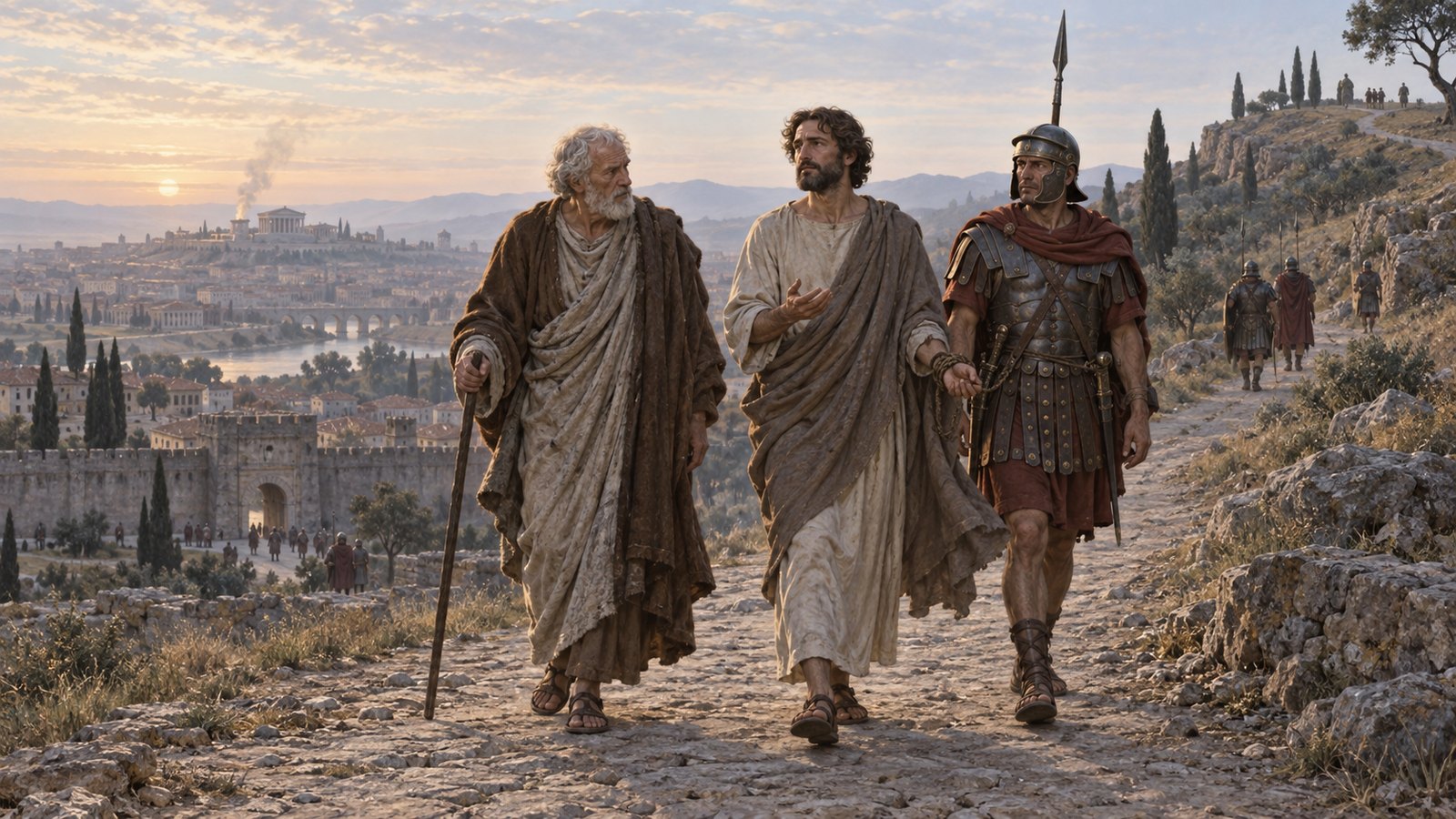
Kanus’s philosophy teacher accompanied him. They had come near a hill where, Seneca says, a daily sacrifice was offered to Caesar as a god. The location lets imperial power remain visible in the background: teacher and prisoner walk within a landscape marked by the ruler’s cult.
The teacher asks what Kanus is thinking. Kanus answers with a plan. At the swiftest instant of all, he intends to watch whether the spirit is conscious of leaving the body. The language turns the last moment into an observation whose instrument is attention itself.
Kanus even promises that, if he discovers anything, he will come to his friends and report the condition of departed souls. Seneca surely knows the promise cannot be verified in the ordinary way. Its function is to carry inquiry beyond the limit imposed by the sentence.
The sequence has now moved through three scales of time. There are ten days of waiting, the few moments needed to count the board, and the almost ungraspable instant in which life ends. Each scale receives an act suited to it: endurance, wit and concentrated observation.
Seneca calls this peace in the middle of a storm. He says Kanus used his own fate as a proof of truth and continued learning not merely until death but from death. The execution itself is not described. The essay withholds the spectacle of killing and fixes instead on the work of the mind before it.
Seneca Made a Philosophical Exemplum, Not a Transcript
Kanus’s final hours reach us through a moral essay written to guide its reader. Seneca shapes the order, supplies praise and tells us what the board scene means. Even his wording—Kanus played with the board—announces interpretation rather than detached reporting.
That does not make the details useless. The ten-day interval, centurion, counted pieces, companion, teacher and sacrificial hill give the episode unusual physical structure. But their survival is inseparable from Seneca’s purpose. We do not possess Kanus’s diary, the opponent’s account or the centurion’s testimony.
Source criticism sharpens rather than empties the story. Seneca’s arrangement reveals what he believed tranquillity should look like under absolute pressure. It is not blankness. Kanus speaks, calculates, jokes, questions and proposes an experiment. His composure remains active.
The one-counter lead is therefore more than a polished last word. It anchors an unfinished human situation. A game has rules, a position and another player; death arrives from outside it. By naming the score, Kanus refuses to let interruption masquerade as completion.
Caligula determines that the walk will happen. The centurion determines when Kanus must rise. Seneca’s Kanus retains the narrower but decisive power to choose what he notices: first the counter, then his friends’ question, finally the movement of his own mind. That is why the smallest number in the episode carries its largest claim.
Sources
Seneca, On Tranquillity of Mind 14.