
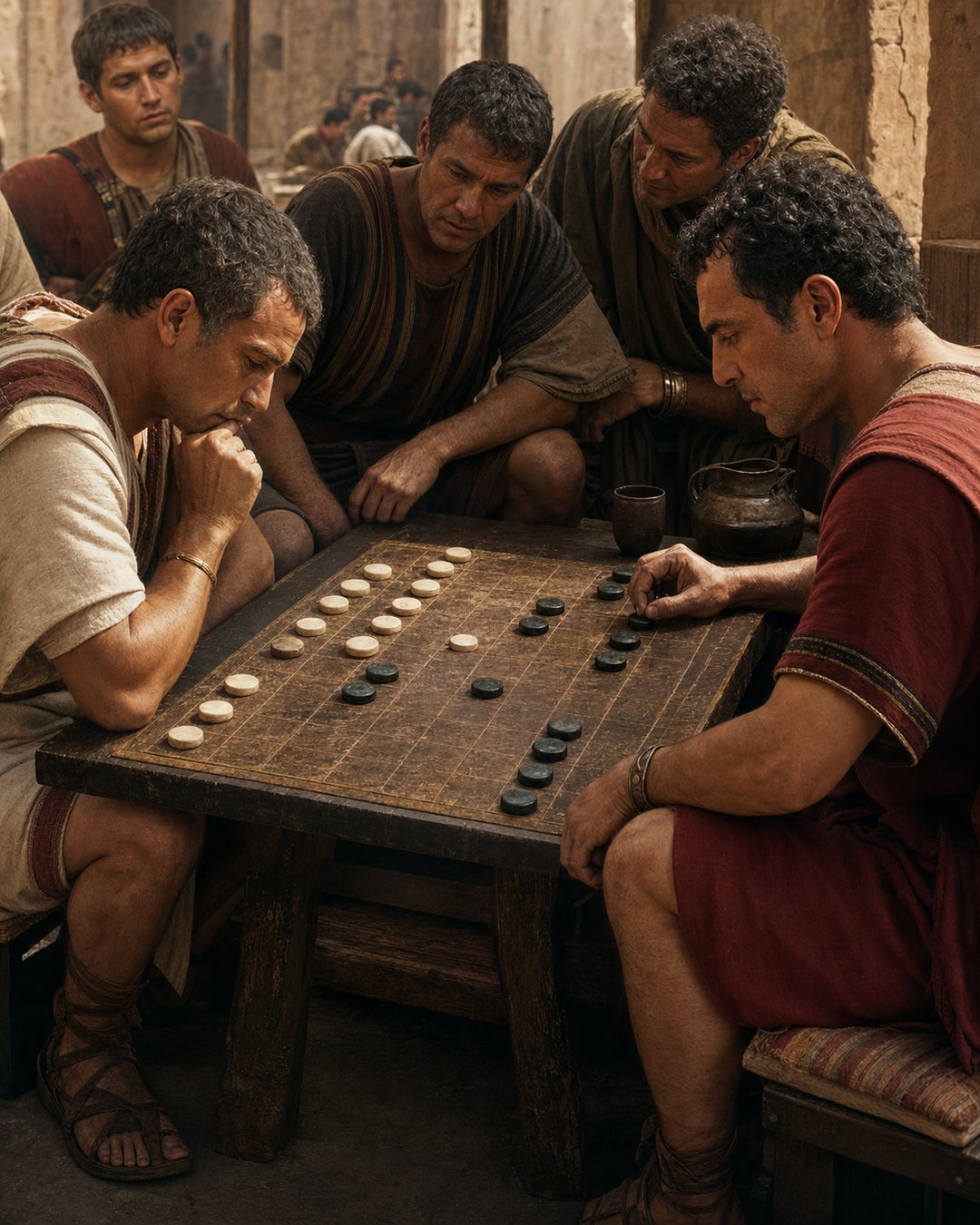
Two Romans could sit over a grid with equal armies and no dice to blame. Each moved a counter into a new square, watched the reply, and tried to make the opponent’s line become a trap. The game later writers called ludus latrunculorum, the game of little soldiers or mercenaries, survives as scattered boards, pieces, literary remarks, and arguments about rules.
That uncertainty is part of the history. No complete Roman rulebook has reached us. Modern reconstructions compare brief texts and archaeological patterns, but details such as board size, opening arrangement, special pieces, and the exact conditions for victory remain disputed. We can describe a family of evidence more securely than one universal commercial game.
Even with that caution, the mechanism is vivid. Opposing counters occupied a bounded field; movement created lines and vulnerabilities; capture was associated with enclosing an enemy between friendly pieces. A simple board transformed a table, pavement, or scratched stone into a contest of patience that spectators could read and players could remember long after a throw of knucklebones was forgotten.
The Grid Could Be Made Almost Anywhere
Roman gaming boards appear scratched into paving slabs, steps, floors, and reused stone as well as made as portable objects. A grid required little material: intersecting lines, a flat surface, and counters distinguishable by color, material, or shape. The setting could range from a house to a military site or a public place.
Not every scratched pattern is automatically a latrunculi board. Grids served multiple games, and pieces easily wandered from their original context. Archaeologists must consider dimensions, wear, associated finds, and parallels rather than assigning a famous name to every set of squares.
The portable arithmetic described in our article on the Roman abacus also used counters and lines, but its outcome was an answer rather than an opponent’s defeat. Similar humble objects could organize number in one setting and competitive space in another.
Ancient Writers Praised Skill More Than Rules
Literary references assume that readers recognized the game. Authors mention pieces, lines, enclosure, and clever play without pausing to teach beginners. That is exactly what makes them frustrating evidence: familiarity encouraged allusion while making a formal explanation seem unnecessary.
Ovid used gaming imagery in poetry and referred to a piece caught between enemies. Martial praised a skilled player who could rescue counters from danger. Such remarks support positional capture, but poetry is not a technical manual. A metaphor can preserve a mechanism while leaving the sequence of legal moves unclear.
The social signal is firmer. Strategic gaming could display foresight, composure, memory, and the ability to read another person. These were flattering qualities for elites and officers, yet the low cost of a scratched board allowed play far beyond wealthy rooms. Prestige and accessibility could occupy the same grid.
A match also created an audience. Bystanders could recognize a threatened enclosure, debate a missed escape, and remember a reversal even if they never touched a counter. Unlike solitary calculation, face-to-face play produced a small public record carried in conversation. A renowned player’s status depended not on owning luxurious equipment but on repeatedly seeing a line before others did.
Capture Worked Through Position
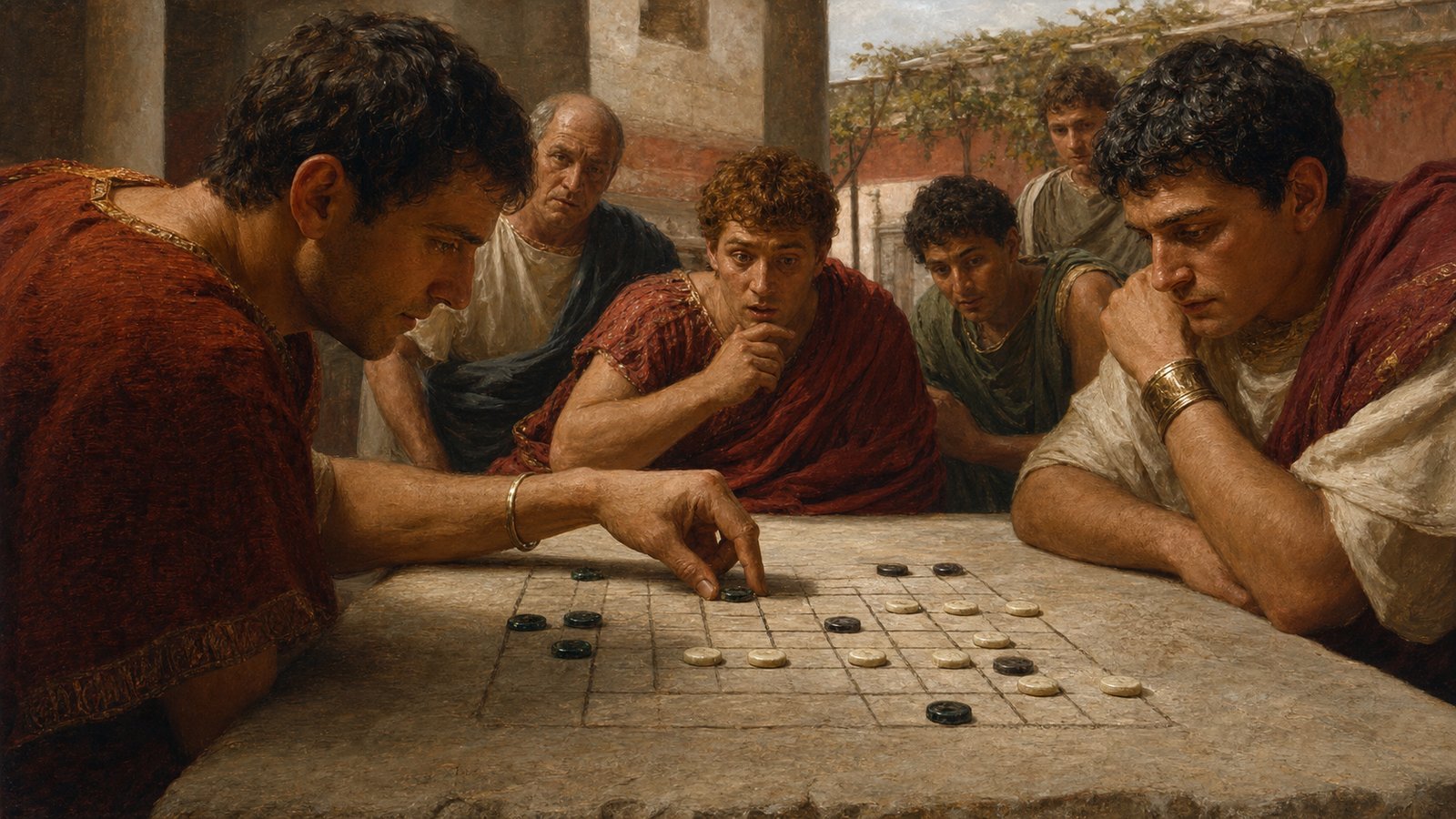
The best-known reconstruction treats ordinary counters as pieces moving orthogonally across a grid. An opposing piece is captured when bracketed between two enemies. This custodial capture differs from chess, where one piece normally enters the occupied square. The attack is created by relationship rather than by a single powerful token.
A player pursuing that capture had to reveal intention without making the trap too obvious. Advance one counter and an opponent could withdraw; hold a pair too rigidly and another part of the board might be abandoned. The useful threat was often a choice between two losses. Even a compact grid could reward several moves of preparation rather than the first available capture.
If that core is right, every move changes more than one destination. It opens a line behind the moving piece, supports neighbors, threatens enclosure, and can invite a countertrap. A counter near the edge may have fewer escape routes; a connected group can protect space while risking several pieces if its formation breaks. Captured material mattered, but position could matter first. Sacrificing one counter to open a line or divide an opposing group is a plausible consequence of the mechanism even when no ancient tactical handbook explains it.
Modern players should label reconstructed rules honestly. Scholars have proposed different boards, movement ranges, leaders, and victory conditions. Playing one version can illuminate the strategic possibilities, but it does not prove that a legionary at Vindolanda or a patron at Rome followed the same printed sheet.
Dice Belonged to a Different Kind of Tension
Romans also played games of chance with dice and knucklebones, and some race games combined throws with movement. Gaming culture therefore included luck, calculation, wagering, and social performance in different proportions. Latrunculi matters because it shows that randomness was not the only attraction.
The dice article at The Lost Eagles explores how a visible throw transferred uncertainty onto a small object. A positional board did almost the opposite. It left the player exposed: after the pieces were set, a bad line could be attributed to judgment rather than fortune.
That distinction did not make strategy morally pure. Competition could provoke boasting, anger, wagers, delay, and obsession. Roman moralists often distrusted leisure when it displaced duties. The board was small, but the behavior around it remained public enough to affect reputation.
Counters Carried Identity Without Portraits
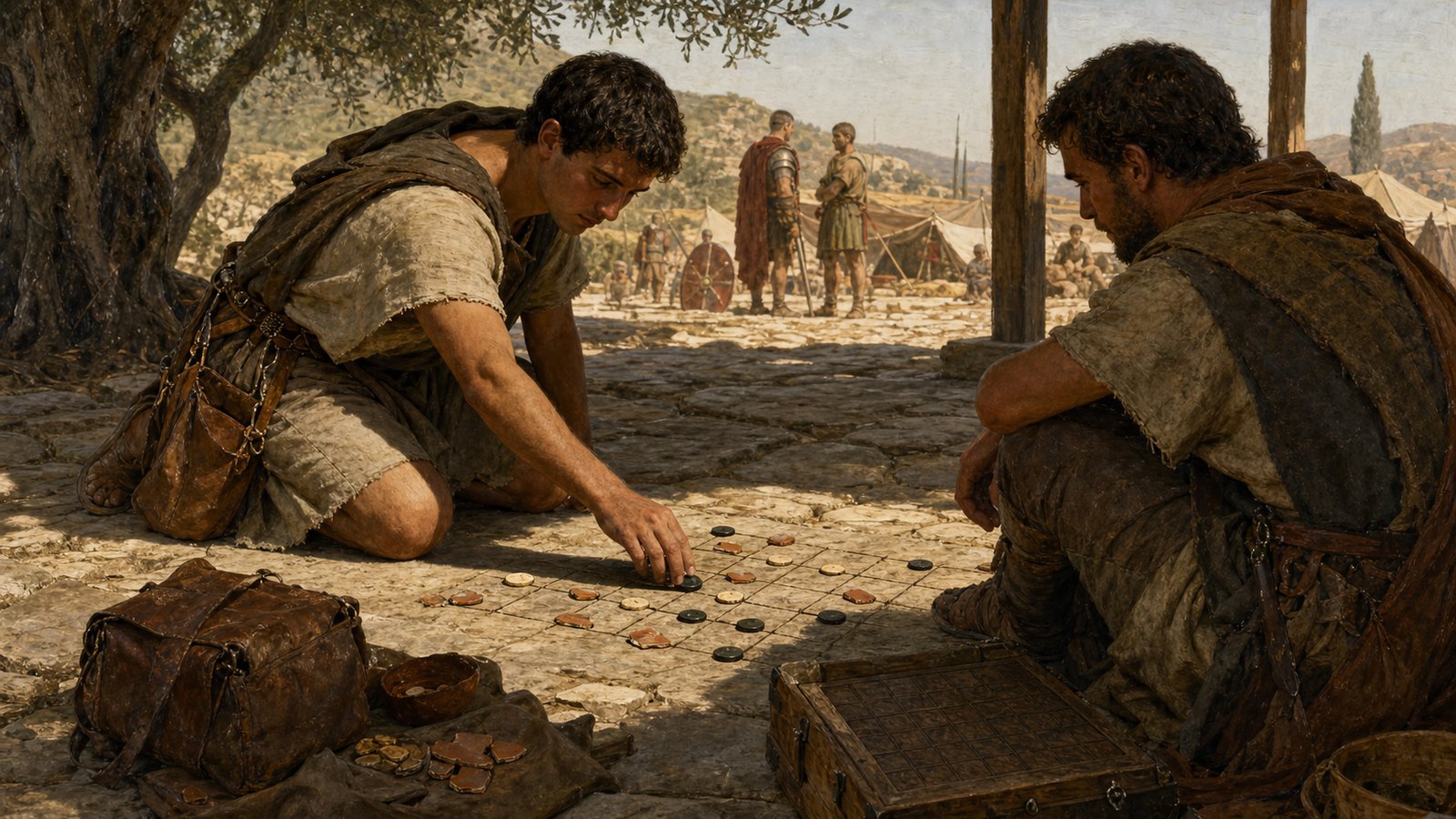
Pieces could be made from glass, bone, pottery, stone, or other available materials. Sets needed opposing identities, not realistic soldiers. Color and shape turned anonymous discs into two forces whose meaning lasted only while the game continued. A chipped potsherd could serve when a matched glass set was unavailable; functional contrast mattered more than splendor. This material flexibility helps explain why play could travel with people and be improvised at a stopping place.
Some surviving counters bear marks or numbers, but interpretation depends on context. A lone disc might belong to a board game, calculation, accounting, a token system, or another activity. Archaeology often preserves the object while losing the rule that activated it.
The same ambiguity surrounds many ordinary Roman tools. A signet ring or military diploma announces its institutional purpose more loudly. A smooth gaming counter acquires purpose from neighboring pieces and scratched lines. Its identity is relational, just like the capture mechanism itself.
The Missing Rulebook Is a Useful Warning
It is tempting to give latrunculi a neat diagram, exact starting rows, and a decisive final objective. That produces a playable modern game but can exceed the sources. Responsible reconstruction separates what ancient remarks strongly suggest from choices made to fill silence.
The secure outline is still substantial. Romans recognized a board contest with opposing pieces; they associated skilled play with planning; enclosure or being caught between enemies appears in descriptions; and physical grids and counters made such games available in varied settings. The unresolved details belong in the conclusion, not hidden from it.
A Roman board game could compress military language without recreating a battle. Nobody bled when a line closed, but the emotional structure—advance, exposure, rescue, encirclement, loss—was legible at a glance. The board’s deepest trick was not pretending that counters were soldiers. It was making two seated people experience space as danger.
Sources & Further Reading
- World History Encyclopedia, “Games, Sport & Recreation in Ancient Rome”
- The British Museum, “Top 10 Historical Board Games”
- Encyclopaedia Britannica, “Latrunculi”
- The Metropolitan Museum of Art, “Glass Gaming Piece”