
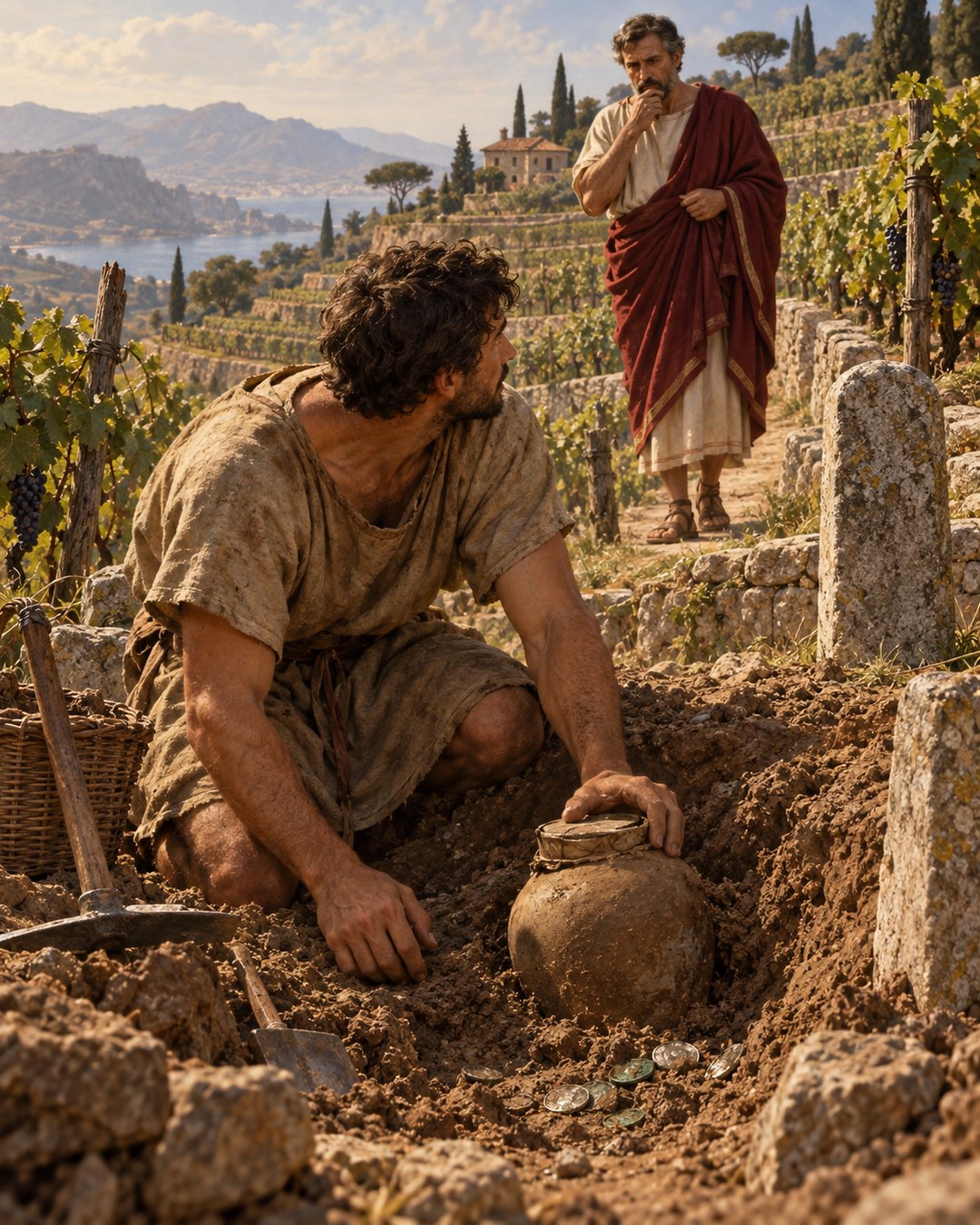
A jar of old money emerges from the earth. No living person remembers who buried it, and no ordinary chain of ownership reaches back to the deposit. Discovery feels sudden, but Justinian’s Institutes refuses to leave the result to whoever grabs first.
The text asks where the treasure was found. On the finder’s own ground, the whole deposit can belong to the finder. On another person’s ground, it is divided equally. On imperial or public land, one half goes to the finder and the other to the fisc.
Location turns surprise into allocation. The vanished owner explains why the deposit qualifies as treasure; the present ground explains who receives it.
An Ancient Deposit Needed a Forgotten Owner
The legal definition is narrower than any valuable thing underground. The Institutes describes treasure as an ancient deposit of money whose owner is no longer remembered. Age and broken memory work together.
A recently hidden purse would present a different problem. Someone may still own it and seek its return. Treasure in this section belongs to a past so disconnected that the law treats it as having no present owner. The definition removes the absent depositor from the immediate contest without pretending every buried object meets the rule.
The word “money” also keeps the passage focused. It does not automatically decide the status of every statue, tool, grave good, or mineral seam. Modern use of “treasure” is broad; this legal text establishes a particular category before assigning shares.
Archaeological discovery and ancient entitlement should not be collapsed. The named Christians preserved by the Durobrivae silver hoard matter today because context, inscriptions, and conservation retain information. Institutes 2.1.39 instead explains how a legal system allocated a qualifying find.
The lack of remembered ownership is therefore not mere atmosphere. It is the hinge. Once the former owner can no longer anchor the claim, the law has to choose among discovery, control of land, and claims attached to public authority.
This definition also prevents simple burial from manufacturing treasure overnight. Concealment alone is not enough. The deposit must belong to an ancient, ownerless past as the legal text understands it. A contemporary owner cannot be displaced merely because another person reaches the money first with a spade.
One’s Own Ground Joined Discovery to Control
The simplest case combines finder and landowner in one person. When someone discovers treasure on his or her own ground, the rule attributed to Hadrian grants the find to that person. No second private land claim competes with the act of discovery.
The Institutes describes Hadrian’s settlement as following natural equity. That phrase gives the distribution a language of fairness, but the operation remains concrete. The person who controls the soil and the person who exposes the deposit are the same.
This does not mean effort creates the title in every circumstance. The rule concerns a fortuitous find: treasure encountered by chance. It does not authorize excavation anywhere or erase other restrictions. Its subject is the ownership consequence after a qualifying ancient deposit happens to be discovered.
Chance narrows the moral picture. The finder has not purchased the value or received it by inheritance. The gain arrives through discovery. By joining that accident to ownership of the ground, the rule gives the windfall a stable destination instead of treating surprise itself as the only legal argument.
Ground is not passive scenery. It supplies the legal relationship that discovery alone lacks. The deposit has lost its remembered owner, but the soil around it has not necessarily lost one. Where both roles coincide, the law can award the whole without dividing them.
The structure recalls the rule for returning creatures discussed in the ownership of bees that retain a habit of return. In both cases, Roman law translates physical facts into a boundary for possession. Yet the treasure rule looks backward to forgotten ownership, while the bee rule watches ongoing behavior.
Another Person’s Soil Produced Two Equal Shares
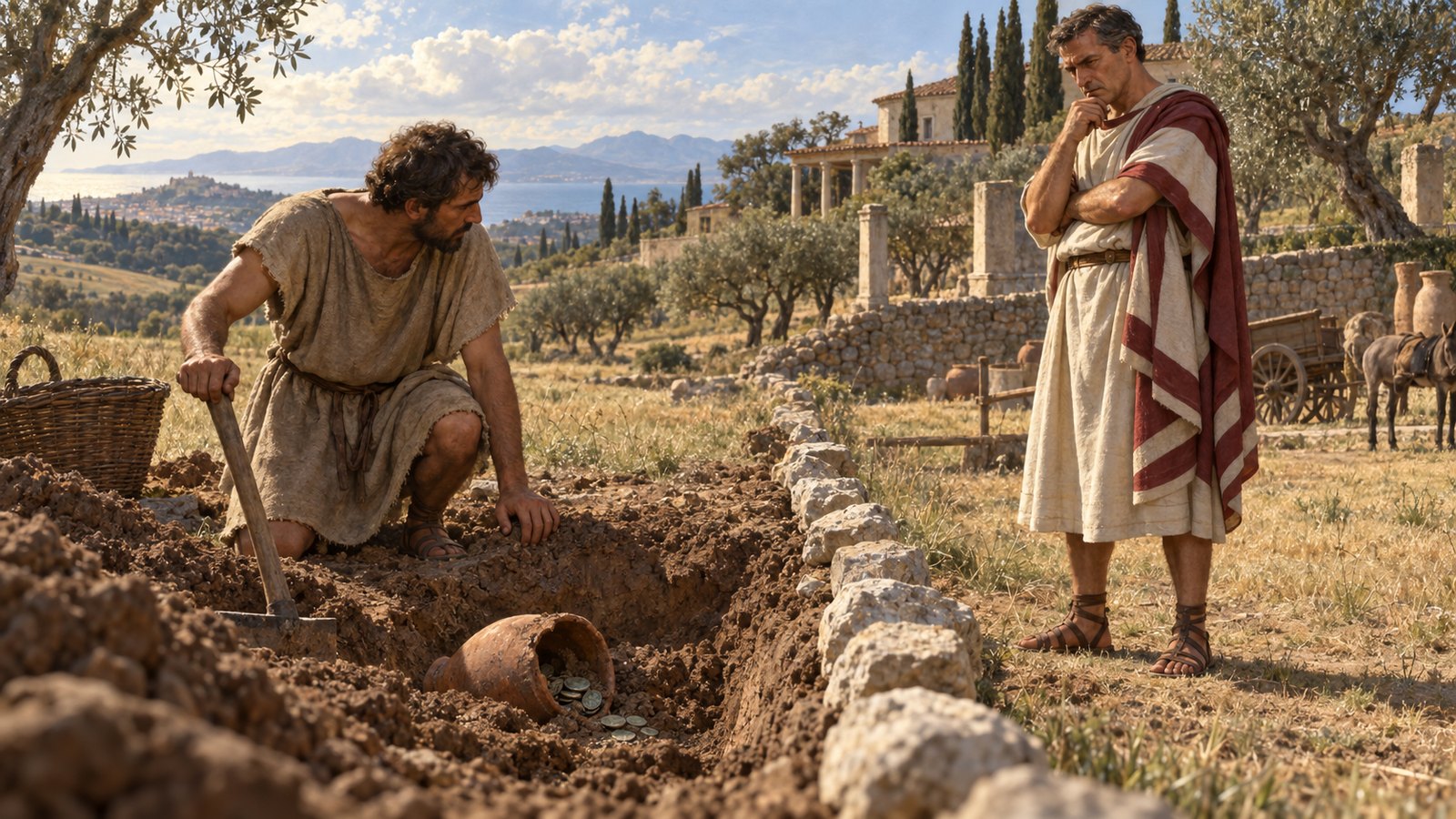
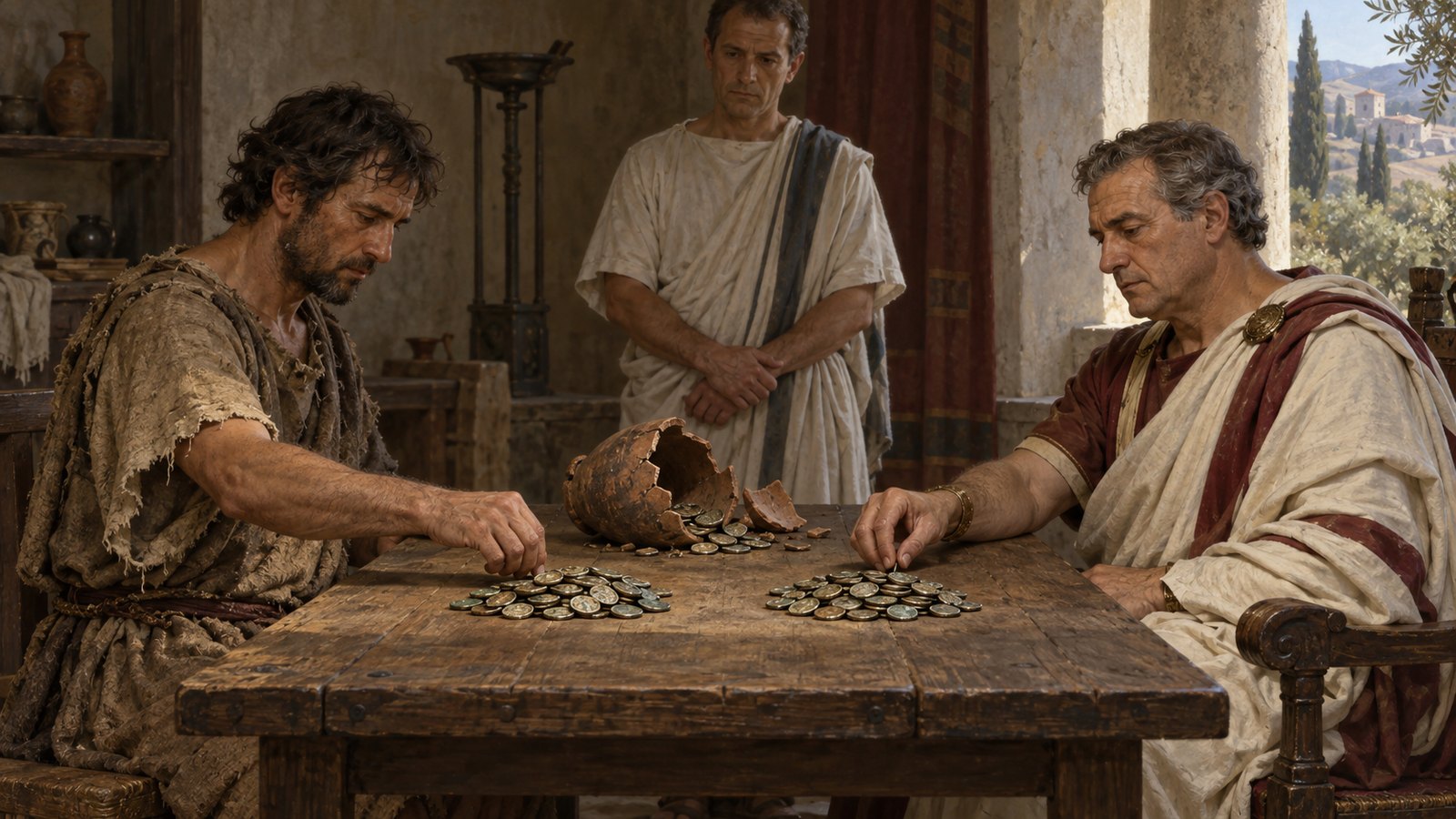
When the finder encounters treasure on land belonging to someone else, neither discovery nor landed control receives everything. Hadrian’s rule divides the deposit: half to the finder and half to the landowner.
The equal split recognizes two distinct connections. Without the finder, the ancient deposit might remain unknown. Without the other person’s ground, the finder has no private place in which the object was lawfully situated. The rule refuses to let one connection swallow the other.
Equality also makes the outcome administrable. The passage does not propose a sliding reward based on digging depth, labor, coin count, or how long the land has been held. Once the legal category and location are established, the shares are fixed.
The fraction protects an incentive on both sides. A finder has reason to disclose a discovery because half is recognized. A landowner has reason to permit a lawful resolution because the soil carries an equal claim. The source does not explicitly present this as economic policy, so it is safest to describe the balance rather than invent Hadrian’s private motive.
The text does not tell us how a disputed jar was guarded, counted, or physically divided. It does not preserve a lawsuit between one named finder and one named owner. Inventing those scenes would obscure what the source does preserve: a general allocation rule organized by the status of the land.
Boundaries therefore become consequential before anyone sees the coins. A low wall, surveyed edge, or recognized field limit can decide whether a finder keeps all or shares half. The treasure lies still for generations, but the legal geography above it can change.
Public and Imperial Ground Redirected the Other Half
The Institutes extends division beyond private land. If treasure is found on imperial or public property, the finder receives half and the fisc receives half. The second share follows the authority attached to the ground.
This preserves the same two-part logic while changing the recipient. On another private person’s property, the landowner takes the corresponding half. On imperial or public ground, the fiscal claim occupies that position. Discovery is still rewarded, but it does not erase the institutional owner.
The passage also gives sacred and religious places a striking treatment: a fortuitous finder there receives the treasure. The source lists those places alongside the finder’s own ground rather than assigning an automatic half to the fisc. That detail warns against assuming all exceptional land categories produced the same result.
Roman law could react sensitively to physical place. The dispute involving Italian rivers contesting obligations to Rome shows communities arguing through geography and administration. Treasure law works on a smaller object, but again location determines which legal relationship becomes active.
Sacred and religious ground makes the map more complex than a simple private-versus-state division. The Institutes places fortuitous finds there with the finder’s award. A reader has to follow the categories actually named rather than assume holiness automatically transfers the money to a temple or emperor.
Here the system does not recover the ancient owner. It organizes claims among the people and institutions still present. The finder contributes revelation; the land contributes jurisdiction and control; the fixed fraction prevents either element from becoming invisible.
A buried deposit may feel detached from the surface world. Institutes 2.1.39 makes the opposite point. The instant treasure is uncovered, the contemporary identity of the ground reaches down into the hole.
The result is a compact decision tree. First establish that the money is ancient treasure with no remembered owner. Then identify the ground. Own or sacred ground points to the finder; another private owner produces equal shares; imperial or public land divides the value between finder and fisc. The drama of discovery ends in classification.
Sources
Justinian, Institutes 2.1.39.