
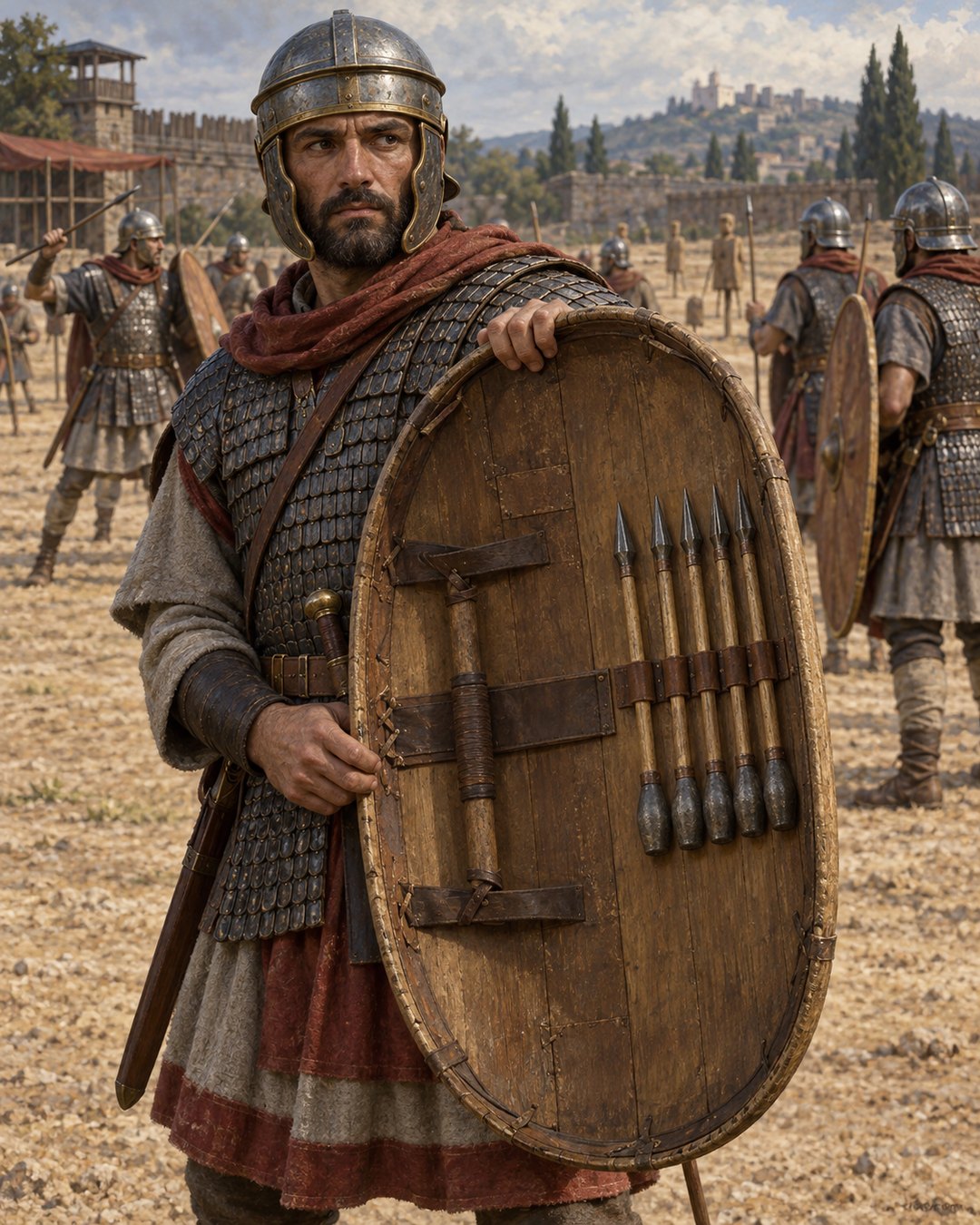
Five short darts travelled on the protected side of a soldier’s shield. They were weighted with lead, close enough to the hand to be drawn and thrown, yet carried inside the object that had to remain ready for defense. Vegetius calls them plumbatae or martiobarbuli.
His description is compact, but its tactical consequence is large. If every trained infantryman carries five, a formation does not need to wait for sword range or depend entirely on a separate body of archers. It can release a distributed missile attack and then continue fighting with its usual equipment.
The important number is not simply five. The important phrase is “inside their shields.” Storage, protection, and attack have been designed around the same surface.
The Shield Carried Ammunition without Becoming a Quiver
Vegetius discusses the lead-weighted darts in the first book of his military handbook, amid instructions about what recruits should learn. He treats proficiency as an exercise rather than as an accidental talent. A soldier must practice the throw until the weapon can be used from formation.
The lead gives the compact dart concentrated weight. Vegetius does not provide a universal surviving measurement in this passage, so one should resist turning every archaeological point into his exact weapon. His evidence is functional: lead-weighted missiles, five carried inside the shield, trained use.
Placement on the inner face solves several problems. The darts move with the soldier instead of requiring another container to swing at his side. The shield protects their fittings from direct contact. The throwing hand can reach them while the defensive face remains oriented toward danger.
That arrangement differs from the sling’s two-cord release. A slinger needs flexible cord, ammunition, and space for a rotating or extended cast. The plumbata is stored already assembled, one of five compact missiles waiting behind a rigid barrier.
The source does not explain the precise leather loops or clips used in every unit. Images must therefore show a plausible carrying method without pretending that one reconstructed rack is certain. The firm evidence is the relationship: the inner shield and a set of five.
Training Turned Five Objects into One Sequence
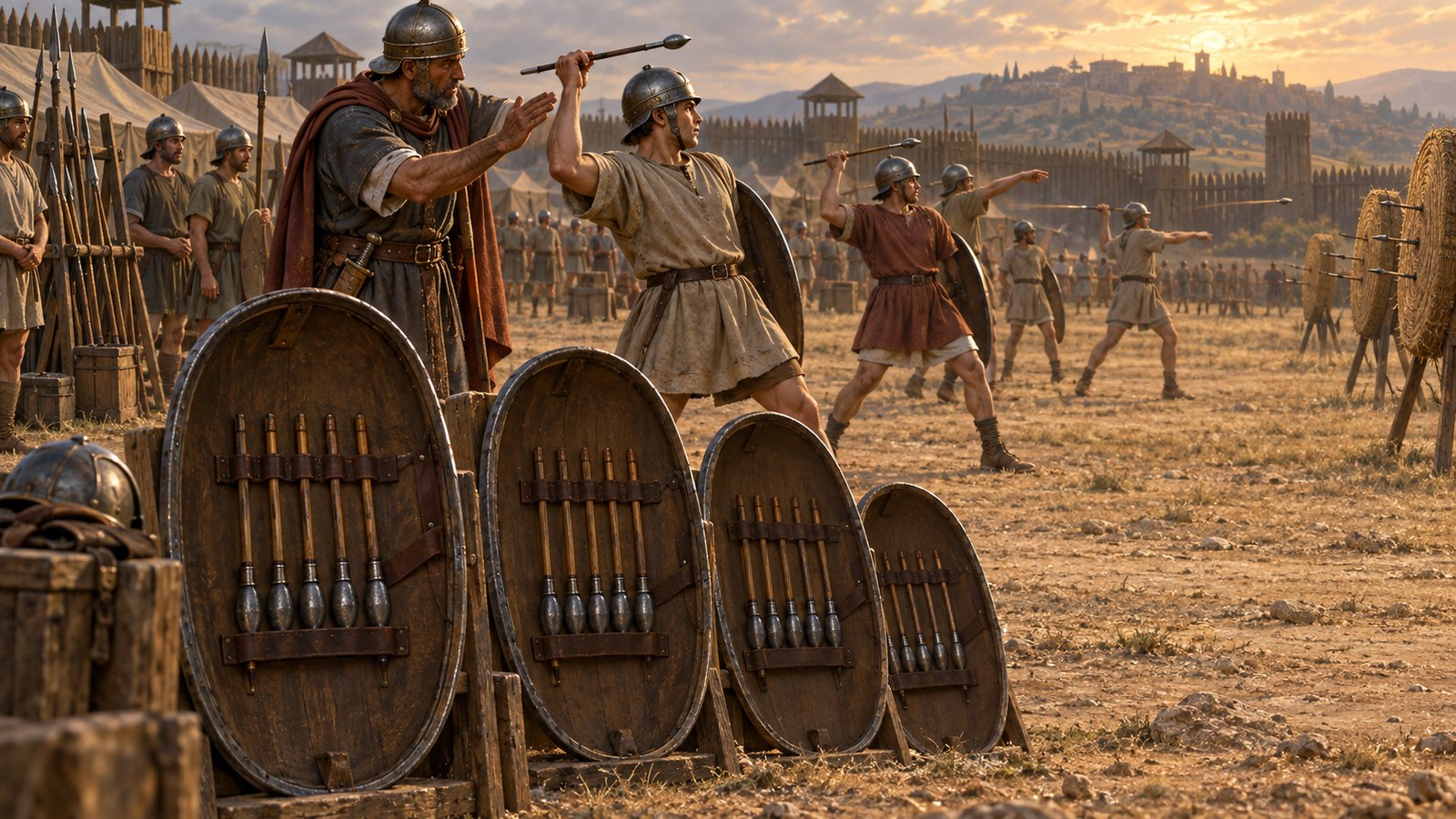
A dart behind a shield is useful only if a soldier can retrieve it without losing control of the shield. Practice had to combine several motions: maintain cover, find the shaft, free it from its holder, establish a grip, open the throwing angle, release, and recover the guarded stance.
Vegetius associates this exercise particularly with Illyrian soldiers. He names the Jovian and Herculian legions as units whose skill brought distinction. The passage links individual repetition to collective reputation: many men performing the same small sequence can define how an entire formation is valued.
Five missiles also impose order. A soldier cannot throw indefinitely. He has a short, known reserve. The number encourages a burst before contact rather than a prolonged contest with dedicated archers. Once the darts are gone, shield, javelin, spear, or sword still determine the next phase.
Because the reserve is visible on the shield’s inner face, expenditure can be felt immediately. Each empty fitting marks one fewer throw. The arrangement does not require a soldier to search a bag or guess how many pieces remain. That practical reading follows from the fixed set Vegetius names, even though he does not describe a formal counting drill.
The twice-weight training gear examined in Rome’s heavy wicker shield drill made ordinary combat equipment feel lighter after repetition. Plumbata practice asks for a different adaptation. It does not simply increase load; it teaches a weapon to emerge from behind protection at the correct moment.
Vegetius does not name an individual recruit, record a score, or prescribe one daily number of throws in chapter 17. Those omissions prevent a cinematic training timetable from being passed off as fact. What survives is enough to reconstruct the skill problem without inventing its schedule.
A Volley Began before Ordinary Weapons Reached
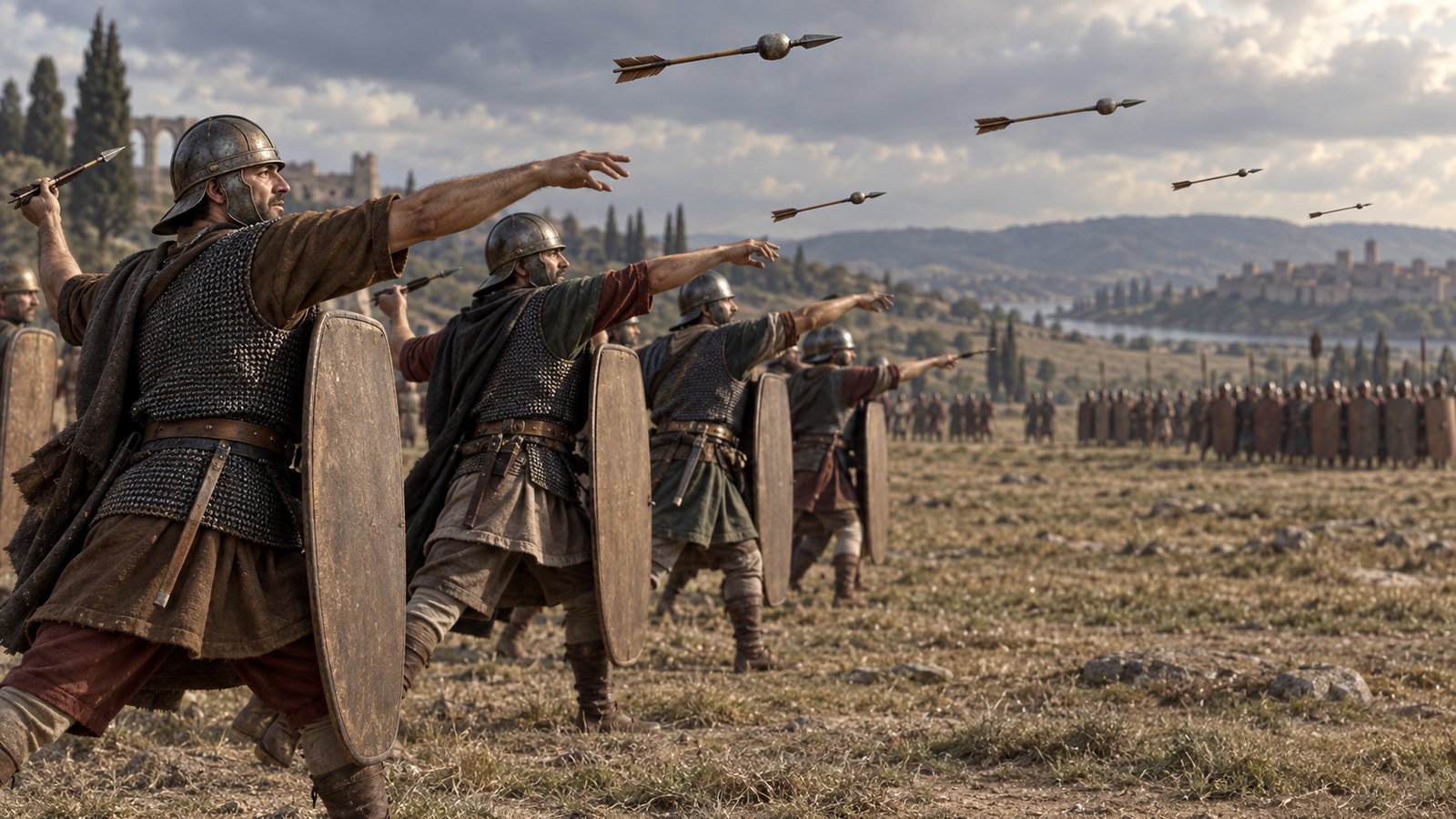
Vegetius explains the payoff through distance. Properly trained soldiers could discharge their darts before they came within the reach of the enemy’s ordinary missiles. In his comparison, infantrymen briefly performed the work of archers.
He says the darts could wound both soldiers and horses. The claim identifies the target environment as a mixed battlefield rather than a practice board. A compact lead-weighted point descending into a formation threatens bodies and disrupts approach even when it does not decide the battle by itself.
The comparison with archers should not erase the weapon’s limits. Five darts do not turn shield-bearing infantry into a permanent missile corps. They create a window. During that window, men organized for close fighting can project force beyond the distance at which their heavier weapons or swords matter.
That window affects an approaching enemy’s choices. A formation expecting safety before ordinary javelin range instead meets missiles from troops who still possess shields and close weapons. Vegetius emphasizes wounds, but disruption is embedded in the geometry: horses and men must continue forward through a threat released earlier than expected.
Distribution multiplies the effect. One soldier has five. A line has five times the number of men able to throw. Because the missiles are carried individually, the formation does not depend on a single cart, specialist, or central issue point at the instant of use.
It also spreads failure. A dropped dart or a poor throw reduces one man’s small reserve rather than exhausting the unit’s only missile source. Conversely, skill has to be repeated across the line if the distributed system is to deliver more than scattered individual casts.
This is also why training must be collective. A volley released at random can waste the range advantage and obstruct movement. Vegetius does not preserve a shouted command sequence here, but his emphasis on exercise implies controlled use rather than five private decisions detached from the line.
The Jovians and Herculians Made Skill a Unit Identity
Vegetius claims that the Jovian and Herculian units won preference over other troops through mastery of these darts. He presents their weapon skill as a reason for advancement to legionary rank and dignity. Whatever the institutional history compressed in that statement, the author wants technique to explain status.
The names themselves evoke imperial prestige, but Vegetius’s lesson is practical. A celebrated title does not throw the dart. Men have to repeat the action until shield storage, draw, aim, and release work under pressure. Reputation grows from a movement made reliable across many bodies.
The author’s praise gives the chapter an institutional memory. He is not merely listing an object from an armory. He attaches the weapon to units whose standing supposedly demonstrated what systematic instruction could achieve. Whether every detail belongs to one date is less important to his argument than the model of trained excellence he wants later readers to imitate.
Roman military systems repeatedly joined small routines to large outcomes. The layered obstacles outside Caesar’s Alesia lines worked because pits, stakes, and fields were arranged before an assault. The plumbatae work at the soldier’s scale: preparation is carried into the encounter on each shield.
The passage should not be stretched into a claim that all Roman armies in all centuries carried identical sets. Vegetius wrote a prescriptive compilation shaped by examples from different periods. His five-dart detail is evidence for a method he thought worth teaching, not a photograph of every legion.
Within that method, the shield is more than a wall. Its outer face receives threat; its inner face organizes an answer. The soldier begins covered, reaches behind the defense, and sends one of five lead-weighted missiles into the space before close combat.
Five darts are a modest inventory. Multiplied by a trained line and released at the chosen distance, they become a tactical interval the opponent has to cross.
Sources
Vegetius, Epitoma rei militaris 1.17.