
Pliny the Elder did not believe the best cinnamon had to be shot down from giant birds’ nests with leaded arrows. He dismissed that story, winged serpents, clawed bats, and an Arabian perfume detectable far out at sea as inventions that helped raise prices.
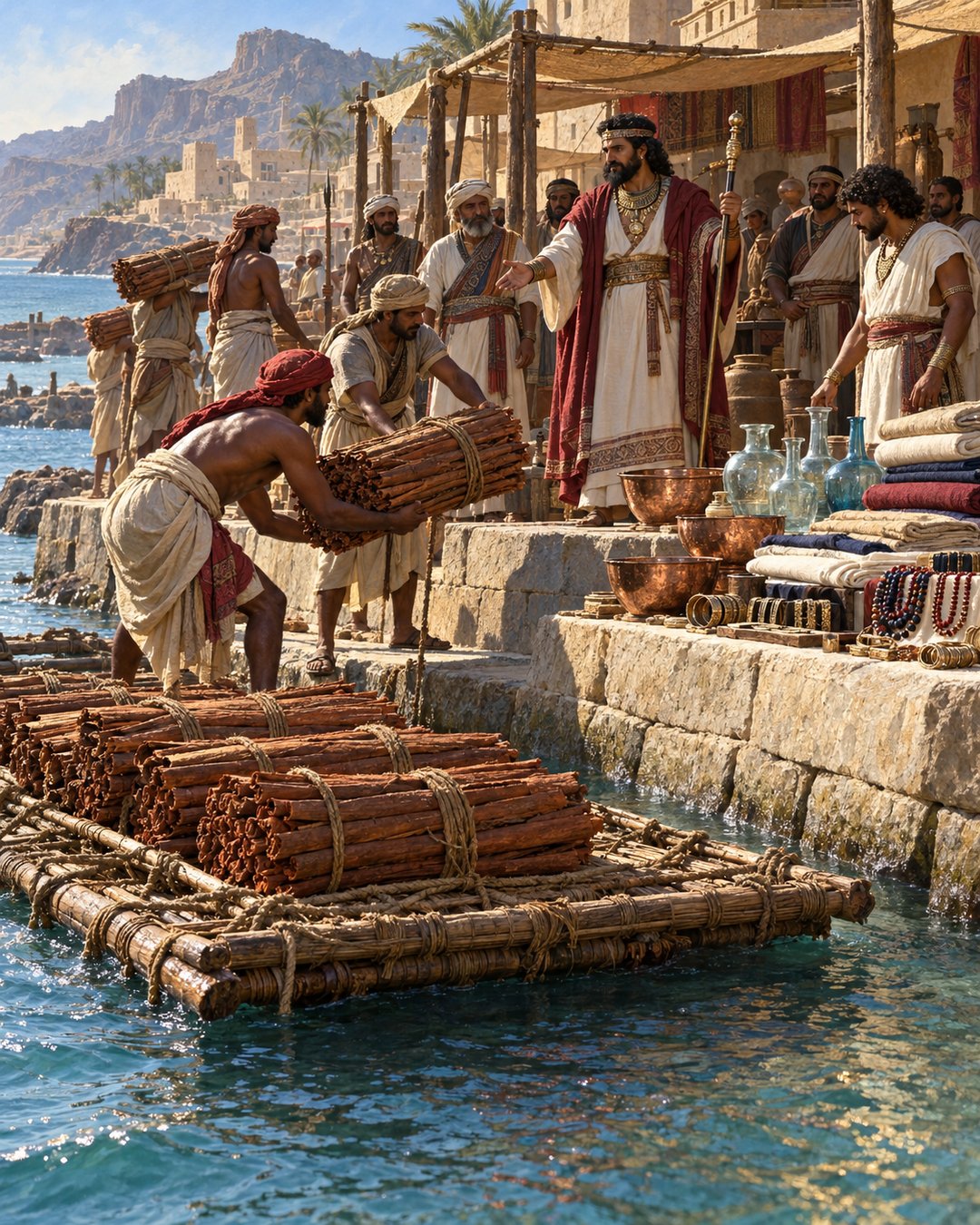
His alternative was not a short or simple supply chain. He placed cinnamon among Ethiopians, then had Troglodyte traders buy it from neighbours and carry it on rafts without rudders, oars, or sails. Winds drove them from gulf to gulf, around Arabia, and toward the Gebanite port of Ocilia.
The return could consume almost five years, and Pliny says many travellers died. At the destination, bark was not merely unloaded. Quality, royal control, proclamation, and price determined what happened next.
Marvel stories hid the source while making distance profitable
Pliny begins with tales inherited from famous antiquity. Cinnamon and cassia, it was said, lay in nests built on inaccessible cliffs and trees by unusual birds, especially the phoenix.
One version made the birds carry chunks of meat upward until the weight broke the nests and dropped spices within human reach. Another armed collectors with arrows weighted by lead.
Cassia acquired its own guardians: a terrifying clawed bat and winged serpents around a marsh. The obstacles differed, but the commercial effect was similar. A buyer heard that the commodity came through danger no ordinary traveller could inspect.
Pliny states his diagnosis bluntly. Such tales were invented to increase the prices of the goods. His skepticism is part of the market account, because information and value travelled together.
He also rejects the claim that Arabia’s combined fragrances announced the peninsula to Alexander’s fleet while it was still far from land. Smell becomes another form of inaccessible proof: the consumer is asked to imagine a whole coast broadcasting luxury.
This argument fits beside the many charges that accumulated along the frankincense road. Frankincense became expensive through visible stages and tolls. Cinnamon, in Pliny’s telling, also gathered value through stories that obscured where collection began.
His correction must still be read as an ancient geographical claim, not a modern botanical map. Pliny places the plant among Ethiopians linked by marriage to Troglodytes. That is the supply geography his chapter reports.
The important shift is from monsters to intermediaries. Cinnamon does not descend from a nest. Neighbours grow or gather it, traders buy it, and transport begins.
Wind replaced steering on a voyage measured in years
The Troglodytes carried their purchase over what Pliny calls vast tracts of sea. Their rafts had no rudder. Oars and sails did not propel them.
Instead, timing supplied control. The merchants chose the winter season around the equinox, when a south-easterly wind could drive them along a direct sequence from gulf to gulf.
After doubling the promontory of Arabia, a north-easterly wind carried them toward Ocilia, a Gebanite port. Route knowledge therefore consisted partly in waiting for one wind and then receiving another after a dangerous turn.

Pliny admires daring where equipment is absent. “Man alone” stands in place of the arts of navigation in his description. That rhetoric should not be mistaken for a full technical plan, but it records the feature he found astonishing.
He says merchants might need almost five years before returning and that many perished. The statement turns distance into tied-up life as well as tied-up capital. Goods exchanged at the far end could not quickly rescue a household waiting for the trader.
The cargo moving back included glass and copper, cloth, buckles, bracelets, and necklaces. Cinnamon therefore belonged to an exchange rather than a one-directional extraction. Manufactured objects and adornment travelled toward the suppliers.
The list also joins materials with different durability. Glass could break, cloth could rot, and metal objects added weight, yet each had a place in the return bargain described by Pliny.
That pattern complements the loan contract that exposed financing behind an Indian Ocean cargo. The cinnamon chapter gives no surviving contract. It reveals risk through winds, delay, death, and the bundle of goods carried back.
Ocilia mattered because it converted a wind-borne arrival into access to the next commercial authority. Reaching Arabia did not end the chain; it delivered traders to a controlled market.
A small shrub became valuable through bark, ritual, and grading
Pliny’s plant is not an imposing tree. He gives a maximum height of two cubits and says the smallest examples stood only a palm high. Shoots appeared close to the ground.
While green, it had no scent. Its leaves resembled wild marjoram, and it did better in dry places than in rain. Constant clipping was required.
Level ground did not make collection easy. The shrub thrived among tangled brakes and brambles. A low plant could still resist the gatherer through its surrounding vegetation.
Permission came before cutting. Pliny says workers sought leave from a god whom some identified as Jupiter and Ethiopians called Assabinus. He reports offerings from forty-four oxen, goats, and rams.
Work was restricted to daylight between sunrise and sunset. A priest divided the branches with a spear and reserved one share for the god before a dealer stored the rest in lumps.
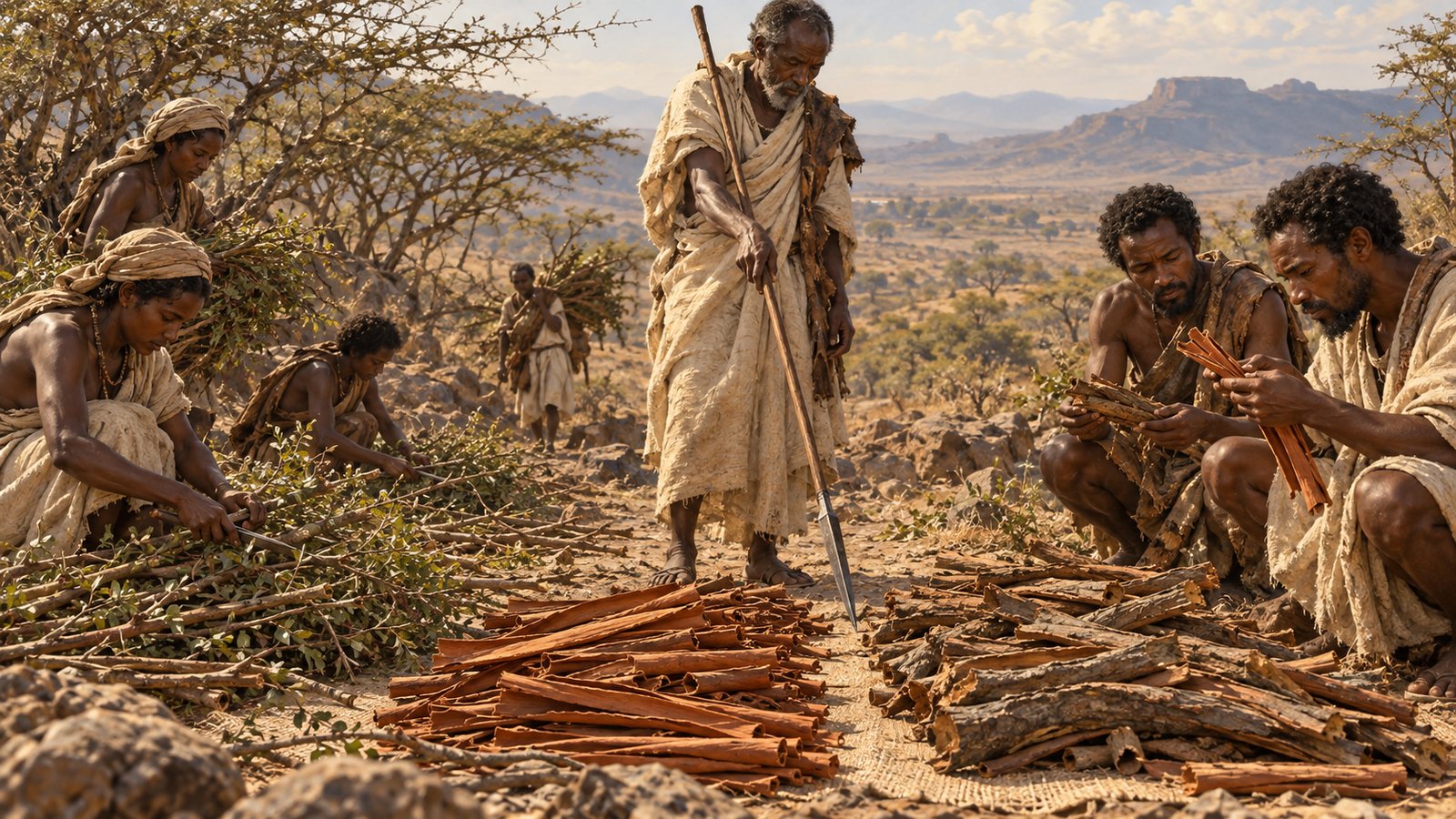
Then commercial anatomy took over. Thin upper lengths about a palm long produced the finest cinnamon. Lower sections declined in quality because the valued bark formed a smaller share of the piece.
The wood itself had little esteem. Its acrid taste resembled wild marjoram, and it carried the separate name xylocinnamum.
Buyers could test texture. Good pieces were not rough and did not crumble readily when rubbed together. Soft cinnamon or bark that fell away too easily was rejected.
Pliny gives ten denarii per pound for cinnamomum in one part of the account and notes changing preferences between white, black, and mottled kinds. Grade was not one permanent visual rule.
The sequence shows value being made through subtraction. Gatherers separated divine share from dealer’s share; merchants distinguished upper bark from lower material; buyers removed soft or crumbly pieces; the wood fell outside the most prized category.
A royal proclamation opened the market and exposed the price
The Gebanite king alone possessed the right to regulate cinnamon sales, according to Pliny. The market opened by public proclamation.
That detail makes the destination an institution, not merely a beach. Traders who survived the wind route still entered a sale whose timing and authorization belonged to a ruler.
Pliny reports that cinnamon had once reached one thousand denarii per pound and then increased by half. He connects the rise to reports that forests had burned.
Even here, certainty breaks down. He says it was not established whether people set the fires out of resentment after injustice by those in power or whether accident caused them. Other writers blamed extremely hot southern winds.
A supply shock therefore generated competing stories just as origin had. Pliny is most confident about the market’s response and less certain about the fire behind it.
Cinnamon also crossed from commerce into display. Vespasian was the first, Pliny says, to dedicate cinnamon chaplets set in embossed gold at the temples of the Capitol and Peace.
Pliny himself remembered a heavy cinnamon root in the Palatine temple dedicated by Livia to Augustus. Drops emerged from it annually and hardened into grains until a fire destroyed the temple.
This final object resembles amber transformed from long-distance material into imperial spectacle. A traded substance could retain the aura of route and rarity after entering Rome.
The chapter’s central irony is that Pliny attacks fabulous commerce while preserving an extraordinary one. He removes phoenix nests, yet leaves rafts without steering, a voyage of years, ritual cutting, royal proclamation, forest fires, and temple offerings.
What makes the account useful is not a choice between “myth” and a perfectly modern report. It is the layered machinery of value that Pliny could see: origin claims, hazardous movement, exchange goods, sacred permission, physical grading, controlled sale, and imperial display.
Cinnamon reached a Roman reader only after those layers had accumulated. By the time bark entered a gold dedication, its small shrub and tangled dry ground were almost impossible to see—exactly the informational distance that marvelous stories had exploited.
Sources
Pliny the Elder, Natural History, Book 12, chapter 42.