
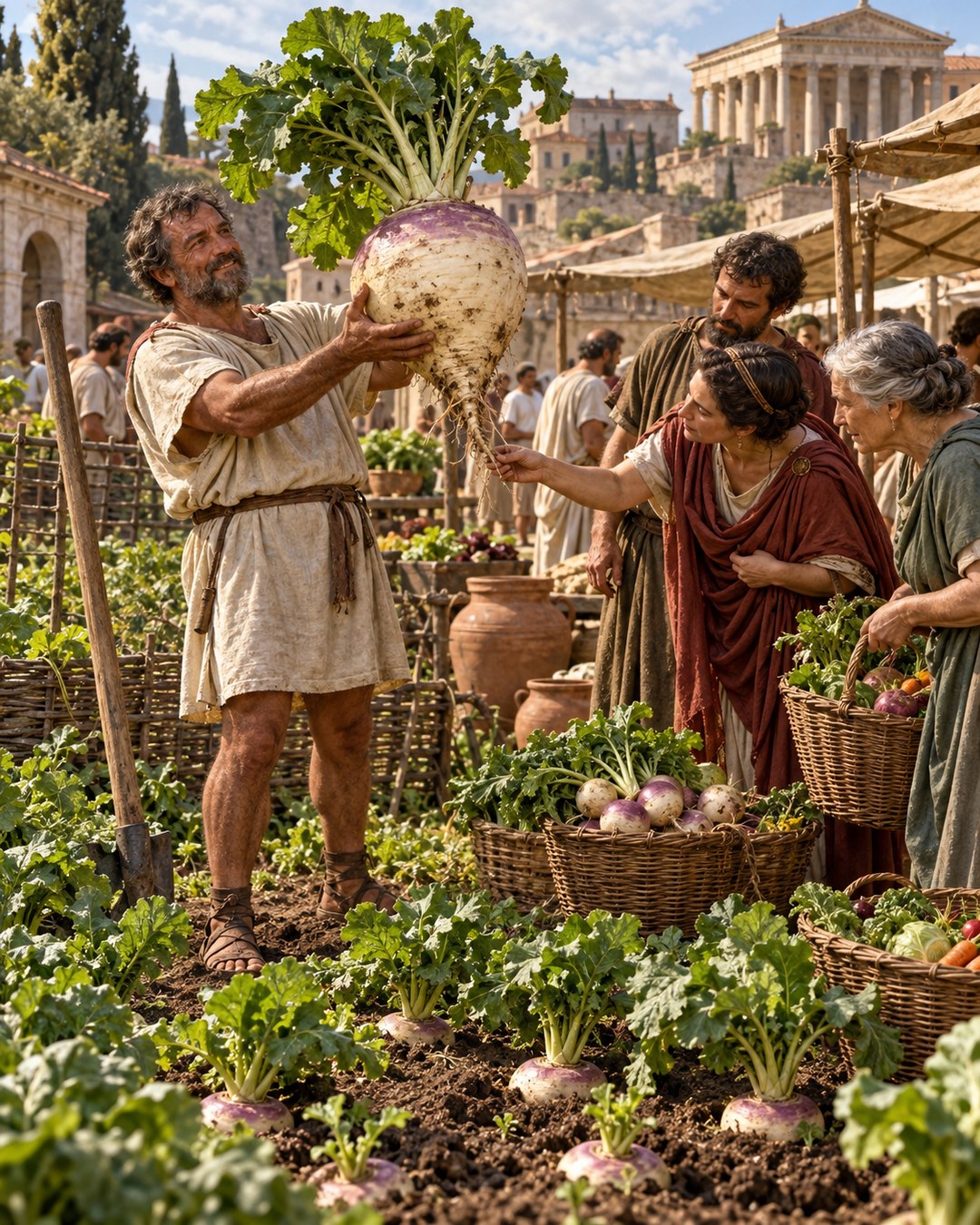
Most turnips hide the part people want underground. Pliny the Elder singles out a Corinthian exception whose great root stood almost clear of the soil and grew upward rather than digging down.
It belonged to a list of five named kinds. Another endured severe cold; another was prized for sweetness and a short round shape; another grew long. Leaves offered clues to flavour, while the names Amiternum and Nursia could raise a turnip’s reputation in Rome.
This is not a botanical key in the modern sense. The ancient categories and the translator’s cautions do not always line up neatly with current species. It is something equally useful for social history: a compact record of how growers and buyers noticed difference in a very ordinary root.
Round and long roots carried claims about use
Pliny begins with rape, grouping it with turnips among plants whose substantial parts are concealed in the earth. He reports a medical classification that called round examples male and larger elongated examples female.
Those gendered labels are ancient terminology, not a statement about plant sex that should be repeated as modern botany. Their value lies in the traits attached to them. The elongated form was considered sweeter and better for keeping.
Shape therefore mattered after harvest. A root that stored well could bridge days or seasons when fresh garden produce was unavailable. Sweetness mattered at the table, while keeping quality mattered in cellar, market, and household planning.
Pliny also records a belief that repeated sowing could turn the elongated form into the round one. The edition’s note challenges the claim and suggests confusion in transmission. The disagreement is a reminder that agricultural writing can preserve both observation and inherited error.
A Roman reader did not encounter “the turnip” as one stable object. Seed history, root outline, taste, and storage behaviour created subcategories whose names promised practical consequences.
That attention to slow selection differs from the mobile cucumber beds made for Tiberius. The cucumber story changes the growing environment around one desired crop. The turnip list asks which kind is already suited to cold, flavour, shape, or storage.
Five place names turned one crop into a field guide
The catalogue names Corinthian, Cleonaean, Liothasian, Boeotian, and green turnips. Names connect roots with places or recognizable types, letting a short word carry expectations that would otherwise require a long description.
The Corinthian grows to a remarkable size. More unusually, its root is almost out of the ground. Pliny calls it the only kind that shoots upward rather than extending down like the others.
That habit would be visible before harvest. A grower could watch the edible body emerge, judge size, and perhaps protect it from damage. Pliny does not describe those tasks, so they remain reasonable questions rather than sourced procedures.
The Liothasian was also called Thracian by some people and was best at standing extreme cold. A climate trait becomes part of the variety’s identity. Seed that performs through harsh weather offers security that sweetness alone cannot.
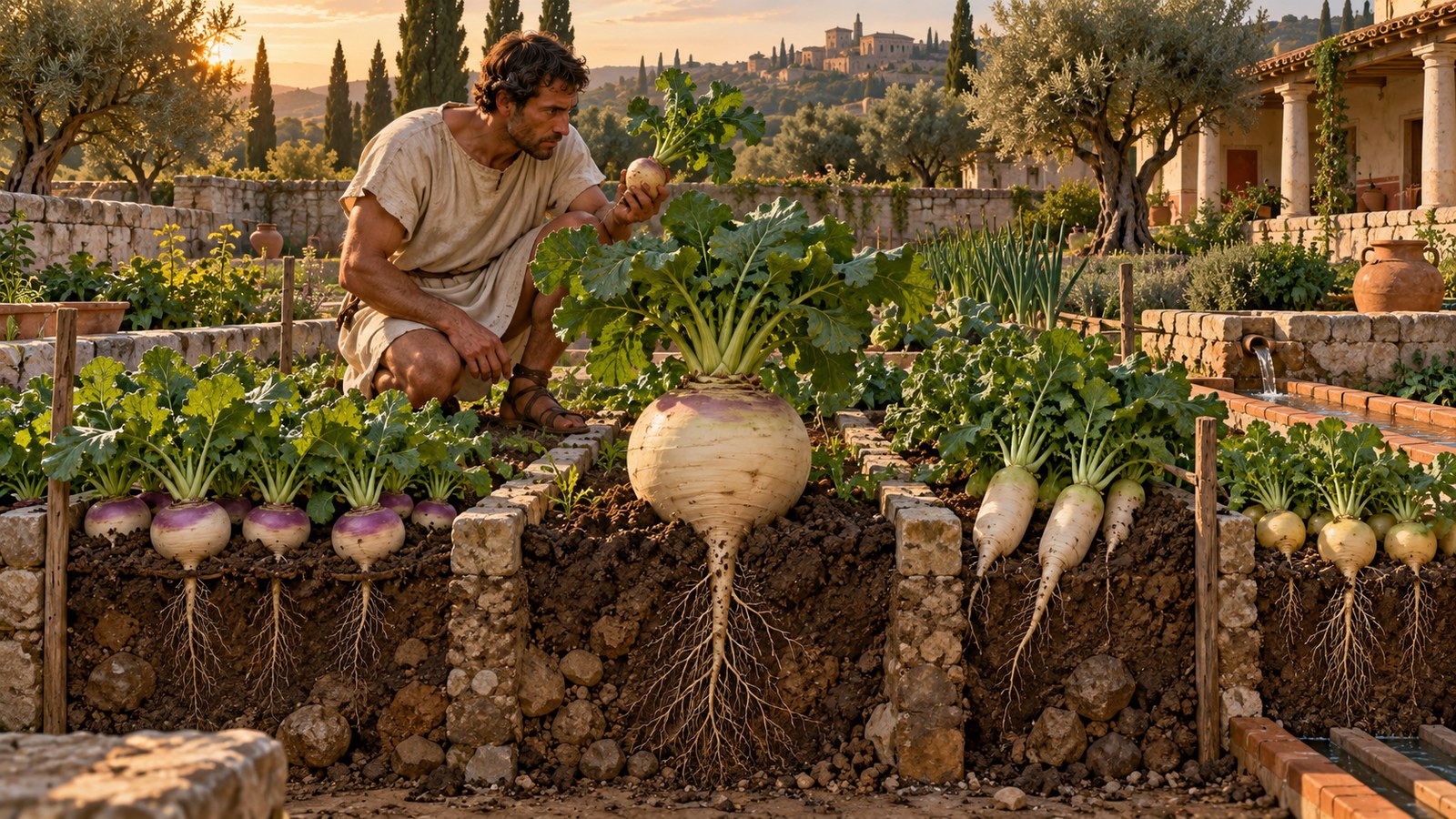
The Boeotian came next in sweetness and was notably round and short. The Cleonaean went the other direction, with an elongated form. The brief descriptions create a market table in prose: big, exposed, cold-hardy, sweet, round, short, or long.
These labels do not prove perfectly standardized seed strains across the Mediterranean. Names can travel, change, or become selling language. Pliny records a classification in use, not a certification system.
Leaves let a buyer predict sweetness before cutting the root
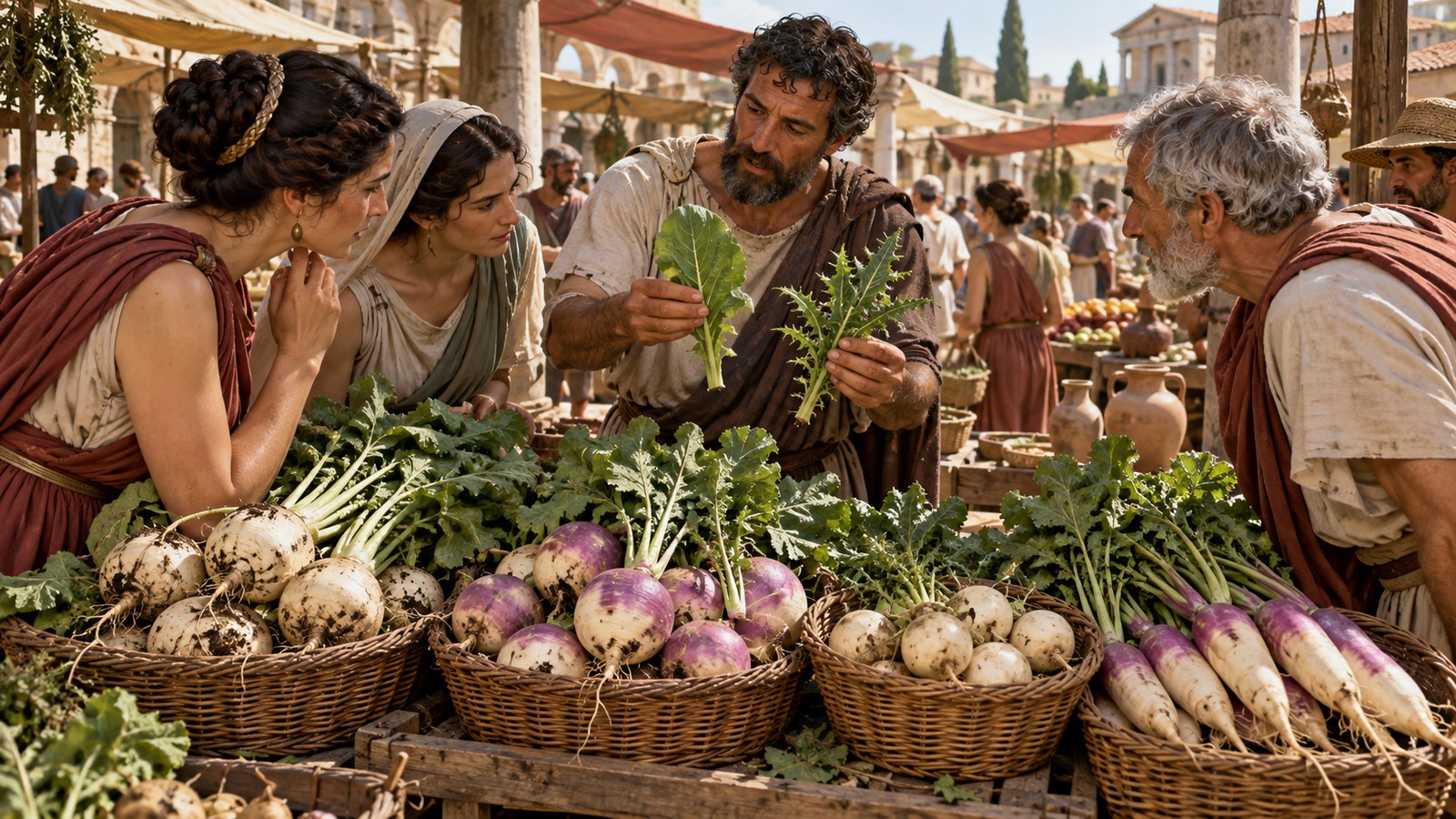
Pliny offers a general visual test. Thin, smooth leaves indicated the sweeter roots. Rough, angular, prickly leaves signalled a more pungent taste.
That relationship turns foliage into advance information. The edible root may still be hidden, but its leaves can guide selection while the plant is in the ground or sitting intact in a market.
The rule is exactly the kind of compressed knowledge that circulates between growers, sellers, cooks, and medical writers. It does not require cutting every root open. A glance and touch supply a forecast.
Pliny also mentions a wild kind whose leaves resemble rocket. Resemblance places an unfamiliar plant beside one a reader might already know, though the edition’s notes warn that the ancient names in this chapter can slide between radish and turnip.
The caution is important. We can recover Pliny’s distinctions without pretending every Latin and Greek plant term has one uncontested modern equivalent. Ancient horticulture was precise in its own practical ways even when translation remains unstable.
This leaf-reading belongs beside the long selection behind Ravenna’s giant asparagus. Both passages show gardeners noticing variation. Here, however, the diagnostic surface is the leaf and the hidden consequence is flavour.
Amiternum and Nursia sold reputations as well as roots
At Rome, Pliny says, turnips from Amiternum and Nursia received the highest rank. Those grown near the city came next.
The sentence adds geography to the field guide. A turnip arrives with a place name that can influence expectation before anyone sees its interior. Regional reputation becomes a form of information in the market.
Transport also shapes that reputation. Roots that keep well can survive a journey more successfully than delicate produce. Pliny does not connect each named district to a route or price, so those logistics should not be invented; the ranking nevertheless proves that origin mattered to Roman evaluation.
Produce grown near Rome had the advantage of proximity, yet it followed Amiternum and Nursia in esteem. Prestige could outweigh distance. Buyers were not judging vegetables only by whether they appeared fresh that morning.
The chapter contains no recipe and no household serving scene. It remains close to classification: forms, leaves, climates, and regions. That narrow focus is why it reveals so much about decision-making before a root reached the pot.
Root shape could affect more than appearance. A long root and a round one occupy soil differently, present different surfaces when lifted, and fit differently in baskets or storage spaces. Pliny only explicitly attaches sweetness and keeping to the forms he describes, so the rest remain practical questions rather than hidden claims.
Cold tolerance belongs to a different stage of risk. A sweet root is irrelevant if weather destroys the crop before harvest. The Liothasian or Thracian name therefore carried a promise about survival, while the Boeotian description emphasized the eating quality of a short round root.
The wild turnip complicates the boundary of the cultivated list. Its rocket-like leaf gives a recognition cue, but Pliny does not rank it with Amiternum or Nursia. Naming a wild relative helped readers sort the plants around fields without giving every one the same market status.
Regional esteem could reinforce cultivation choices. If Roman buyers rewarded an origin, growers had reason to maintain the visible qualities associated with it. Reputation moves backward from market stall to seed selection even when Pliny leaves contracts and prices unrecorded.
A grower might want cold tolerance. A seller could point to origin. A buyer could inspect leaf texture. A storekeeper cared about keeping quality. A cook noticed sweetness and pungency. One crop moved through several systems of judgement.
The upward-growing Corinthian turnip is the memorable curiosity, but the larger story is choice. Pliny’s ordinary root has varieties, reputations, visual tests, and disputed inherited claims. Roman horticulture did not begin at the dining table; it began with the problem of telling one turnip from another.