
A battering ram and a fire do not ask the same thing of a wall. One concentrates repeated impact against a face; the other searches for material that will burn. In Gallic War 7.23, Caesar pauses his campaign narrative to explain how Gallic builders made one structure answer both threats.
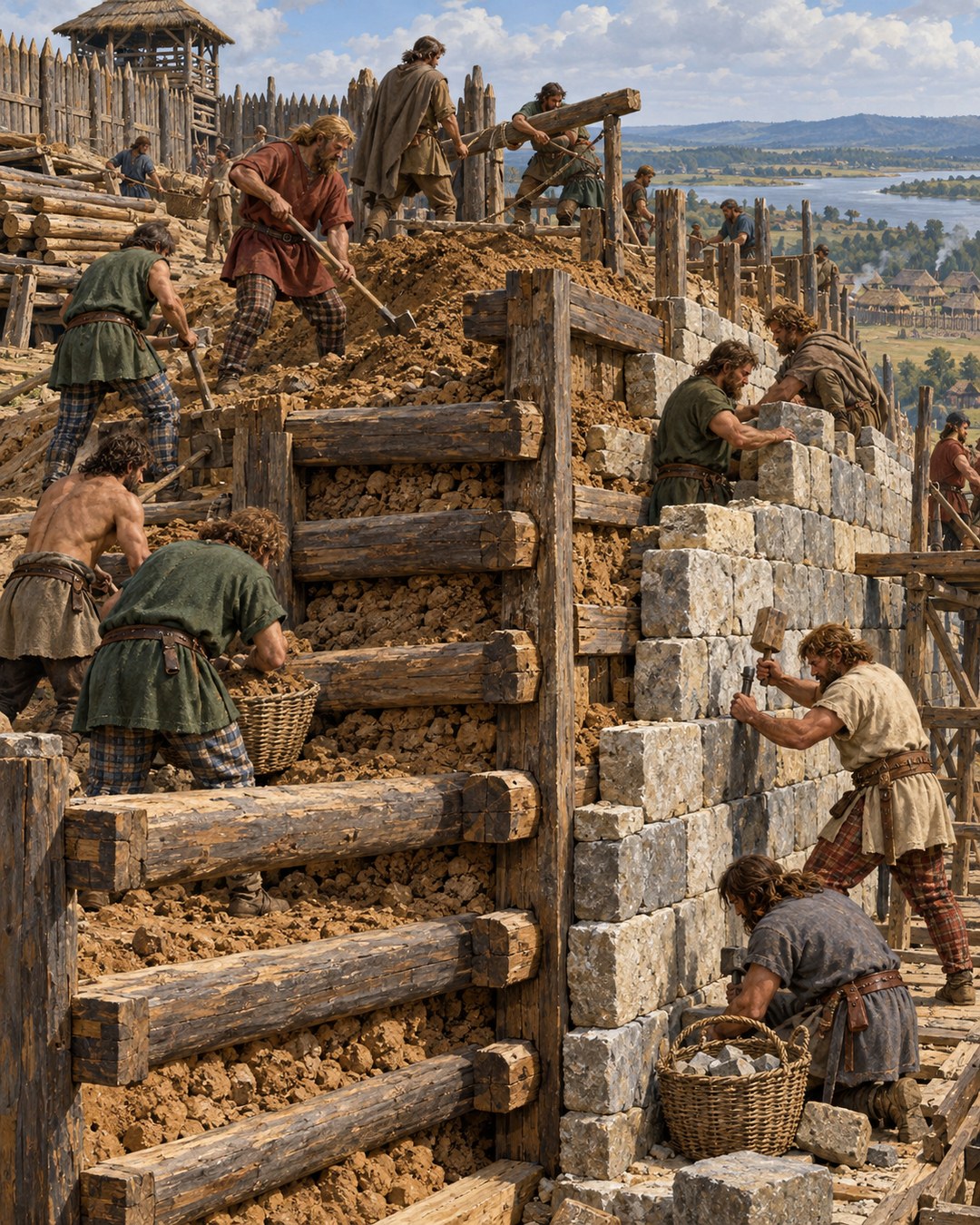
The wall was not simply a bank of earth hidden behind masonry. Straight timbers ran inward through it, large stones occupied the spaces visible at the front, and earth locked the internal work together. The pattern then rose in repeated courses. Caesar’s forty-foot beams made the face difficult to tear loose, while stone shielded the timber from direct flame.
His account comes from an enemy commander and is not a neutral building manual. Even so, its unusual precision preserves a mechanism. The strength lay in the relationship between materials: stone, wood, and packed earth each did a job the others could not perform alone.
Two-foot intervals organized the wall from the ground upward
Caesar begins at ground level. Straight beams were joined lengthwise and set down with equal spaces of two feet between them. Their visible ends belonged to the face, but their length carried deep into the body of the wall.
The spacing matters because it establishes a repeating frame. This was not random timber buried as fill. A builder had to keep the beams parallel enough for stonework to occupy the open sections and regular enough for the next course to follow the same order.
Inside, the beams were mortised and covered with a large quantity of earth. Mortising tied pieces into a larger wooden system; packed earth added mass and denied an attacker an empty cavity behind the façade. The front gaps were closed with large stones.
Once one level had been assembled, another was placed above it. Caesar stresses that the interval remained the same and that neighboring beams did not touch. Stone separated timber ends, and timber extended behind stone. The wall acquired its height by repeating a controlled alternation rather than by changing technique halfway up.
This makes the account distinct from the geometry that made round towers harder to attack. A tower changes angles and fields of defence. The Gallic system works within the thickness of a wall, where its important lines are mostly invisible after completion.
There is no surviving bill of quantities in Caesar’s chapter. He does not state how many workers cut a beam, how long the earth was tamped, or which joints were preferred. Those missing details should remain missing. What the text does establish is a measured sequence: timber, interval, stone, earth, and another course.
Stone faced the threat that timber could not survive
Fire was an obvious danger wherever wood entered fortification. Caesar’s explanation is concise: stone protected the work from flame. The facing placed non-combustible material between an attacker and most of the timber.
The two-foot arrangement prevented the front from becoming one continuous wooden screen. Beam ends remained part of the face, but rows of large stones broke them apart. A fire applied at one point therefore met a mixed surface rather than uninterrupted fuel.
Earth behind the face added another barrier. Caesar does not describe a modern fire test, and his wording should not be inflated into a claim that the wall could never burn. He says the stone provided protection. The design reduced access to vulnerable wood while preserving the structural contribution of long beams.
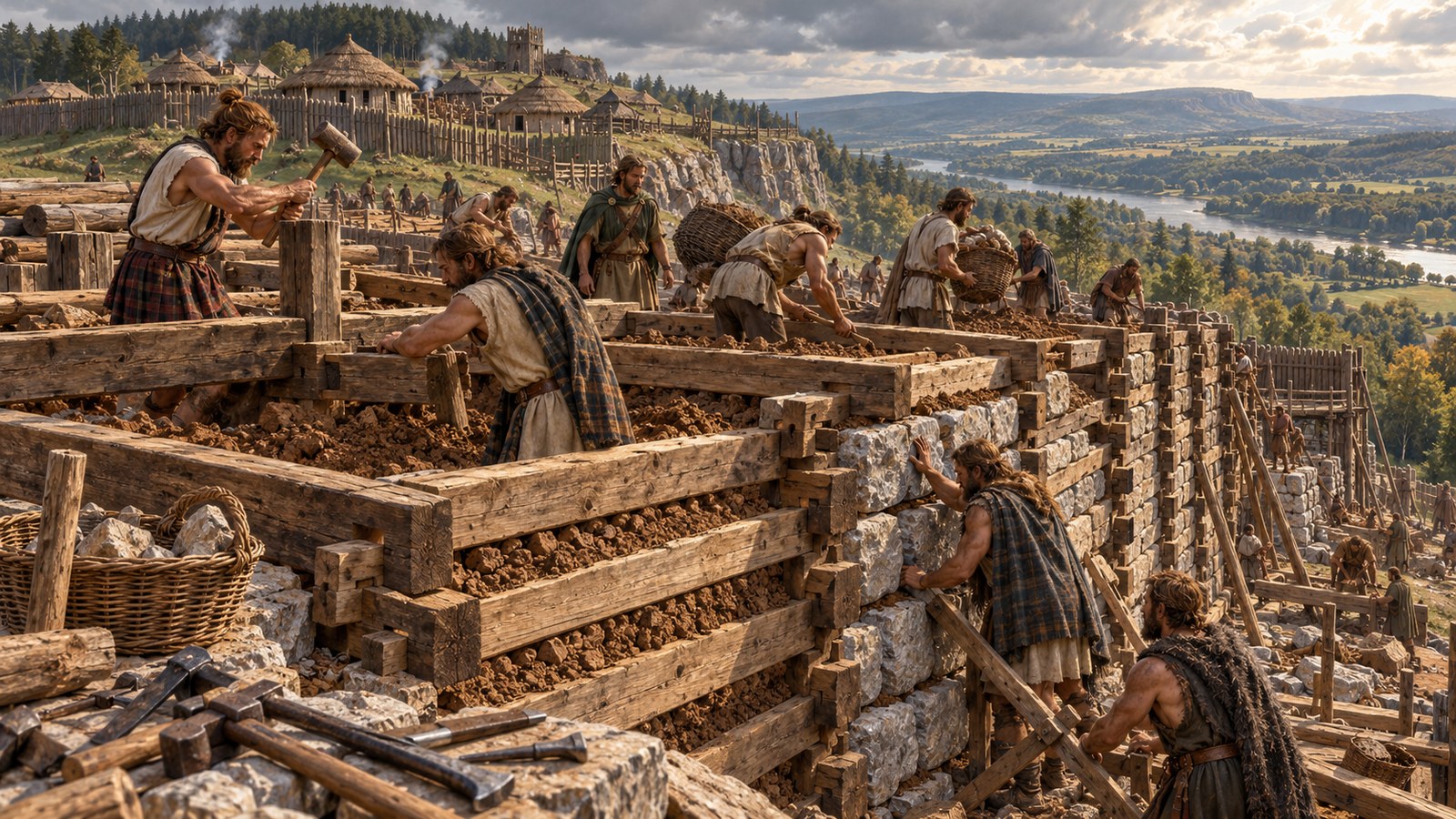
Regular facing also gave the finished work a visual order. Caesar remarks that the alternating straight rows were not unattractive. That observation is useful because it confirms that the pattern could be read on the exterior. Defensive logic and appearance were not separate results.
A wall seen from outside advertised large fitted stone, yet much of its resistance depended on wood concealed behind that surface. The visible material was therefore only one part of the structure. An attacker striking what looked like a masonry face encountered a composite body.
The same principle of hiding the decisive component appears in the buried obstacles Caesar placed outside Alesia, but the tactical situations differ. At Alesia concealment injured advancing troops. Here concealment keeps the wall’s tensile skeleton beyond easy reach.
Long beams answered the battering ram and the pulling hook
Stone handles heat well, but a facing of separate blocks can be attacked by impact or pulled apart. Caesar assigns the answer to the timber. Beams running roughly forty feet into the wall were mortised within the structure, making a local blow contend with a much longer connected element.
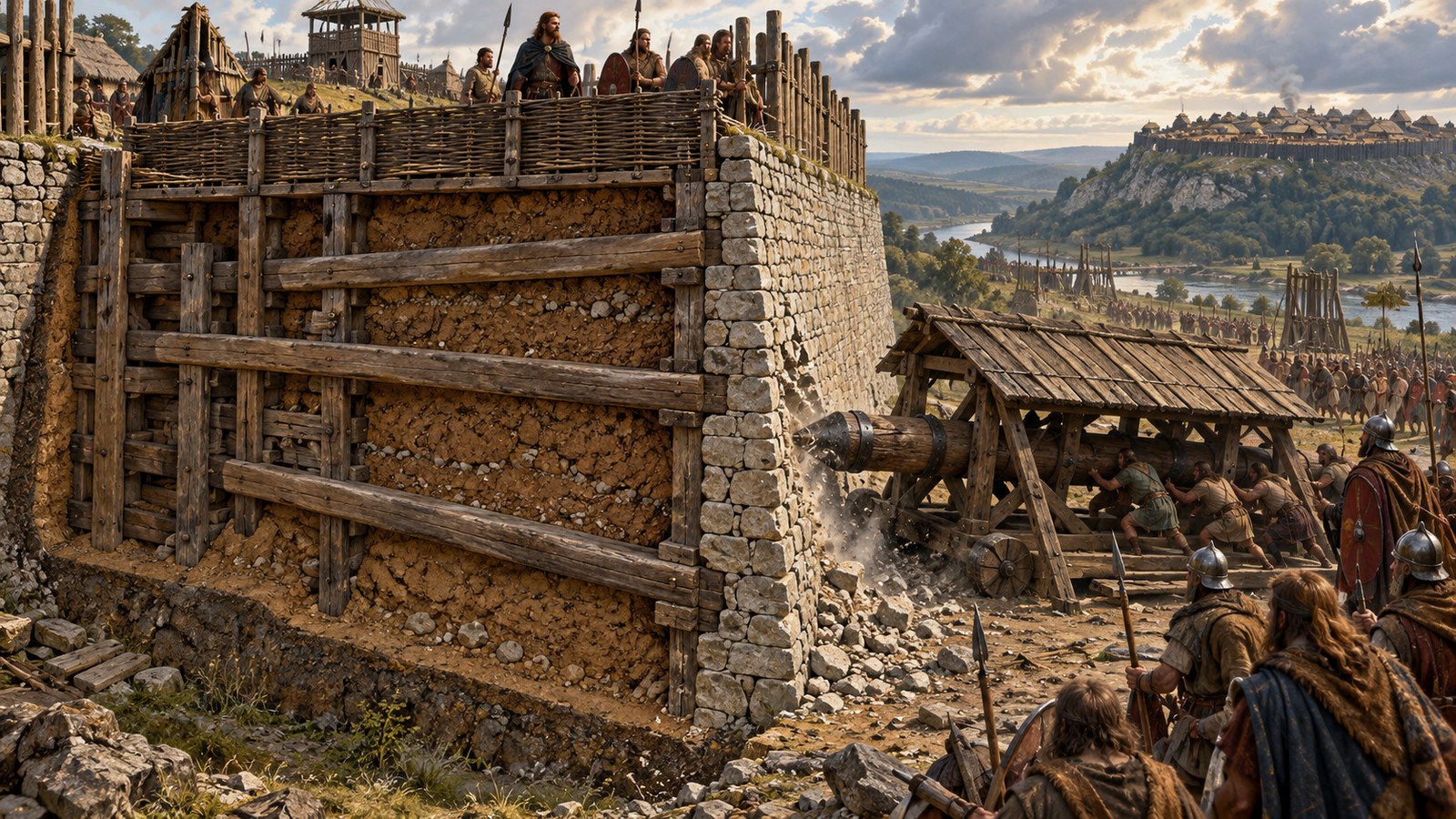
A ram delivers force repeatedly to a limited area. If the face and core separate, each impact can enlarge the breach. The Gallic arrangement made that separation difficult. Stone rows held beam rows in place, and the beams reached back through packed material instead of ending just behind the surface.
Caesar says the work could neither be broken through nor torn asunder. The second phrase is as important as the first. Siege crews did not only strike walls; they also tried to catch and drag material away. A short facing block might move. A forty-foot timber mortised into a network and burdened by earth offered a different problem.
The wall did not make attack impossible. Caesar was describing fortifications in the context of conquest, and Gallic towns could fall through siege, assault, isolation, or decisions made by defenders. The passage explains resistance, not invulnerability.
The dimensions also imply preparation before assembly. Forty-foot members had to be selected, cut, moved, and placed. Stone had to fit the repeated gaps. Earth had to arrive as structural fill rather than accidental debris. Even without a workforce total, the wall records organized supply and shared measurements.
Wood and stone responded differently under stress. Stone is hard but can shift when joints open; timber can flex and tie distant parts together but burns. Earth supplies mass yet needs confinement. The design turns those differences into cooperation.
Caesar’s pause records an enemy technology worth explaining
Campaign narratives usually move through marches, councils, and battles. A paragraph devoted to wall anatomy signals that Roman readers could not be expected to understand the obstacle from a name alone. Caesar had to show why ordinary methods met unusual resistance.
His praise is controlled. The wall is useful, defensive, and visually ordered. Those acknowledgements do not make the account impartial, but they do prevent the Gallic builders from appearing technologically shapeless. Their solution has intervals, joints, courses, and a clear theory of threats.
The description also warns against treating “stone wall” and “timber wall” as complete categories. The important object is the interface. At the face, stone interrupts fire. In the core, wood binds the face to depth. Between them, earth makes the volume solid.
That interface shaped repair as well as construction. Damage to one visible patch did not necessarily mean that the internal beam had failed; damage to a beam end did not remove the entire forty-foot member. Caesar does not narrate a repair crew, so the point must remain structural rather than anecdotal: the repeated units offered more than one path for load and resistance.
For defenders, time was the wall’s product. Every fire that failed to take, every ram stroke that did not open a breach, and every attempt that could not wrench material free bought more hours for missiles, countermeasures, negotiation, or relief. A fortification succeeds by making the attacker spend time and effort.
The passage endures because it explains that delay without mystery. Gallic builders did not discover one miraculous material. They arranged common materials so that an attacker moving from flame to impact found a different layer taking over the defence.
Sources
Caesar, Gallic War 7.23.