
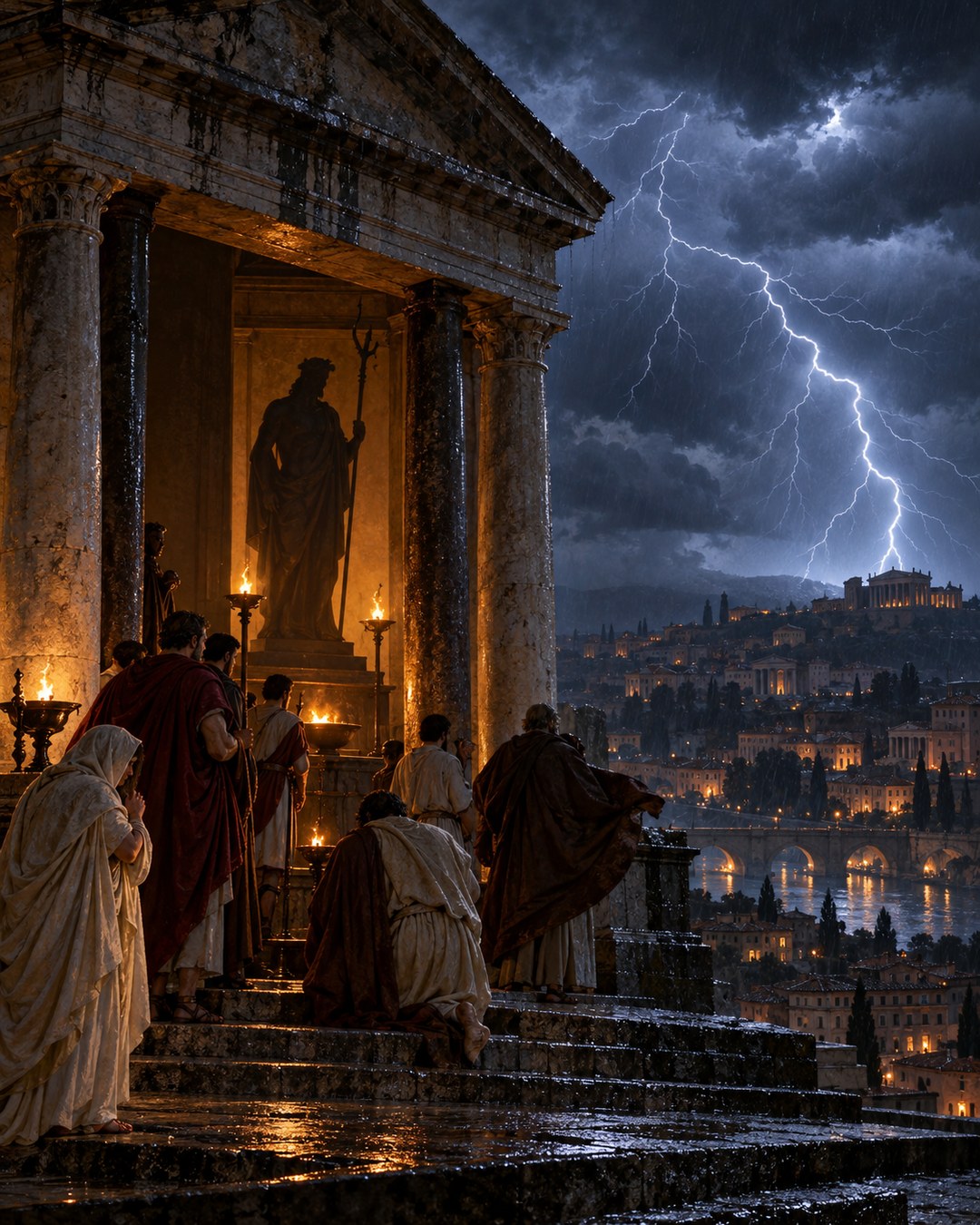
Ovid reaches June 20 and pauses over a god he cannot confidently explain. A temple, he says, was believed to have been dedicated to Summanus when Pyrrhus threatened Rome. Then comes the admission: Summanus, whoever he may be.
The uncertainty is striking because the god still had a precise responsibility. Pliny the Elder says Romans gave daytime thunder to Jupiter and nighttime thunder to Summanus. Time divided the sky into jurisdictions even after one divine name had become obscure.
Together, Ovid and Pliny preserve different parts of the system. The calendar supplies date, temple, and historical setting. Natural history supplies classification. Neither gives a complete theology, but both show that ritual memory can outlast explanation.
June 20 kept a temple anniversary after identity blurred
Ovid’s Fasti moves through the year one day at a time, attaching temples, festivals, stars, stories, and public memory to Roman dates. At June 20 he notes the dedication of Summanus’s temple.
He locates that dedication in the period when Pyrrhus was a terror to the Romans. The wording supplies a broad historical frame rather than a building account. Ovid does not name the architect, describe the plan, or narrate the dedication procession.
His “whoever he may be” is more than a flourish. It shows an educated Roman poet confronting a cult entry whose institutional outline survived better than the god’s identity. The date could be copied and observed even when interpretation became uncertain.
A temple anniversary is a durable mnemonic. Priests, calendars, locations, and repeated rites can preserve a name without preserving a single agreed biography. Summanus remained findable in time.
This is unlike the Fordicidia sequence that moved ashes from one April rite into another. That festival linked dates through stored material. Summanus’s entry links a date to a fading jurisdiction in the sky.
The source does not authorize a detailed reconstruction of the temple or its ceremony. A historically responsible image can evoke a nocturnal shrine and storm, but columns, roof, offerings, and crowd should remain generic rather than claims about a lost ground plan.
Night and day sent thunder to different gods
Pliny places Summanus inside a discussion of lightning theory. He says the Romans retained two assignments: diurnal thunder belonged to Jupiter, nocturnal thunder to Summanus.
The rule is economical. A witness did not need to identify a rare shape or inspect a struck object before naming the divine sphere. The clock of the natural world supplied the first distinction.
Jupiter’s dominance in Roman public religion makes the daytime assignment unsurprising. The nighttime half is more revealing. Rather than treating all thunder as one undifferentiated expression of Jupiter, the scheme preserved another recipient for events heard or seen after dark.
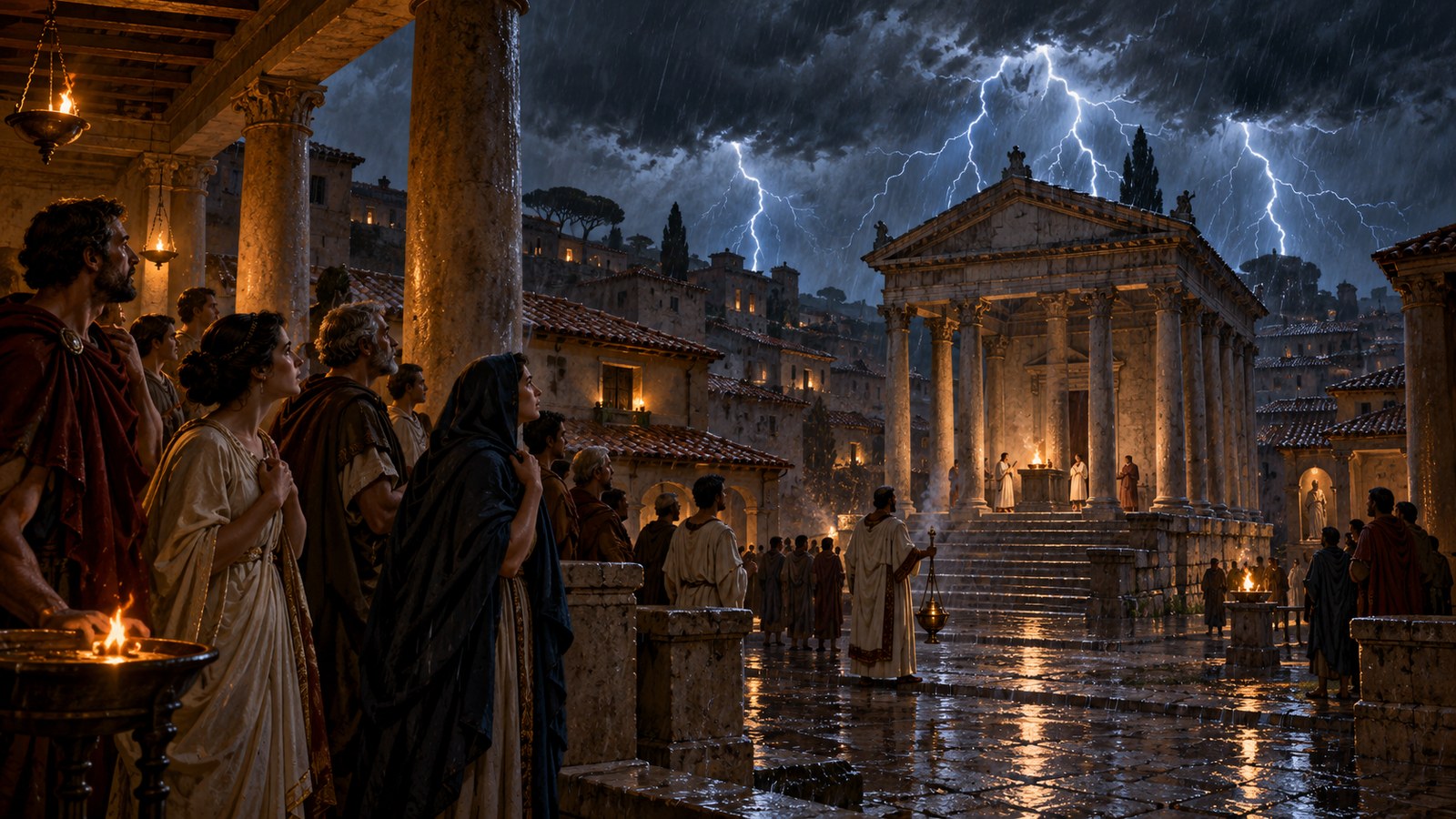
Pliny adds that nocturnal thunder was rarer and connects that rarity with colder conditions in the heavens. His physical explanation belongs to ancient natural philosophy, not modern meteorology. Its importance here is structural: religious classification and causal speculation occupy the same paragraph.
He does not ask readers to choose between god and nature in a modern sense. The text can assign a bolt to Summanus while also discussing temperature, direction, season, and planetary influence. Ancient explanation could stack causes rather than force one category to erase another.
The time-based division resembles the careful reading of a sacrifice whose wording changed which side received the omen. In both cases, classification controls meaning. A detail that looks secondary—hour or phrasing—decides where the sign belongs.
Rome simplified a larger Etruscan map of lightning
Pliny says Etruscan books recognized nine gods capable of discharging thunderstorms and eleven kinds of bolts. Three kinds belonged to Jupiter. The Roman two-part scheme was therefore a reduction, not the whole inherited system.
That larger count suggests specialist knowledge. Eleven kinds require distinctions that can be taught, remembered, and applied. Pliny does not reproduce every category in this chapter, so a modern reader should not fill the missing list from imagination.
What he does preserve is enough to show selection. Romans retained daytime Jupiter and nighttime Summanus while leaving much of the more elaborate map outside his concise account. Simplification made the system easier to state but also made its lesser god vulnerable to forgetting.
Summanus’s narrowness may explain both survival and obscurity. A precise role gives a cult a reason to persist; the same precision can keep it at the edge of stories dominated by gods with broader families, temples, and myths.
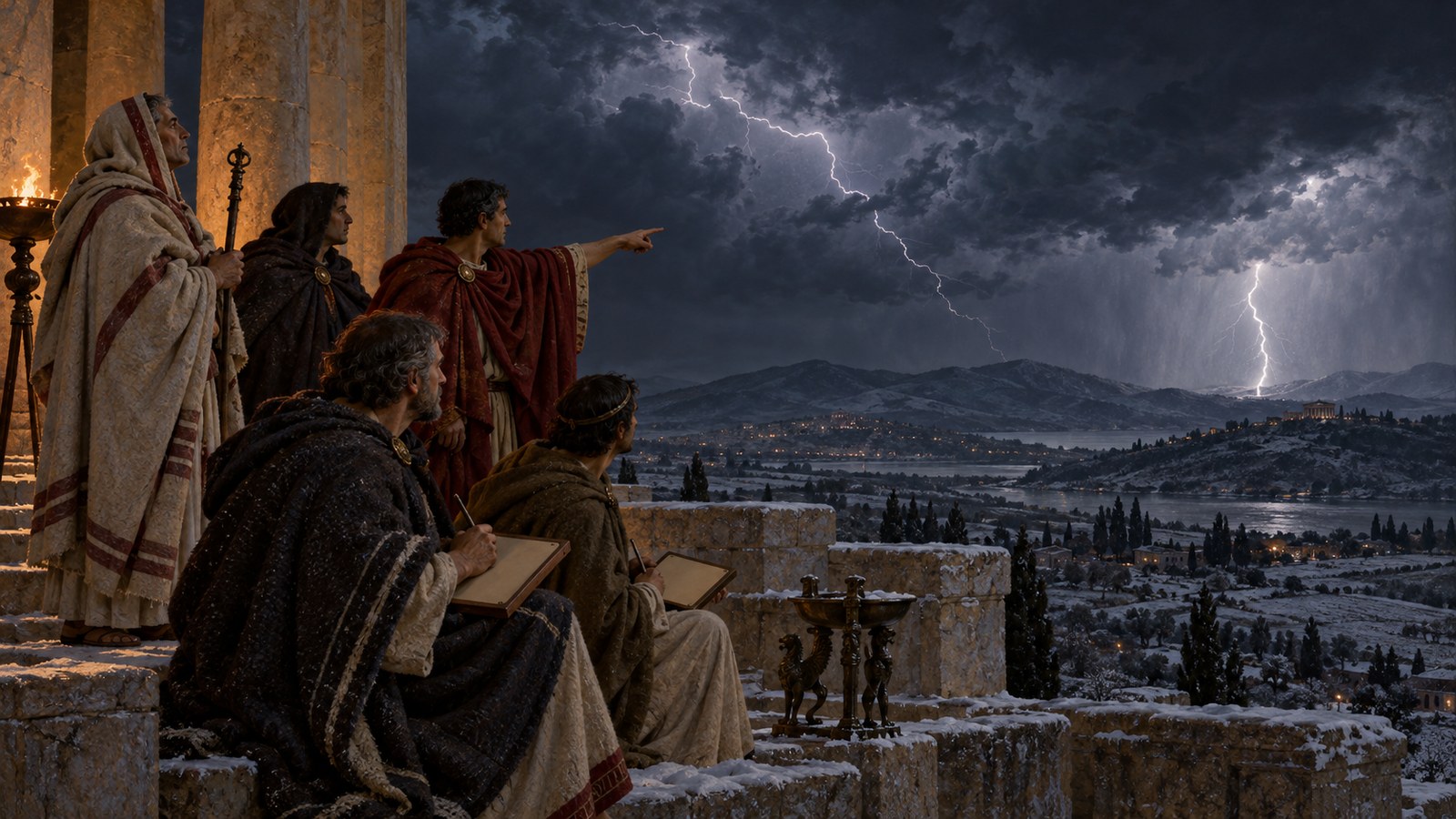
Pliny’s numbers also prevent a simplistic contrast between rational Rome and superstitious Etruria. His Roman account depends on categories inherited from Etruscan books, while his own natural history continues to analyze physical differences among strikes.
Classification was practical because lightning demanded response. A strike could damage property, interrupt public business, mark a place, or require specialist interpretation. Knowing which category applied shaped the next religious question even when Pliny does not spell out every rite.
Winter lightning could be imagined as rising from the earth
Beyond the Roman pair, Pliny reports an Etruscan “infernal” category thought to burst from the ground. These strikes were associated especially with winter and described as fierce and dire.
The theory used direction as evidence. Lightning from higher regions was said to strike obliquely, while the terrestrial kind took a direct line. The absence of an apparent rebound helped observers imagine a nearby earthly source.
Modern atmospheric science does not validate this ancient map as stated. Its historical value lies in the attempt to make frightening variation legible. Season, angle, violence, and time of day became features in an explanatory system.
Summanus belonged to that appetite for distinctions. Night thunder was not simply thunder with less visibility. It occupied another box, carried another divine name, and was considered less common.
Ovid’s uncertainty reveals what classification could not guarantee. A rule may survive in technical or ritual language after stories, etymologies, and popular familiarity have eroded. By his time, the poet could record Summanus’s temple date without pretending to possess a clear portrait.
That honesty is part of the evidence. “Whoever he may be” tells us not that the god was meaningless, but that Roman memory was uneven. Institutions remembered appointments; texts remembered thunder; a poet noticed the gap.
The combination of sources therefore produces no recovered biography of Summanus. It produces something more precise: a god at the intersection of night, lightning, a June anniversary, and a temple traced to the age of Pyrrhus.
When thunder sounded after dark, Rome’s old classification supplied a name. By daylight, Jupiter resumed the sky. The border lasted in writing even after one side of it had become difficult to describe.
A calendar entry and an encyclopaedic chapter also address different audiences. Ovid guides a reader through June, where Summanus occupies one dated stop among many. Pliny sorts thunder within a survey of the natural world. Agreement on the name and nighttime assignment is therefore more significant than repeated wording inside one genre.
The Pyrrhic setting adds another kind of memory. A foreign king’s threat supplied Ovid with a recognizable historical horizon for the temple, but he did not use it to manufacture a foundation story. The war dates the dedication broadly; it does not tell us why every feature of the cult took its later form.
Nor does rarity mean insignificance. A less frequent event can demand more attention precisely because witnesses have fewer ordinary comparisons. Pliny’s comment about colder nighttime heavens tries to explain frequency, while the divine assignment tells Romans how to name the event when it occurred.
The two texts leave useful boundaries. They do not securely identify Summanus with every underworld power, describe a cult statue, or provide the words of a June sacrifice. Keeping those gaps visible lets the surviving pattern stand out: anniversary, temple, night, and thunder.
Sources
Ovid, Fasti 6.729–732; Pliny the Elder, Natural History 2.53.