
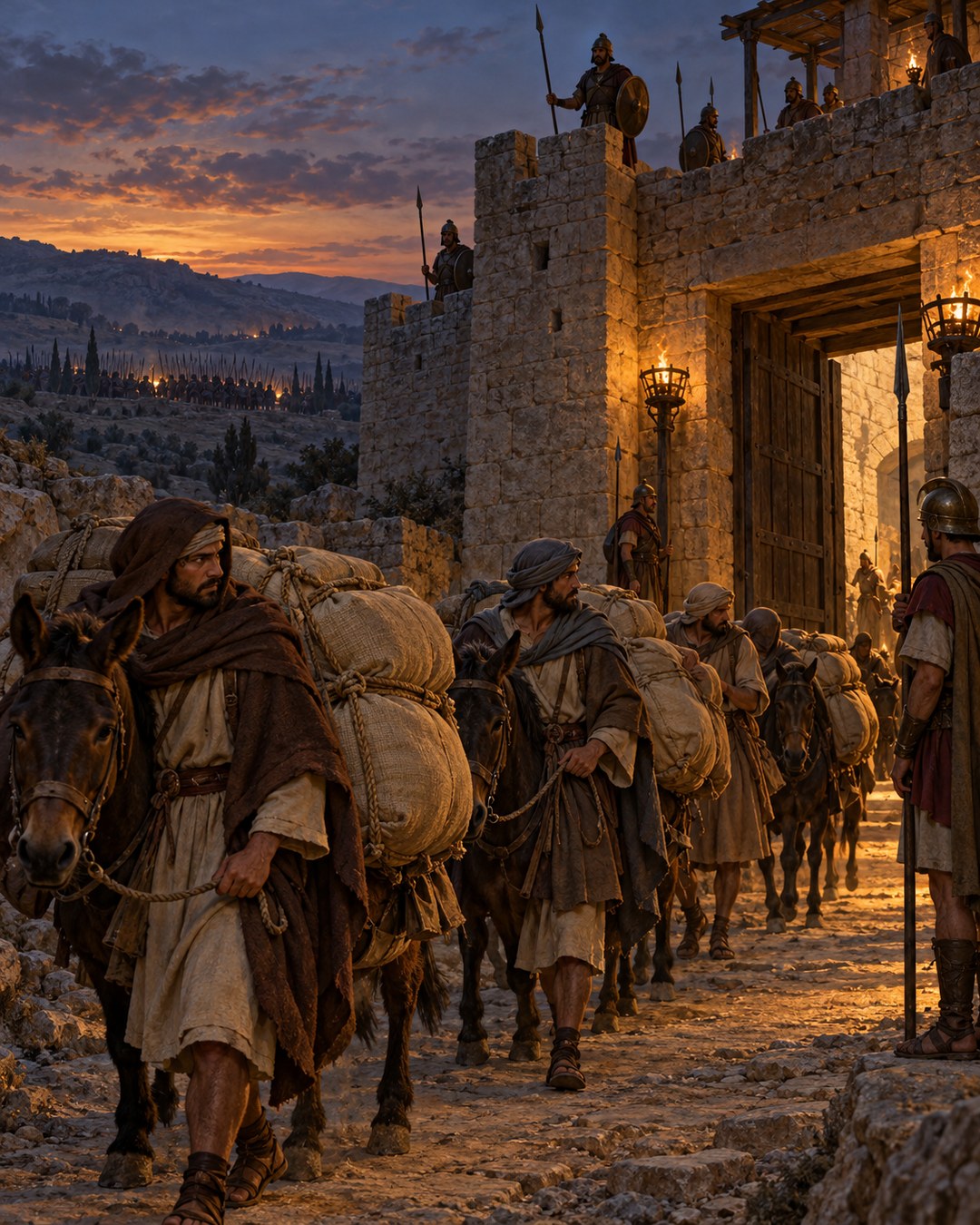
The mules approaching Tegea appeared to carry grain. Their bags held chaff, and the men leading them were soldiers dressed as traders. A gate built to resist an army opened for a supply train.
Frontinus places that trick beside other entries made through festival crowds, returning pack animals, a cargo vessel, a staged harbour quarrel, and the stolen appearance of a commander. The costumes change, but the structural weakness remains the same.
A defended town cannot treat every familiar person and useful load as an enemy. It must admit food, recognize workers, manage crowds, and respond to disorder. The attackers succeed by making those ordinary decisions carry armed force across the boundary.
Tegea’s guards saw grain traffic instead of an assault
Frontinus sets Aristippus’s approach during a Tegean holiday. The population had gone outside to celebrate the rites of Minerva, changing both the number of people at the walls and the rhythm by which traffic moved.
The apparent cargo mattered. Mules with grain-bags belonged to the economy of a city. They approached as something necessary and legible, not as an improvised battering ram.
Yet the bags were filled with chaff. That substitution preserved bulk without carrying the valuable food the load pretended to contain. It also kept the animals and drivers inside a convincing scene of trade.
The drivers supplied the second layer. Soldiers wore the role of traders, passed without attracting the inspection an armed body would receive, and opened the gates to comrades waiting outside.
The operation did not defeat masonry. It defeated classification. Guards had to decide whether the approaching group belonged to the category “merchants bringing grain” or “soldiers attempting entry.” The attackers controlled the visible evidence on which that decision rested.
Holiday timing amplified the disguise. A population focused on ritual movement could leave routines stretched or supervision uneven. Frontinus does not provide the hour, number of mules, or size of the infiltrating party, so those details cannot be supplied. He gives enough to identify the mechanism: civic absence, false cargo, commercial clothing, and a gate opened from within.
This is a different attack from the acoustic search for a siege tunnel beneath Apollonia. There the defender listens for hidden engineering under solid ground. At Tegea, the hidden danger walks along the accepted road and asks to be recognized as ordinary.
At Suenda, a real supply mission returned with false men
Antiochus’s approach to Suenda began with an authentic movement. Pack animals had left the fortified town to procure grain. That journey established an expected return.
He intercepted the animals and killed their attendants. His own soldiers put on the attendants’ clothing and drove the same beasts back toward the walls as though the supply mission had succeeded.
The sentinels admitted them because they mistook soldiers for teamsters. Unlike the Tegean chaff bags, the central deception here was not a newly assembled merchant scene. It was the capture of an existing logistical identity.
Animals, route, task, and clothing all supported the same inference. A guard who had watched a familiar train leave could plausibly see its return as completion of a known errand. The attackers borrowed continuity.
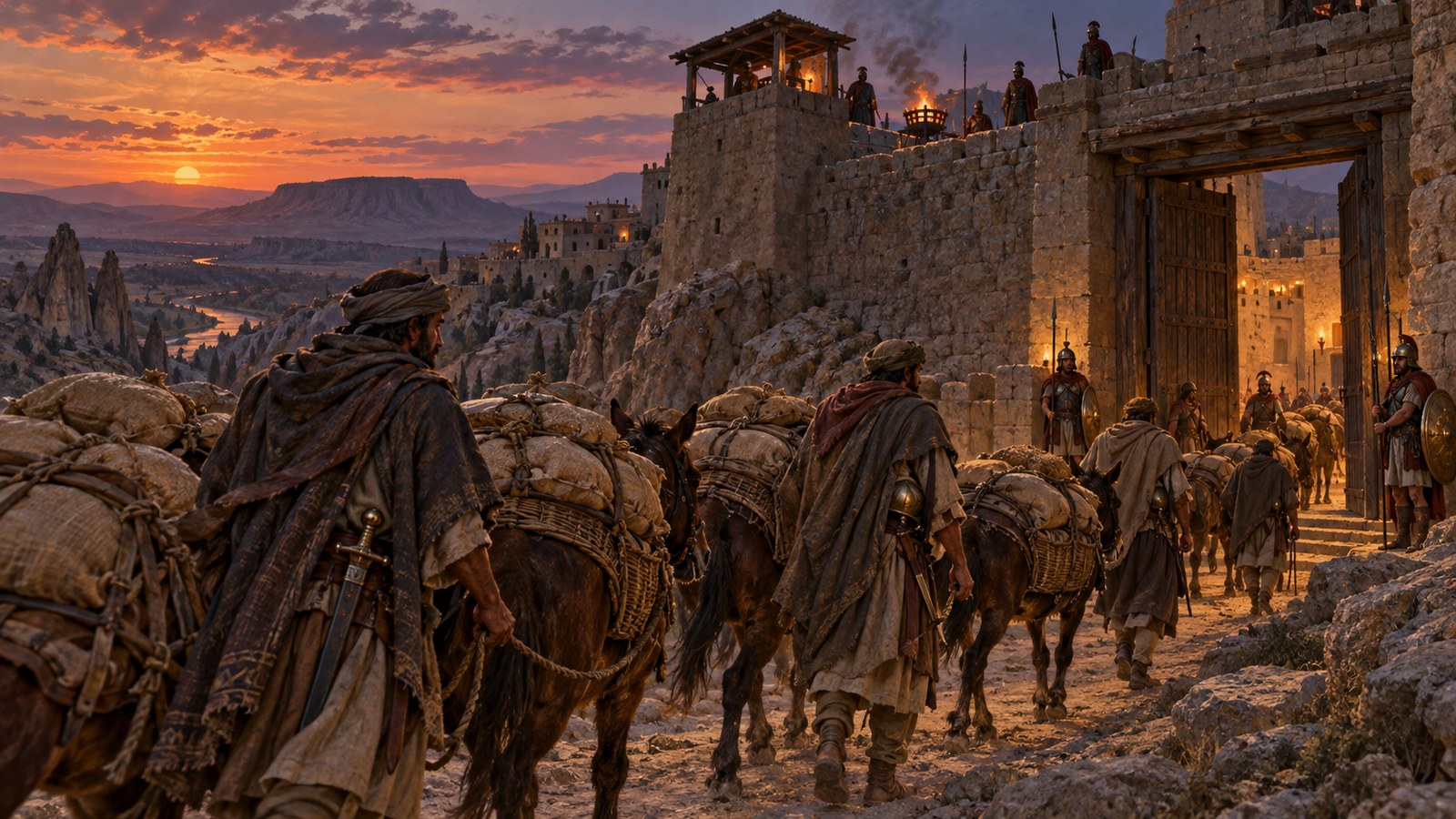
The episode exposes a hard siege problem. A fortified place needs provisions, but every provision route creates contact with the outside. Closing the gate absolutely accelerates shortage; opening it requires confidence in people and loads that may have passed beyond observation.
Frontinus gives no exchange of passwords or inspection procedure. The sentinels simply fall into the trap. That silence keeps the article from becoming a handbook of techniques the source does not describe.
What survives is the asymmetry. Defenders must judge many harmless returns correctly. Attackers need one return to be judged incorrectly. Grain procurement created the chance because hunger forced the city to maintain a channel through its own fortifications.
A visible cargo and a noisy quarrel emptied a harbour
The Theban operation against the Sicyonian harbour worked on a larger stage. Armed men were placed inside a large vessel, while cargo remained visible on deck. The ship therefore presented a commercial surface over a military interior.
That concealment alone was not the entire plan. Away from the sea, a few men had been stationed to meet unarmed members of the crew. After disembarking, those crewmen began a quarrel with them.
The disturbance competed for attention. When Sicyonians were summoned to stop it, personnel moved toward a problem that appeared immediate and public. The Theban crews then seized the unguarded harbour and town.
The ship’s cargo and the staged quarrel performed opposite tasks. One lowered suspicion at the water. The other raised alarm somewhere else. Together they controlled where the defenders looked.
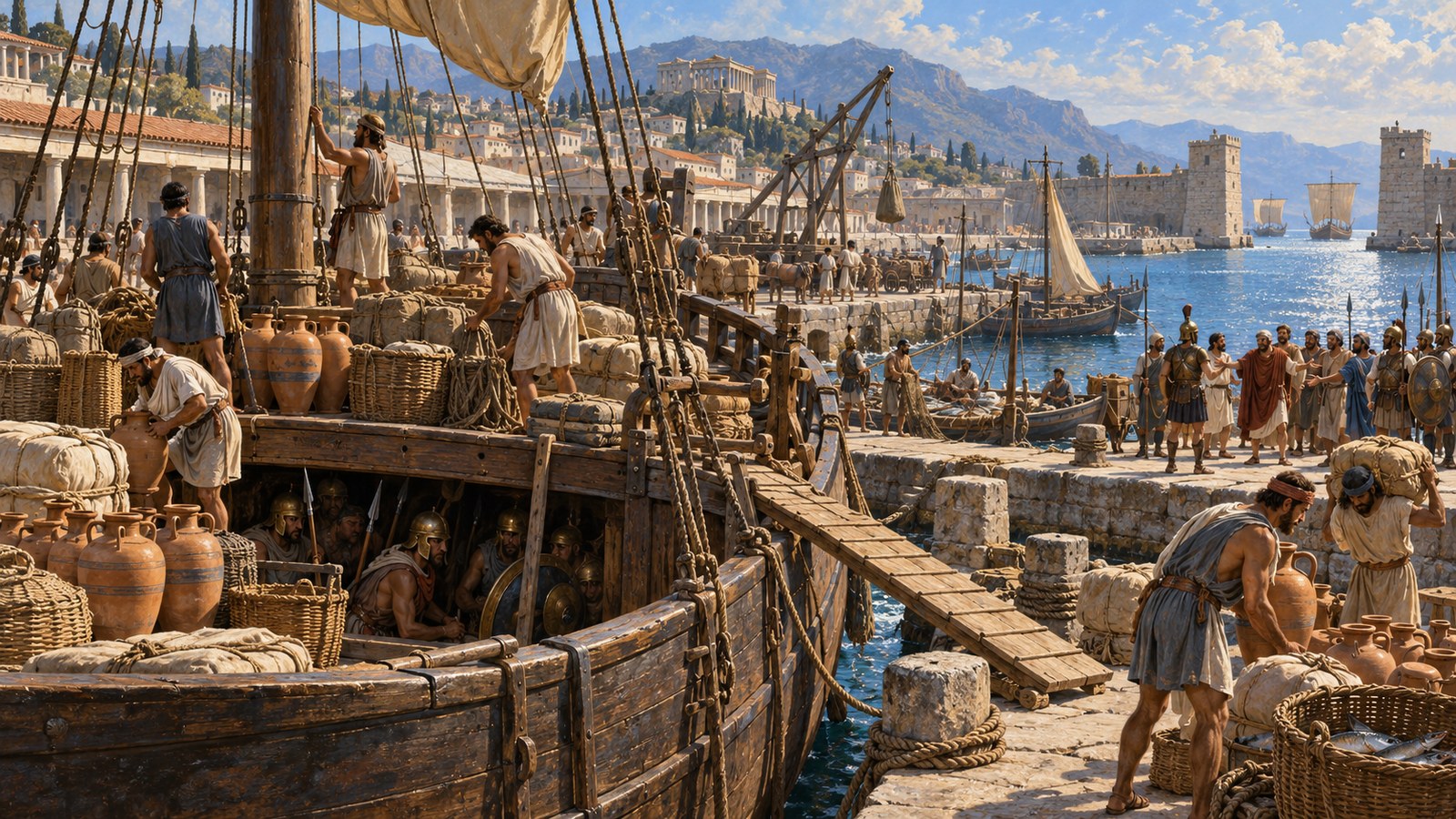
A harbour is especially vulnerable to this split. It is simultaneously a defensive opening and a workplace full of crews, cargo, arguments, and movement. A vessel cannot unload without approaching the very boundary defenders must protect.
The scene contrasts with Caesar’s open fight against Venetic ships and rigging. That battle turned ship construction into a tactical problem in full view. Frontinus’s harbour vessel succeeds by delaying the moment when anyone understands that a battle has begun.
The operation also demonstrates that “disguise” need not mean every soldier wears a costume. The cargo is a disguise for the vessel’s purpose; the quarrel is a disguise for coordinated action; the apparently separate groups are parts of one plan.
Frontinus’s real subject was permission at the threshold
The final example sharpens recognition into a single person. Timarchus killed Charmades, a commander serving King Ptolemy, then adopted the dead man’s Macedonian cloak and helmet.
Presented as Charmades, he was admitted into the harbour of the Sanii and took possession. The account depends on visual authority: clothing and equipment that made a familiar rank appear to approach.
Beside this incident, Frontinus includes Epaminondas sending troops dressed as women among women outside an Arcadian town during a holiday. Admitted toward nightfall, they seized the town and opened it to companions.
These examples should not be flattened into identical tricks. One borrows gendered festival movement; one constructs a grain caravan; one hijacks a returning supply mission; one uses a merchant vessel and diversion; one impersonates a commander. Their common feature is narrower.
Each defended place has a rule—formal or habitual—about who may cross. Women returning at night, traders with grain, known teamsters, commercial crews, and recognized officers can all receive permission denied to an army.
The attacker therefore does not make the wall disappear. He makes the guards apply the wrong rule. Stone remains strong while the social information presented at the gate is corrupted.
Frontinus writes a collection of stratagems, not a continuous operational history. His examples are selected because they are memorable and useful, and some report events from cultures and periods far beyond Rome. Their presence in a Roman military text tells us how an imperial-era author organized lessons about siegecraft.
The lesson is not that defenders were foolish whenever they admitted supplies. Refusing every trader, attendant, ship, or commander would make a city impossible to sustain. Security and circulation were in permanent tension.
That is why the chaff-filled bags matter. They are ordinary enough to cross a boundary and empty enough to reveal the deception once the city is lost. A wall could stop an army in formation; it could not by itself decide whether the next mule train was what it claimed to be.
Source: Frontinus, Stratagems, 3.2.7–11.
Sources
Frontinus, Stratagems 3.2.7–11.