
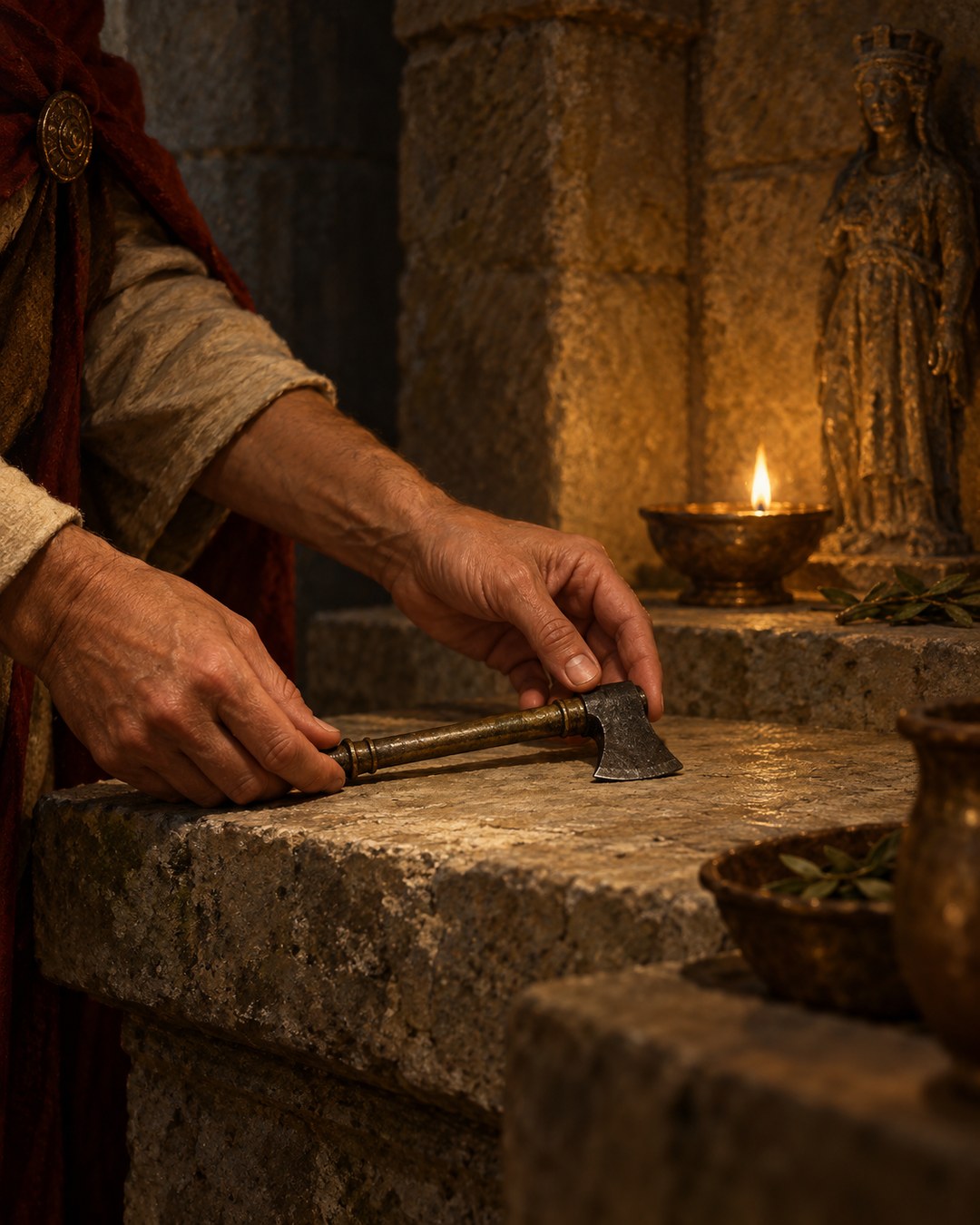
An axe normally announces itself through scale. Its head needs weight, its haft needs reach, and its edge belongs in the world of timber, earth and hard physical work. A Roman object in the London Museum reverses that expectation. It is recognisably a pioneer’s axe, yet it is only 178 millimetres long, 88 millimetres wide and 8 millimetres thick. The tool has not merely been damaged or shortened. It was made as a model.
That change of scale moved the axe into another kind of action. The museum identifies the miniature as a probable religious offering or an object used in a symbolic religious practice. Its iron head and copper-alloy haft preserve the tool’s two-part construction, but the finished object no longer depends on the force of a full-sized swing. What mattered was that the axe could still be recognised.
The tool survived the reduction
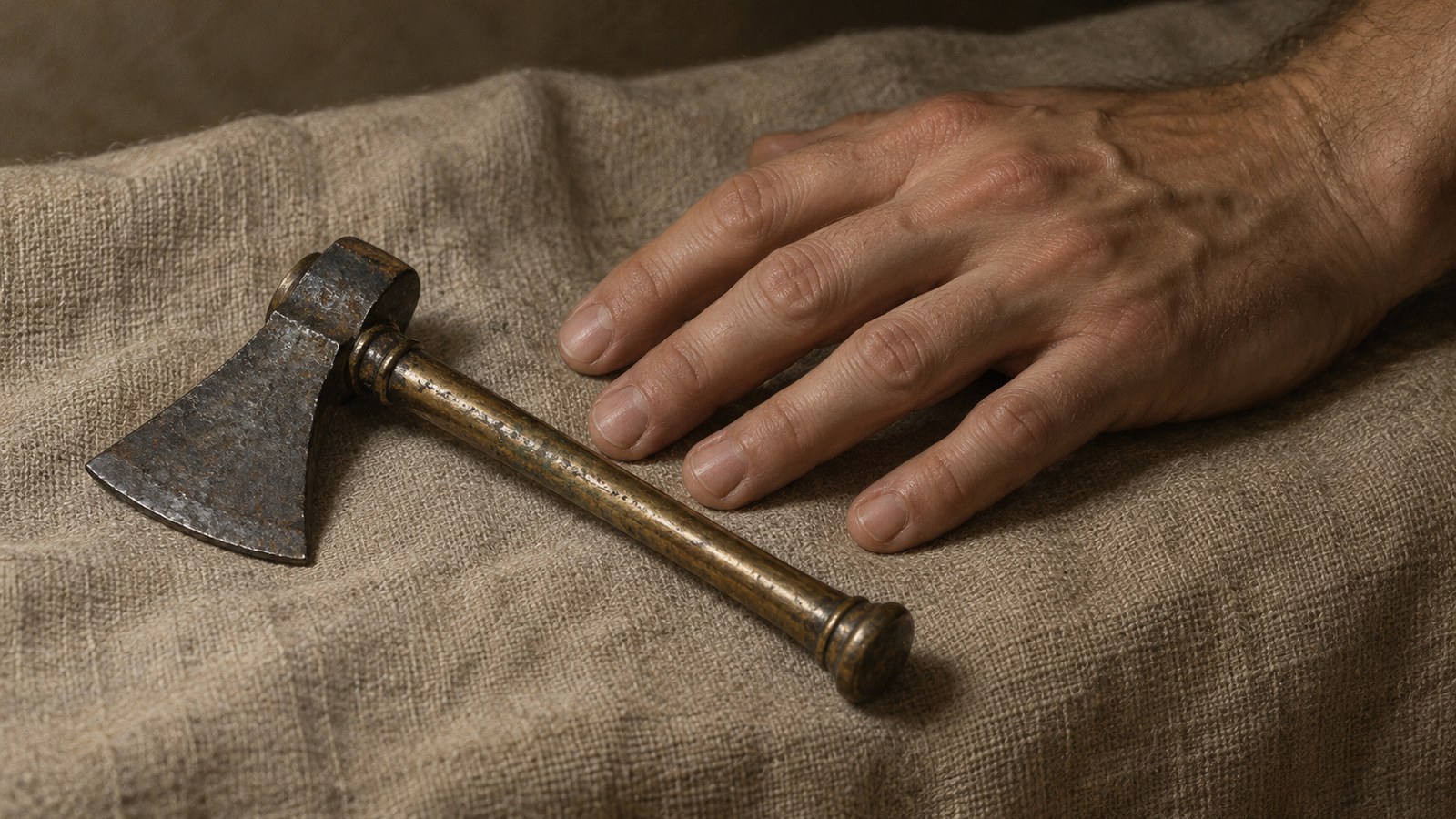
The maker did not turn the pioneer’s axe into a vague token. The catalogue records an iron head attached to a copper-alloy haft. Those materials separate the cutting part from the part held in the hand. Even at miniature scale, the object keeps the visual grammar of a working implement: a head that acts and a haft that directs it.
Its measurements make the reduction concrete. At 178 millimetres in length, the model could be held and presented as one object. A width of 88 millimetres gives the head a visible spread. A thickness of 8 millimetres keeps the whole thing slight. These numbers describe an object that looks like equipment without occupying the space or performing the labour of equipment.
The proportions also prevent “miniature” from becoming a vague adjective. The recorded length is just over twice the recorded width, while the thickness is less than one-twentieth of the length. The model therefore spreads sideways where an axe head must be seen, but remains remarkably thin through its body. Nothing in those measurements suggests a cut-down haft waiting for repair. They describe a deliberately compact representation.
Material choice reinforces that deliberateness. If outline alone had been enough, the whole model could have been made as one undifferentiated piece. Instead, the head and haft were distinguished by iron and copper alloy. The catalogue does not explain the maker’s technique, yet its material description proves that the miniature preserved a contrast normally understood at the scale of a real tool.
That distinction matters because a miniature is not simply a poor tool. A poor tool still asks to be judged by whether it works. This object asks whether its form remains legible after practical capacity has been removed. Iron still says “head”; copper alloy still says “haft”; their joining still says “axe.” Recognition carries the object after utility has fallen away.
A pioneer’s object without a pioneer’s labour
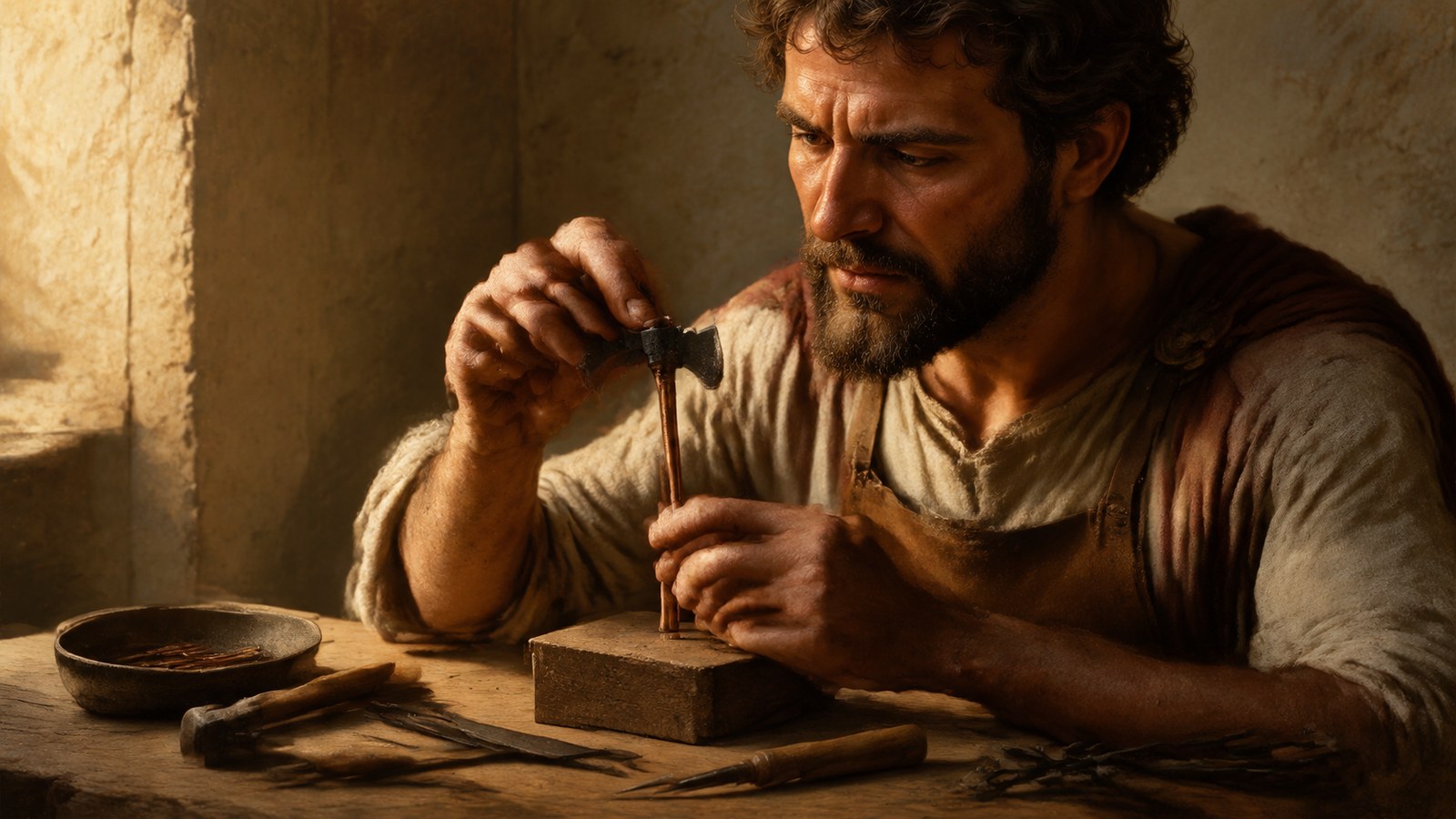
The catalogue calls the original type a pioneer’s axe. That identification places the miniature beside a familiar category of forceful implement, not beside an abstract geometric sign. Yet the model’s proportions deny the usual bodily sequence. There is no long haft to amplify a swing and no heavy head to drive an edge. The object condenses that sequence into an image that a hand can carry.
Roman material culture often made function visible through repeated forms. A reader can see another side of that habit in the way a soldier’s belt organised equipment on the body. There, the object’s value came from use at full scale. Here, the miniature keeps the identity of the implement while suspending the work it normally performs.
The result is not a drawing of an axe. It is a three-dimensional thing built from two metals. Light can catch the iron head differently from the copper-alloy haft. Fingers can encounter the change between them. The offering therefore retains material contrast as well as outline. Scale changes the object’s purpose, but it does not erase its physical specificity.
That specificity gives the model two directions at once. It points outward toward the full-sized pioneer’s axe that made the form recognisable, and inward toward the small object actually present. A viewer did not need to mistake one for the other. The gap between them was productive: the miniature invoked labour while remaining suitable for an offering or symbolic act.
Offering meant making the idea portable
The museum’s wording is careful: the axe was probably a religious offering, or it served in a symbolic religious practice. The surviving record does not name a deity, a sanctuary, an owner or a precise ceremony. Those absences should remain absences. They prevent the miniature from being assigned to a ritual scene that the object itself cannot prove.
What the record does support is a transformation. A working type was made small, durable and portable. The model could represent an axe without requiring a full-sized axe to be surrendered. That is not evidence of cheapness or evasion. It is evidence that the outline, materials and construction of the tool were sufficient to carry meaning in another setting.
The same principle of material action appears in the handling of parched spelt in Roman sacrifice. A substance or object did not need to be verbally explained on the surviving surface in order to take part in a formal act. Its preparation, movement and placement could be the act. With the miniature axe, reduction itself appears to have made a practical implement available for symbolic use.
The museum offers two possibilities rather than collapsing them. “Religious offering” emphasizes the object’s transfer or dedication. “Symbolic religious practice” leaves room for use within an action. The surviving miniature cannot choose between those possibilities for us. Responsible interpretation keeps both because the record supports both and supplies no inscription, named recipient or excavated ritual sequence to narrow them.
The dates leave a long Roman window
The museum dates the object broadly to AD 43–200. That range spans more than a century and a half. It does not permit a precise event or generation to be attached to the piece. It does, however, hold the miniature within Roman-period Britain and prevents it from floating as an undated curiosity.
Broad dating also directs attention back to the object rather than to an invented owner. The measurable evidence is unusually clear: 178 by 88 by 8 millimetres, iron joined to copper alloy, a model of a pioneer’s axe, and a probable religious role. Those details are enough to reconstruct the mechanism of meaning without pretending to reconstruct the missing biography.
A full-sized axe changes material through impact. This miniature changed the axe itself through scale. The head, haft and outline survived, while reach, weight and cutting force did not. That selective survival is the object’s most revealing feature. It shows how a familiar tool could cross from labour into religious practice by becoming small enough to stand for its own kind.
Its place in the museum’s permanent collection extends that selective survival. The original practice is no longer observable, but the durable iron-and-copper model remains measurable. Modern description can record dimensions, materials and probable function without recovering a lost name or prayer. The object’s restraint is precisely what makes it useful: it shows a transformation in form while warning us not to overfill the silence around it. Its 8-millimetre thickness remains a final reminder that symbolic force did not require the mass of a working axe.
Sources
London Museum, “Miniature axe” collection record.