
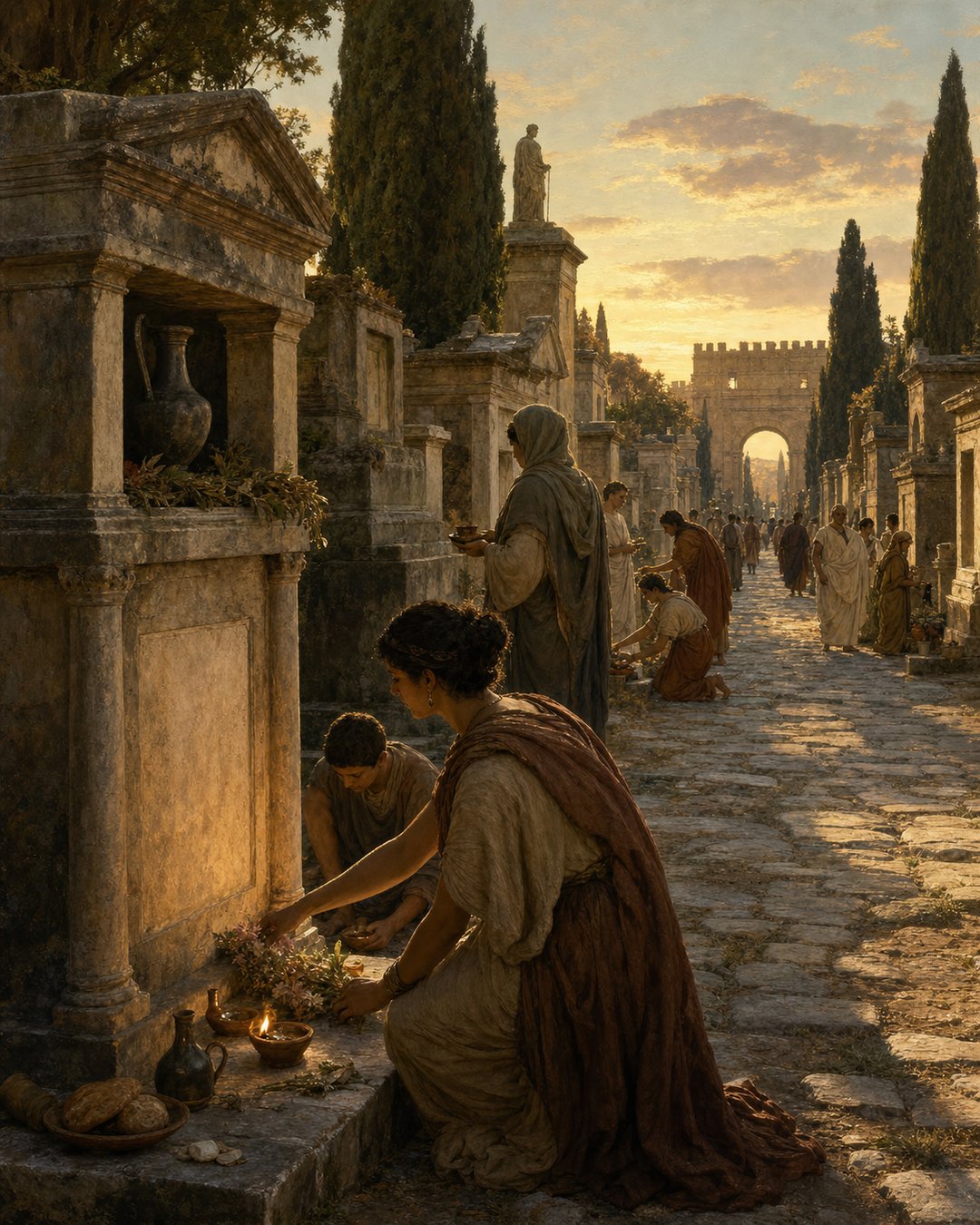
Roman history can sound as if it belongs to emperors, generals, and senators. Funerary inscriptions change the volume. Along roads outside towns and cities, stones named spouses, children, freedpeople, trades, ages, patrons, and grief. They made ordinary lives visible in a world where most ordinary voices disappeared.
A tomb inscription was not only a marker of death. It was a public message. It asked someone passing by to notice that a life had existed, that a relationship mattered, and that a household wanted memory to survive beyond the funeral.
The road turned mourning outward
Roman tombs often stood along roads outside city boundaries. That placement mattered because roads created readers. A grave hidden in a private corner speaks mainly to family; a tomb beside a route addresses travelers, neighbors, clients, merchants, and strangers.
The dead therefore remained in public circulation. People leaving the city, arriving at market, or walking between settlements could pass names and faces carved into stone. Memory became part of the roadside landscape.
A name could be an achievement
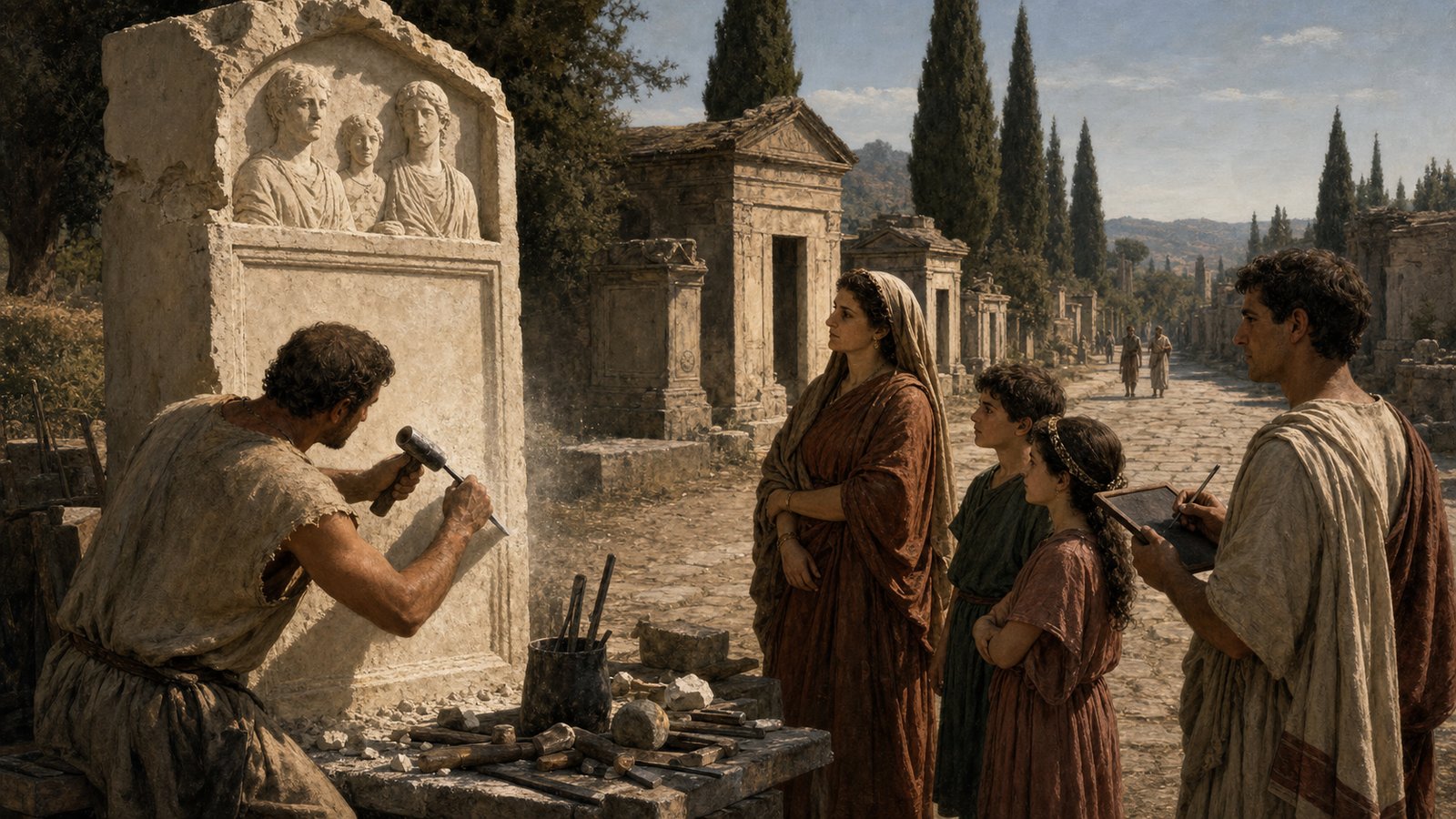
For many people, having a name carved in stone was itself a claim. Literary histories rarely paused for shopkeepers, freedwomen, children, laborers, nurses, craftsmen, or ordinary spouses. Inscriptions gave some of them a durable form.
The words might be formulaic, but formula does not make them empty. A name, age, relationship, or trade could preserve the exact social facts a family most wanted remembered. Stone made those facts harder for time to erase.
Freedpeople used tombs to announce belonging
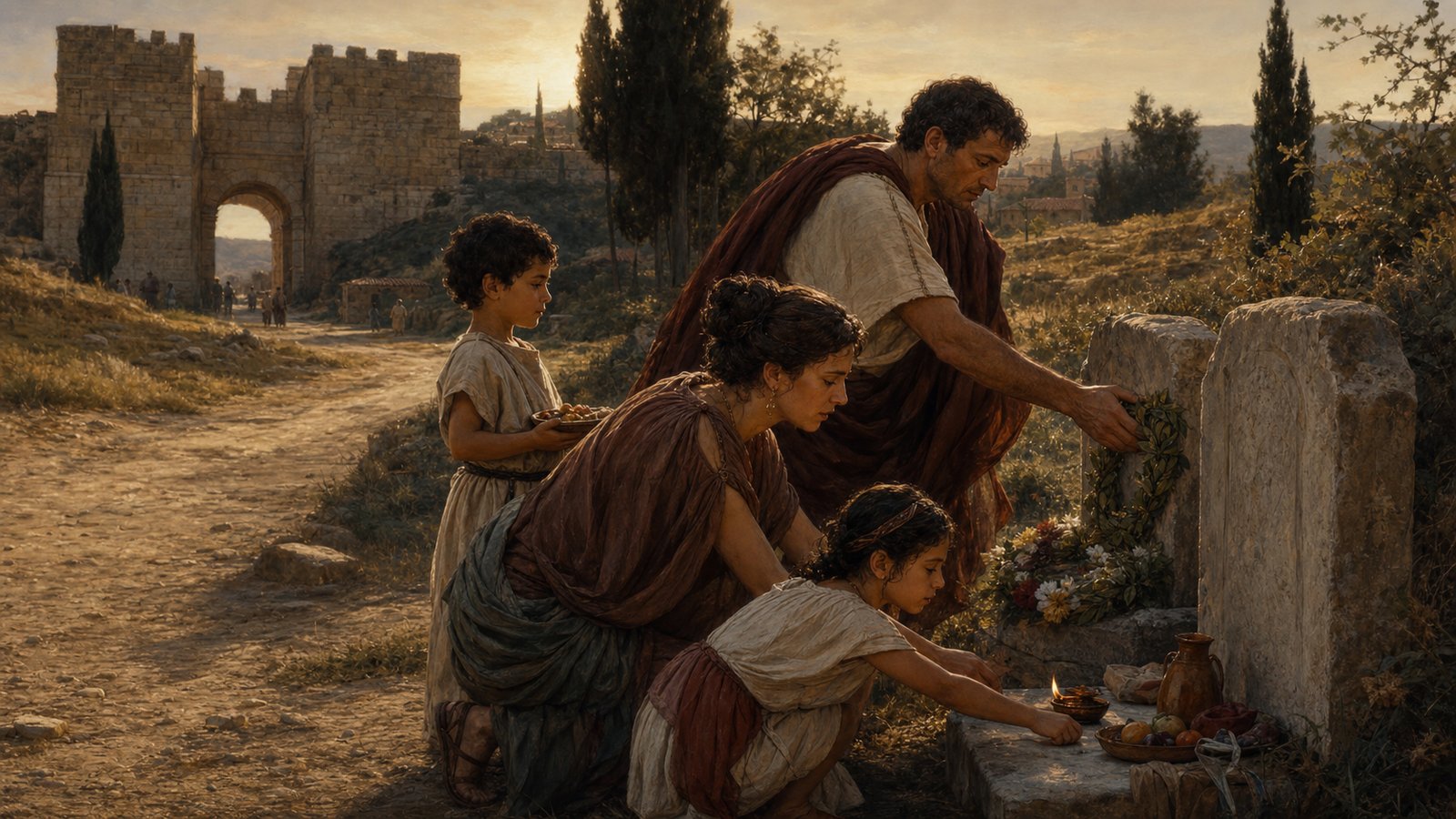
Freedpeople are especially visible in Roman funerary evidence. Their inscriptions could record names, patrons, spouses, children, and the legal language of status. For people whose lives had crossed the boundary from slavery to freedom, public commemoration mattered intensely.
A freedman or freedwoman’s tomb could say: this person belonged to a household, held a name, formed relationships, and deserved memory. The inscription turned a legal transition into a social presence.
The passer-by became part of the ritual
Many epitaphs speak outward, asking the passer-by to pause, read, greet, or remember. That habit made the stranger part of commemoration. The dead did not speak only to descendants; they addressed anyone literate or curious enough to stop.
Imagine a traveler slowing beside a tomb road at sunset. A garland hangs near a stone, a family has left offerings, and carved words invite a brief act of attention. The reader’s pause becomes a small continuation of the funeral.
Small details carried whole households
Funerary inscriptions often preserve details that feel modest: a spouse’s affection, a child’s age, a trade, a freedperson’s patron, a family group, a conventional dedication to the spirits of the dead. These details are precisely why the evidence matters.
They show Roman society at the level of households rather than institutions. Empire becomes not only conquest and law, but also a mother counting years, a husband naming a wife, or a freedperson carving a place in public memory.
Stone made grief durable, but not silent
A tomb did not remove loss. It organized loss so others could see it. The inscription gave grief a grammar: names, relationships, formulas, virtues, ages, and sometimes pleas to readers. That grammar helped families turn private pain into public continuity.
This is why Roman funerary inscriptions made ordinary lives visible. They were small monuments against disappearance. Beside the roads of empire, they told strangers that even un-famous people had names worth carrying a few steps farther.
The stones also remind us that memory had costs. Someone paid for the plot, the carving, the monument, the portrait, or the burial club that made commemoration possible. Visibility was not equally available to everyone, but where it appears, it tells us what families valued enough to make public.
The common formula Dis Manibus, dedicated to the spirits of the dead, placed individual loss inside a shared ritual language. A reader could recognize the pattern before learning the person. The formula opened the door; the name made the loss particular.
Portrait reliefs and tools sometimes sharpened the message. A baker could be shown with bread, a smith with tools, a family with joined figures. Even when words were brief, images and objects could help a viewer understand how the dead wanted to be remembered.
There is tenderness in the numbers. Ages on tombs can feel statistical until we remember who chose to carve them. A child’s years, months, or days might be recorded because precision was a form of love. Counting became mourning.
The roadside setting also made memory competitive. Tombs stood near other tombs, and families knew their monuments would be seen alongside neighbors and strangers. Commemoration was private feeling placed in a public field of comparison.
For historians, these inscriptions are invaluable because they multiply the cast of Roman life. They do not abolish silence; many people still left no stone. But they break the illusion that Rome was made only by the powerful.
That is why an ordinary epitaph can be more startling than a triumphal monument. The triumph tells us how a state wanted victory remembered. The epitaph tells us that a household wanted a person remembered, and trusted a stranger on the road to help.
Freedpeople make this especially vivid because names could carry the marks of dependence and transformation at once. A former slave might bear a patron’s name, a new family role, and a public claim to respectability in the same small text. The inscription did not erase the past, but it gave the person a recognized place after death.
The passer-by was not expected to know the whole story. That is part of the power of the form. A few carved facts could invite enough recognition: here was a wife, a son, a tradesman, a freedwoman, a child, a household that grieved. The stone asked for attention without requiring intimacy.
In that sense, roadside tombs made Roman society visible from below. They reveal the desire to be counted, named, and situated in relation to others. Emperors filled the city with official memory, but ordinary families filled the roads with smaller acts of survival.
Those smaller acts changed the landscape of travel. A road out of Rome or Pompeii was not an empty corridor between destinations. It was bordered by remembered people, each monument turning movement into encounter. A traveler passed through a community of the dead before reaching the living city.
The inscriptions also show how Roman identity was relational. People were remembered as someone’s spouse, child, freedperson, patron, colleague, or parent. The self on stone was rarely alone. It was placed inside a network because a life became legible through the bonds others were asked to remember, even when the person named had never appeared in any senator’s history or imperial archive or public record.
Sources & Further Reading
- Smith Dictionary, Funus
- Smith Dictionary, Sepulcrum
- Poetry in Translation, Latin Epitaphs
- British Museum, Roman funerary reliefs
- LacusCurtius, Di Manes
- Smith Dictionary, Libertus
- Oxford Classical Dictionary, Roman funerary practices
- Epigraphic Database Roma
- Metropolitan Museum of Art, Roman Funerary Art
- Smith Dictionary, Via