
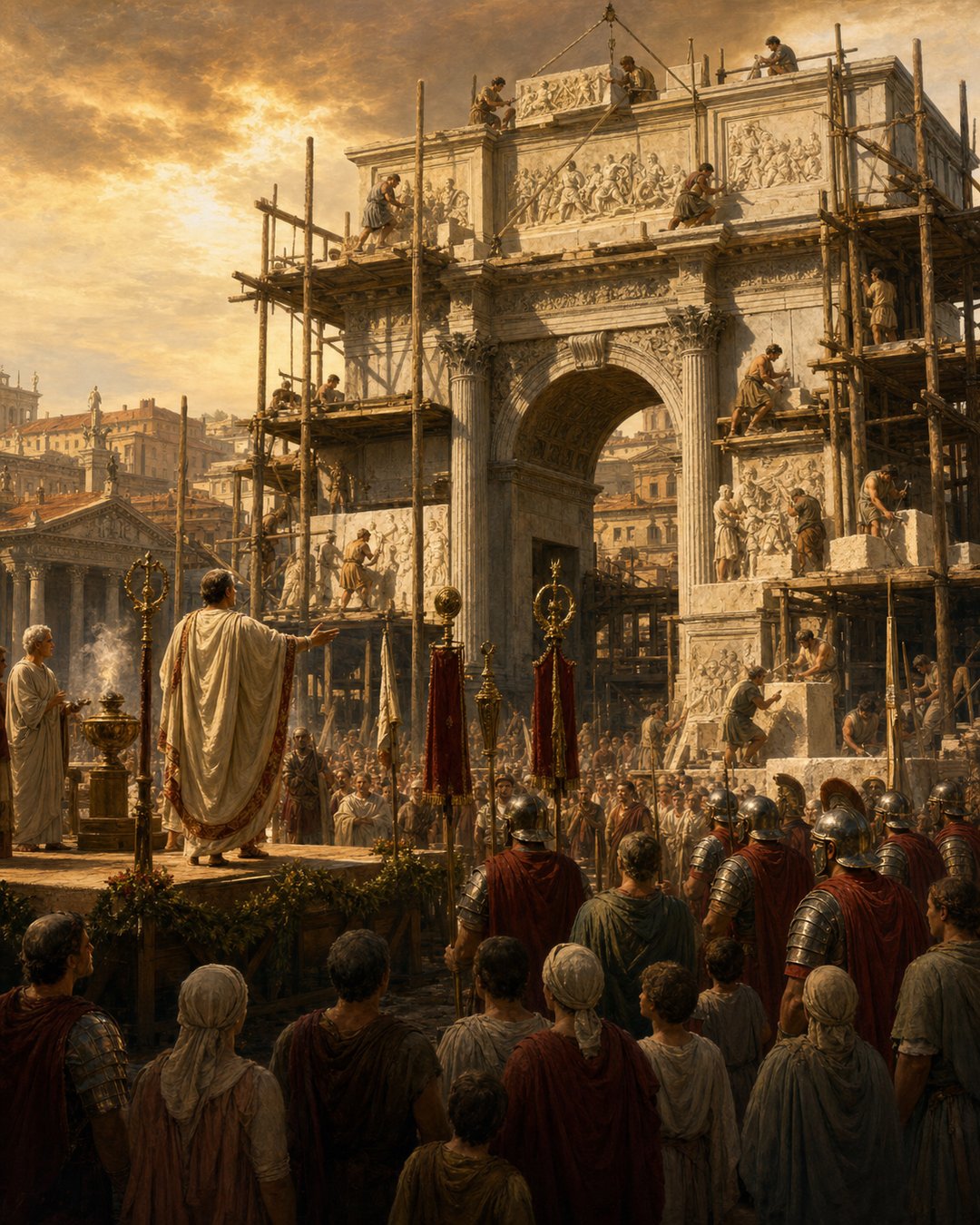
A triumph ended after one day. The crowd dispersed, the soldiers went back to ordinary duties, the captives disappeared into Roman systems of display and punishment, and the spoils found new homes. A triumphal arch solved that problem for memory.
The arch made victory permanent by turning a procession into architecture. It stood where later pedestrians could not help meeting the old story again. Rome did not only celebrate victory; it built routes through which victory could keep instructing the city.
A parade needed stone to outlast itself
The Roman triumph was a living spectacle of movement: commander, soldiers, spoils, captives, music, sacrifice, and crowd. Its force came partly from being temporary. People had to be there. They had to see it before it vanished.
An arch changed the time scale. It preserved the logic of procession in a fixed form. Later viewers could walk beneath a memory of the event long after the actual day had passed.
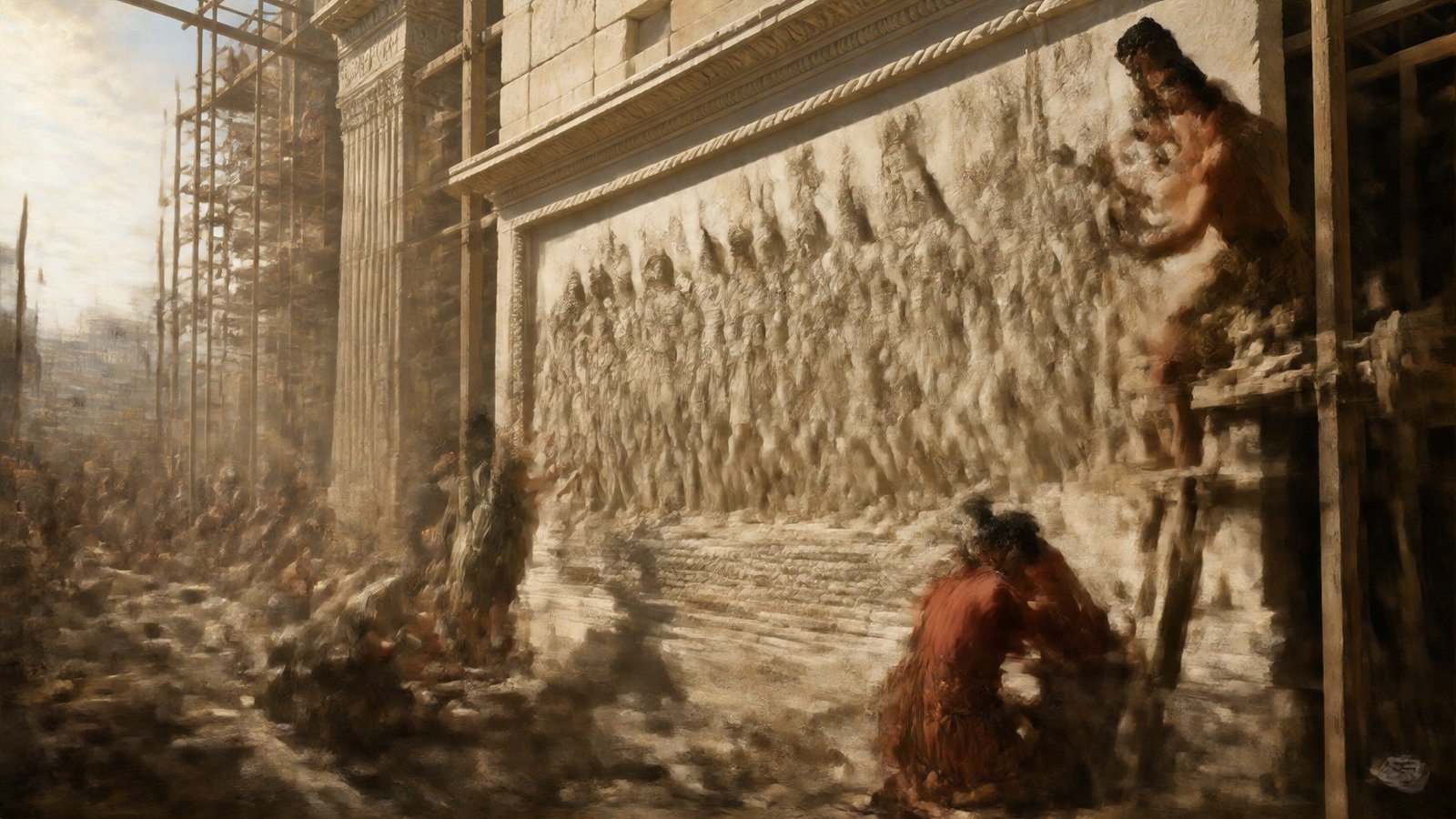
Reliefs turned conquest into a lesson
Relief panels could show spoils, captives, standards, gods, soldiers, and imperial figures in a controlled order. The viewer did not receive a neutral record. He received a lesson in what the victory was supposed to mean.
On the Arch of Titus, the famous procession of spoils from Jerusalem made a distant war visible in Rome. The carved scene allowed later crowds to see conquest as if it were still passing by.
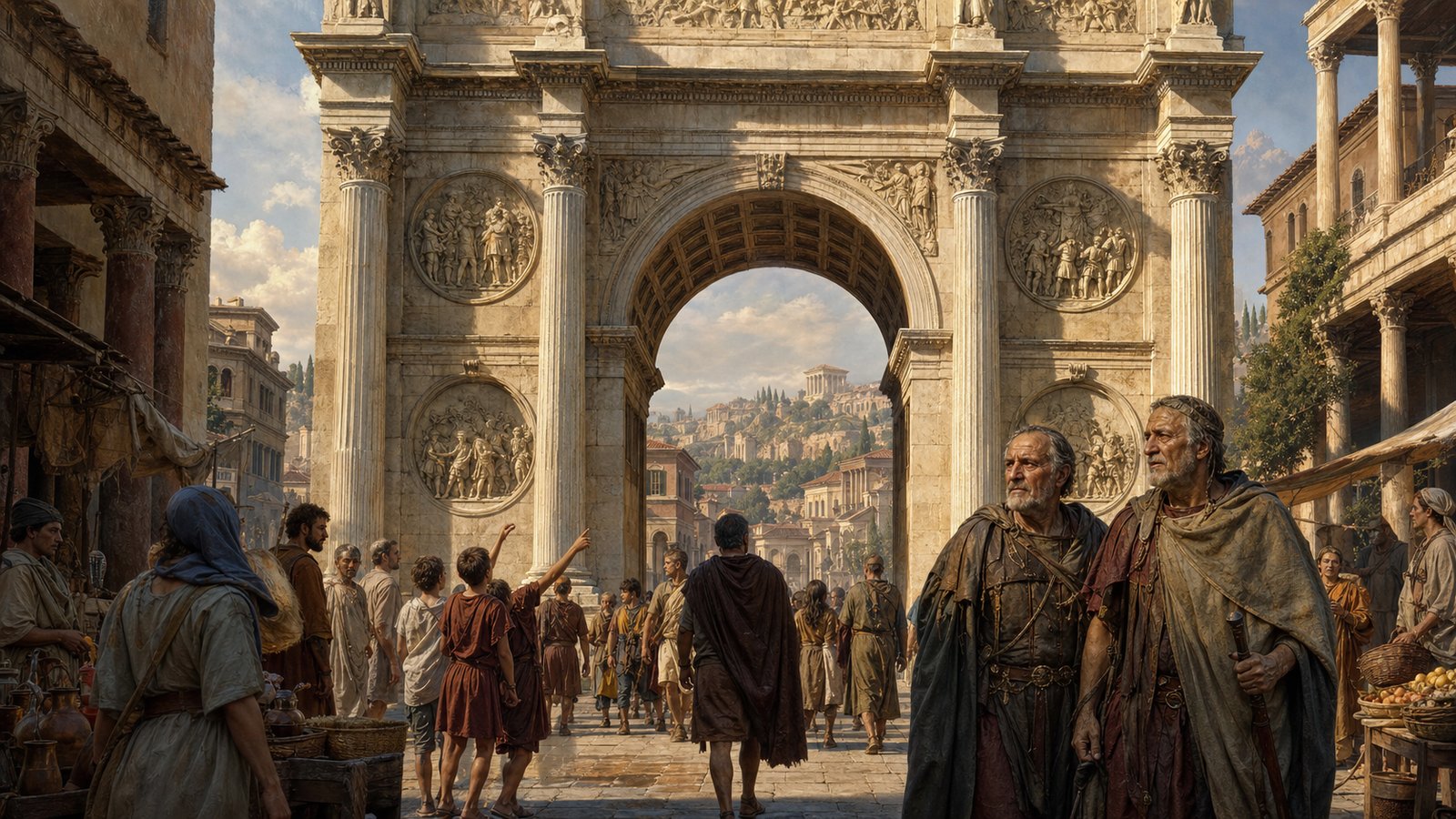
Placement made memory unavoidable
A monument’s location mattered as much as its carving. An arch placed on a route or in a civic center became part of repeated movement. People saw it while going somewhere else. Memory entered daily habit.
That repetition gave the monument power. A single speech can be forgotten. A stone arch encountered again and again can turn a ruler’s version of victory into the city’s background.
The arch linked ruler, army, and city
Victory monuments joined military success to public legitimacy. They told the city that campaigns elsewhere had meaning here. The ruler who commanded, the soldiers who fought, and the citizens who walked under the arch all became part of one visual story.
This could be dynastic as well as military. A victory did not only honor the dead or reward the living. It strengthened a claim that a family, emperor, or regime deserved continued attention.
Old stone could be reused for new power
The Arch of Constantine shows that Roman monuments did not freeze memory once and for all. Earlier reliefs could be reused, reframed, and made to serve a new ruler. Stone looked permanent, but interpretation remained flexible.
That flexibility is revealing. Rome treated the past as a material resource. A later emperor could borrow the dignity of earlier images and place himself inside a longer story of legitimate command.
Victory became part of the street
The strongest effect of a triumphal arch was ordinary repetition. Children, merchants, veterans, visitors, petitioners, and officials could all pass under a structure that made conquest part of the city’s daily scenery.
This is why Roman triumphal arches made victory permanent. They did not merely decorate Rome after war. They trained later eyes to remember war in the form chosen by power.
The arch also changed the relationship between viewer and event. A person who never saw the campaign, never joined the army, and never stood in the triumphal crowd could still learn the official story through stone.
That official story was selective. Reliefs could emphasize order over suffering, divine favor over logistics, and dignified procession over the violence that produced the spoils. Monumental memory is powerful partly because it edits without admitting that it edits.
The physical act of passing beneath the arch mattered. The viewer did not only look at victory from a distance. He moved through a framed space built to honor it. Architecture made the body participate in remembrance.
The arch’s height and mass also did work. It made victory larger than any one viewer. Standing below it, a pedestrian felt the difference between individual life and imperial memory carved in stone.
The monuments could speak to foreigners as well as Romans. Visitors entering or moving through the city encountered proof that Rome wanted its victories seen as public facts. Conquest became part of the urban introduction.
Even damage and survival changed the message. A worn relief still suggested endurance. A missing inscription could not erase the form. The arch remained a claim that something important had happened and deserved to occupy space.
The arch therefore sits between history and propaganda. It preserves information, but it also organizes emotion. The viewer is invited to admire, accept, and repeat the association between victory and rightful rule.
That invitation could be renewed for centuries. A triumphal parade might fill one day with sound and spectacle. A monument filled many ordinary days with quieter instruction.
The great arches remind us that Roman memory was built in layers. Procession became relief, relief became landmark, landmark became route, and route became habit. The city itself helped rehearse the meaning of victory.
For Rome, that was the point. Military success was too valuable to leave in the past. By fixing it in stone and placing it where people walked, the triumphal arch made victory keep working long after the soldiers had gone home.
The arch also disciplined the viewer’s imagination. It did not ask pedestrians to reconstruct supply lines, casualties, negotiations, or local suffering. It offered a framed conclusion: victory had happened, the ruler deserved memory, and the city was the proper place to display the result.
That conclusion could become more persuasive through routine than through argument. A person passing under the same monument year after year might stop noticing each carved detail, yet still absorb the larger message that Roman power had a past worth honoring.
The monument therefore turned memory into environment. It made victory part of route-finding, shade, meeting places, and urban orientation. In that sense, the arch did not merely tell Romans what to remember; it helped build a city in which forgetting required effort.
The reliefs also gave war a civic afterlife. A battlefield might lie far beyond Italy, but its edited image could stand beside courts, temples, markets, and processional routes. The city absorbed distant violence into local pride.
This absorption mattered because most viewers knew war through stories rather than experience. The arch supplied a story with stone authority. It told the passer-by where to look, which figures deserved prominence, and how defeat should appear beneath Roman order.
Over time, the monument could outlive the political circumstances that produced it. People who no longer remembered every campaign detail still inherited the arch as a landmark. Victory had become architecture, and architecture had become memory.
Sources & Further Reading
- Encyclopaedia Britannica, Triumphal arch
- Khan Academy, Arch of Titus
- SmartHistory, Arch of Titus
- Smith Dictionary, Triumphus
- Livy, History of Rome, Book 45
- LacusCurtius, Arch of Septimius Severus
- Khan Academy, Arch of Constantine
- Oxford Classical Dictionary, Roman public monuments
- LacusCurtius, Roman arches
- Cambridge Core, Roman triumph and memory