
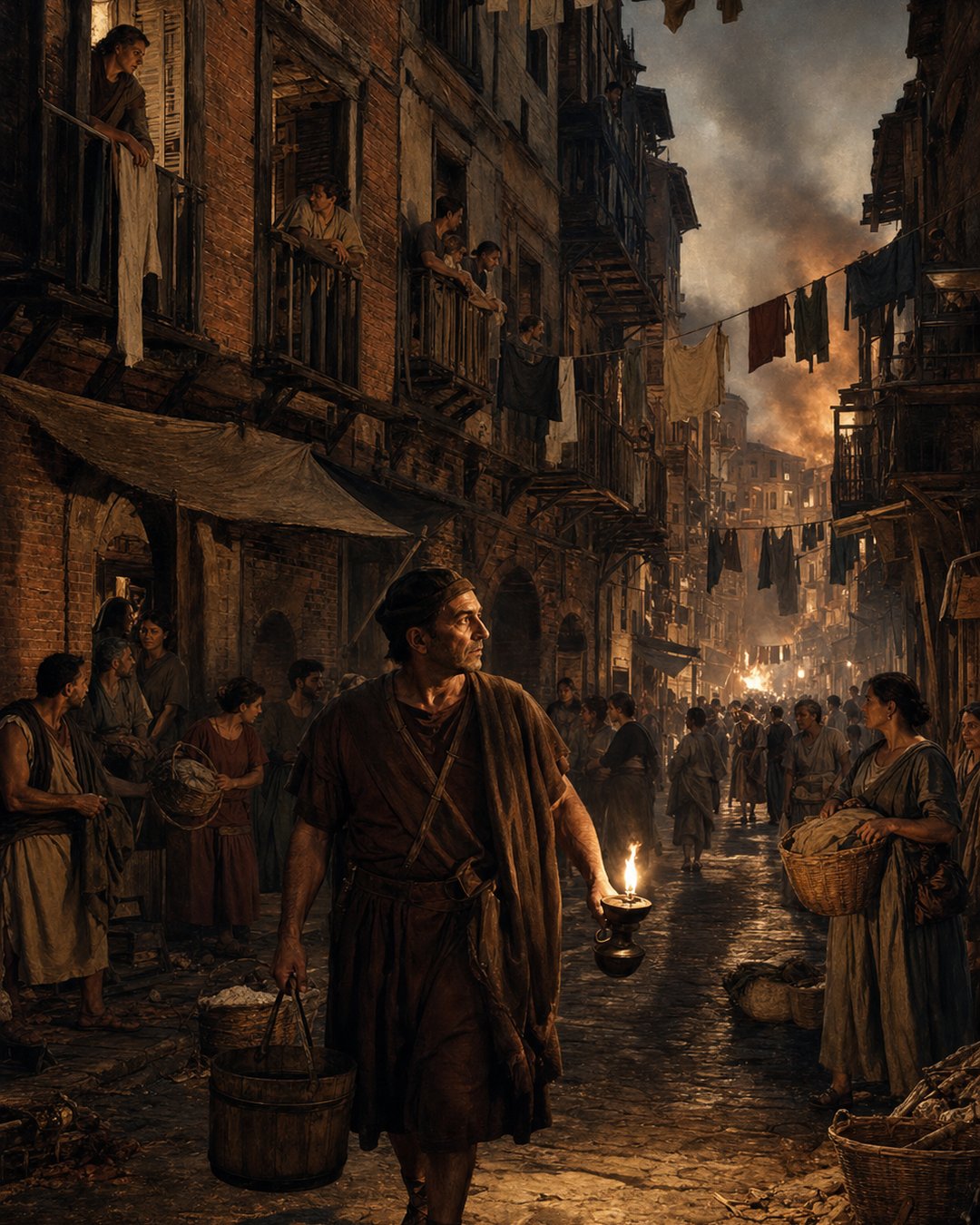
A Roman apartment fire was never only a private misfortune. In a crowded block of insulae, one lamp, brazier, stairwell, or careless flame could become the problem of every neighbor above, below, and across the street. Density changed the meaning of accident.
The insula matters because it made danger public. Rome’s poor and middling residents did not live inside the tidy marble city of later imagination. Many lived in rented, multi-storey buildings where height, crowding, timber, smoke, and haste made fire part of urban politics.
Crowding turned flame into a shared threat
The basic problem was proximity. A cooking fire or lamp might begin inside one room, but an apartment block tied households together through walls, stairs, roofs, shops, and passages. The building made neighbors vulnerable to one another.
Juvenal’s complaint about living high above the street is comic, bitter, and concrete. The danger is not abstract. Someone poor enough to live upstairs also had farther to escape when trouble began.
Tall buildings made escape political
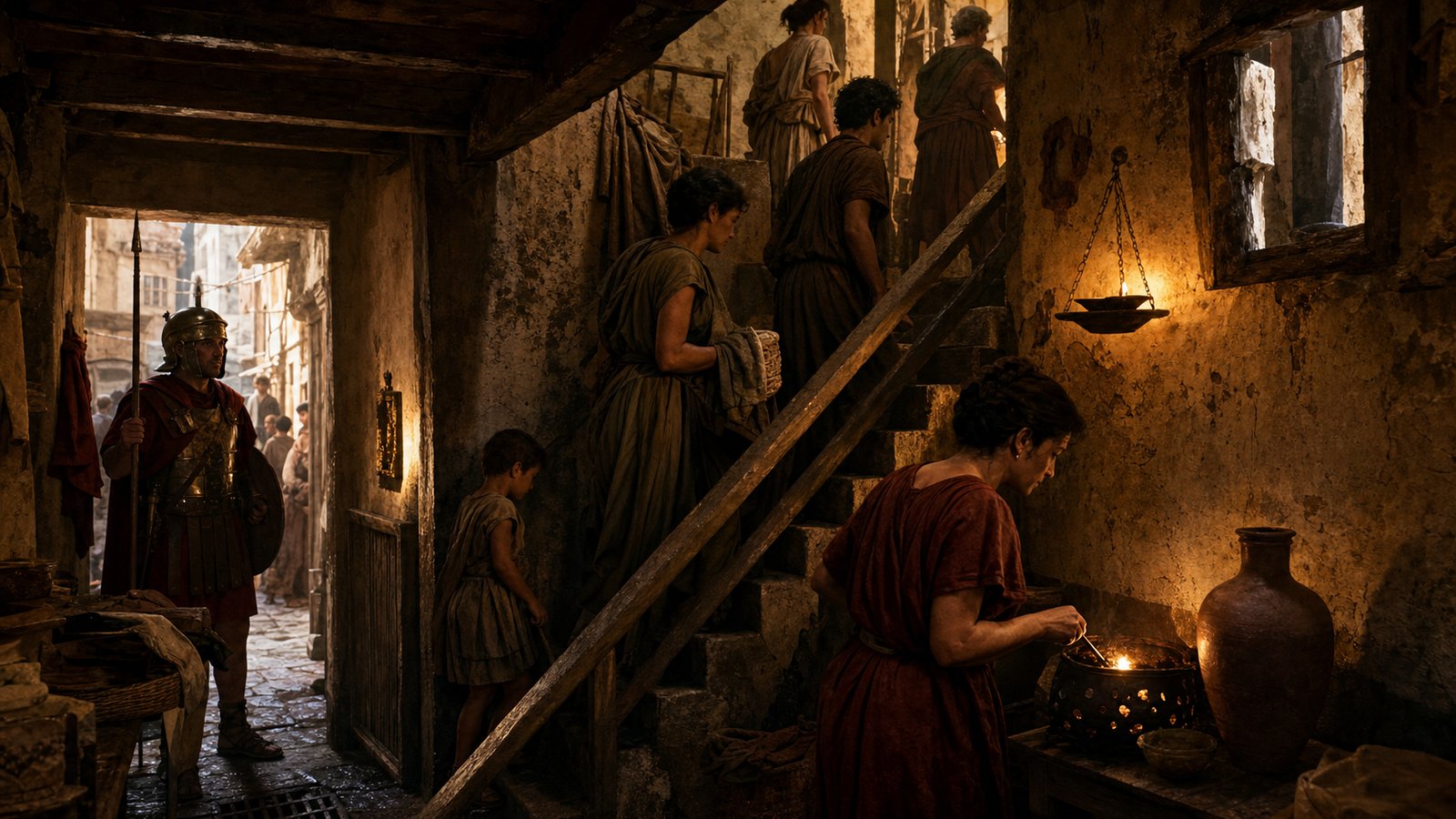
Height turned a household risk into a question of civic order. If stairs filled with smoke, if upper rooms were cramped, or if the street below was narrow, survival depended on more than personal caution. It depended on building practices, watchmen, and the city’s willingness to treat housing as a public issue.
That is why insulae belong in the history of government. They forced Rome to confront the fact that private rent could produce public danger. A landlord’s choices and a tenant’s lamp could become a city’s emergency.
The vigiles made the city watch itself
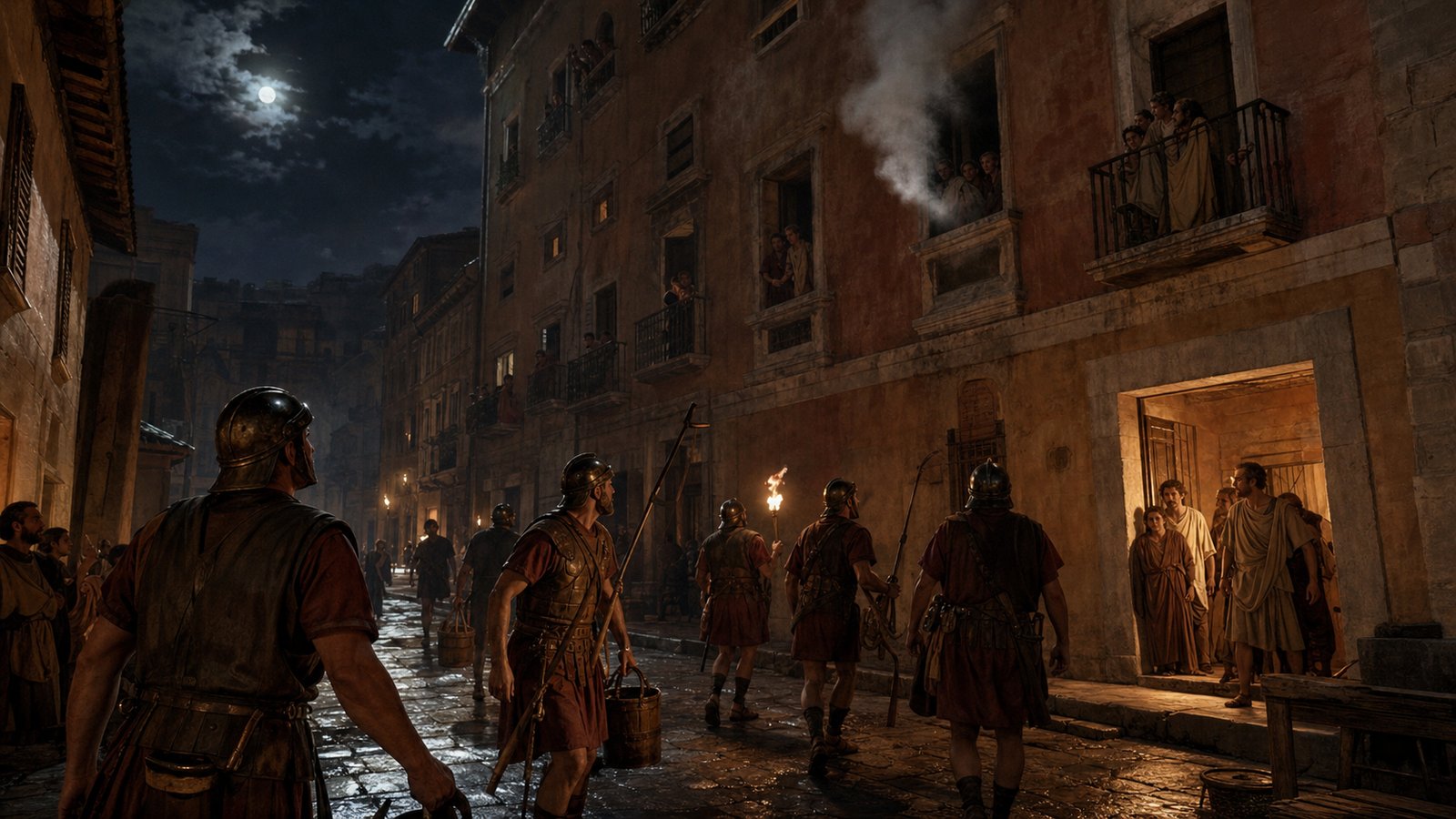
Augustus’ organization of the vigiles recognized that fire needed standing attention. A city of Rome’s size could not rely only on neighbors shouting after smoke appeared. It needed night watch, buckets, hooks, patrols, and men whose job was to notice danger before it became catastrophe.
Picture a narrow street after dark: oil lamps in windows, a brazier inside an upper room, a watchman listening below, and a smell of smoke moving faster than explanation. The scene is ordinary until it becomes urgent.
Nero’s fire exposed the scale of the problem
The great fire of 64 CE made Rome’s vulnerability impossible to ignore. Tacitus describes devastation on a scale that turned urban form itself into evidence. Streets, building materials, open spaces, and access routes all mattered because the city had become the fuel bed of its own disaster.
Nero’s rebuilding measures, as Tacitus reports them, reveal the lesson. Wider streets, height limits, and more fire-conscious construction were not decorative reforms. They were attempts to make the next disaster less easy.
Apartment life carried unequal risk
Not everyone shared the danger equally. The wealthy could leave a townhouse more easily than a tenant trapped on an upper floor. Poorer residents depended on buildings they did not own and repairs they did not control. Their safety was often rented from someone else.
That imbalance made fire a social fact. It punished the people least able to change the structure around them. Rome’s housing market placed bodies, flames, and profit inside the same walls.
Fire made the hidden city visible
When nothing burned, the insula could disappear behind daily routine. Tenants climbed stairs, shopkeepers opened stalls, lamps were lit, rent was demanded, and neighbors argued. Fire revealed the system all at once: design, density, poverty, authority, and infrastructure.
This is why Roman insulae made fire a public problem. They showed that urban life is never only a collection of private rooms. In a dense city, one household’s flame could test the whole civic machine.
The most revealing detail is not merely that Rome burned. Ancient cities burned often. The revealing detail is that Romans built institutions and rules around the expectation of fire. The vigiles, rebuilding regulations, and complaints of urban writers all point toward a city trying to live with predictable danger.
A tenant’s experience was sensory before it was political: smoke under a door, heat in a stairwell, shouting in the street, sandals on steps, a jar of water passed too late. Those details explain why fire could not remain a private affair. Fear climbed through the building faster than blame could be assigned.
The insula also reminds us that Roman infrastructure was not only aqueducts and roads. Housing was infrastructure too, even when privately owned and badly maintained. A city that depends on rented vertical living inherits every weakness of those structures.
For officials, fire threatened more than lives. It threatened shops, grain, records, shrines, temples, streets, and the credibility of order. A city that cannot contain fire begins to look less governed, even if its monuments still stand.
For landlords, density could mean income. For tenants, density could mean exposure. The same building that multiplied rent also multiplied risk. That tension made the ordinary apartment block one of the least glamorous but most important spaces in Rome.
The vigiles stood at the edge of that tension. They were not a modern fire department, and they could not erase danger. But their existence made a public promise: the city recognized that fire in a crowded block was not just bad luck.
That promise was always imperfect. Buckets, hooks, patrols, and orders could fail against wind, timber, panic, or bad construction. Still, imperfect public action is historically important because it shows what Rome had learned to fear.
The insula therefore changes how we imagine Roman daily life. The empire of roads and legions also contained people sleeping above shops, storing oil, cooking near combustible beams, and listening for trouble at night. Urban greatness rested on precarious rooms.
A smoky stairwell is a small scene, but it opens onto the larger Roman city. It joins law, rent, labor, materials, policing, and fear. When the watchman entered the street, he was responding not only to a flame but to the city form that allowed the flame to matter so much.
Even the architecture carried a warning. Upper rooms might be cheaper, hotter, harder to reach, and harder to flee. The people who could least control the building often had the longest escape route when smoke began to climb.
Fire also made neighbors responsible for one another before any official arrived. A bucket passed from hand to hand, a shouted warning, a door kicked open, or a child carried down a stair were emergency acts of urban citizenship. Rome’s institutions mattered because the first minutes were always local.
The public lesson was therefore simple and uncomfortable. A city cannot pack people vertically, light its rooms with flame, cook indoors, and then pretend danger belongs only to the careless individual. The insula made risk collective because the building made daily life collective.
After the flames, blame could travel in many directions: tenant, landlord, neighbor, builder, magistrate, watchman, emperor, or fortune. That very spread of blame proves the point. Fire in Rome belonged to no single room because the city had woven rooms, streets, shops, and authorities into one combustible system.
Sources & Further Reading
- Smith Dictionary, Insula
- Juvenal, Satire 3
- Suetonius, Augustus, 30
- Smith Dictionary, Vigiles
- Tacitus, Annals, 15
- Tacitus, Annals, 15.43
- World History Encyclopedia, Roman Domestic Architecture
- Ostia Antica, Insulae
- Cambridge Companion to Ancient Rome
- LacusCurtius, Rome Topography: Fires