
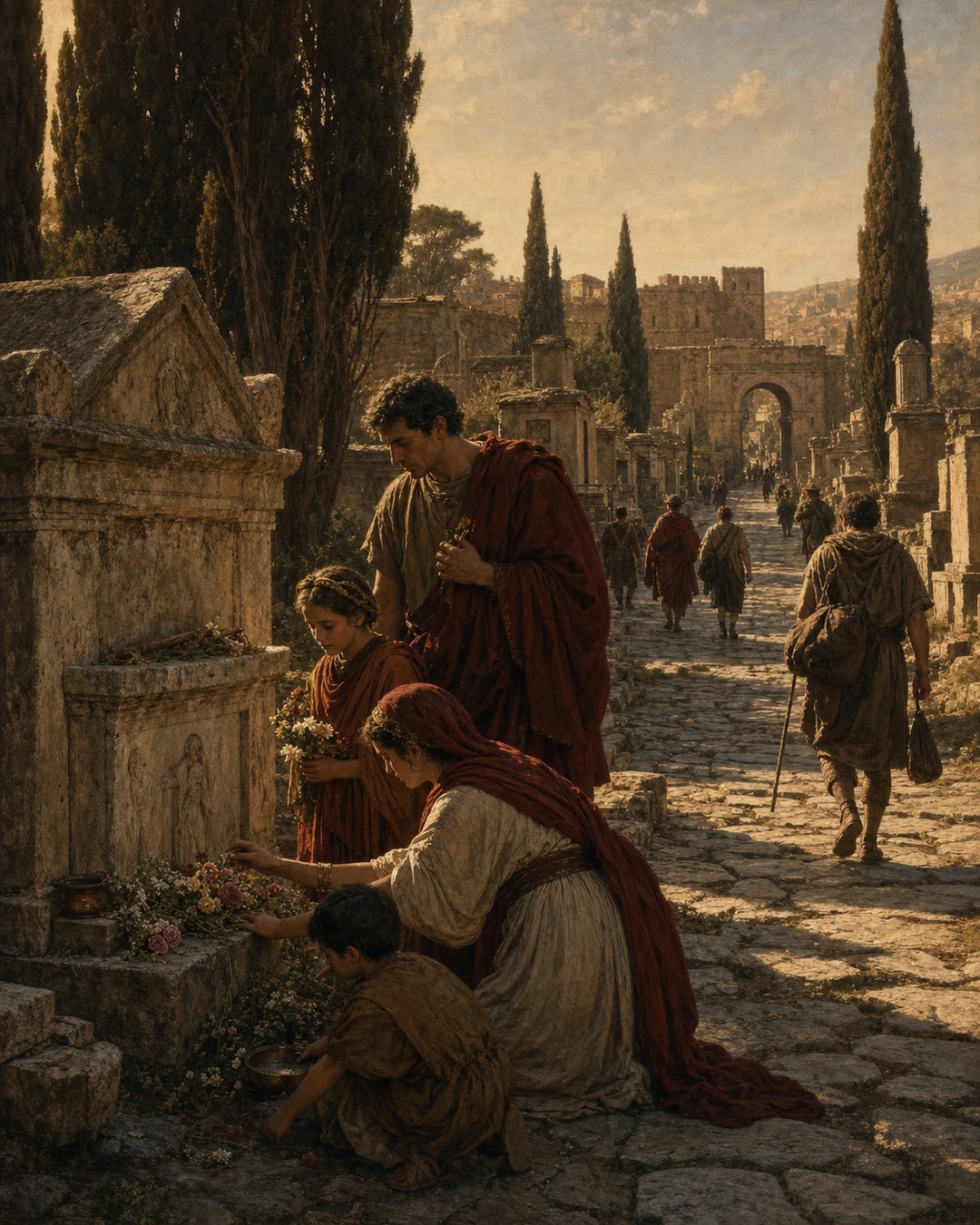
A Roman road did not simply bring travelers to a city. It could bring them past the dead. Tombs along the roadside turned the approach to an urban gate into a corridor of memory, status, family pride, and repeated attention.
Roadside tombs made memory public because they refused to let death disappear into private feeling alone. They placed names, monuments, portraits, offerings, and family claims where strangers had to pass them.
The city edge became a gallery of the dead
Roman tombs often stood outside city walls, especially along roads. That placement made practical and religious sense, but it also gave commemoration an audience. Travelers met the dead before they met the gate.
Imagine a late afternoon road: cart wheels on stone, dust in the air, a family placing a garland, and tomb facades catching low light as strangers walk by. Memory has been built into the route.
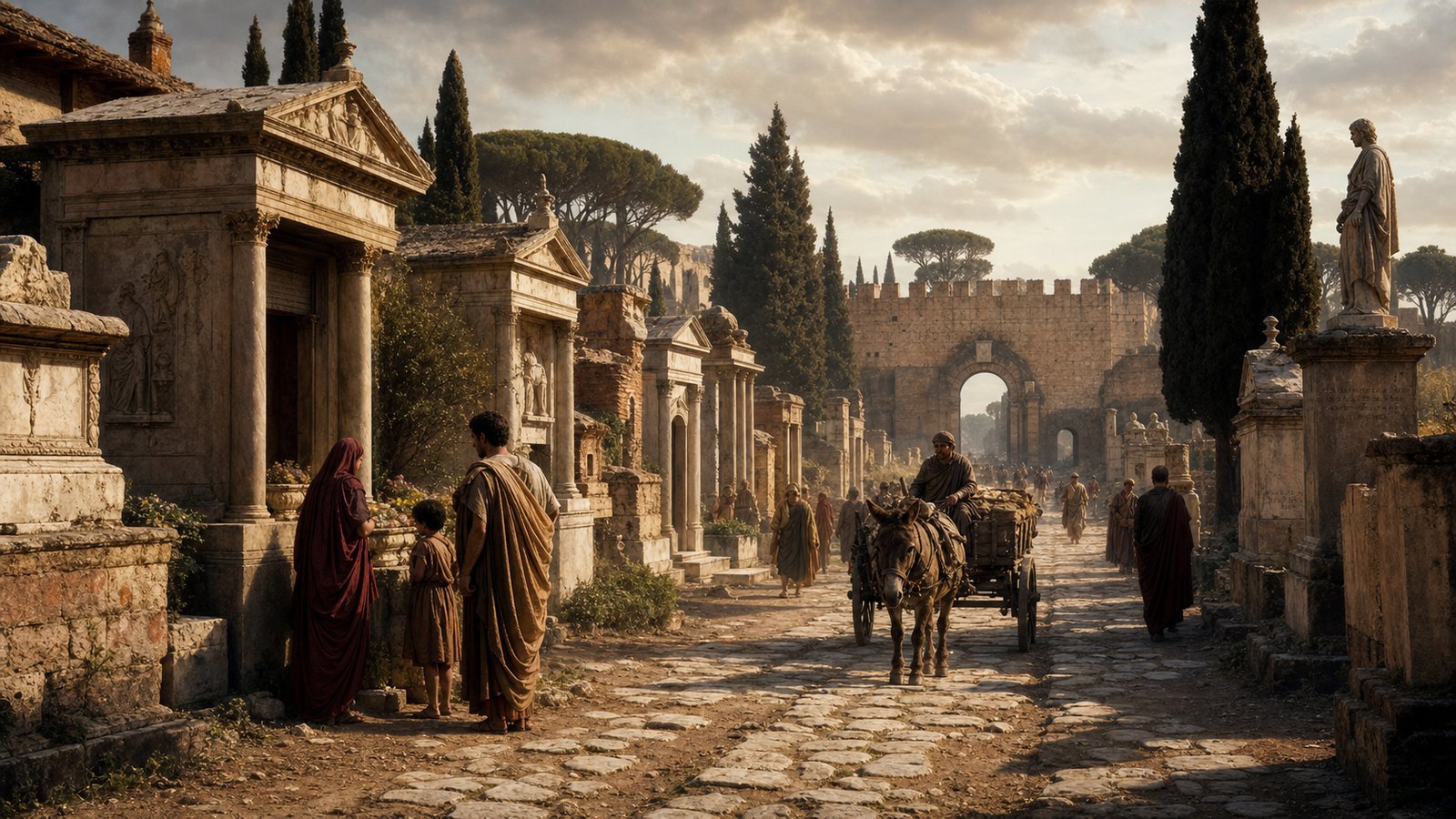
A tomb faced movement
A roadside tomb was not hidden in a silent private field. It faced traffic. Merchants, soldiers, officials, neighbors, pilgrims, and curious passersby could all become temporary witnesses.
That mattered because public memory needs repetition. A monument seen once may fade. A monument placed on a road can be encountered again and again by people whose journeys keep the dead in circulation.
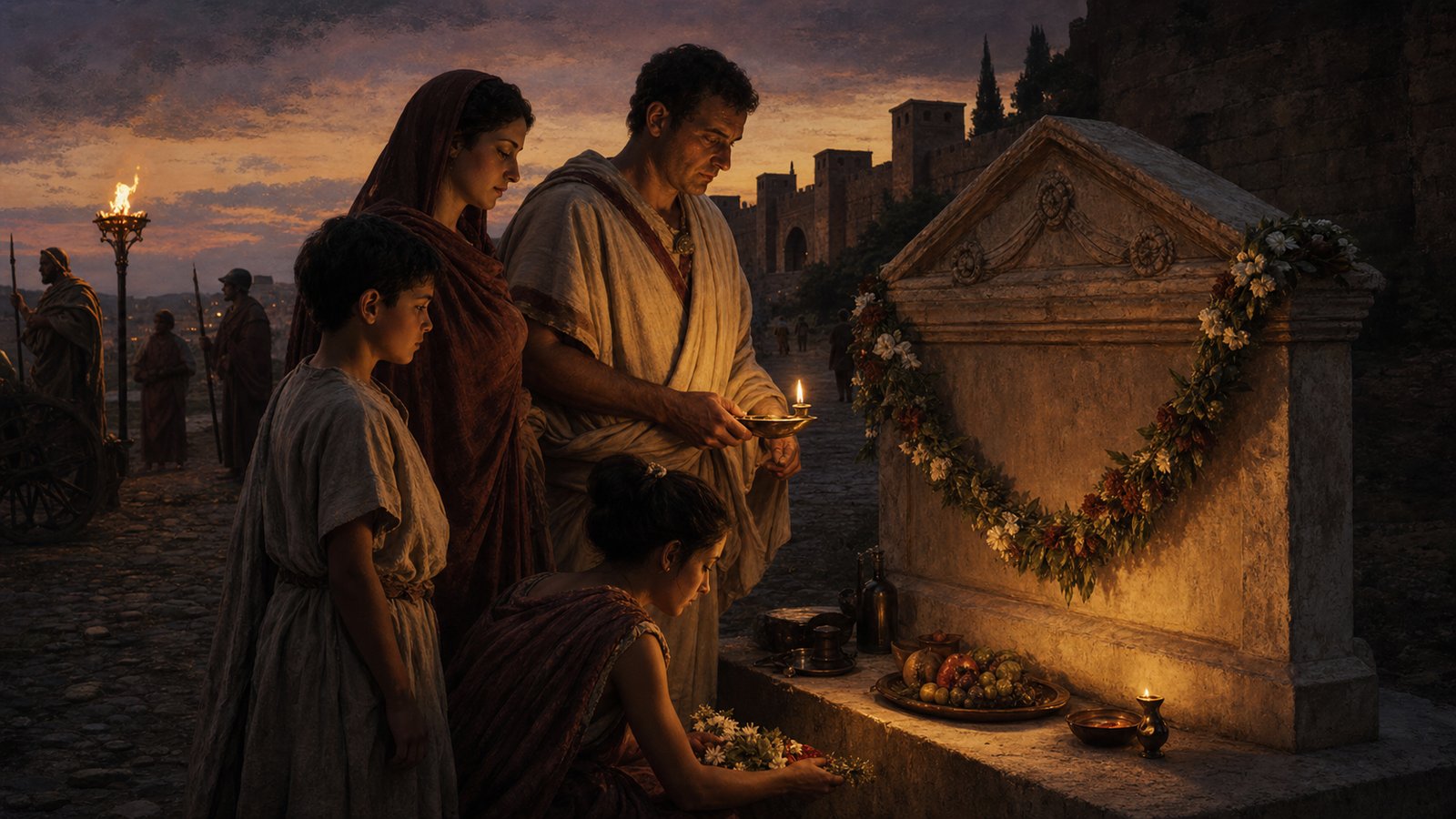
Family identity became architecture
Tombs could display status, family connection, portraits, and inscriptions. Even when the living mourned privately, the monument projected a public claim: this person belonged, this family endured, this name deserved notice.
The stone did not only mark loss. It managed reputation. In a society deeply attentive to rank, ancestry, and honor, a tomb could keep social identity active after death.
The road connected private grief to Roman movement
Roads carried armies, trade, messages, and taxes. When tombs lined those same routes, family memory stood beside the infrastructure of empire. The dead occupied the paths of the living state.
That physical overlap is striking. A traveler might pass a tomb while carrying goods, orders, rumors, or news. The road made memory part of ordinary movement rather than a separate sacred island.
Funerary ritual required return
Roman commemoration involved more than a burial day. Offerings, visits, mourning customs, and family attention could keep the relationship with the dead active. A roadside tomb gave those repeated acts a visible stage.
The sensory detail is human: an oil lamp near stone, food placed carefully, hands brushing dust from a surface, voices lowered as other travelers pass without stopping. Public memory still required private labor.
The dead asked to be seen
The roadside setting reveals a Roman instinct about remembrance. Memory was stronger when it had witnesses. A family could mourn in private, but a monument beside a road asked the wider world to recognize that the person had existed.
This is why Roman roadside tombs made memory public. They turned roads into corridors of remembrance, making death part of the shared landscape rather than a hidden ending.
The arrangement also changed the emotional texture of travel. A road lined with tombs reminded passersby that movement and mortality occupied the same space. Every journey toward the city crossed a boundary marked by previous lives.
For families, visibility could be a form of protection against oblivion. A stone set beside a busy route had a better chance of being noticed, named, and remembered than a grave without an audience.
The tomb’s message did not require every passerby to care deeply. Recognition could be brief and still matter. A glance, a read name, or a moment of curiosity added another small act of public attention.
There was ambition in this as well as grief. Roman monuments often taught viewers how to understand status. A tomb could say that a family had money, connections, taste, freed status, military service, or civic pride.
That ambition does not make the emotion false. It shows how Roman society joined feeling and display. To love a family member could also mean giving that person a durable public form.
The road made that durability useful. It guaranteed an audience not by gathering people into a theater, but by placing memory where people already had to move.
This is one reason roadside tombs are so revealing. They show Roman memory working at human scale: stone, dust, offerings, travel, names, and the desire not to vanish.
A city approached through tombs was therefore never only a city of the living. Its roads announced that the dead remained socially present, watching the traffic of Rome continue past them.
The pattern also mattered because it was repeatable. Romans learned authority through repeated encounters with objects and places that seemed ordinary: a counter, a seal, a road, a monument, a mark, a queue, or a familiar route through the city.
That repetition gave small details political weight. A single scene might look trivial, but the habit formed around it could teach people where to gather, whom to trust, what to remember, and how to recognize power when it appeared.
For this reason the evidence should not be reduced to decoration. Material details changed behavior. They shaped how people moved, spoke, waited, watched, and judged one another in daily life.
The human scale is essential. Rome was not experienced only through emperors, armies, and laws. It was also felt through surfaces, doorways, hands, lamps, dust, food, wax, stone, and the sound of other people nearby.
When those details are put back into the story, the larger system becomes easier to understand. Roman power lasted partly because it found ways to become useful, visible, memorable, and difficult to ignore in ordinary settings.
The surviving evidence is fragmentary, but the fragments point toward a world where public life was built from repeated practical encounters. What looks small in isolation could become large because it happened every day.
That daily quality is the key. A city does not become Roman only by decree. It becomes Roman when people keep meeting Roman forms in the places where they eat, work, travel, mourn, write, bargain, and remember.
Attention to these forms also protects the story from becoming too abstract. The empire was made of institutions, but institutions had to touch bodies and routines before they could feel real.
In that sense, the object or place at the center of this article is a clue. It shows where official systems and private lives met, and where Rome turned an idea into a visible habit.
The lesson is not that every Roman saw the system clearly. Most people probably noticed immediate needs first: a drink, a document, a road, a family duty, a message, a promise, or a name on stone.
Yet those immediate needs gave the system its strength. Power became durable when people used its forms for their own practical reasons, not only when officials demanded obedience.
That is the quieter story behind the grander one. Rome endured through places and objects that made authority feel normal because they kept appearing at the moments when people needed something done.
Sources & Further Reading
- World History Encyclopedia, Roman Tomb
- World History Encyclopedia, Roman Roads
- Smith Dictionary, Funus
- World History Encyclopedia, Roman Daily Life
- Metropolitan Museum of Art, Roman Art