
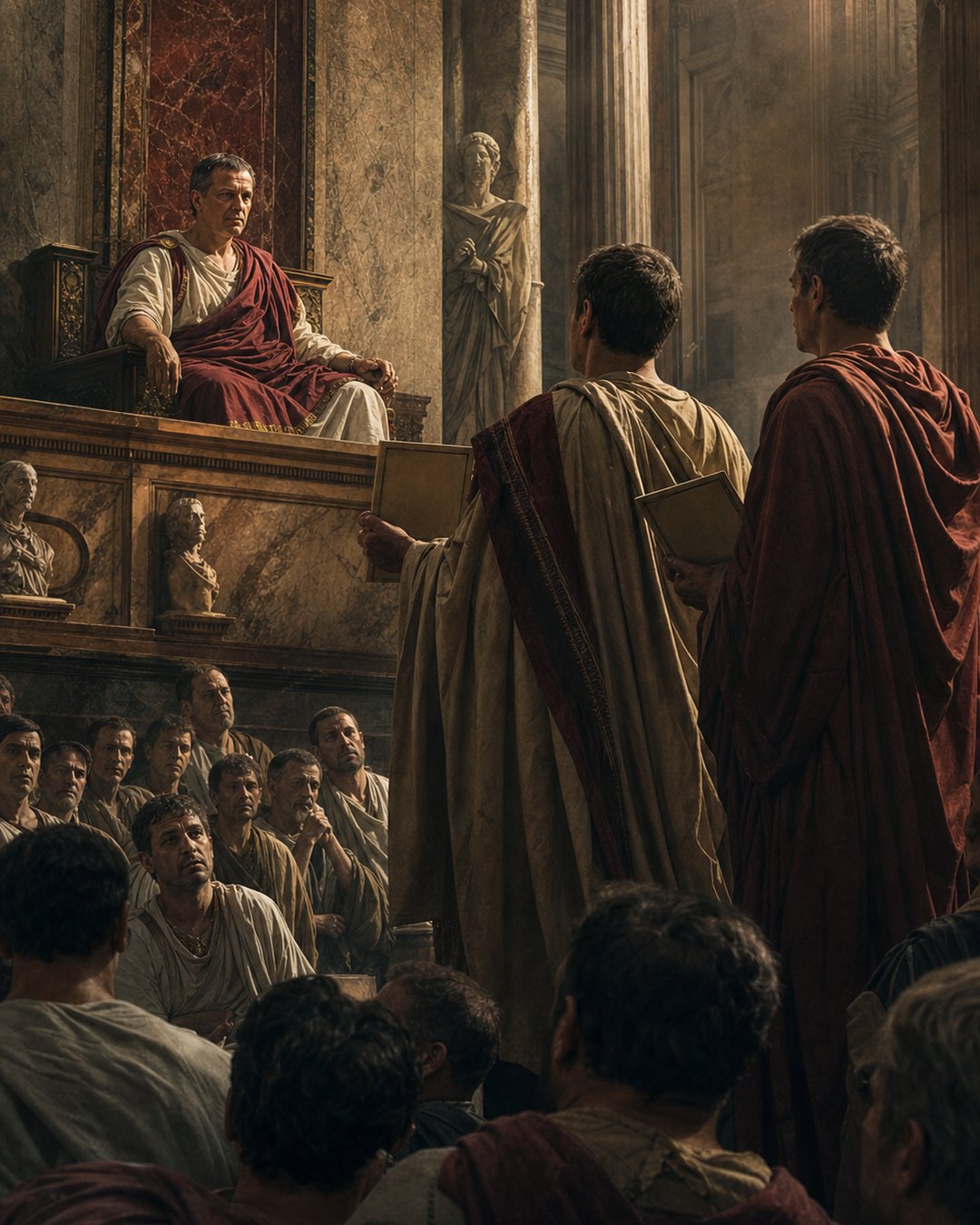
A Roman lawsuit was not only an argument about right and wrong. It was a scene. Bodies gathered, tablets appeared, officials took their places, and private injury was translated into public procedure.
Roman law courts made conflict public because a quarrel became more powerful when it passed through buildings, magistrates, judges, witnesses, and records. The city did not simply solve disputes; it taught people how a dispute should look when authority handled it.
The basilica gave conflict a roof
The basilica was a public building for legal proceedings, business, and gatherings. That combination matters. Legal conflict did not belong to a sealed modern courtroom separated from civic life; it stood close to trade, movement, waiting, and reputation.
A roof changed the quarrel. It gathered voices under architecture, gave parties a place to stand, and made the disagreement part of a recognizable civic setting rather than only a private feud.
The tribunal made authority visible
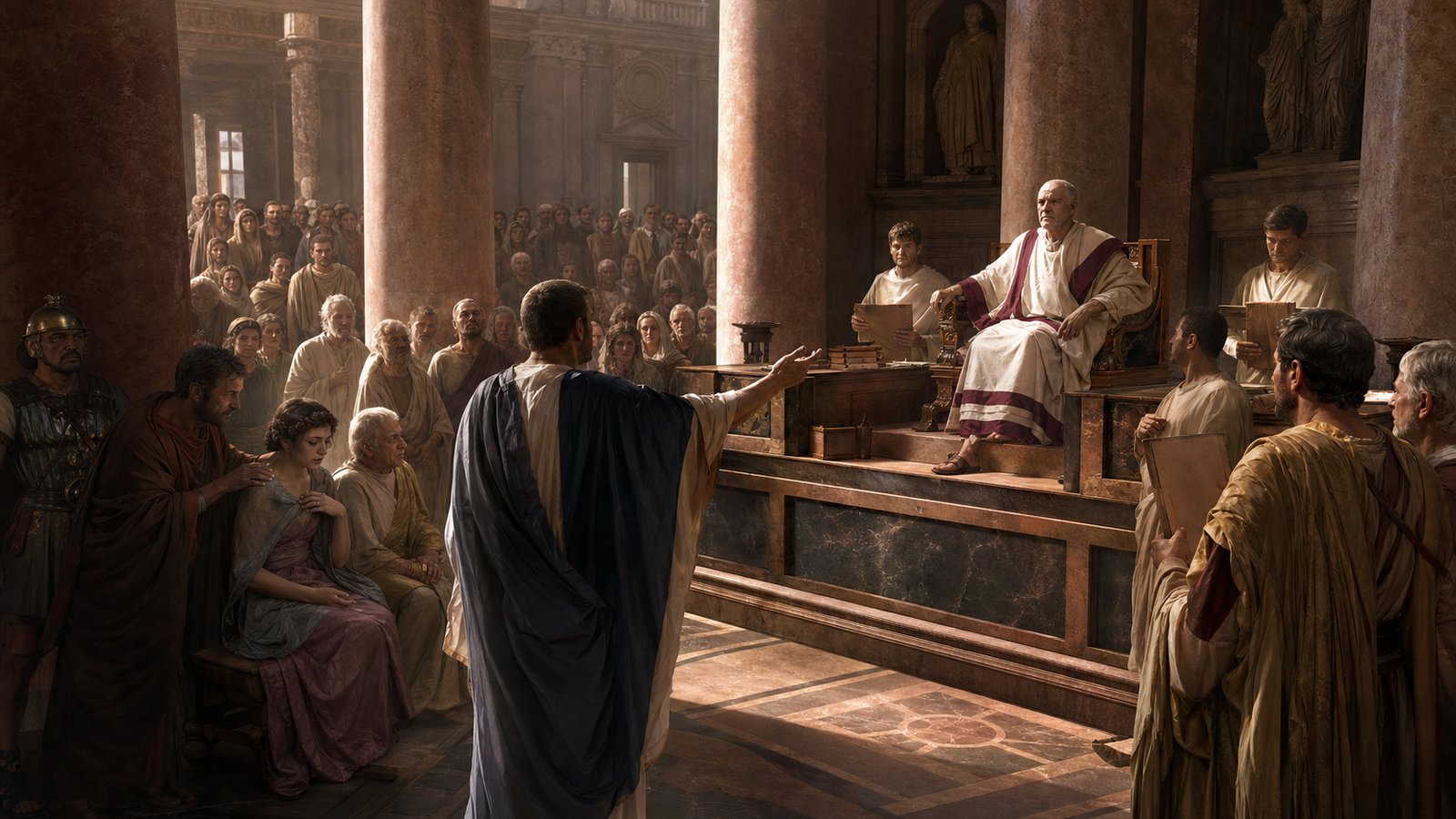
A praetor’s judicial role turned procedure into public office. Authority had a body, a seat, a place, and a sequence. People could see that a conflict had entered a form larger than either party.
Imagine the mini-scene: an advocate turns toward the tribunal, a witness shifts under the gaze of a crowd, wax tablets rest in a clerk’s hand, and the losing party already feels the forum waiting outside. Procedure has begun to discipline anger.
Judgment became a role, not a shout
The judex reminds us that judgment was not supposed to be mere noise. A recognized judge or juror made decision a social role, something assigned, watched, and remembered.
That did not make Roman justice pure or equal. Influence, wealth, status, and rhetoric could still bend outcomes. But the form mattered because it made power act through a visible path instead of pretending that conflict had no rules.
Tablets made accusation durable
Spoken accusation fades quickly in a crowd. Tabulae, writing tablets, gave legal business a more durable surface. Claims, obligations, accounts, and procedural memories could be carried beyond the heat of a single exchange.
The tablet did not guarantee truth. It made truth claims easier to inspect, repeat, dispute, and store. In a city of reputation, that durability could be as important as the verdict itself.
The forum carried the decision outward
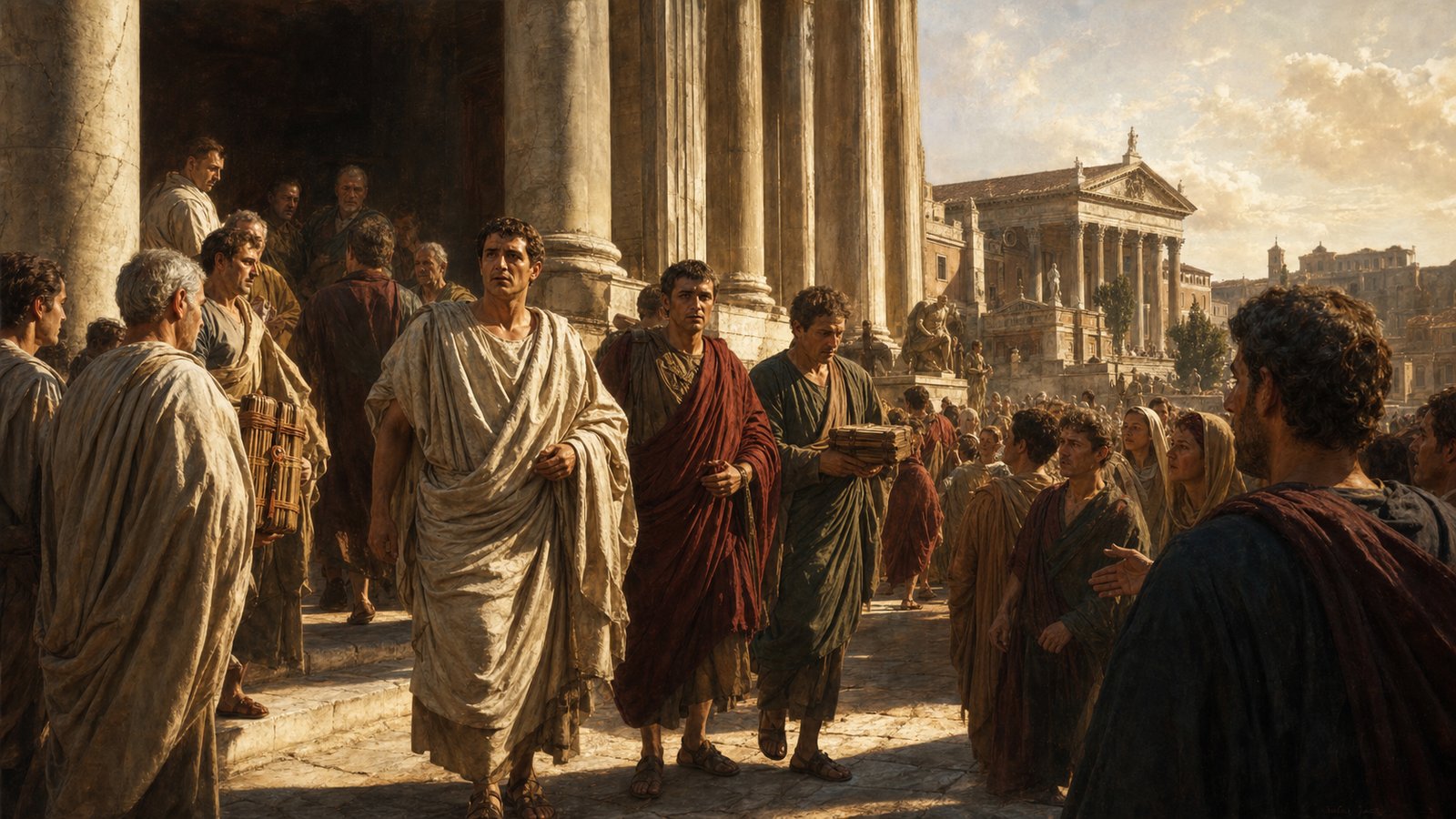
A legal scene did not end at the edge of the tribunal. The parties walked back into a public world where people had watched, heard, guessed, or waited for the result. The forum turned legal memory into social memory.
This is the deeper point. Roman courts made conflict public not because Romans loved embarrassment for its own sake, but because authority needed visibility. A dispute handled in public taught everyone nearby that quarrels could be converted into procedure.
The setting also changed the emotional temperature of conflict. A private insult might demand immediate retaliation. A quarrel brought into a basilica had to move through pauses, roles, order, witnesses, and formal speech. The architecture slowed anger down.
Slowing anger did not remove violence from Roman life. It created another option beside it. The party who appeared before authority accepted that reputation would now be fought through procedure as well as through personal force.
That acceptance was itself a public lesson. People watching a case saw not only the litigants but the shape of civic authority: who spoke first, who waited, who had documents, who brought supporters, and who seemed comfortable under scrutiny.
A basilica’s openness mattered because law was never only about the parties. Legal procedure helped define what the community could recognize as a claim. The crowd learned which injuries could be named and which arguments had to be translated into acceptable language.
The praetor’s presence gave this translation weight. A magistrate did not need to erase social inequality to make the scene meaningful. His role told observers that the quarrel had become an issue of public order.
The judex added another layer by making judgment a delegated act. Instead of letting the loudest party own the outcome, Roman procedure could mark someone as responsible for deciding. That responsibility was visible enough to be praised, criticized, or remembered.
Documents intensified the process. A tablet could outlast the flush of performance. It could be consulted, carried, invoked, or used to embarrass someone whose spoken version no longer matched the recorded one.
This made legal conflict particularly dangerous for reputation. A man did not merely risk losing property or a claim. He risked being seen as unreliable, reckless, dishonest, weak, or unable to command the support he expected.
The public nature of the scene also rewarded preparation. A litigant who arrived with witnesses, tablets, advocates, and supporters already communicated seriousness before a decision was reached. Procedure began before the judgment; it began with the visible equipment of the case.
That equipment made conflict legible. The raised seat, the tablets, the crowd, the advocates, the waiting parties, and the basilica’s columns all told onlookers what kind of event they were seeing. Rome turned private pressure into a civic tableau.
The tableau helped authority reproduce itself. Every case performed the claim that disputes should be brought into forms that the city could recognize. Even a messy or unjust outcome could reinforce the expectation that conflict had a public grammar.
There was also relief in that grammar. A city cannot survive if every injury becomes only vengeance. By providing a public setting for accusation and decision, Rome offered at least a rough channel through which resentment could travel.
Yet the channel was not innocent. Because procedure was public, it could magnify inequality. The well-connected litigant might arrive with better advocates, more witnesses, and a more confident crowd. Visibility can discipline the weak as easily as the strong.
That tension is what makes Roman courts historically revealing. They show a city trying to make conflict governable without making it private. Disputes became civic scenes, and civic scenes became lessons in power.
When the parties stepped back into the forum, the legal decision continued to live. People talked, patrons evaluated clients, rivals measured weakness, and future quarrels borrowed memory from what had just happened. The court had ended, but the public consequences had not.
A Roman law court therefore belonged to the architecture of reputation as much as to the architecture of justice. It made conflict visible enough to be judged by officials and by the city around them, turning quarrel into procedure and procedure into memory.
The most revealing detail is that so many ordinary objects joined the scene. A seat, a tablet, a witness, a line of columns, and a gathered crowd all helped mark the difference between private anger and public process.
That difference could protect the city even when it disappointed the litigants. Procedure gave conflict a route to travel, and a route made it easier for neighbors to understand why one quarrel became a case while another remained only gossip.
For Romans, that public intelligibility mattered. Authority had to be seen doing something recognizable. The court made power legible by giving conflict a script, a place, and a memory that could survive the voices that first raised it.
Sources & Further Reading
- Smith Dictionary, Basilica
- Smith Dictionary, Praetor
- Smith Dictionary, Judex
- Smith Dictionary, Tabulae
- Smith Dictionary, Forum