
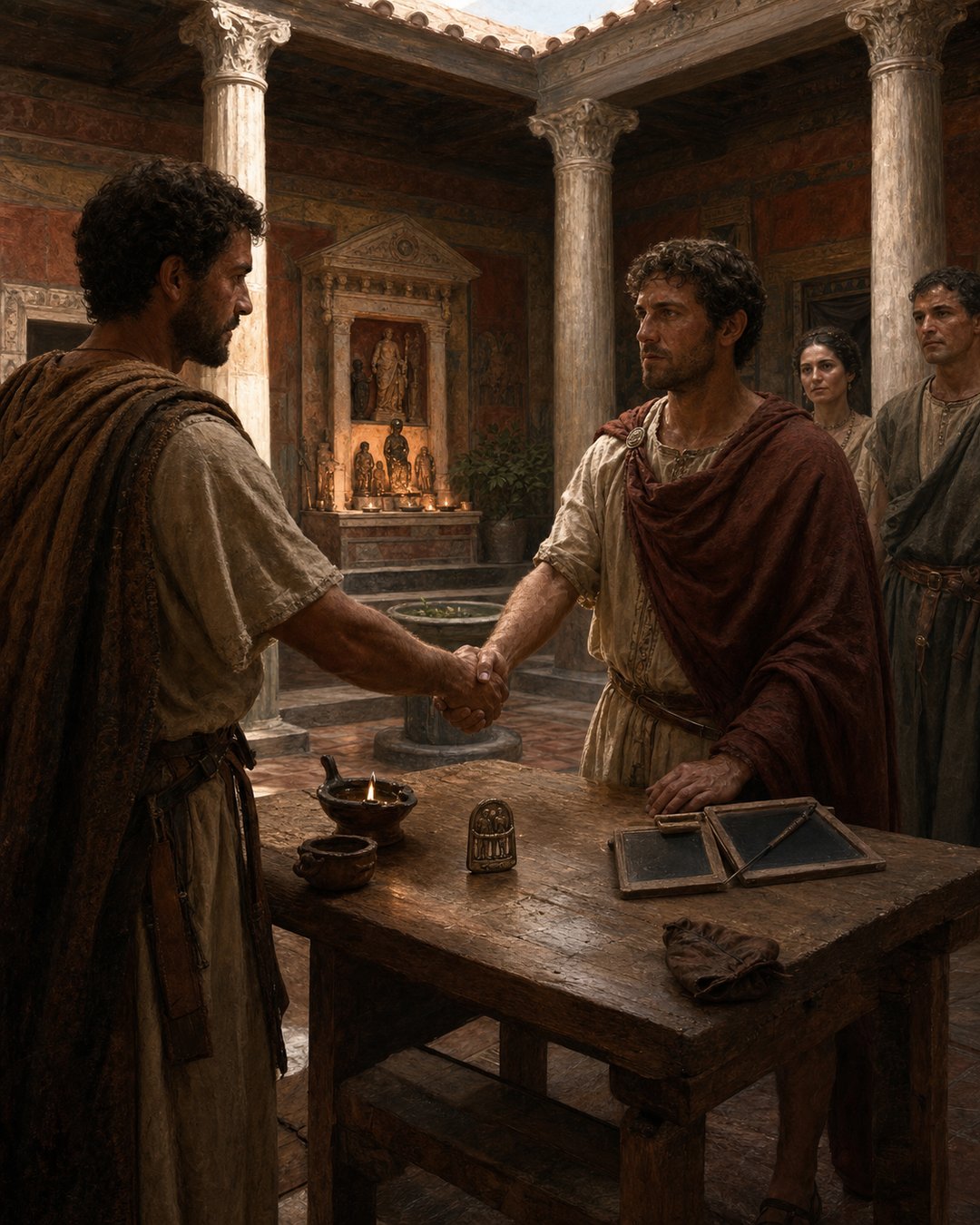
Trust is easy to praise and difficult to move. A promise made in one house can become fragile when the guest is far away, the host is dead, or a descendant has to decide whether an old bond still matters. Rome had ways to make that problem material.
Roman hospitality tokens made trust travel because hospitium was not only a pleasant welcome. It could be a recognized bond, and a tessera could turn that bond into something carried, compared, remembered, and honored.
Hospitium was more than kindness
Hospitium meant hospitality or guest-friendship, but reducing it to politeness misses the point. It could create a social bond with duties and recognition attached. A host did not merely offer a bed; he acknowledged a relationship.
That relationship mattered because travel placed people outside the safety of their own household. Roads, strangers, distance, and uncertainty made recognition valuable. A known guest was not the same as an unknown traveler.
The token made memory physical
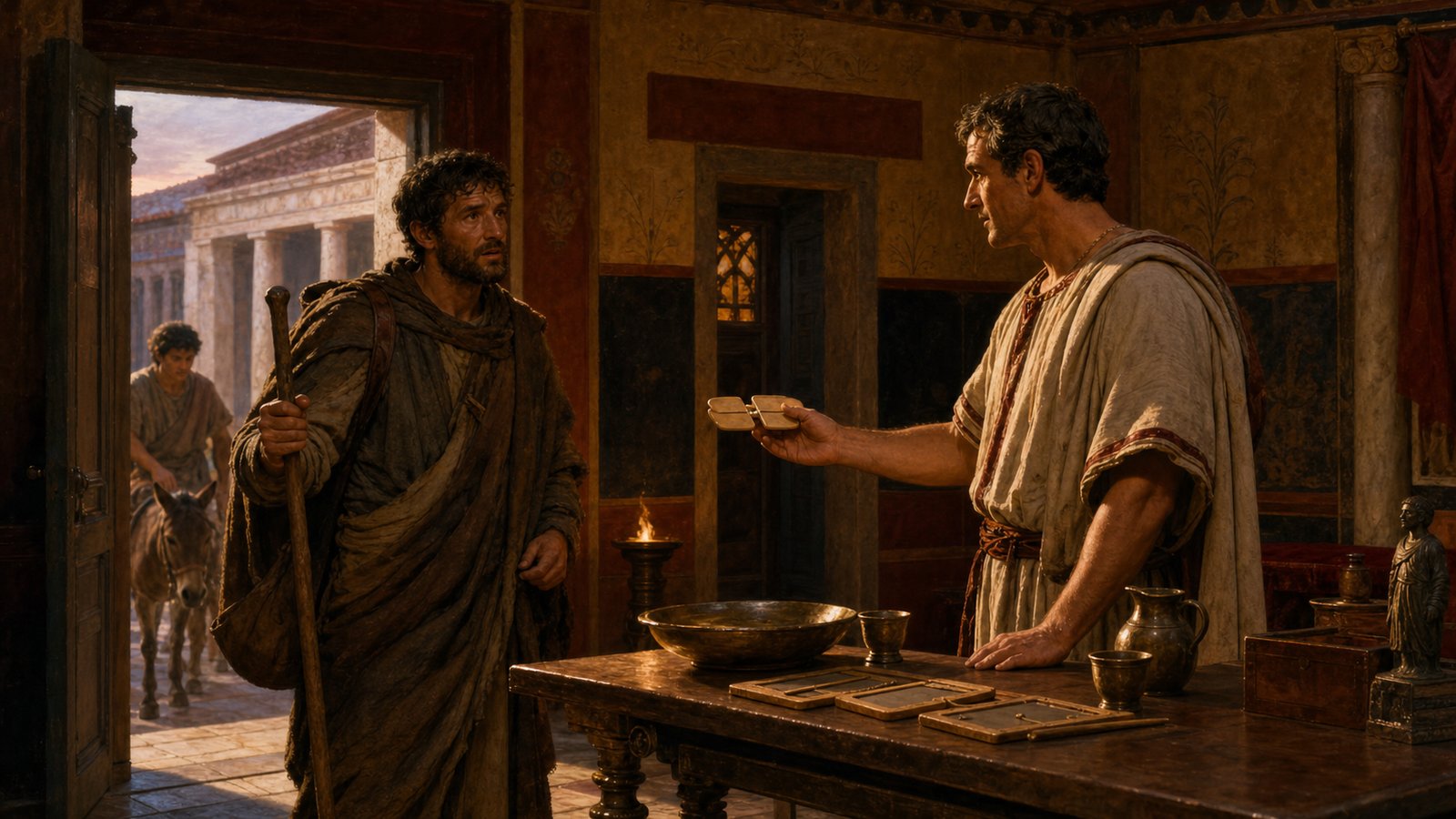
The tessera hospitalis is the revealing object. A token could preserve a bond in a form that outlasted the original conversation. It turned trust into something small enough to carry and solid enough to show.
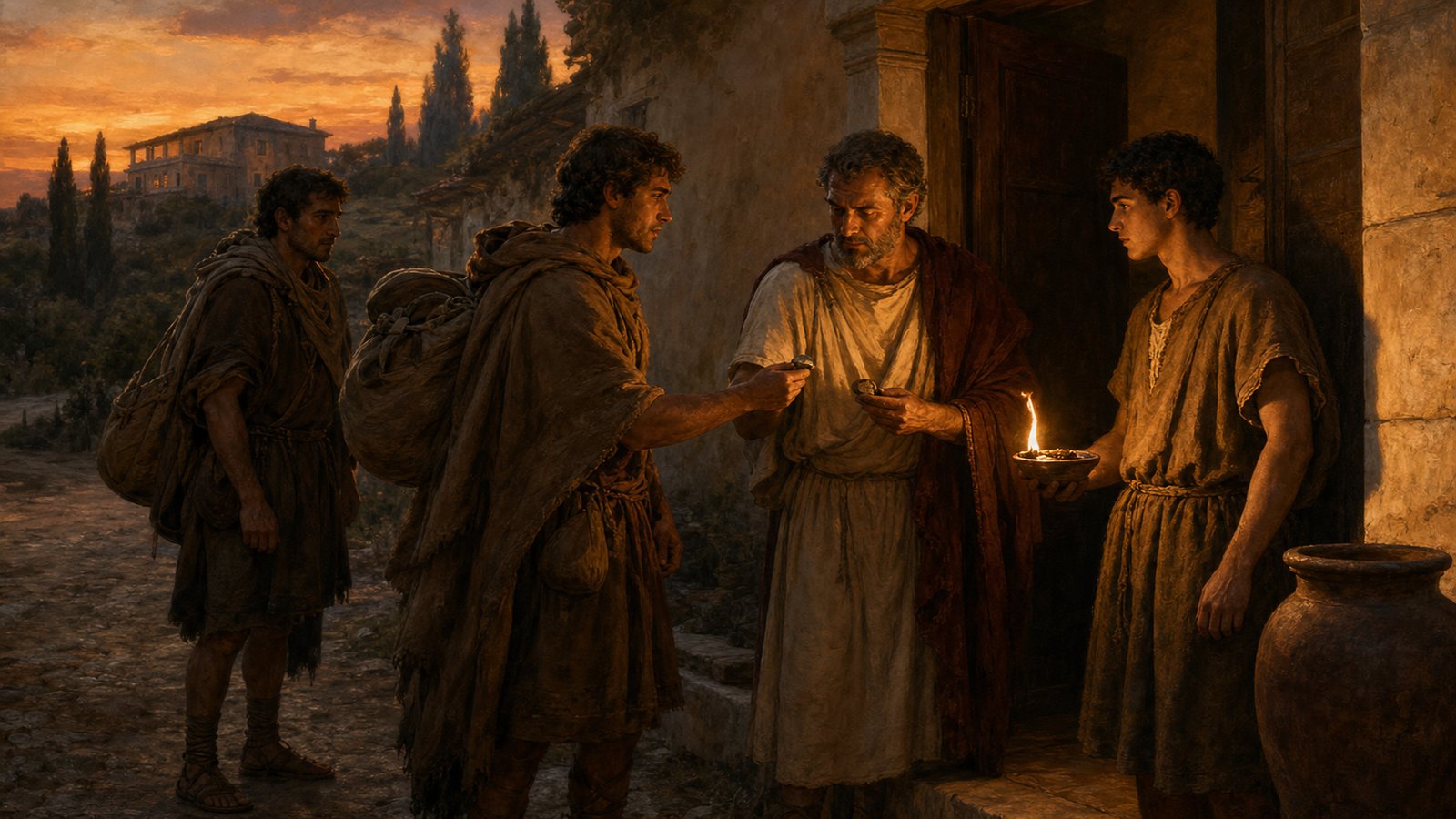
Imagine the mini-scene: a traveler at a doorway, dust on his cloak, a servant holding a lamp, the host examining a token while old names return to the room. Recognition has become a physical act.
A household could receive a past promise
The domus gives the bond a stage. Hospitality did not float in the air; it entered rooms, thresholds, tables, and family memory. A token could force a household to confront an earlier obligation when a guest appeared.
This is why the object mattered. Spoken memory can be denied or forgotten. A token does not prove everything, but it makes forgetting harder. It asks people to compare, remember, and respond in public enough fashion that refusal has a social meaning.
Obligation traveled through status
Roman client and patron language helps us see the wider habit. Social life often turned on bonds of protection, dependence, honor, and expectation. Hospitium belonged to a world where relationships could be practical instruments as well as moral claims.
A hospitality token did not make everyone equal. It could connect unequal people, powerful houses, travelers, clients, friends, or descendants. But it gave the relationship a recognizable form that could survive the awkward moment of arrival.
Trust needed objects because distance weakens words
The deeper lesson is simple and sharp: Rome did not trust trust to feeling alone. It used names, households, tokens, witnesses, and repeated duties to keep bonds visible across distance and time.
A small tessera could therefore do work larger than its size. It carried a claim from one place to another and asked a household to make the past active again.
This is not sentimental hospitality. It is hospitality with memory, status, and expectation built into it. The guest gains a way to be recognized; the host inherits a responsibility to treat recognition seriously. Both sides know that the object changes the encounter.
A token also reduced the embarrassment of asking. The traveler did not arrive with only a plea. He arrived with a sign that the relationship had a history. The object spoke before the full explanation began.
That speech was especially useful across generations. People die, households change, and stories become uncertain. A tessera could help descendants inherit an obligation they had not personally created. It made the past portable enough to knock on a future door.
The token’s smallness is part of its force. Large monuments impress crowds, but small objects often govern intimate decisions. A token in the hand could decide whether a stranger became a guest, whether a story became credible, or whether a household remembered itself as honorable.
Hospitality also depended on thresholds. The doorway is where uncertainty becomes social drama. Is this person welcome? Is the bond real? Who recognizes him? Who takes responsibility? A tessera turned that threshold into a place where evidence could be handled.
The system could be abused, misunderstood, or refused. No object abolishes suspicion. But the need for such objects shows the pressure of mobility in the Roman world. Movement required more than roads; it required ways for trust to arrive with the traveler.
The connection with clients and patrons reminds us that Roman trust often came braided with hierarchy. Protection could be generous and controlling at the same time. Recognition could open doors while also defining who owed thanks, loyalty, or deference.
A hospitality token therefore reveals a society that made personal bonds durable by giving them visible supports. The strongest relationships were not always the most private ones. They were often the ones that could be named, shown, remembered, and acted on.
This makes hospitium useful for understanding Roman public life. Even inside a house, recognition had a public edge because reputation watched from nearby. A host who honored a bond displayed reliability; a host who ignored it risked being remembered differently.
The traveler, too, carried more than luggage. He carried a claim about who he was in relation to another household. The token made identity relational: not simply a name, but a name attached to a promise.
When the token was accepted, distance briefly collapsed. A bond formed somewhere else became present in the room. The past entered through the doorway and demanded food, shelter, conversation, protection, or at least acknowledgment.
That is the quiet power of the tessera hospitalis. It did not make travel safe in any modern sense. It made one kind of danger negotiable: the danger of arriving as nobody. With a token, a traveler could arrive as someone already partly known.
The object also disciplined memory. It asked people not merely to feel generous, but to recognize a specific inherited tie. Hospitality became less like mood and more like a practice that could be repeated when the right sign appeared.
A Roman hospitality token therefore made trust travel by giving it weight, edge, and shape. The bond still depended on people, but the object helped the bond survive the long road between them.
The material detail also kept the bond from becoming too vague. A general claim of friendship could be flattering or suspicious, but a specific token asked a sharper question: does this object match a known relationship, and will this household act as if the relationship still lives?
That question mattered because travel exposed people to delay, weather, theft, illness, and dependence on strangers. Roads could move bodies, but they could not by themselves make a door open. Hospitium helped turn movement into arrival by giving the traveler a social claim to present.
The token also gave the host a way to act honorably without seeming naive. Acceptance was not blind generosity; it was recognition of a remembered bond. The object let kindness appear disciplined, tied to names, households, and reciprocal memory.
In this sense, the tessera belongs beside Rome’s other small instruments of public order: seals, tablets, tickets, weights, and coins. Each made an invisible claim easier to handle. The hospitality token made the invisible claim of trust tangible enough to cross a road, a generation, or a suspicious threshold.
Sources & Further Reading
- Smith Dictionary, Hospitium
- Smith Dictionary, Tessera
- Smith Dictionary, Cliens
- Smith Dictionary, Patronus
- Smith Dictionary, Domus
- Smith Dictionary, Taberna