
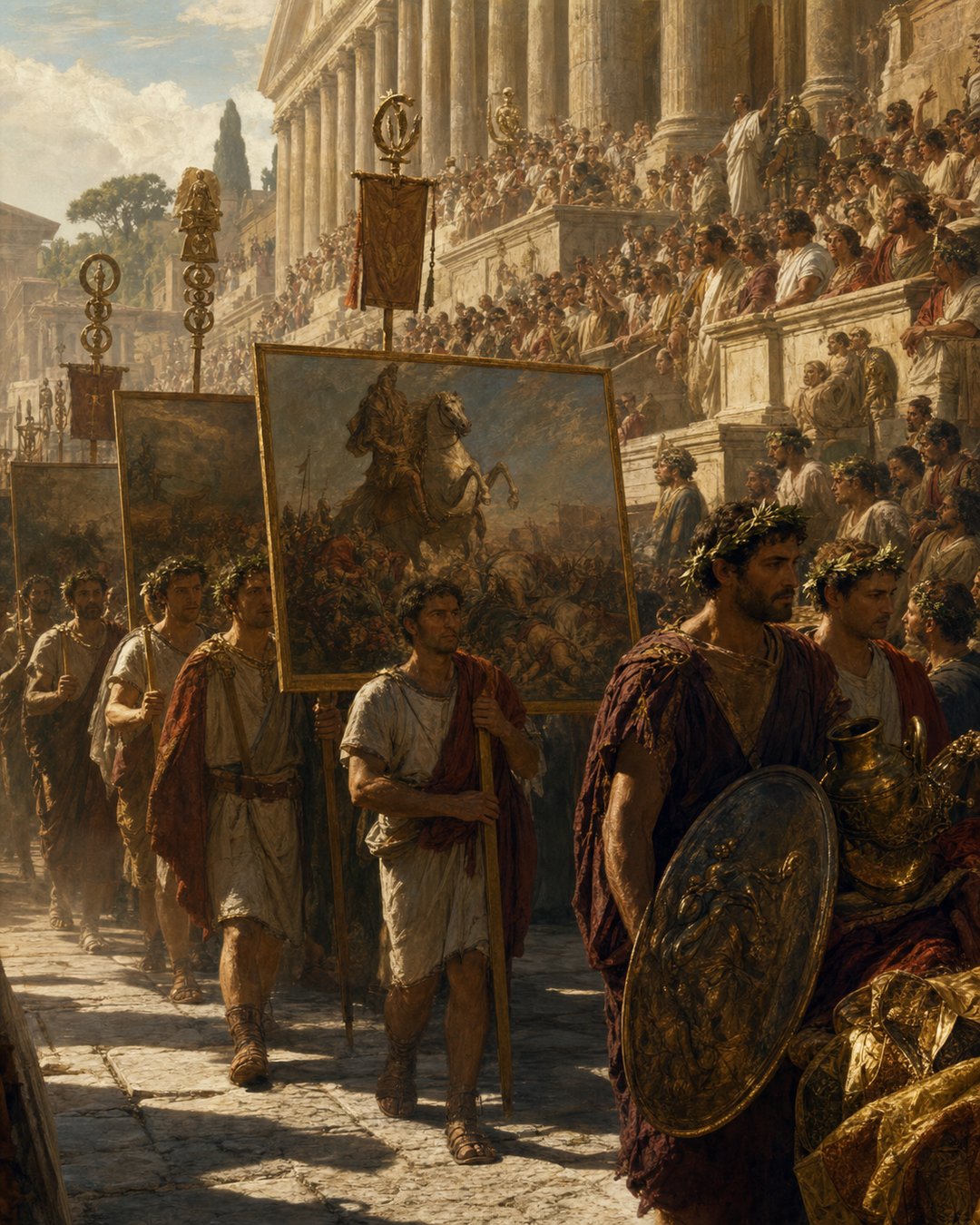
A triumph had to solve a problem of distance. The battle was over, the landscape was far away, and most spectators lining the streets had never seen the rivers, hills, cities, ships, or camps where victory had happened. The crowd needed more than a claim that Rome had won.
Roman triumphal paintings made conquest readable because they helped turn remote violence into a sequence of public images. Spoils supplied evidence, captives supplied human drama, soldiers supplied force, but painted panels could give the watching city a story to follow.
The triumph was a moving argument
Triumphus was not a quiet honor. It was a public procession that arranged victory through movement, order, sound, costume, and spectatorship. The commander did not simply announce success. He moved success through the city.
Picture the scene: trumpets, dust, laurel, soldiers, captured objects, and panels lifted high enough for people behind the first row to glimpse. The city read conquest by watching one element follow another.
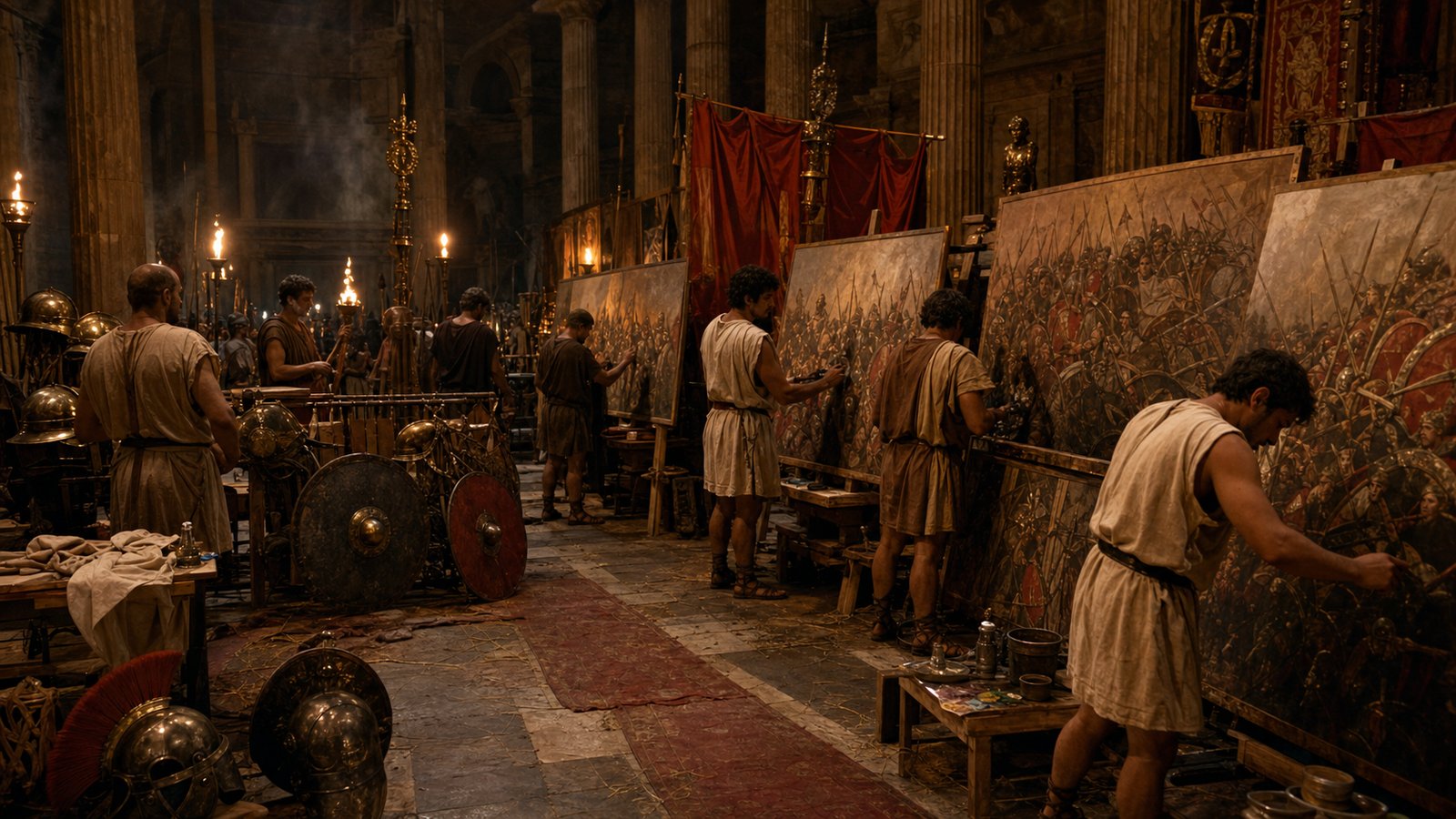
Pictures bridged the distance from battlefield to street
Tabulae, boards or panels, remind us that display needed surfaces. A painted scene could compress a siege, crossing, surrender, or landscape into something portable. It made the unknown place imaginable.
This was not the same as modern reporting. It was staged, selective, and political. Yet selection was the point. The image told spectators where to look and how to understand the victory before the next part of the procession arrived.
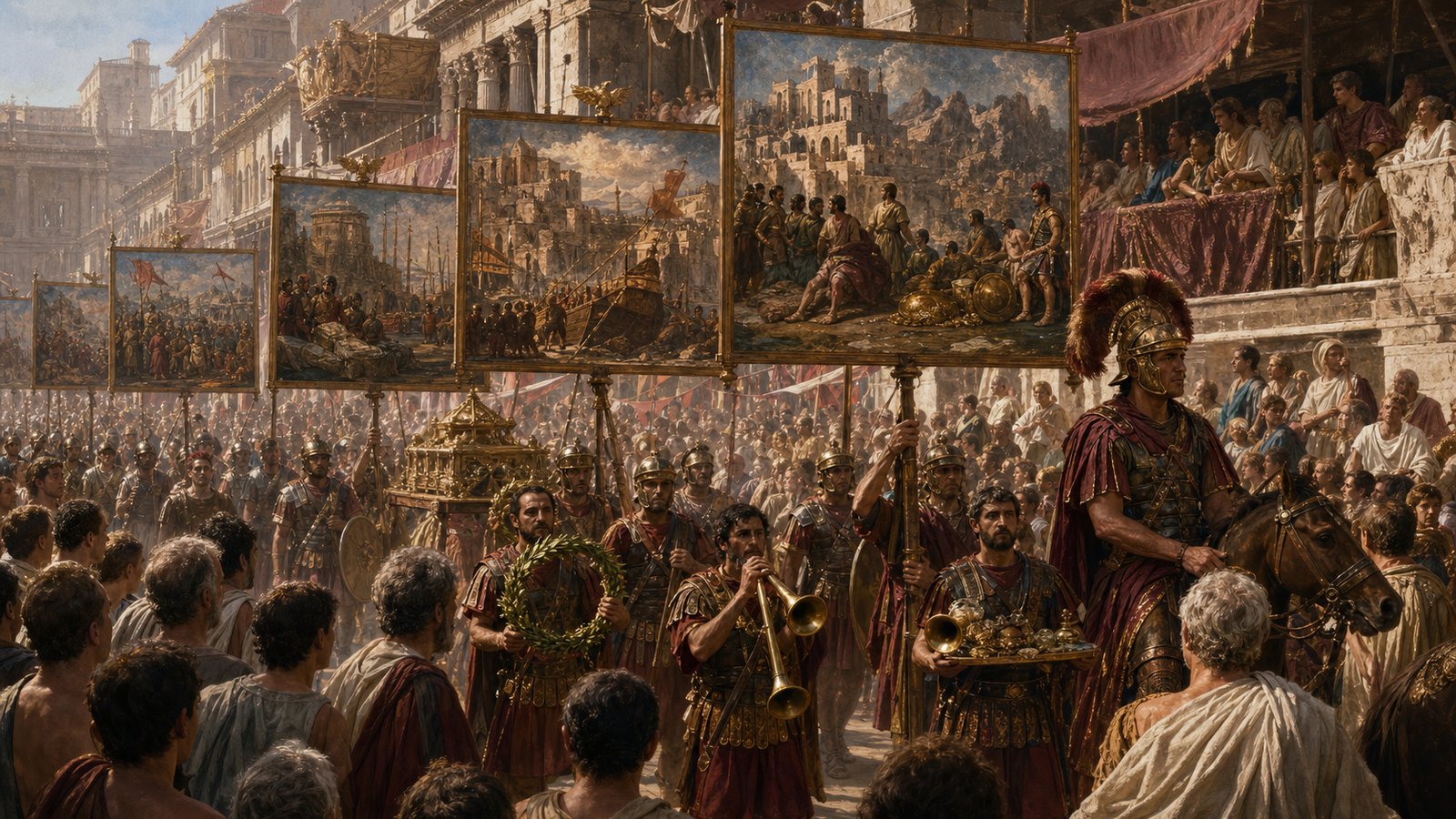
Spoils gave the pictures weight
Spolia, spoils, made victory tangible. A captured object could say, this belonged to the enemy and now it serves Rome’s memory. But an object alone does not always explain itself to the crowd.
Pictures and spoils strengthened each other. The object gave the painting proof; the painting gave the object context. Together they made conquest easier to absorb than either would have been alone.
Procession created a sequence of meaning
Pompa, procession, matters because order turns display into story. A heap of trophies can overwhelm the eye. A procession lets spectators encounter victory in parts: images, objects, captives, soldiers, honors, and commander.
The same principle appears in Trajan’s Column. Roman public art often made war understandable by arranging scenes in a readable order. The triumph did it with moving bodies and carried panels.
The crowd became part of the reading
A triumph was not complete without spectators. The crowd supplied attention, memory, rumor, applause, and repetition. Painted panels worked because people gathered to look and later retold what they thought they had seen.
Triumphal paintings made conquest readable by letting Rome imagine distant events as a civic experience. The battlefield entered the city not as confusion but as a procession the crowd could follow.
The pictures did not need to be neutral to be powerful. In fact, neutrality would have missed the point. The triumph was an argument that victory was real, deserved, and meaningful to the city that watched it pass.
A painted panel could make geography emotional. A river, wall, ship, mountain, or burning camp became more than scenery. It became evidence that the commander had carried Roman power into a place the spectator might never visit.
The panels also helped manage scale. War is too large for a street. It contains marches, councils, hunger, mistakes, weather, fear, and hundreds of small actions no procession can hold. A picture selects a few moments and lets them stand for the whole.
That selection could hide costs. The crowd saw victory shaped for celebration, not the full confusion of battle. But the selective image still mattered because it created the public memory most spectators would actually possess.
This connects with Roman trophies. A trophy gives defeat a visible body. A triumphal painting gives defeat a scene, a sequence, and a direction through the city.
The human labor behind the images is easy to miss. Someone had to decide what to show, prepare boards, mix pigments, paint figures, mount panels, and carry them steadily through a dense crowd. Public memory required craft.
The procession also controlled pace. A spectator could not examine each panel forever. The image moved, disappeared, and was replaced by the next element. That fleeting quality made the triumph feel like a story unfolding rather than a museum display.
The temporary nature of the paintings may have increased their urgency. People had to look while the victory was before them. Memory formed in motion, amid noise, heat, pressure, and the excitement of standing inside the event.
Crowds do not read in a single voice. Some spectators may have admired, others doubted, others searched for familiar names or hoped for gifts. But the images gave all of them common material for conversation.
The commander benefited from that shared material. A victory no one can picture is easier to forget or question. A victory carried through the streets in scenes becomes available to rumor, praise, rivalry, and political ambition.
The paintings also joined visual art to civic space. They were not private decoration. They were tools of public persuasion, designed to work at street level among bodies pressed together.
That is why triumphal paintings belong in the same history as coins, arches, columns, and inscriptions. They made Roman power legible by changing events into images that could travel.
The achievement was not only artistic. It was administrative and emotional. The state and commander had to decide which version of conquest deserved to be seen, then place that version before a city trained to read public signs.
Roman triumphal paintings made conquest readable because they gave spectators a path through victory. The crowd did not have to know every tactical detail. It had to see enough to believe that distant violence had become a Roman story.
The painted panel also changed the authority of the commander. A spoken claim might be challenged as boasting, but a carried image surrounded by spoils, captives, soldiers, and ritual sounds could feel like proof arranged before the public eye. The commander’s version of the campaign acquired color, sequence, and witnesses.
For spectators, the paintings offered a rare kind of access. They could not march with the army or inspect the enemy city, but they could see a selected version of those places moving past them. The panel made distance briefly domestic, bringing foreign terrain into Roman streets.
The panels also worked because they were temporary. A permanent monument asks people to return to it; a processional image asks people to catch it now, while the crowd is present and the music is loud. That urgency helped memory form around the event.
Triumphal images therefore belonged to a broader Roman habit of making power readable. Coins miniaturized rulers, arches fixed victory in stone, inscriptions pinned names to places, and paintings made the route of conquest visible in motion.
The danger, of course, is that readable conquest can look cleaner than real conquest. The painting selected, arranged, and simplified. Yet this selectivity is precisely why it mattered: public memory often begins with the version that is easiest for the crowd to see and repeat.
Sources & Further Reading
- Smith Dictionary, Triumphus
- Smith Dictionary, Pompa
- Smith Dictionary, Tabulae
- Smith Dictionary, Spolia
- Smith Dictionary, Corona