
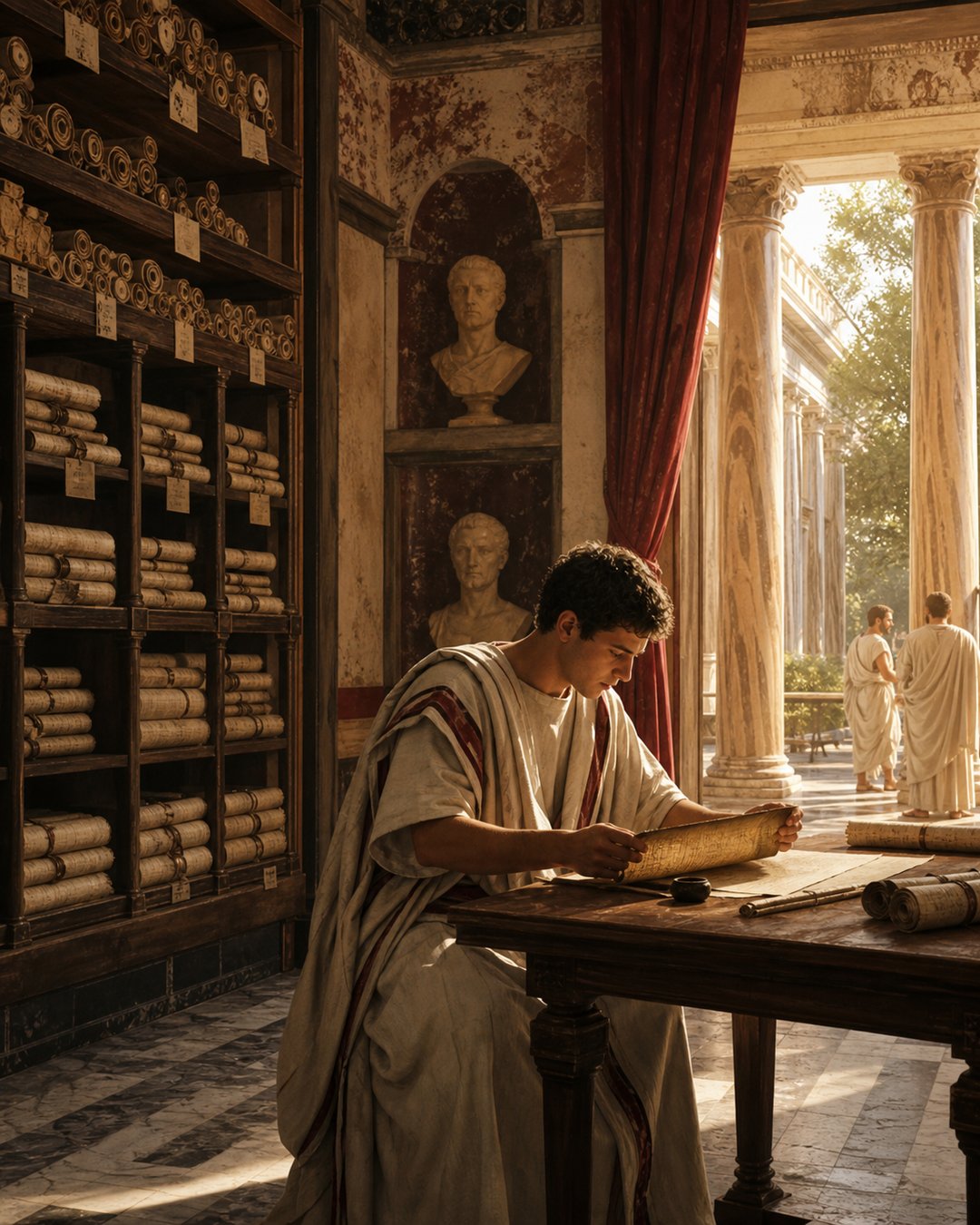
A Roman library was not only a quiet room for people who liked books. It was a place where memory took architectural form: shelves, scroll boxes, busts, tables, porticoes, and controlled access turned learning into something the city could see.
Roman libraries made memory public because they changed written culture from scattered possession into a visible claim. A scroll in a private chest could be useful; a scroll arranged in a library could help a household, patron, emperor, or city say that it preserved the past.
A room made memory harder to dismiss
Bibliotheca, the library, matters as a word because it names a place, not just a collection. Once scrolls were gathered in a recognizable room, memory had furniture, light, routes, and guardians. A visitor did not merely hear that learning existed. He could enter a scene designed to display it.
Imagine the concrete scene: shelves dark with scroll ends, a scribe smoothing papyrus, a marble portrait watching from above, and a reader stepping in from a shaded portico. The room made cultural authority physical.
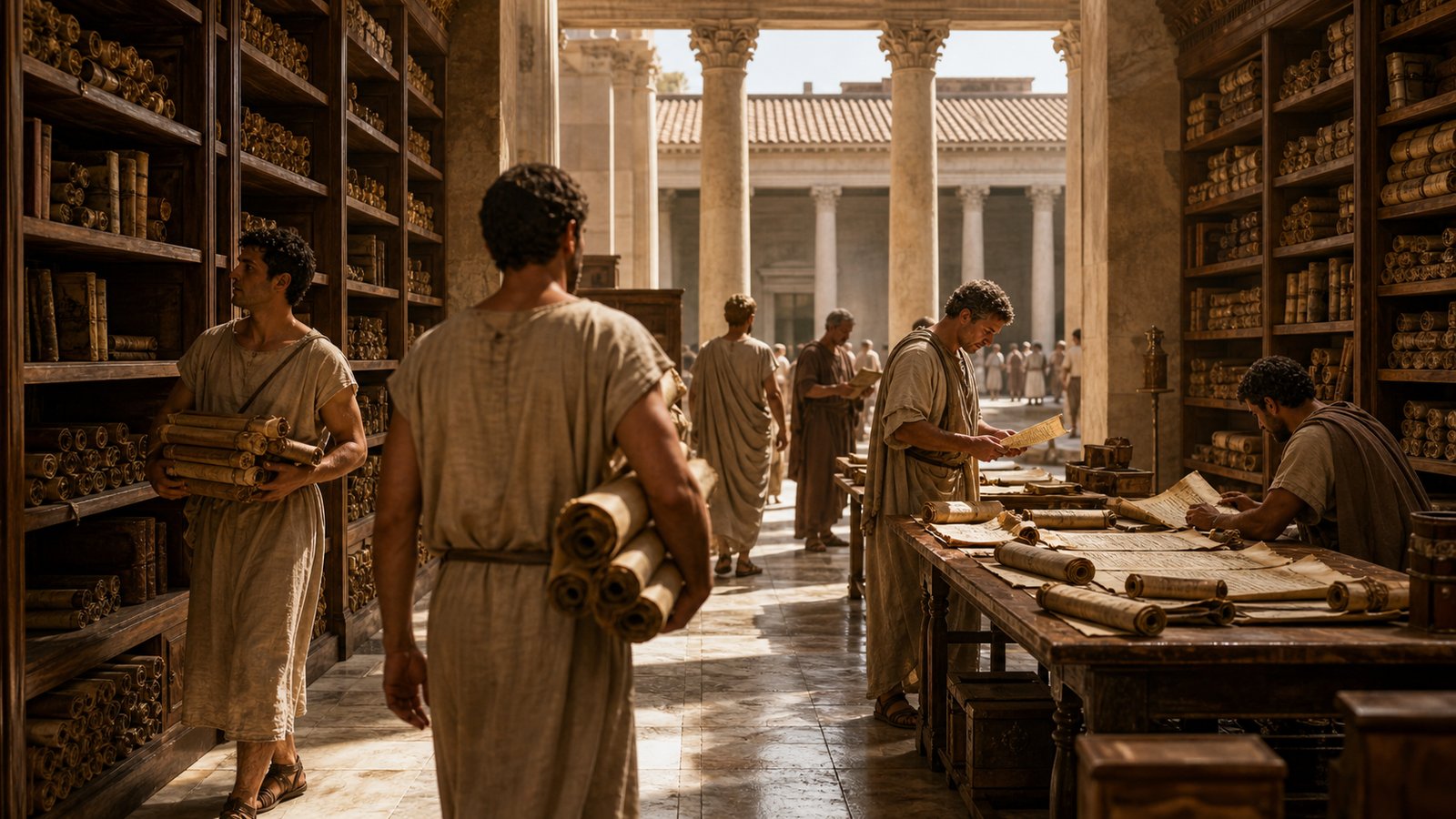
Archives and libraries shared a Roman instinct
The Tabularium points to the same habit from another direction. Records gained force when they were stored in an official place, preserved by routine, and connected to public authority. Libraries were not archives in a narrow sense, but they shared the Roman instinct for making memory spatial.
This is why the library belongs beside Roman public notices. Both turned words into visible public form. The difference was pace: notices announced; libraries accumulated.
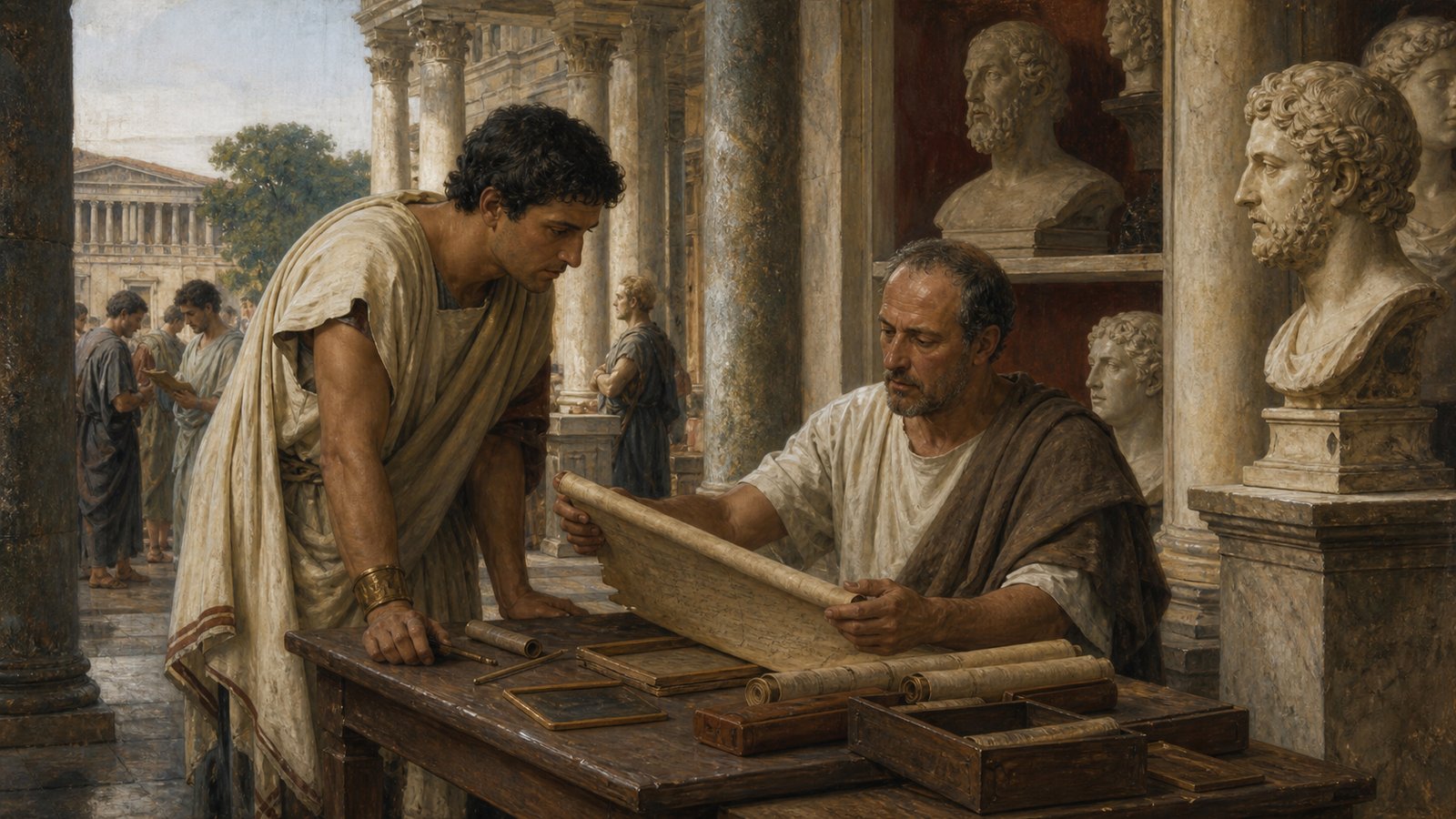
Porticoes made reading semi-public
A porticus was a walking place, a shelter, and a frame for conversation. When learning sat near such spaces, it did not retreat entirely from public life. Reading and display could share architecture with walking, waiting, meeting, and showing status.
The library therefore did not erase hierarchy. Access mattered. Education mattered. Patronage mattered. Yet the fact that a collection could be entered or glimpsed gave learning a civic face it would not have in a locked private box.
Portraits turned authors into company
Roman rooms of memory often worked through faces as well as texts. Busts and portraits could make dead authors, patrons, or models of culture seem present. The visitor read among witnesses, not in a blank storage chamber.
That visual company mattered because Roman memory loved embodiment. Ancestor masks, statues, inscriptions, and portraits all made absence look present. A library did the same with intellectual inheritance.
The shelf was a quiet monument
A library lacked the violence of a triumph and the height of an arch, but it still made a public claim. It said that certain words deserved survival, that certain names belonged together, and that possession of culture could become civic prestige.
Libraries made Roman memory public by giving written culture a place in the city’s visible order. The shelf was quieter than stone conquest, but it could still teach visitors what a powerful society wanted remembered.
The physical details matter. A scroll could be rolled, tied, labeled, moved, damaged, copied, and lost. Public memory depended on that vulnerable material, so the room around it became part of the claim. Shelves and attendants did cultural work because they promised that fragile things would not simply vanish.
A Roman library also joined leisure to authority. The person who could spend time with texts had access to a world beyond immediate labor. That made the library attractive, but it also made it socially charged. Knowledge was never only knowledge when it sat inside buildings funded, guarded, or displayed by elites.
The library’s public quality did not mean everyone entered equally. Some people served, some copied, some read, some merely saw the prestige from outside. The point is not democratic access in a modern sense. The point is that memory became staged enough for inequality itself to be seen.
Scrolls made time feel layered. A reader could sit in one Roman afternoon while reaching into Greek poetry, law, history, philosophy, or records of earlier generations. The library made that layered time visible by gathering past voices in one place.
This is different from a single inscription. An inscription fixes one message. A library suggests abundance: many texts, many authorities, many arguments, many possible returns. Its power came from accumulation rather than one command.
The portico deepened that accumulation because movement passed beside memory. A visitor could walk, pause, glance, enter, leave, and return. Knowledge became part of an urban rhythm, not a detached miracle.
Libraries also helped patrons present themselves as preservers rather than mere owners. To sponsor, house, or protect texts was to claim a relationship with civilization. In Rome, that sort of claim could be political even when it sounded literary.
The quietness of the scene should not fool us. Decisions about what to copy, keep, organize, and display are decisions about value. A Roman library made those decisions visible enough to become social facts.
A shelf of scrolls therefore belongs in the same world as a milestone or a brick stamp. Each one tied authority to material form. Each made a claim last longer than a spoken moment.
The reader in the room was not alone with the past. He sat inside a social arrangement that told him which texts were available, whose portrait watched over them, and which patron or institution had made the encounter possible.
That makes the library a public object even when the reader’s experience was private. The act of reading could be solitary, but the conditions of reading were built, funded, guarded, and displayed.
Roman libraries made memory public not by shouting but by arranging survival. In a city that loved spectacle, the ability to preserve quietly was another kind of power.
The public room also changed the reader’s own body. He had to enter, sit, request, handle, and return. Those small actions made learning a disciplined encounter rather than an invisible possession. Memory became something one approached through rules.
The busts and shelves taught a second lesson. Rome could conquer with armies, but it also wanted to inherit and organize older worlds of language, philosophy, law, and history. The library staged that inheritance without needing a battlefield.
Even the danger of loss made the institution meaningful. Fire, damp, theft, careless copying, and political neglect could destroy texts. A library answered that danger with order: shelves, attendants, copying habits, and the promise that some voices would be kept available for future readers.
In that sense, the library made Roman memory accountable. It invited the question of what deserved a place, who controlled the place, and how a city wished to be remembered when its loudest spectacles had ended.
The arrangement also made forgetting visible. Empty shelves, damaged scrolls, or neglected rooms would have told their own story about failed care. A library was therefore a promise renewed by maintenance: someone had to keep ordering, copying, guarding, and inviting memory back into use. The room made neglect easier to notice, and it made care visible as daily civic labor for Rome.
Sources & Further Reading
- Smith Dictionary, Bibliotheca
- Smith Dictionary, Tabularium
- Smith Dictionary, Atrium
- Smith Dictionary, Porticus
- Smith Dictionary, Tabulae