
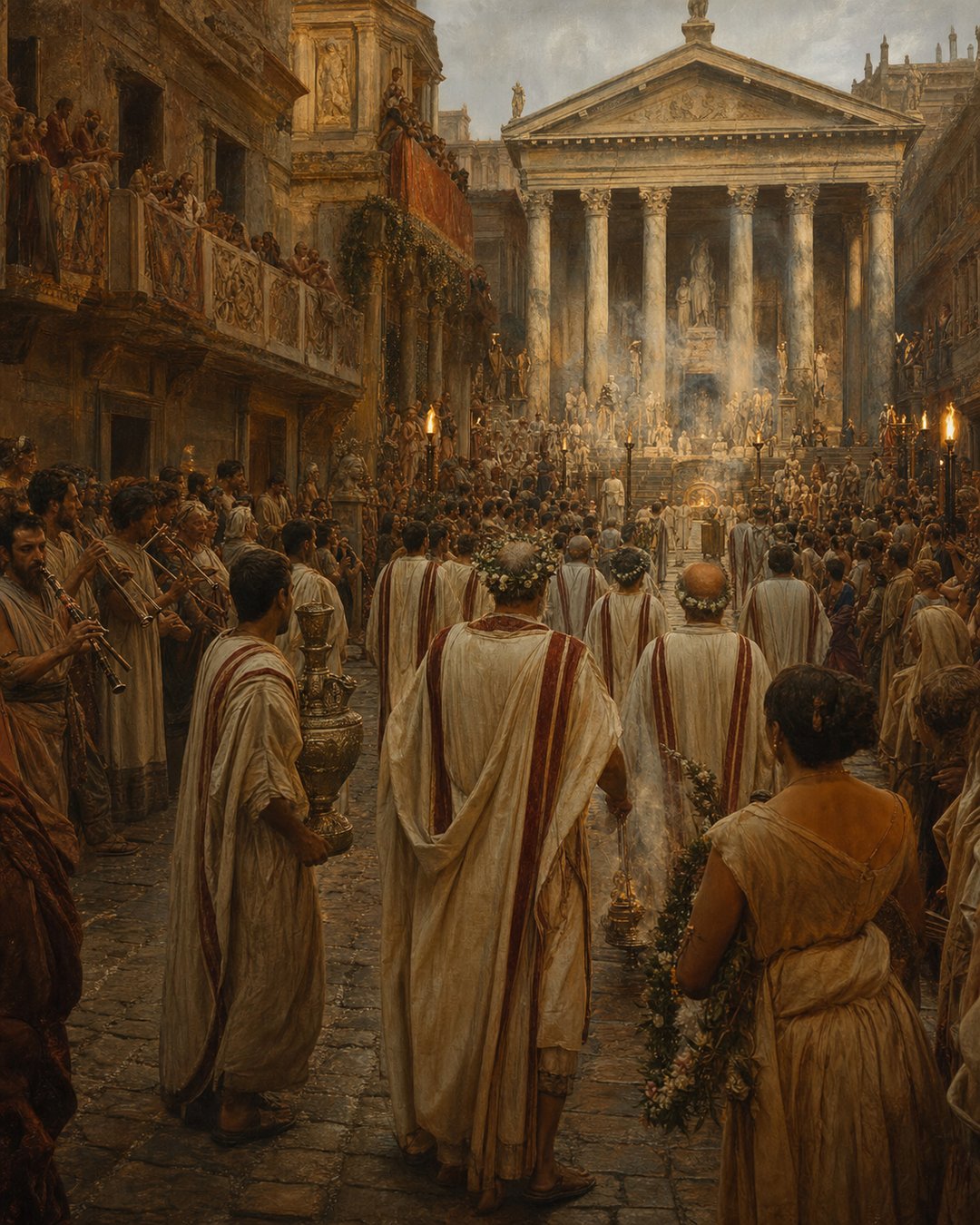
Roman religion was not a private feeling that happened to borrow public buildings. It moved. It formed lines, filled streets, gathered spectators, carried implements, raised smoke, and made the relationship between city and gods visible in bodies.
Roman processions made religion move through the streets because ritual needed witnesses as much as words. The pompa turned sacred action into ordered public motion, then brought that motion to an altar, temple, or civic space where the city could recognize what it was doing together.
The pompa made belief visible as movement
Pompa means procession, and the word is already a lesson. A procession is not only a group walking. It is a sequence people can read: attendants, priests, musicians, victims, magistrates, objects, and crowd. The city sees religion in order.
Picture the route: incense in the throat, flute notes against stone, laurel leaves, hooves or sandals, children trying to see, and adults measuring who stands where. The ritual becomes a moving diagram of Roman society.
Sacrifice needed a public center
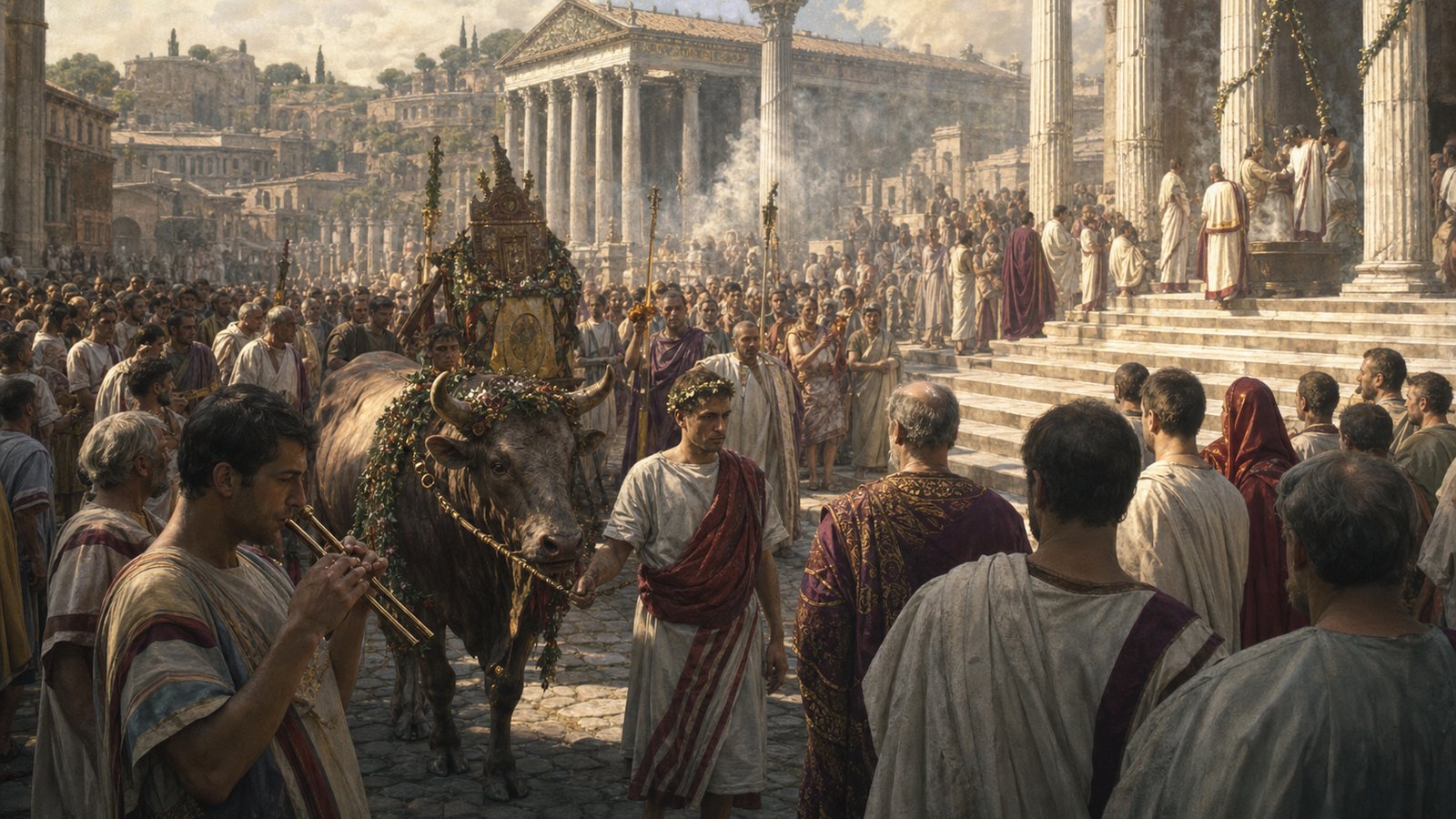
Sacrificium was an act, but it was also a scene. Implements, attendants, animal, altar, words, flame, and witnesses all mattered because an offering had to be performed in a form that made sense to the community.
The altar, the ara, gave that performance a center. Movement through the streets narrowed into one place where smoke rose and attention gathered. A crowd could see where the offering happened, even if not every person heard every word.
Supplication turned anxiety into civic action
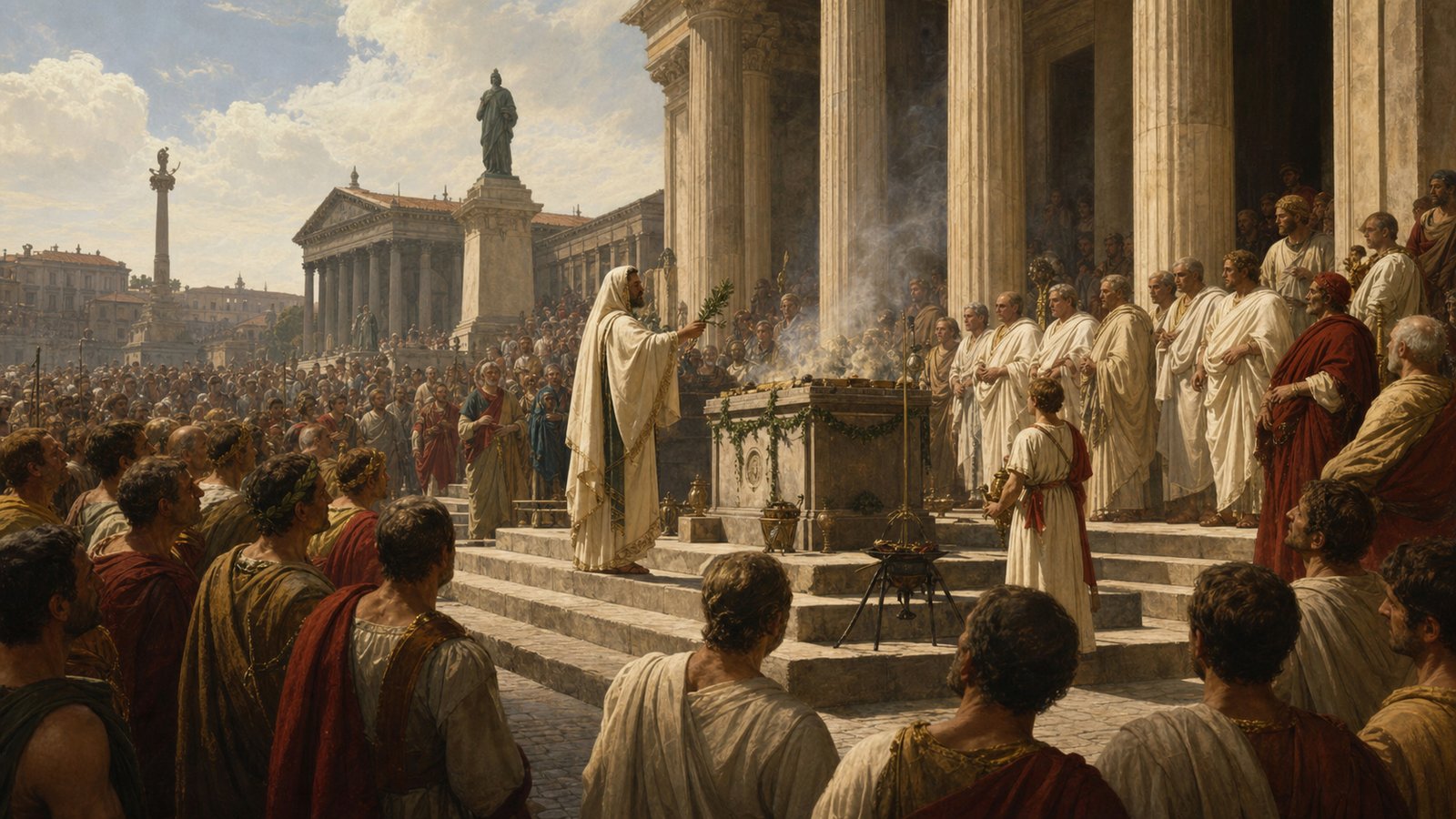
Supplicatio shows a different emotional register. Public prayer or thanksgiving could answer danger, victory, uncertainty, or divine concern. It gave the city a way to act together before events had become comfortable memory.
This matters because Roman public life often converted feeling into form. Anxiety did not remain only rumor. Gratitude did not remain only relief. Processions and prayers gave these moods a civic body.
Sacred space began before the temple door
Templum reminds us that Roman sacred space was marked and bounded, but a procession stretched sacred attention across ordinary streets. The road toward the shrine became part of the ritual experience.
That movement links processions to Roman calendars. Time and route both organized public religion. The city learned not only what to do, but when and where to do it.
The crowd was part of the rite
A procession did not need every spectator to understand theology in the same way. Its force came from shared visibility. People could see that priests acted, magistrates appeared, offerings moved, and the city presented itself as attentive to divine order.
Processions made Roman religion public by refusing to leave sacred action hidden. They put ritual into motion, made streets into witnesses, and reminded people that the gods were approached through the visible habits of the city.
The sound mattered as much as the route. Music could announce the procession before it arrived, preparing a street to become a ritual corridor. The smell of smoke could linger after the line passed, leaving evidence that public religion had occupied ordinary air.
Such scenes also trained memory. A child who watched one procession learned where bodies stood, how priests moved, what animals and garlands meant, and how the crowd should behave. Ritual knowledge entered people through repetition as much as instruction.
The procession’s order could express rank without a speech. Some people walked near the front, others carried objects, others watched from thresholds or upper rooms. Public religion carried social structure with it.
That social structure did not make the rite fake. It made it Roman. Rome rarely separated sacred action from civic form, public honor, office, family prestige, and remembered precedent. A procession could be devout and political at the same time.
The altar concentrated the route’s energy. After the walking, music, glances, and waiting came the focused moment: words, gesture, flame, blood or offering, and the crowd’s expectation that proper form mattered.
Proper form is the key. Roman religion often cared deeply about doing things correctly. A procession helped correctness become visible. If order failed, if the route broke, if the object was mishandled, people could notice.
That visibility made ritual accountable in a rough civic sense. The gods might judge invisibly, but citizens judged the human performance: who led, who followed, whether the rite looked complete, and whether the city had behaved as a city.
A supplication could make collective vulnerability bearable. Instead of each household fearing alone, the city took up a shared action. It moved, prayed, thanked, or begged in a form that allowed anxiety to become public discipline.
The procession also joined neighborhoods to central spaces. A temple might dominate one place, but the route brought sacred attention past shops, doorways, shrines, and corners where daily life normally held the street.
This is why movement matters. A stationary rite can be powerful, but a procession recruits the city along the way. It turns bystanders into witnesses and makes geography participate.
The scene was not gentle for everyone. Crowds could be cramped, animals frightened, officials proud, and spectators excluded from the best views. Yet the very friction made the event memorable as a bodily experience.
Roman processions made religion move through the streets because they made sacred order something people could hear, smell, follow, and remember. The gods were approached through public choreography, and the city learned itself by watching the line pass.
The route also gave ordinary places a temporary sacred charge. A shopfront, a doorway, or a corner normally used for bargaining could become part of a ritual corridor for a few minutes. The city did not need to rebuild itself; the procession redrew it with movement.
There was discipline in that temporary transformation. People had to make room, watch their bodies, fall quiet or respond, and recognize that the line had priority over ordinary errands. Religion interrupted routine, but the interruption itself became routine because the community knew what the movement meant.
The procession also linked memory to geography. People remembered where the animal balked, where smoke thickened, where a magistrate appeared, where a child first saw the temple steps above the crowd. Ritual became easier to retell because it had passed through specific streets.
For officials, the public route carried risk. A badly ordered procession could expose weakness, confusion, or impiety in front of the very crowd it was meant to reassure. Visibility strengthened ritual only when the performance held together.
That risk helps explain the care invested in sequence. The pompa made religion public not simply by being beautiful, but by being legible. Each role and object told spectators that Rome knew how to approach the divine through recognized civic form.
In the end, the street mattered because it gave religion witnesses beyond the temple’s threshold. The procession let people participate as walkers, watchers, listeners, and rememberers, turning sacred action into a shared urban event with public memory attached to every step, sound, plume of smoke, and watched pause, preserving the rite in bodies as well as records and stories afterward.
Sources & Further Reading
- Smith Dictionary, Pompa
- Smith Dictionary, Sacrificium
- Smith Dictionary, Supplicatio
- Smith Dictionary, Ara
- Smith Dictionary, Templum