
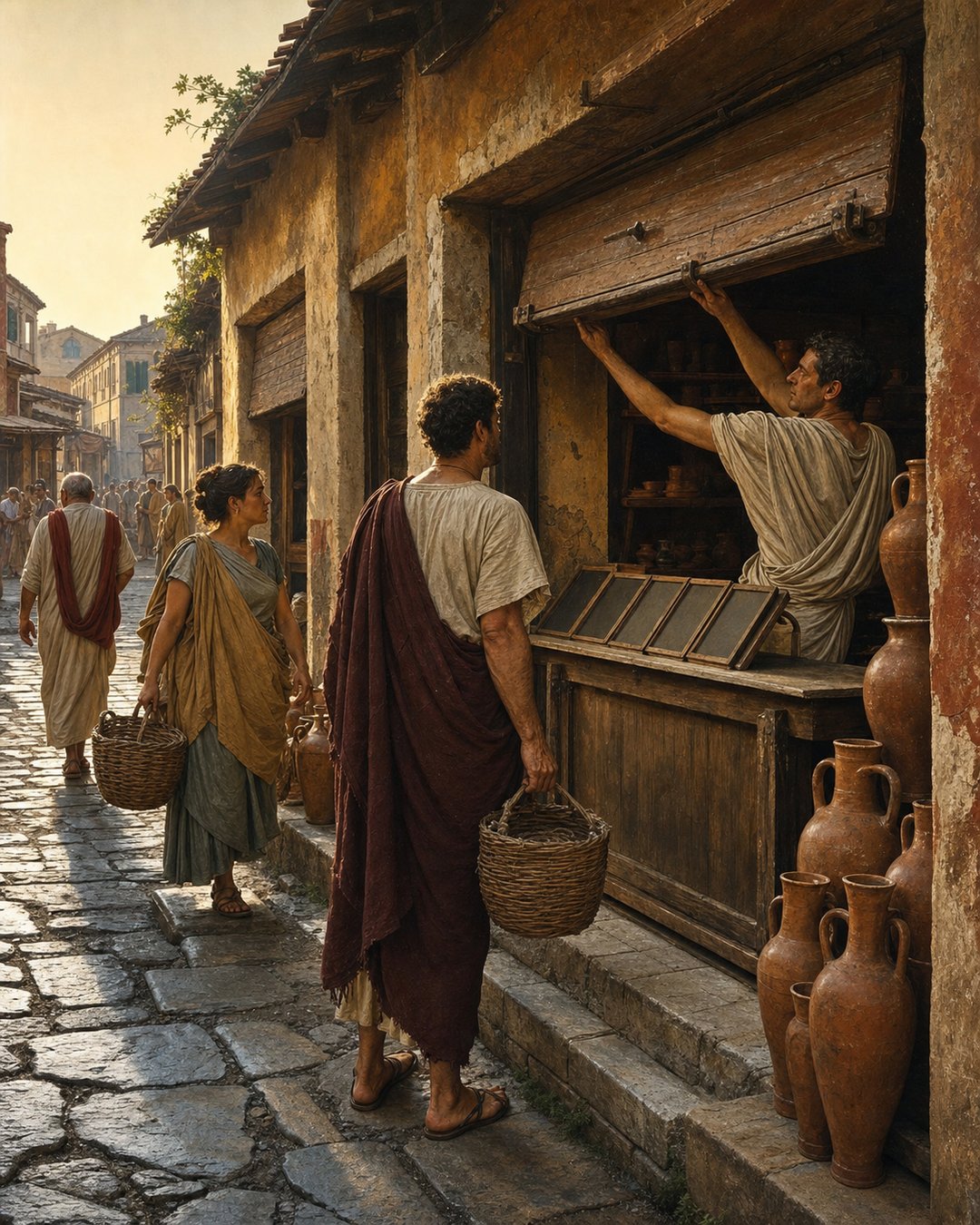
A Roman market was not confined to one grand space. It could appear in smaller bursts along a street whenever shutters opened, counters filled, and passersby slowed down.
Roman tabernae made streets into marketplaces because they pushed exchange to the edge of public movement. A doorway became a stage where goods, prices, trust, suspicion, and news could be seen.
The shopfront changed the meaning of a doorway
Taberna names the shop or booth, and its power begins with architecture. A private interior opened toward public traffic. The threshold became commercial, not merely domestic or defensive.
Picture the morning scene: a wooden shutter lifted, amphorae set near the entrance, a shopkeeper leaning across a counter, and customers pausing in the street before the day has fully gathered speed. The city begins bargaining through doorways.
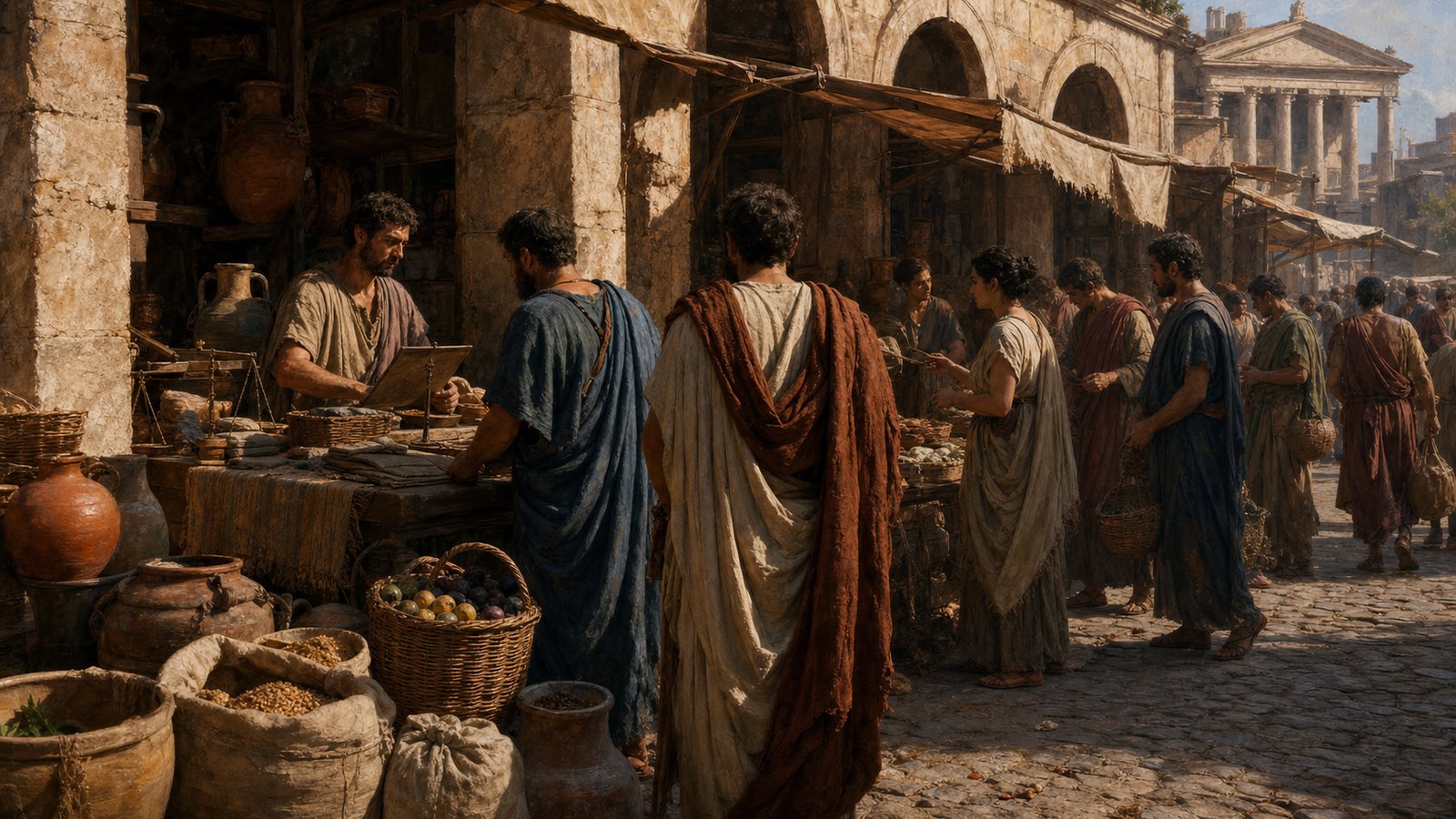
Small trade spread beyond the formal market
The macellum concentrated market activity, especially food trade, but tabernae spread commerce through ordinary routes. People did not need to enter a single official market to encounter exchange.
This mattered for urban rhythm. Trade could meet someone on the way to court, to a bath, to a patron’s house, or to the forum. The marketplace leaked into the paths people already used.
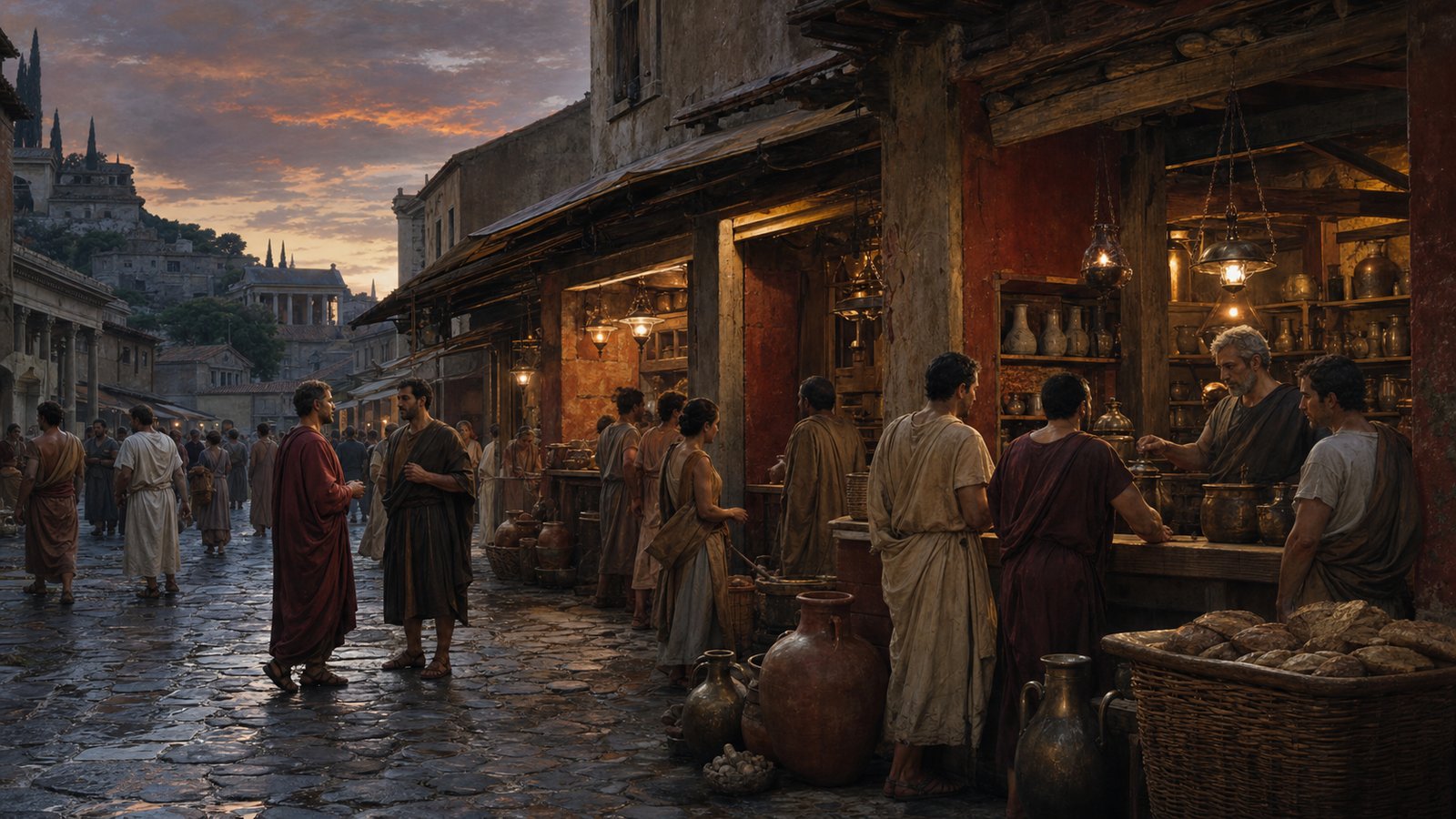
Weights made trust public
Pondera, weights, turned exchange into something partly inspectable. A customer might still distrust the seller, but the transaction now involved an object that claimed to measure fairly.
The mini-scene is easy to imagine: a hand reaching for a weight, a basket set on a scale, a customer watching the balance, another passerby listening as price becomes argument. Trust has become visible enough to quarrel over.
Amphorae gave goods a public body
Amphorae made trade material. They carried oil, wine, sauces, and other goods through networks too large for a single customer to see. On the street, the vessel made distance and supply feel present.
A row of amphorae outside a shop told people that goods had arrived, could be counted, and might be compared. Containers turned invisible movement into objects with weight and expectation.
The street carried news with the goods
The forum reminds us that Roman public life mixed business, law, greetings, politics, and gossip. A taberna belonged to that same ecology because buyers and sellers rarely exchanged only goods.
Prices, shortages, arrivals, scandals, rumors, and complaints moved with customers. The shopfront made the street a marketplace of information as well as things.
The taberna’s importance lies in its scale. It was small enough to feel ordinary and frequent, yet public enough to change the street around it. Repeated shopfronts could turn a route into a corridor of negotiation.
This did not make trade equal. Sellers knew more than buyers; buyers suspected cheating; officials and landlords shaped conditions; poor customers counted coins carefully. But visibility changed the character of the exchange.
A bargain made at a counter had witnesses. A complaint could attract ears. A false weight could become a public accusation. Even when no one intervened, the possibility of being seen mattered.
Smell was part of the marketplace too: oil, wine, bread, fish sauce, smoke, dust, wet stone, and human sweat. The street did not merely display goods; it surrounded the body with evidence that exchange was happening nearby.
The shopfront also created repeated memory. People learned which doorway sold what, who was fair, who had supply, who talked too much, and where news arrived early. Commerce became mapped onto the city through habit.
A macellum may have offered concentration, but tabernae offered persistence. They made trade appear again and again in the spaces between official destinations. The city became commercially legible at walking speed.
Amphorae and baskets helped customers judge abundance before words began. Full containers suggested supply; empty spaces suggested lateness or scarcity. Goods had a public posture even before price was named.
Weights did similar work for fairness. They could not make every transaction honest, but they gave suspicion a concrete focus. A buyer could look at the balance instead of relying only on the seller’s face.
The taberna therefore joined object, voice, and route. It made goods visible, prices audible, and social information mobile. A person might leave with bread or oil, but also with a rumor about a shipment, a debt, a magistrate, or a neighbor.
Roman streets were never just corridors. They were places where movement created contact. The shopfront exploited that contact by placing exchange exactly where people already passed.
This helps explain why the smallest urban spaces matter. Empire may move through roads and harbors, but daily confidence often forms at a counter. People believe supply exists because they see jars, sacks, measures, and sellers in reach.
Roman tabernae made streets into marketplaces by turning ordinary thresholds into public engines of exchange. The open shutter told the street that business had begun, and the street answered by turning trade into conversation.
The doorway also made reputation local. A seller could become known not as an abstract merchant but as the person at that counter, with those jars, those habits, and that way of weighing a purchase.
Customers carried those judgments outward. Fairness, shortage, price, quality, and insult traveled through talk as surely as oil or wine traveled in containers. The shopfront produced stories as well as sales.
Because tabernae repeated along routes, they created a commercial memory of the neighborhood. People knew where to stop quickly, where to avoid, where news gathered, and which doorway changed when supply ran short.
This made the street more than a surface for movement. It became a chain of small public tests: trust at the scale, patience at the counter, recognition between neighbors, and suspicion when goods or weights looked wrong.
The Roman marketplace therefore lived in both formal buildings and ordinary openings. The taberna mattered because it made exchange unavoidable, visible, and socially noisy at the exact point where private business met public life.
This visibility mattered especially because daily trade depended on trust repeated in small amounts. A single purchase might seem trivial, but thousands of such encounters taught people whether the city felt supplied, fair, expensive, or unstable.
Tabernae made those judgments immediate. A passerby could see the crowd at one counter, the emptiness at another, the jars waiting in shade, and the raised voice over a disputed measure. The market became a public mood.
By opening onto the street, the shop made commerce part of urban awareness. Rome did not have to announce that exchange was happening; the shutters, baskets, amphorae, weights, and waiting customers announced it all day.
The repeated threshold also joined commerce to memory. A shopkeeper became part of the route, a counter became part of a neighborhood, and a measure became part of what people trusted or doubted about daily life.
That is why the smallest shopfront belongs in a larger history of Roman order. The taberna made urban exchange visible at human scale, where a citizen could test the empire through a jar, a weight, a price, and a conversation.
Sources & Further Reading
- Smith Dictionary, Taberna
- Smith Dictionary, Macellum
- Smith Dictionary, Pondera
- Smith Dictionary, Forum
- Smith Dictionary, Amphora