
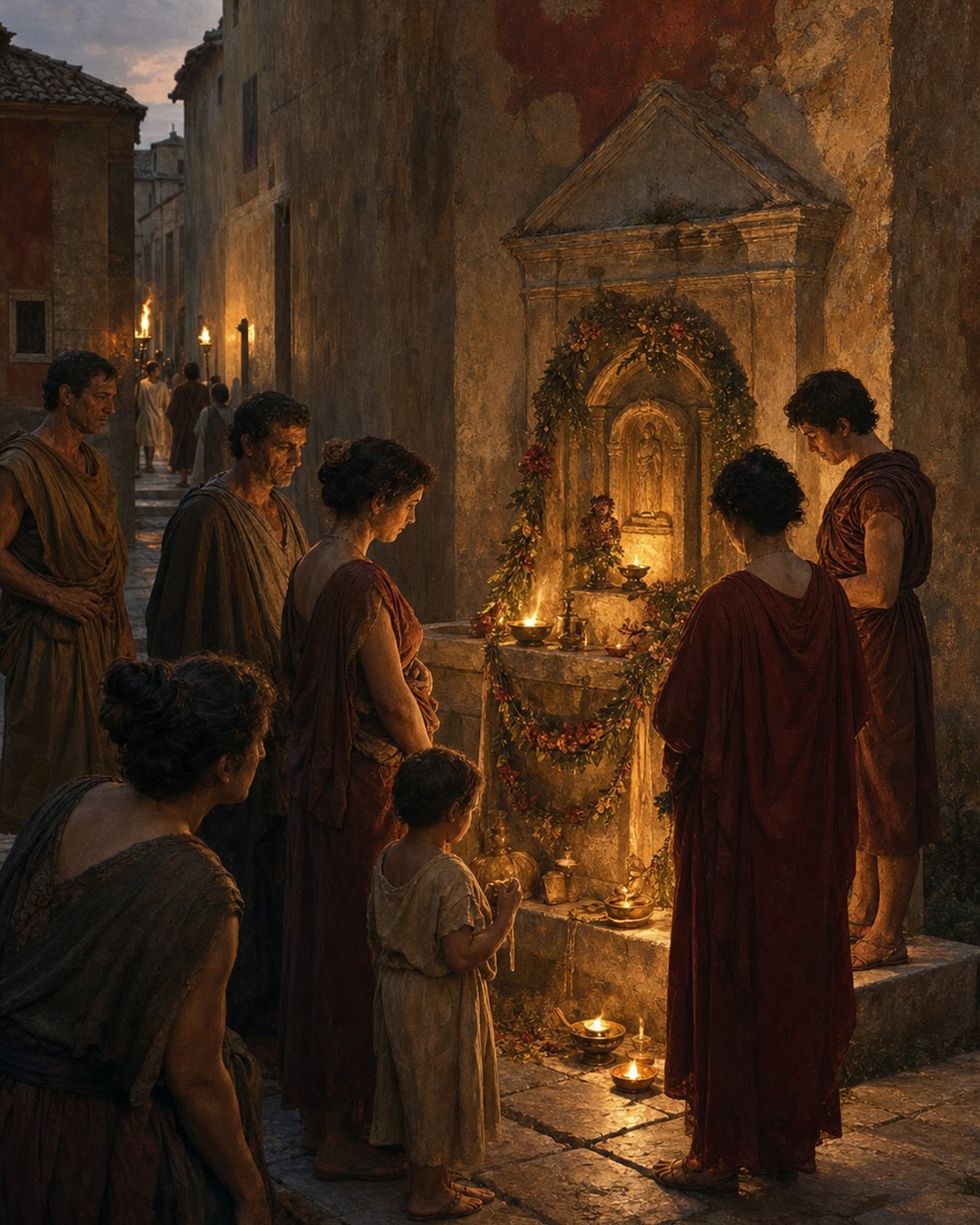
A Roman crossroads was never only a place to turn left or right. It was where carts slowed, neighbors recognized one another, shopfronts opened, gossip moved, and local gods could be noticed by people who might not share a household.
Roman crossroads shrines made neighborhoods visible because they gave a vicus a sacred marker in the street. A small altar or shrine transformed passing space into remembered space, and repeated ritual made local belonging easier to see.
The crossing gave the neighborhood a stage
The Compitalia was connected with the Lares of the crossroads, which already tells us that religion could attach itself to an ordinary urban junction. Sacred attention did not need a monumental temple to matter.
A vicus was a street or neighborhood unit, and the crossing gave that local identity a place where people actually encountered one another. The shrine did not invent the neighborhood, but it helped the neighborhood recognize itself.
A small shrine changed the meaning of a corner
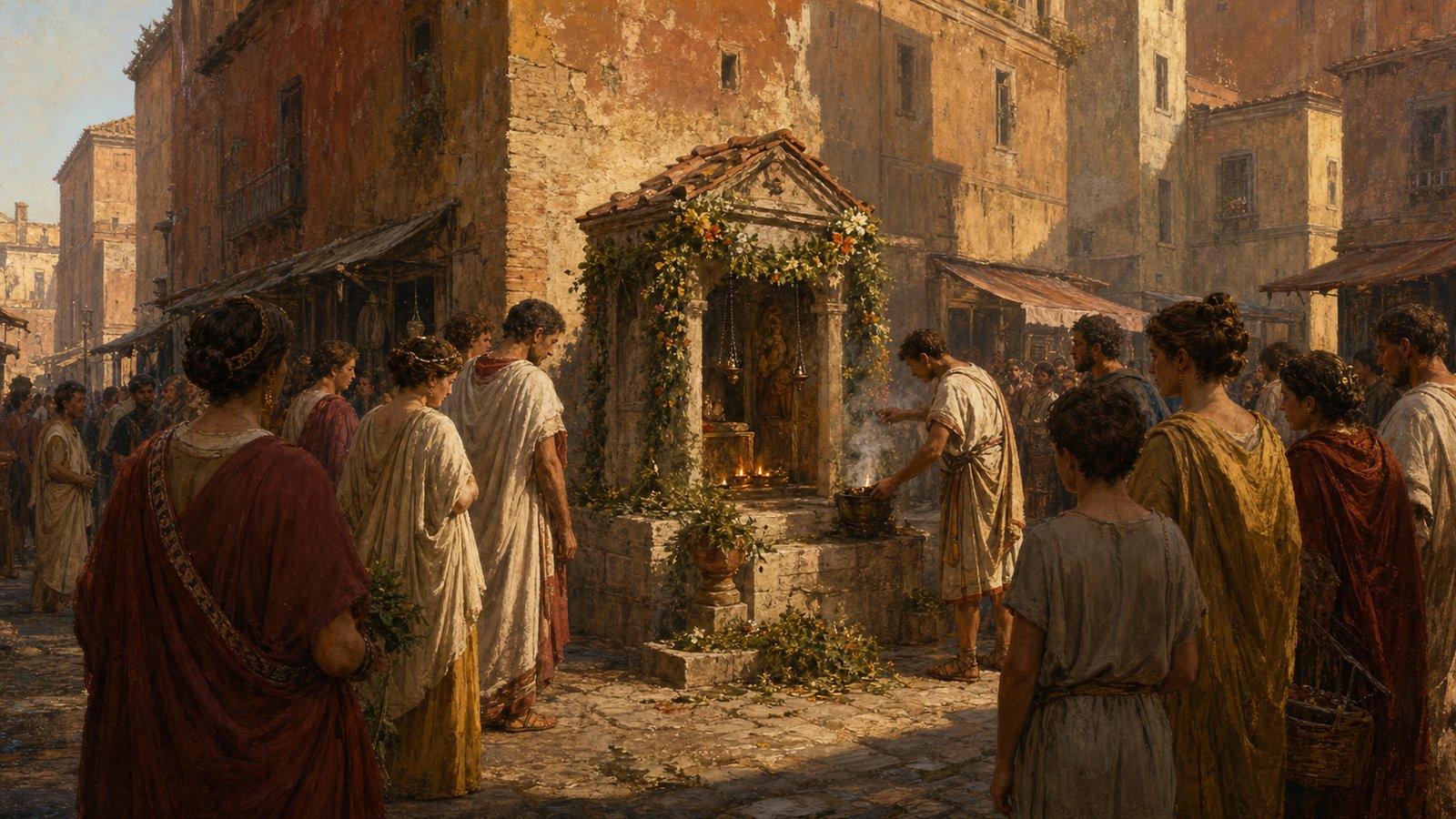
A sacellum was a small sacred place. That scale is important. The power of a crossroads shrine came from being close enough to ordinary life that people could not treat it as distant spectacle.
Imagine the mini-scene at dusk: lamp smoke in the air, garlands hung against worn plaster, a worker pausing with dusty hands, a child watching an offering placed by the altar. The city has become local for a moment.
The altar made devotion physical
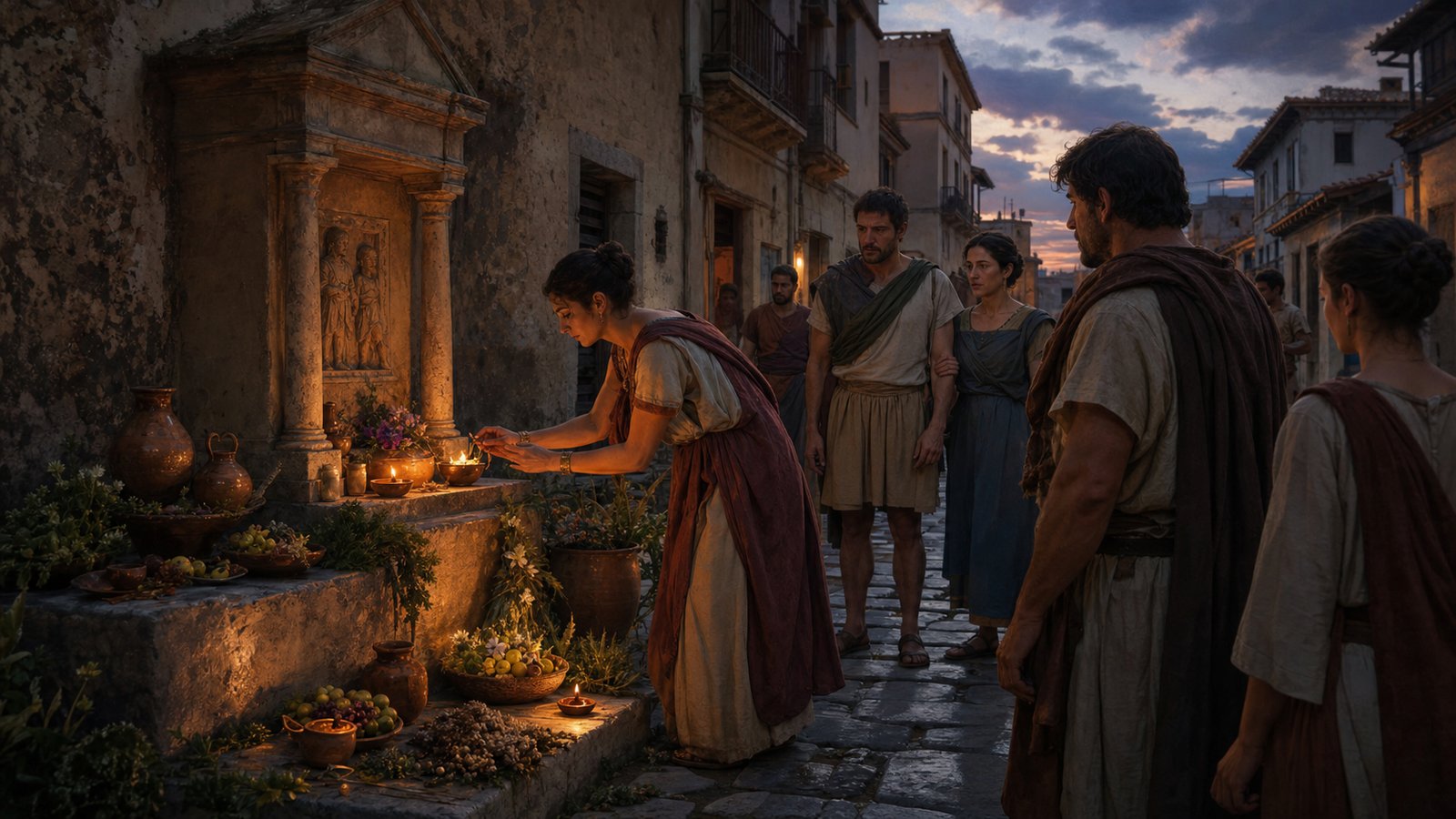
An ara made offering visible. Fire, incense, food, flowers, and approach all turned belief into actions that neighbors could notice. A person did not merely say the crossing mattered; the body stopped there.
This physicality is the key. A shrine at a junction made the boundary between movement and memory porous. People passed through the same spot again and again, and ritual taught them to see it as more than traffic.
Domestic protection spilled into the street
The lararium reminds us that Roman protection could be imagined at the household level. Crossroads religion widened that instinct. The same desire for guarded thresholds could move from private rooms to shared streets.
That overlap made the neighborhood feel like a social body. People who did not eat at the same table could still share a ritual point where protection, memory, and daily passage met.
Local religion made public life smaller and nearer
Rome is often described through emperors, armies, and great monuments. The crossroads shrine shows another scale of public life: a corner, a lamp, an altar, a few neighbors, and a repeated festival.
That smaller scale mattered because most people experienced the city locally. A shrine could make a huge urban world feel legible by giving one crossing a face, a rhythm, and a set of shared gestures.
The shrine also made time visible. On ordinary days it could sit quietly beside traffic, but festival attention changed the same corner into a public event. The place did not move; the neighborhood’s attention returned to it.
Because the shrine stood where people crossed paths, it gathered a mixed audience. Shopkeepers, tenants, porters, children, slaves, freedpeople, visitors, and householders could all recognize the same corner without possessing the same status.
That did not make the neighborhood equal. Roman society remained deeply ranked. Yet a shared shrine created a point where unequal people could see one another participating in a local rhythm.
The object itself did practical work. A small altar, lamps, and garlands gave memory handles. Without them, the crossing might be only a route. With them, it became a place someone could describe, decorate, avoid neglecting, or return to.
This is why the shrine belongs to the history of urban visibility. It made a social unit visible not by listing members but by marking the point where their daily movements overlapped.
A festival at the crossing also made absence noticeable. A neglected shrine, a missing participant, or a dark lamp could say something about the health of local obligation. Ritual created expectations, and expectations made the neighborhood readable.
The sensory details mattered: oil smell, low flame, flower rot, smoke on plaster, dust on sandals, and the scrape of feet around the altar. These were not abstract signs. They were repeated bodily cues that taught people where they belonged.
A crossroads shrine therefore did two things at once. It acknowledged powers beyond the street, and it made the street itself feel socially charged. Protection and neighborly recognition met in one small place.
For a city as large as Rome, this localizing function was crucial. People needed ways to live inside the city without being swallowed by its scale. The shrine gave one corner a memory and one neighborhood a visible center.
The lesson is quiet but important. Roman public life was not only made in the forum or the amphitheater. It was also made where streets met and neighbors learned to see a corner as theirs.
A shrine also gave local memory a rhythm that did not depend on one powerful sponsor. Repeated care by ordinary neighbors could make the corner feel watched, tended, and included in the moral life of the street.
The Compitalia detail matters because it ties this visibility to a named festival rather than vague piety. A calendar moment could pull the vicus into view and remind residents that their quarter had obligations as well as routes.
The altar made participation practical. One person could bring a small offering, another could hang greenery, another could light or tend a lamp, and another could simply pause long enough to acknowledge the place. Small actions accumulated into public recognition.
The crossing also gathered strangers into local order. A visitor might not know the people of the vicus, but the shrine announced that this was not anonymous space. Someone cared for it, decorated it, and expected it to be treated as meaningful.
That expectation could restrain behavior in subtle ways. A sacred corner was still a working urban corner, but ritual attention made neglect, insult, or disorder more visible. The shrine gave the street a kind of witness.
In a city of rented rooms and crowded movement, such witness mattered. It helped people imagine that protection and memory were not confined to aristocratic houses. Even a modest crossing could hold a public claim: this neighborhood is seen.
That claim was powerful precisely because it was ordinary. The shrine did not need marble scale to anchor attention; it needed repetition, recognizable care, and a place where many routes met.
Every returning passerby helped renew the corner’s meaning. The act of seeing the altar again, even without stopping, kept the sacred marker inside the neighborhood’s daily map.
This gave Roman urban life a layered texture. Grand temples spoke for the city, but small shrines spoke for the street, making local identity visible through humble objects and repeated gestures.
By giving a junction ritual duties, the shrine made ordinary movement carry memory. The neighbor who passed to buy bread, fetch water, or return from work also passed a reminder that the vicus had gods, habits, and witnesses.
Sources & Further Reading
- Smith Dictionary, Compitalia
- Smith Dictionary, Vicus
- Smith Dictionary, Sacellum
- Smith Dictionary, Ara
- Smith Dictionary, Lararium