
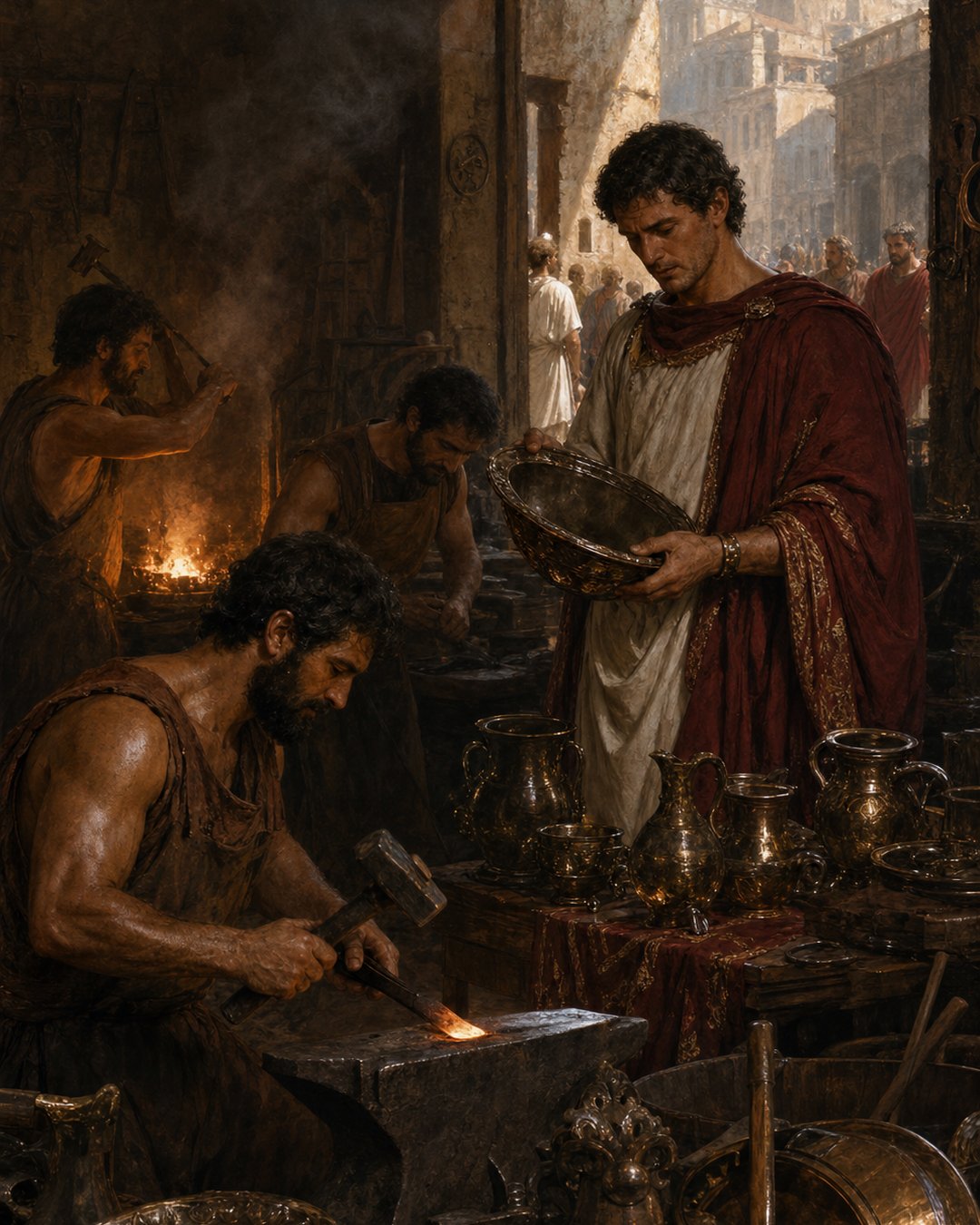
A Roman workshop was not simply a room where things were made. When it opened toward the street, it became a public argument about skill, reliability, noise, and reputation.
Roman workshops made craft public because labor could be watched, heard, smelled, and judged. The doorway turned work into evidence before the finished object ever changed hands.
The shopfront made labor visible
A taberna could be a shop or place of trade, and its importance lies in contact with ordinary movement. People did not have to imagine all work hidden in elite houses or distant yards. Some work faced the street.
A street-facing workshop made craft legible. The customer could see tools, workers, materials, and the rhythm of production. Smoke and sound announced that skill was happening in real time.
Tools turned reputation into a scene
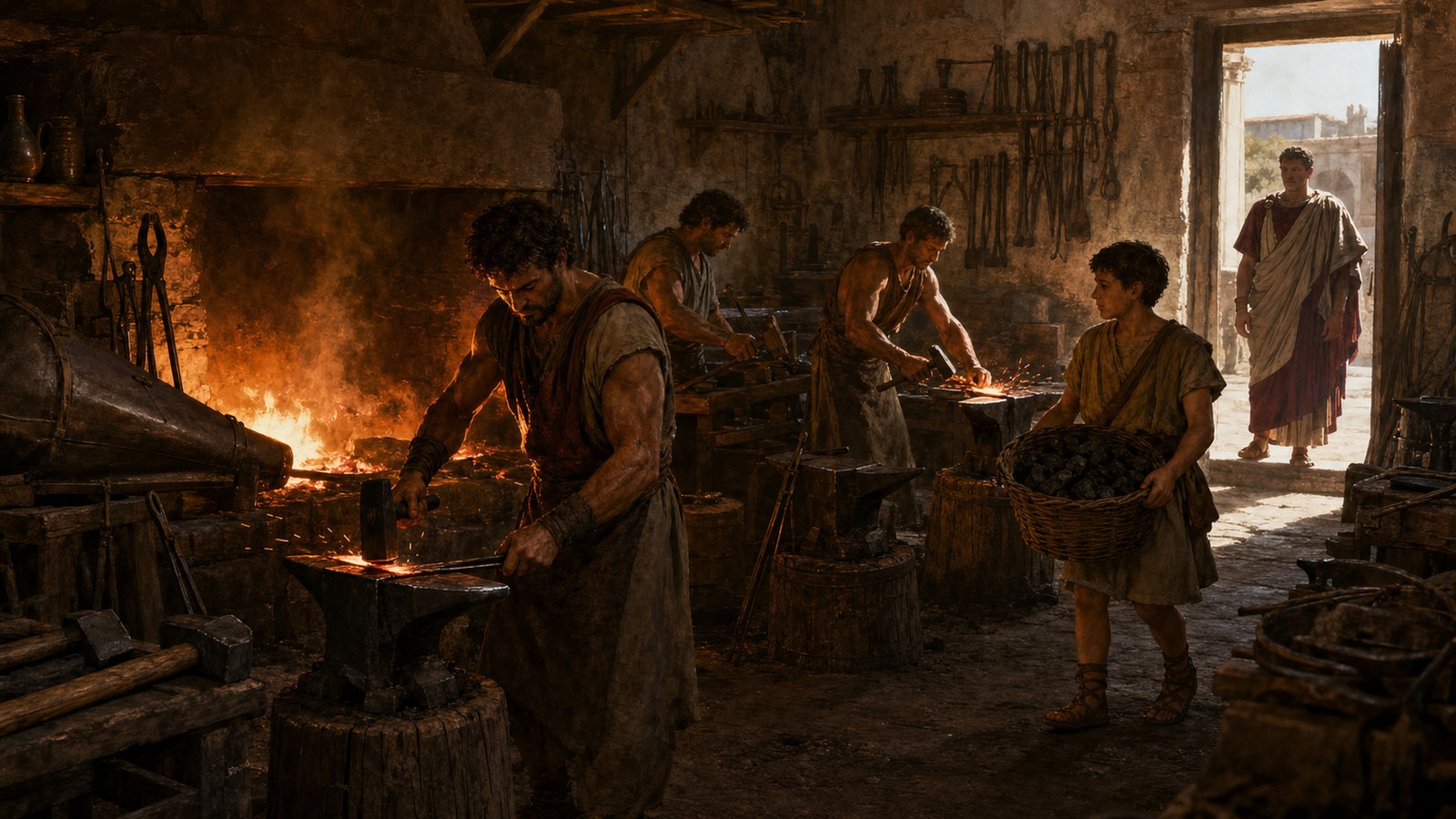
Craft reputation is hard to prove in the abstract. A doorway full of tools made it easier. Hammers, tongs, benches, scales, blanks, half-finished pieces, and soot all told passersby that the worker belonged to a practical world.
Picture the mini-scene: furnace heat on a narrow street, an apprentice carrying charcoal, a smith lifting a hot piece with tongs, a buyer leaning closer while sparks fade. The workshop has become its own advertisement.
Associations gave workers a shared identity
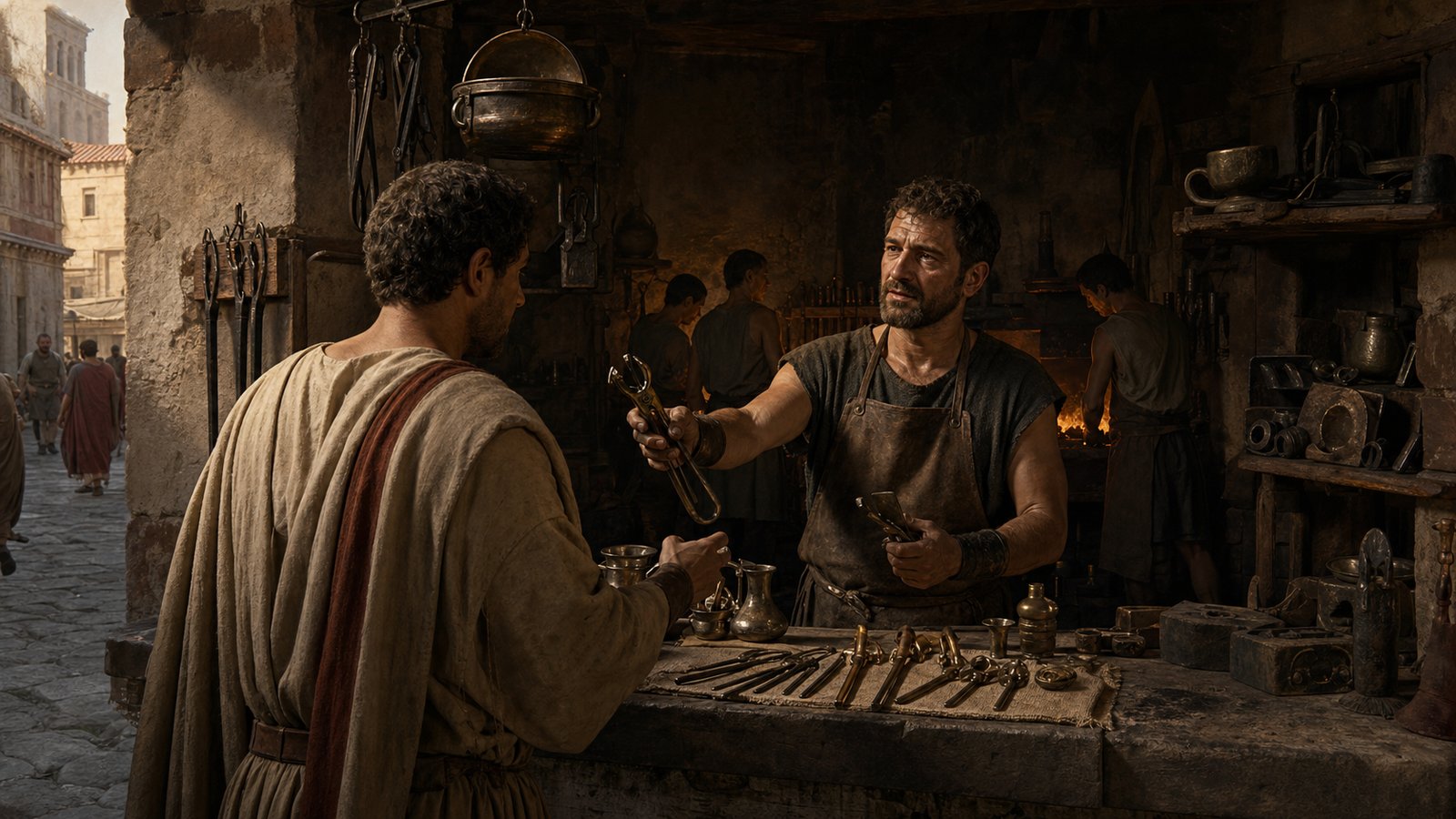
A collegium could organize people around common purposes, including trades and obligations. That matters because craft was not only individual talent. It also depended on shared standards, networks, memory, and recognition.
A worker known only by one object might vanish into the sale. A worker connected to a group, a street, and repeated customers became easier to remember. Craft identity gained a social frame.
Accounts helped labor survive the moment
Tabulae remind us that records mattered. A transaction could be written, a debt remembered, a commission noted, and an obligation carried beyond the heat of bargaining.
This made the workshop more than a noisy room. It was a place where material skill and recorded exchange met. The object on the bench and the note on the tablet belonged to the same economy of trust.
The street judged quality before officials did
The forum shows how Roman public life blended business, visibility, and reputation. Workshops participated in that same culture at a smaller scale. They made economic life observable where ordinary people moved.
That visibility could help and hurt. Good work gained witnesses; sloppy work gained witnesses too. The public doorway turned craft into a performance that customers could revisit in memory.
The sound of a workshop mattered because sound travels faster than explanation. A hammer on metal, a saw against wood, or a potter’s wheel could tell the street that production was underway before anyone stepped inside.
Smell mattered as well. Charcoal smoke, hot metal, leather, oil, clay, or dye could attach a craft to a place. A passerby might know the workshop by the air around it as much as by the worker’s name.
This sensory publicity made craft more trustworthy than a silent claim. A merchant saying “I can do this” is one thing; a worker surrounded by tools and partly finished work offers another kind of evidence.
The workshop doorway also collapsed distance between maker and buyer. The customer did not meet only a finished object in a market stall. He could sometimes meet the process that gave the object value.
That process was social. Apprentices watched masters, neighbors watched apprentices, and customers watched both. Skill moved through eyes and repetition as well as through formal teaching.
A craft shop could therefore become part of the street’s memory. People remembered who repaired a hinge, shaped a lamp, sharpened a tool, or delayed a commission. Reputation accumulated in practical stories.
The workshop was not democratic in any simple sense. Some workers were enslaved, some poor, some dependent on patrons, and many vulnerable to price and demand. Visibility did not erase inequality.
Yet visibility gave labor a presence that elite political writing can miss. The street knew the maker through noise, sweat, heat, and repeated contact. Craft entered public life through use rather than applause.
Records deepened this presence. A tablet could preserve an order when memory failed, and it could make a customer return not only with a complaint but with a claim. The written note extended the workshop beyond the conversation.
That combination of visible skill and remembered obligation made craft public in a Roman way. It was not public because the state celebrated it, but because the street could see and judge its usefulness.
The workshop also made failure visible. A cracked tool, a delayed order, or a badly repaired fitting did not remain an abstract complaint when the maker could be found at the same doorway tomorrow.
This repeated availability mattered in an economy where formal guarantees were limited. The public location of labor let reputation harden through use, memory, and ordinary conversation among customers.
The collegium angle adds another layer. Workers could imagine themselves not only as isolated hands but as people joined by trade, obligation, and mutual recognition. Craft had social edges as well as technical ones.
Even the apprentice in the corner belonged to this public process. Learning happened under watchful eyes, and the street could see skill being transmitted from one set of hands to another.
That made the workshop a small institution of urban trust. It showed the city that useful things did not appear by magic; they came from heat, discipline, tools, records, and reputations that could be tested in public.
The doorway therefore linked production and accountability. Work went out into the street, but judgment came back through the same opening, carried by customers, neighbors, and the memory of repeated exchanges.
A taberna also made the boundary between making and selling thin. The same space could display raw material, unfinished work, tools, and completed objects, so a buyer encountered a chain of production rather than a mysterious commodity.
That chain created confidence through concreteness. A repaired hinge, a forged fitting, or a shaped vessel could be understood by looking at hands, heat, and habit, not only by trusting a sales pitch.
The street-facing workshop also joined craft to neighborhood identity. People could say not only what was made, but where it was made and by whom. Place attached itself to skill.
For the worker, this could be risky. Visibility meant interruption, comparison, complaint, and the constant pressure of being seen. Yet the same exposure made a reliable worker easier to find again.
For the customer, the open workshop offered a practical reassurance. If the object failed, the maker was not an invisible supplier somewhere beyond reach; he was part of the street’s remembered pattern.
This is why the workshop deserves a place in the story of Roman public life. It made labor visible enough to become reputation, and reputation visible enough to become trust.
The buyer, the apprentice, the neighbor, and the maker all shared that visibility. The shopfront turned useful work into something the street could remember and test again.
Sources & Further Reading
- Smith Dictionary, Taberna
- Smith Dictionary, Collegium
- Smith Dictionary, Tabulae
- Smith Dictionary, Forum